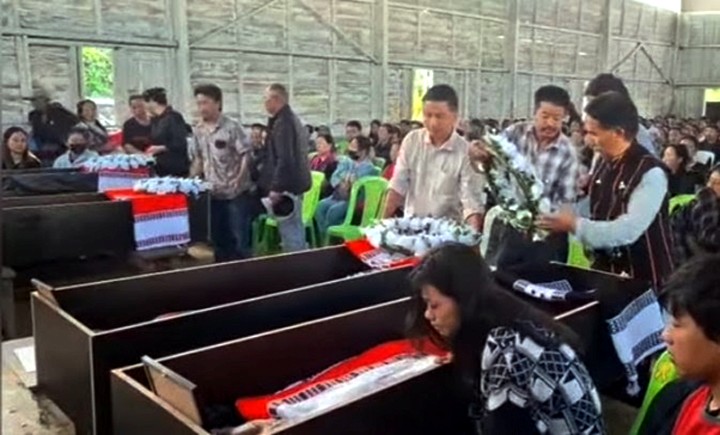
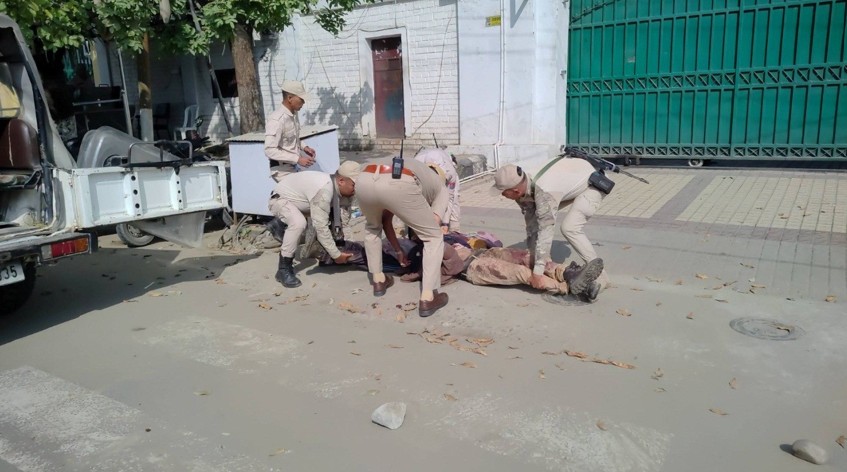
The killing of three Meitei men in Sunurok Uyok hills near Nongshum and Khongban Tangkhul on October 19, 2026, exposes the fragility of Manipur’s relative calm. The recurrence of attacks must be examined not merely as a law-and-order problem, but in the context of an unresolved violent conflict involving ethnic groups, entrenched territorial divisions, armed-group accountability and the state’s failure to restore a common civic space.
The killing of three Meitei men and the injury of three others in Sunurok Uyok hills near Nongshum and Khongban Tangkhul in Imphal East district on October 19, 2026, has once again exposed the precarious nature of the relative calm that periodically prevails between Meitei and Kuki-Zomi communities. The victims had gone to collect firewood they had gathered earlier and left to dry. According to survivors, armed men concealed at the location opened fire on them. Three men died, one while being taken to hospital.
The attack occurred in Sunurok Uyok hills near Nongshum and Khongban Tangkhul, near the boundary between Imphal East and Kuki-dominated Kangpokpi district. Its location, the alleged involvement of Kuki militants, the reported proximity of a Suspension of Operations (SoO) camp identified as Sinai Camp, and the demand by local MLA Thokchom Lokeshwar for its removal have raised urgent questions about civilian security and the effectiveness of the arrangements governing Kuki-Zomi militant groups.
The recurrence of such violence demands a broader political examination. Why do attacks resume after periods of relative calm? Why do civilians remain vulnerable in areas where the state claims to maintain security? And why have security deployments, ceasefire arrangements and political interventions failed to establish lasting peace?
These questions are central to the arguments developed in my earlier analyses published in Imphal Review of Arts and Politics particularly those concerning Manipur’s frozen conflict, the emergence of de facto territorial boundaries, the management of ethnic separation and the growing distance between official claims of normalcy and the peace people actually need.
The central argument is that recurring attacks cannot be understood solely through ethnic hostility or the actions of individual armed militant groups. They must also be examined through the political and institutional conditions that allow armed coercion to persist, territorial separation to become entrenched, and the state to manage violence without resolving the conflict that sustains it.
The Frozen Conflict Behind The Recurring Violence
In “Guns are Silent but Delhi’s ‘Normalcy’ Narrative Masks a Partitioned Manipur,” published in November 2025, it was argued that the relative calm following the violence that erupted on May 3, 2023, had not resolved Manipur’s conflict. Instead, it had allowed the divisions created by the violence to become embedded in everyday life. The subsequent analysis, “Is Manipur’s ‘Frozen Conflict’ A Design or The Product of Policy Failure?” examined whether the persistence of these divisions reflected a deliberate political arrangement or the failure of policy to address the conflict’s underlying causes.
The concept of a frozen conflict is particularly useful for understanding the October 19 killings. A frozen conflict is not necessarily one in which fighting continues everywhere or at the same intensity. It is one in which the fundamental disputes over territory, political authority, security and collective identity remain unresolved, even as the parties adjust to a precarious status quo.
Manipur increasingly exhibits these characteristics. Communities remain geographically separated; displaced people continue to face obstacles to returning safely to their homes; buffer zones regulate movement across ethnic fault lines; and competing political demands concerning territorial integrity and coexistence, and a Separate Administration remain unresolved. Armed groups and the circulation of weapons further complicate the restoration of common civic life.
In these circumstances, violence need not be continuous to remain politically effective. The possibility of an attack can determine where people travel, whether they return to their villages, how they pursue their livelihoods and whether they trust members of another community. A period without major confrontation may reflect temporary restraint rather than reconciliation, disarmament or a restoration of confidence in the state.
The Nongshum Hills attack illustrates this distinction. If villagers cannot safely collect firewood near their homes because armed militants may be present, the absence of firing elsewhere cannot reasonably be described as a return to normalcy.
The incident also demonstrates why a lull may create a misleading sense of security. Residents may resume ordinary activities because they believe the immediate danger has receded, while armed militants retain the capacity to strike. When violence resumes, the consequences extend beyond the immediate victims – fear returns, movement contracts, demands for protection intensify and the possibility of renewed retaliation grows.
The central lesson is that recurring attacks are not simply interruptions of peace. They reveal that the foundations of peace have never been adequately established.
Armed coercion and the recurrence of attacks
The first structural explanation lies in the persistence of armed coercion as a means of influencing the conflict’s political and territorial outcomes.
Before, it was examined how attacks on civilians undermine their ability to exercise basic rights and make security dependent on the conduct of armed actors in “Terror, Statelessness, and the Collapse of Constitutional Sovereignty in Manipur”. The argument is particularly relevant to the present incident, although the motives and affiliations of the attackers must be established independently.
An attack on civilians can have consequences far beyond the immediate loss of life. It can discourage people from entering particular areas, make access to land and forest resources dangerous, reinforce demands for territorial separation and intensify the belief that communities must depend on their own organisations for protection. Violence thus acquires a political effect even when its precise objective remains unclear.
If armed actors can determine where members of another community may safely travel, work or reside, they exercise a form of coercive territorial power that belongs neither to a lawful political organisation nor to a constitutional government. Civilian access becomes contingent on the restraint of armed militants rather than the protection of the law.
The October 19 attack raises this concern because the victims were engaged in an ordinary livelihood activity, not an armed confrontation. If the survivors’ accounts are substantiated, the attack transformed a routine journey to collect firewood into a lethal encounter even after the villagers had specifically sought and obtained permission from the Assam Rifles deployed in the area before going to collect firewood. The resulting fear may discourage other residents from entering the area, irrespective of whether the attackers intended to establish territorial control.
It would be premature to conclude that the attack was organised to obstruct the return of displaced people or advance a particular political demand. Such a claim would require evidence of planning, motive and organisational direction. Nevertheless, its wider effect may be to reinforce the territorial and psychological divisions already produced by the violent conflict continuing for three and half years.
The distinction between an ethnic community and an armed organisation is essential. Responsibility for an attack must rest with those who planned, carried out or facilitated it, not with an entire community. Civilians who oppose militancy or favour coexistence must not be treated as collectively responsible for crimes committed by Kuki militants. The same principle protects Meiteis or Nagas and other communities from collective blame or retaliation.
Yet this distinction must not become an excuse to ignore the political environment in which armed violence persists. When perpetrators believe that attacks can be repeated without a credible prospect of prosecution, a climate of impunity develops. Such impunity is not established merely because an attack occurs; it must be assessed through the state’s response, the quality of investigations, the enforcement of weapons controls and the eventual prosecution of those responsible.
The decisive question is whether the authorities can convert post-attack operations into sustained preventive action. Arrests and search operations matter, but their effectiveness must be judged by whether they establish responsibility, disrupt the networks that enable violence and reduce the likelihood of further attacks.
The SoO Framework and The Problem of Accountability
The reported proximity of Sinai Camp makes the Suspension of Operations arrangement a central issue in the aftermath of the killings. The SoO framework was intended to suspend hostilities and create conditions for negotiations with participating Kuki-Zomi militant groups. It was not intended to confer permanent authority over territory or civilian movement, nor to exempt participants from criminal law.
On October 23, 2026, Manipur Home Minister Govindas Konthoujam stated that the SoO agreement had expired on September 4 and had not been renewed. He also reported that 18 people were found at Sinai Camp during searches, including one identified as a cadre covered by the former arrangement, while the identities and affiliations of others were being investigated. Three people had separately been arrested in connection with the killings. These developments make it essential to distinguish verified evidence from allegations and preliminary claims.
The investigation must determine who carried out the killings, whether the accused were linked to an armed militant group, whether the attack was planned through an organisational structure, and whether anyone supplied weapons, logistical support or instructions.
At the same time, the circumstances surrounding the camp warrant serious scrutiny. Authorities must establish whether personnel associated with the former arrangement were complying with its ground rules, whether weapons and armed activity were adequately monitored, and whether unauthorised individuals could operate from or around designated locations without effective oversight.
In another earlier article, “Perceived State Inaction and SoO Dynamics are Reconfiguring Ethnic Power, Territory, and Conflict in Manipur,” it was examined how ceasefire arrangements and perceptions of state inaction can reshape ethnic relations and territorial power. The underlying concern is that an arrangement designed to reduce violence can become counterproductive if monitoring is weak, enforcement is inconsistent or political considerations appear to protect armed actors from accountability.
A ceasefire is a means of creating conditions for a political settlement; it is not the settlement itself. If armed militant groups retain the capacity to intimidate civilians, exercise coercive influence over territory or evade lawful restrictions, the distinction between a ceasefire and an informal distribution of armed power begins to collapse.
The consequences are damaging across communities. Meitei residents may interpret the survival of armed structures and the recurrence of attacks as evidence that militant groups enjoy political protection. Kuki-Zomi residents may fear that the end of the agreement will expose them to indiscriminate security operations or retaliation. Naga communities may also conclude that their security depends on their own capacity to organise and resist armed threats. Such perceptions can reinforce the very insecurity that a ceasefire is meant to reduce.
The official expiry of the SoO agreement does not automatically eliminate armed militant networks, weapons or the territorial disputes associated with them. Nor does its expiry justify indiscriminate action against an ethnic community. The government must explain what framework will replace it if the SoO is really not extended and how authorities will verify former cadres, control weapons, monitor camps and prosecute offences.
The real test is whether the state can prevent armed militant groups from exercising power outside the law, not simply whether a ceasefire agreement remains formally in force.
Buffer Zones and The Entrenchment of Territorial Separation
A second structural explanation lies in the territorial consequences of the continued violent conflict.
It was argued that mobility and access to roads are integral to constitutional sovereignty in “India’s NH Projects in Manipur Mask a Politics of Highways, Buffer Zones, De-Facto Borders, and a Frozen Conflict”. A highway cannot fulfil its public purpose if civilian movement depends on ethnic identity, armed threats or security escorts. The same argument applies to forest paths, village approaches and livelihood areas near the boundary between the districts of Imphal East and Kangpokpi.
An administrative boundary does not inherently constitute a conflict frontier. It becomes one when movement across it is governed by fear, armed presence and the expectation of violence. Residents may live on one side of the boundary while depending on land, forests or economic resources on the other. Areas previously used for routine activities can become dangerous without any formal change in their legal status.
This is how territorial separation becomes embedded in daily life. People begin to calculate not simply the distance to a forest or field, but who might be present, whether protection is available and whether their ethnic identity could expose them to attack.
Buffer zones may reduce direct confrontation at particular locations and give security forces time to respond. But when they become permanent substitutes for a political settlement, they can entrench the divisions they were intended to manage. They separate populations without necessarily disarming armed actors, resolving territorial claims or restoring confidence in common institutions.
Nor do buffer zones guarantee safety everywhere. Security may be concentrated at established checkpoints while vulnerable forest paths and village approaches remain inadequately monitored. If authorities focus primarily on preventing clashes at recognised boundaries, they may overlook the places where civilians travel for work and livelihood activities.
The Nongshum Hills attack therefore raises questions beyond the presence of security forces in the wider region. Was the area subject to an effective threat assessment? Were the villagers assured that they could collect firewood safely, as the local MLA alleged? If so, how the Assam Rifles provided that assurance, and what arrangements were made to implement it? These questions require a factual inquiry.
The broader policy implication is clear. A government cannot indefinitely substitute territorial separation for the restoration of lawful civilian access. Security must ultimately make it possible for people to move safely across former conflict lines rather than require them to accept those lines as permanent.
The constitutional promise of equal citizenship is weakened when access to land, ancestral villages or ordinary livelihoods depends on the presence or restraint of armed militants.
Constitutional Sovereignty and The Failure of Preventive Governance
The third explanation concerns the state’s ability to exercise authority consistently throughout Manipur.
The earlier analysis of constitutional sovereignty argues that sovereignty must be judged not merely by the formal presence of government institutions but by their ability to protect citizens and enforce their rights. Administrative offices, security deployments and constitutional procedures do not, by themselves, establish that people enjoy effective protection throughout the territory.
The authorities did respond to the October 19 killings through arrests, search operations and investigations though late. Such measures are necessary and should not be dismissed. But reactive capacity is not the same as preventive authority.
A state demonstrates effective sovereignty when it can anticipate foreseeable threats, control illegal weapons, protect vulnerable populations, prosecute offenders and sustain security after the immediate crisis has passed. If attacks recur in areas where civilians remain exposed, the adequacy of the security strategy must be questioned.
This does not automatically establish deliberate complicity by the government. Political reluctance, intelligence failure, inadequate coordination and institutional weakness are different possibilities that require different evidence. Nevertheless, public confidence is shaped by what people experience. When citizens believe that the state responds more effectively in some areas and to a particular community than others, or that some armed militant groups enjoy greater freedom of action than others, perceptions of selective enforcement take root.
In Manipur, this problem extends beyond conventional law and order. The state has struggled to restore common civic space across communities divided by the conflict. When lawful authority is experienced as effective in one locality but uncertain in another, citizens begin to question whether the same law protects everyone equally.
The Union government has a particular responsibility because President’s Rule was imposed on February 13, 2025, before an elected government was formed again on February 4, 2026. The respective responsibilities of the Union and state governments have changed over this period, but the constitutional obligation to protect civilians has not disappeared.
Article 355 places a duty on the Union to protect states against external aggression and internal disturbance and to ensure that state government is carried on in accordance with the Constitution. Article 14 guarantees equality before the law, while Article 21 protects life and personal liberty. Their practical significance is tested when citizens face threats from armed militant groups.
Constitutional sovereignty cannot mean only that Manipur remains formally within the Indian Union. It must also mean that lawful authority, protection and accountability operate throughout the state.
This is why the response cannot be measured solely by troop numbers or the frequency of security operations. The more fundamental question is whether the security architecture is designed to restore the rule of law and common citizenship, or merely to contain the consequences of an unresolved conflict or to counter the decades-old insurgency movements.
Political Ambiguity and The Incentives For Renewed Violence
Manipur’s conflict is also a struggle over territory, political representation, security guarantees and the state’s future constitutional arrangements. The demand for a Separate Administration among sections of state BJP MLAs, Kuki-Zomi militant leadership and the insistence of other communities on preserving Manipur’s territorial integrity and coexistence, and detection and deportation of illegal immigrants reflect fundamentally different political objectives.
Neither objective can be resolved through violence. Nor can a durable settlement emerge if any party believes that armed coercion can secure concessions unavailable through negotiation.
The state’s political ambiguity becomes consequential when negotiations with armed militant groups are not accompanied by demonstrable enforcement of legal restrictions. If political demands remain unresolved while the armed structures associated with the conflict survive, the incentive to retain coercive capacity may persist.
This does not establish that every attack is centrally directed or that all armed militant groups share a common strategy. Organisations can be fragmented, commanders can pursue competing interests, and individual attacks may arise from local disputes or criminal motives. The necessary task is to establish the circumstances of each incident without losing sight of the wider political environment.
When armed power continues to influence territorial access and political bargaining, violence can retain its strategic significance even when no organisation openly claims responsibility. An attack can deepen separation, undermine confidence in security arrangements and increase pressure for more exclusive territorial or political solutions.
The October 19 killings must therefore be investigated at several levels – who carried out the attack; whether it was planned; whether the perpetrators were connected to a SoO group or any other Kuki armed militant group; and whether any wider network provided weapons, logistical assistance or direction. Establishing individual guilt is indispensable, but investigating possible organisational responsibility is equally important where evidence warrants it.
The broader argument about Manipur’s managed federalism is relevant here. The state retains its formal constitutional identity, but questions of security, territorial access and political negotiation have increasingly been shaped by central authorities and armed actors. The challenge is to ensure that negotiations reduce the power of armed coercion rather than institutionalise it.
Negotiations with armed militant groups are not inherently wrong. They may be indispensable to ending a conflict. But a ceasefire without a political process can preserve the capacity for renewed violence; political negotiations without enforcement can reward coercion; and security operations without an inclusive settlement can suppress immediate threats while leaving their underlying causes intact.
The state must break this cycle.
From official normalcy to people’s peace
The October 19 killings also revive the question that runs through in earlier analyses – whose normalcy is being restored?
The formation of an elected government in February 2026 restored Manipur’s formal political institutions, but it did not resolve the conflict. As the analysis of normalcy after President’s Rule argued, administrative functionality and substantive peace must be distinguished.
For the state, normalcy may mean that violence has been contained sufficiently for government offices, transport and economic activity to function nominally. For people living near conflict boundaries, peace means something more fundamental – the confidence that they can travel, work, and return to their homes and pursue ordinary livelihoods without being targeted because of their ethnic identity.
The Nongshum Hills victims were collecting firewood. Their deaths expose the inadequacy of a peace defined primarily by the absence of large-scale fighting. If ordinary activities remain dangerous, then normalcy exists more convincingly in official statements than in people’s lives.
The Chief Minister Yumnam Khemchand’s government must therefore move beyond condemnations and assurances of strict action. It must establish the facts, prosecute those responsible, examine the security failures that allowed the attack and demonstrate that civilians will be protected regardless of their community.
It must also resist the temptation to treat each incident as an isolated law-and-order problem. Individual crimes require individual accountability, but repeated attacks in a frozen conflict demand scrutiny of the wider conditions that make renewed violence possible.
A durable response requires four interconnected measures – credible investigation and prosecution; effective control of armed militant groups and illegal weapons; secure civilian movement and rehabilitation; and a political process that addresses territorial concerns without rewarding violence.
Civil society also has an important role. The earlier discussions of the Thadou Covenant of Coexistence and related civil-society initiatives emphasised that peace cannot depend exclusively on negotiations between governments and armed militant groups. Community leaders, displaced people and groups advocating coexistence must have the space to challenge ethnic polarisation and reject the claim that armed militant groups speak for entire communities.
Dialogue alone cannot replace security or justice. But without channels for engagement, every attack risks reinforcing the belief that coexistence is impossible.
The government must make it possible for people who oppose violence to participate in public life without intimidation. That is essential to rebuilding trust across communities.
The State Must Prevent The Next Attack
The killing of three Meitei men near Nongshum Hills should not be treated as proof, before the investigation is complete, that a particular militant group directed the attack or that every member of a community bears responsibility. Such conclusions would undermine both justice and the possibility of reconciliation.
But it would be equally inadequate to dismiss the incident as an isolated crime unrelated to Manipur’s wider crisis.
The recurrence of violence must be understood in the context of an unresolved political conflict, the survival of armed capabilities, the entrenchment of territorial separation, contested accountability and declining confidence in common institutions. The precise motives of individual attackers may differ, but these structural conditions create an environment in which violence can repeatedly undermine peace.
The state’s responsibility is not merely to respond after civilians have been killed. It is to dismantle the conditions that allow such attacks to recur. That means enforcing the law impartially, controlling weapons, scrutinising armed militant group arrangements, protecting vulnerable civilian areas and advancing a political settlement that restores common civic space.
The answer cannot be collective punishment, retaliatory violence or the permanent division of communities. Nor can it be an indefinite extension of security arrangements that manage separation without resolving the conflict.
Manipur does not need another interval of silence that can be shattered by the next attack. It needs a peace in which the threat of violence no longer determines where people may travel, work or live.
Until the state can guarantee that ordinary civilians can collect firewood, cultivate their land, return to their homes and move freely without fear of armed attack, claims of restored normalcy will remain premature. The real test of constitutional sovereignty is not whether the government can manage the aftermath of violence, but whether it can make the next attack less likely.

Senior Editor: Imphal Review of Arts and Politics