
I had the privilege of watching the National Award-winning classic Mayophygee Macha (Mayophy’s child), a celluloid film scripted by Maharaj Kumari Binodini, produced by Thouyangba Thougamba, and directed by the Oken Amakcham, newly restored in 2K resolution. What mesmerised me most was the film’s ability to articulate a profound social critique without always relying on words. Its silences, gestures, facial expressions and seemingly ordinary actions speak volumes about the social structure of Manipur.
Erving Goffman, in The Presentation of Self in Everyday Life (1959), conceptualises social interaction through the metaphor of theatrical performance, in where individuals present themselves in accordance to social expectations, status and relationships. Seen through this lens, Mayophygee Macha becomes a fascinating sociological text. Its characters do not simply occupy social positions; they perform, negotiate and reproduce class, gender and social distinctions through the ordinary routines of everyday life. The film’s social commentary often lies not in what its characters say, but in what they leave unsaid.
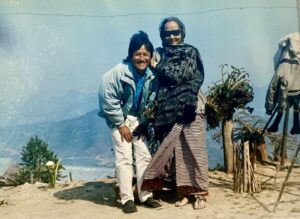
At the heart of the story is Mayophy, a Tangkhul girl from a fractured family who lives with her mother and grandmother. Her life unfolds at the intersection of familial vulnerability, gendered expectations, and community relations, yet she is never portrayed merely as a victim of circumstance. Her strength becomes most visible when Basanta, a Meitei man she marries, abandons her and their child without explanation and later marries another woman. Left to raise her child alone, Mayophy assumes the responsibilities of motherhood with remarkable resilience, refusing to let abandonment define her life.
What makes Mayophy’s character even more compelling is the subtlety with which the writer portrays her transformation across different stages of life. As an unmarried young woman, her a lowered gaze, shyness, and gentle demeanour that reflect a certain modesty and vulnerability. However, following marriage and the experiences that reshape her life, her expressions and demeanour acquire a different quality, revealing a growing confidence shaped by age, hardship, and experience. This contrast is particularly striking because her transformation is conveyed not merely through dialogue or dramatic events, but through the nuances of her expressions and conduct. In this way, the writer captures how womanhood is not a fixed identity but an evolving experience, shaped by time, relationships, social expectations, and the circumstances women must navigate.

What struck me even more was her courage in standing against the disapproval of her own village. Her child is spoken of negatively because the father is a Meitei man from outside her community. Yet Mayophy refuses to reject her child because of the circumstances of his birth. She raises him with dignity and affection, even as she carries the pain and resentment of being abandoned by Basanta. The child’s earring, which only Meitei children wore, and the affectionate name “Sanajaoba,” by which she lovingly calls him, become subtle markers of his Meitei identity and her determination to claim her child with love rather than shame.
This is where the film becomes especially significant in the context of Manipur. It does not simply present a story of a Tangkhul woman and a Meitei man; it complicates the idea that communities can be understood through the actions of a single individual. Basanta’s actions do not make every Meitei man the same. The film deliberately presents us contrasting Meitei characters in Lalit, the Deputy Commissioner, and Kunjo, Mayophy’s tutor. Both demonstrate care and human concern towards Mayophy and her family. Kunjo, in particular, tutors Mayophy in his free time after office hours and extends genuine care towards her elderly and physically weak grandmother. Lalit, who is enthusiastic about retiring in the hills, makes a poignant statement: “Eina chingbu nungshiba aduna chingnasu eibu nungshiriba”(roughly translated as “I love the hills, and the hills also love me.”) This simple yet profound statement speaks volumes about his sense of belonging and affection towards the hills, which also inspires him to write a book about his experiences and life in Ukhrul.
This contrast is important. Through its characters, the film quietly reminds us that an individual’s actions should not be used to a measure of an entire community. Human beings are more complicated than the identities assigned to them. There can be kindness within one community, betrayal within another, and affection that crosses boundaries that society considers fixed.
Kunjo’s relationship with Mayophy is particularly deep. A Meitei man from Imphal, he takes the initiative to educate a Tangkhul girl simply by giving his time and attention. His act may appear ordinary, but within the film’s social context, it becomes profoundly meaningful. Education becomes a bridge between two social worlds, demonstrating that relationships between the hills and the valley have historically existed not only through politics and institutions but also through every day human encounters.
The film simultaneously offers a sharp commentary on class. One scene that stayed with me is Lalit’s invitation to Kunjo, his subordinate, to join him and Major Saihab for their morning jog. Kunjo hesitates and says that he will join them another time. In the following scene, Lalit and the Major go jogging while Kunjo, already awake, stands outside his house with a toothbrush and houfi, watching the two men pass by. The scene is deceptively simple. Why does Kunjo hesitate? Is it merely personal reluctance, or does it reflect an internalised awareness of social distance? The film leaves the question open. Yet this hesitation can be read sociologically as an indication of how class and hierarchy shape people’s sense of belonging, even in spaces that appear socially neutral. Have leisure and health concerns itself become classed?
The same subtlety appears in the contrasting imagery of the cigar and sugar. After completing their morning jog and reaching the mountaintop, Lalit and Major Saihab light their cigars. The irony is striking, those who have just prioritised physical exercise engage in an activity associated with health risks. But the cigar seems to carry another meaning. It functions as a marker of leisure, distinction and status. Through Veblen’s concept of conspicuous consumption, the cigar can be understood not simply as something being smoked, but as an object through which social position is performed.
Then comes the seemingly insignificant detail of sugar. While Kunjo is helping Lalit complete his book by typing the manuscript, Lalit, while serving, adds two spoonfuls of sugar to Kunjo’s tea without asking, even though he takes none in his own. Is this simply an indication that the Deputy Commissioner knows his subordinate well enough to anticipate his preferences, or does the gesture carry a deeper sociological significance? The moment is brief, almost invisible, yet precisely because of its ordinariness, it becomes sociologically interesting. Sugar becomes more than an ingredient; it enters the film’s subtle vocabulary of class, familiarity and everyday social distinctions. The brilliance of Binodini’s writing lies in these details. She does not need to explain class, gender or social hierarchy to the audience. She allows objects, gestures, silences and relationships to do the work. Oken Amakcham’s direction gives these details visual life, turning everyday behaviour into a quiet but powerful social commentary.
The silent presence of Basanta’s second wife is another moment that stayed with me. Her expression carries a weight that dialogue perhaps could not. She enters a marriage already marked by another woman’s absence, a child left behind and a history that cannot simply be erased by a new marriage. Her silence leaves the audience with questions rather than answers. As Kunjo waits for Basanta, he explains that he has come all the way to meet him regarding a word from Ukhrul. At this, Basanta’s second wife and her mother exchange a knowing glance, a brief but revealing gesture that hints at an unspoken understanding between them. The mother-in-law then hastily tells him that he could leave if he could not wait for Basanta. This reaction speaks volumes. What does she know? What does she feel? What does she understand about the life that came before her? The film does not resolve these questions for us, and that is the deep and strength of the film itself.
Through sociological lenses, Mayophygee Macha can therefore be read as a multilayered account of how society is performed and reproduced through everyday life. Class emerges through leisure, consumption and bureaucratic hierarchy; gender becomes visible through marriage, abandonment and the unequal burden of care; and relationships between communities emerge through ordinary acts of affection and solidarity.
What makes the film even more poignant for me is watching it against the reality of contemporary Manipur. The very next day after watching a film that portrayed human relationships between the hills and the valley, violence erupted again, with three Meitei men reportedly killed in an attack while collecting firewood near the Imphal East–Kangpokpi boundary. The juxtaposition was deeply painful. Mayophygee Macha feels more than a film from another time. It becomes a reminder of a social reality that we seem to be losing sight of: communities are not monolithic, and relationships cannot always be reduced to the boundaries of hill and valley, Meitei and Tangkhul or Kuki, insider and outsider. Mayophy’s story itself demonstrates this complexity. A Meitei man abandons her, but other Meitei men extend kindness to her. A Tangkhul community questions her child, yet Mayophy herself refuses to let that judgment determine her love for him.
Perhaps this is the film’s most profound lesson for the present.
One person’s actions cannot define an entire community. And no political boundary should be allowed to erase the ordinary human relationships that have historically connected the hills and the valley.
At a time when mistrust has become so deeply entrenched, Mayophygee Macha invites us to look beyond collective identities and recover the individual human being behind them. Its message is not that differences do not exist, nor that historical grievances should be forgotten. Rather, it reminds us that coexistence requires us to see one another beyond the categories through which we have increasingly learned to view each other.
The need of the hour is therefore not merely to speak about the territorial integrity of Manipur, but to rebuild the social relationships that give that integrity meaning. Trust, dignity, empathy and mutual recognition cannot be imposed from above; they must be rebuilt through everyday encounters.
Perhaps that is why this film, written decades ago, feels so contemporary today.
Sometimes cinema teaches us to see what society has trained us to overlook. And sometimes, a story from the past quietly asks us the most urgent question of the present:
Can we still learn to see each other as human beings before we see each other as members of opposing communities?

The author is a PhD Scholar in the Department of Sociology, Manipur University