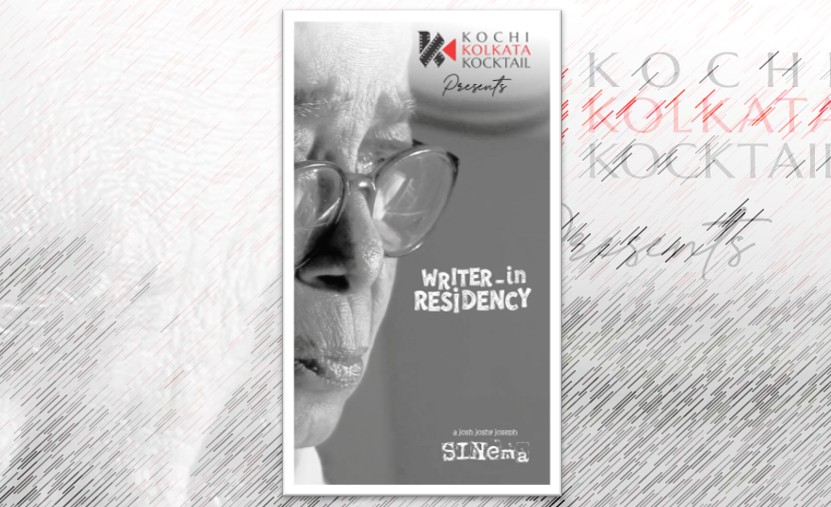
A film’s trailer is a concept taken for a granted given. As a media borne cliche it has the tendency to stick to us in a merely touch and go manner, as a culled piece from the original, a peep into the actual, a commercially intelligent bait, or a meaningful glimpse of what will be. Rarely does a Trailer have a stand alone personality of its own: the non chip of the ol’ block kind, an individual existence of confidence outside of the Film by its merely being there among us. As a recently scattered flavour into the atmosphere the Trailer of Writer-in-Residency by Filmmaker Joshy Joseph is one such particularly non linear, meander of Cinematic wand-wielding that is calling you out to a pleasant and not so altogether pleasant engagement only two minute long, yet laden with layers that charm, confound and bedazzle before you realise it’s over. When it’s over, it’s not the Film that you venture to want to watch, or follow up with, but the Trailer, again, individually and stand apart again.
This rare distinction has been earned in the hearts of the viewer by the reaching out, of the Filmmaker to different contemporary strands of socio-political wet paint. The Film’s author, like a creator artist suspended in the air, is reaching out and hanging on one set of coloured ropes as you watch, then reaching out for another set of ropes of another texture, colour, then reaching out for yet another set of coloured ropes of another texture as the spectators below watch a new pattern of all colours lighting up the sky. During the entire time he has a smile on his face, one not of pride that he negotiates ribboned ropes, but that he likes to touch and reach out new textures and wait for audiences to read stretchroscopic colour and decipher the colours that final emerge– that kind of smile.
A Baul performance to many is new. Closely associated with native culture to a few, it wins hearts by its simplicity and it is a way of artistic existence to most. Yet, the permutations and combinations of ideas that go berserk for a few seconds in the viewer when the Trailer opens are antithesis to your trusting self that anticipated a gentle, non stormy tribute to Mahasweta Devi on her Centenary. When a crowd of black gown clad professionals at court are not judging, watching or hearing a Baul speak, instead enjoying with rhythmic appreciation her rustically engrossing melody, the bewilderment in you takes a new high as you encounter, a case being argued in favour and against the chosen lines in the performance. You now do not know whether to recover from an entertaining action in progress in the most unlikely of solemn places or recover from the drop down phrases as largely spelt argument content falling loud and on your face on the screen.
The grasp is now higher. The gasp on that mid air suspended film creator as he reaches for that next colourful strand is epic. Hisab Achere. Everything is accountable for. You begin to think if accountable is the viewer? The court? The audience? Another perpetrator? To catch you off guard, even off pride, the maker of the very Film comes under scrutiny, volunteers vulnerably for examination and stands in fragile surrender where the Defence Counsel thinks more than what meets the eye has to be liberated from the shackles of judicial confinement.
You hardly have any scope to decipher whether it was humiliation, humility or appeal, that brought the surreal ideation of justice to phrase, to song, to Film on the floor of a Courtroom house, when the unkindest of cuts, Bengalian SIR’s ugly burglary smuggle accosts you like a dagger in the heart.
The tempo is now haywire, the playground richer, and the question most pertinent. Will not all be accounted for? Cowardly in its jarring absurdity is a ruling that facilitated the back door looting of Votes and demolishing of Citizenships. This premise, poor, weak and demi-political is tongue in cheeked, articulated and dismissed by Yogendra Yadav.
Evoked into ripened injustice, heightened corruption and a failed world, is Mahasweta Devi, the recalled mother of those afloat lakhs. As her throbbing beautiful writerliness receives the news, the ruling and reality with her characteristic smirking wisdom, pained she embarks on a journey of Story telling and Story hearing with the Filmmaker.
On the vast canvas of creativity a challenge awaits behind scenes lurking to pounce on us the most unexpected deals from the most unforeseen of quarters. HISAB ACHERE then resounds like an apocalyptic declaration, a lyric of hope and a slogan of underdoghood.
In a layman’s mind, a Trailer has unwritten rules like it must behave itself, lead with a thirst put forth, satisfy enough to plan a bigger watch, whisper little niceties of individual appeal to your artistic sensibility, let you know you want to spend time with the waters you tasted a sip of, make a pleasingly fatalistic paradigm shift that propels a full watch sooner or sooner, not later, and intrinsically add another dimension to your inner aestheticism as if the next feel good factor for you is to graduate from a Trailer to Film.
But when it’s a Writer in Residency like density you encounter there come along innovation, intrigue and experiment to freeze you at Trailer level.
Joshy Joseph’s very layered, expansively promising and categorically runaway trailer is a rogue trailer. It refuses to behave as one. It has an anti lead operative that makes you linger criminally longer at a trailer than you normally would and becomes like other Writer-in-Residency elements, one that must go under the scanner at Court. Complainants are surely viewers.
Whispers of rich experiences impending combine with footprints of strong meaningfulness to the India in the viewer. Three love stories nudge into the unraveling for that later day watch:
Mahasweta’s with her people, the Country’s with its citizens, Joshy’s with the Art he swears by. Footsteps of more love stories than three are rumoured in the Trailer.
Mahasweta Didi deserves a Centenary celebration like her– bold, erratic, nonchalant, versatile, unpredictable, anti regular, and highly intense. But the problem with Mahasweta even if evoked from the world beyond into Joshy’s film endearingly is that she hates showy celebrations, noisy tributes and national attention. She likes to be. Simply be. Yearn-pitched to where her country stalled rights and value, the contempt towards honouring injustice is as vehement in her as spontaneous, when it is the voiceless that screams.

The writer is a Poet and an Academician