
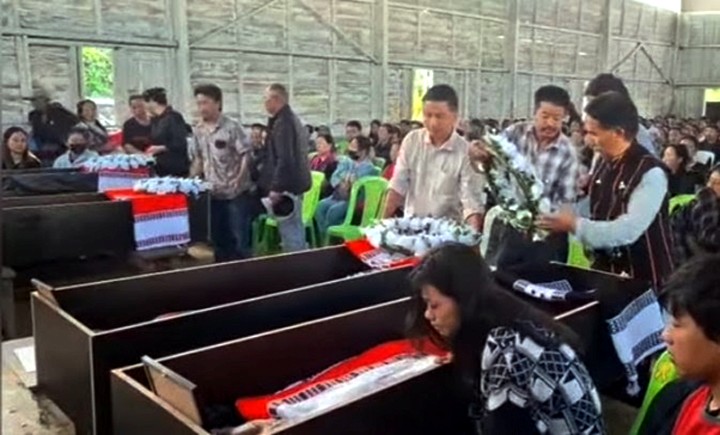
The killing of four Tangkhul Naga civilians near the Indo-Myanmar border in Kamjong district on September 24 has brought further the cross-border dimension of Manipur’s conflict into sharper focus. The four Tangkhul Naga civilians were reportedly attacked near border pillars 91 and 93 in the Kangpat area. Two were killed at Pilong, while two others were allegedly abducted and taken towards Phailen, a Kuki village, where they were subsequently killed. A fifth person reportedly escaped and informed the police. The victims were identified as Betterson Jajo, Vareishim Jajo, Phami Jajo and Ningthem Kashak. Vareishim and Phami Jajo were father and son. One of five civilians present at the settlement, Akhan Kaping, escaped. The Tangkhul Naga Long (TNL) has attributed the attack to the Myanmar-based Kuki National Army-Burma (KNA-B) and other Kuki armed groups, although the attribution has not been independently verified.
The Pilong killings did not occur in isolation. On September 21, 17-year-old Liangmai Naga student NK Wiphenbou was shot dead between Upper Takou and Malek in Tamenglong district. Naga organisations attributed the killing to Kuki militants, although the Kuki side has denied involvement.
The significance of the Pilong incident lies not only in the killing of four civilians. It came immediately after a series of attacks on Naga villages in Kangpokpi and other areas, including the burning of at least 41 Liangmai Naga houses and churches in Makui Chamriupui, Makui Thanamba and Makui Thebaram during nearly 12 hours of violence on September 23–24. Local residents attributed the attacks to Kuki militants, while reports of armed clashes between Kuki and Naga groups remained contested and were not independently verified.
Taken together, these incidents suggest that the conflict is moving into another phase. The violence is no longer confined to the familiar geography of the Meitei-Kuki confrontation. The geography of confrontation between Kuki and Naga has been expanding. Naga villages in, particularly those situated in and close to Kangpokpi district and other Kuki settlements, and the international boundary, are increasingly becoming sites of armed contestation. The crucial question is whether these are isolated clashes between local armed groups or evidence of a widening trans-border military theatre in which Myanmar-based Kuki armed actors are increasingly able to operate inside Manipur.
The May 7 attacks in Kamjong provide the clearest starting point.
The May 7 Attack and the KNA-B Question
On May 7, armed attackers struck the Tangkhul Naga villages of Namlee, Wanglee and Choro in Kamjong district in the early hours of the morning. Houses were burned, residents fled into the surrounding forests and several people were reportedly abducted. Manipur’s Phungyar AC MLA Leishiyo Keishing described the incident as “external aggression” and alleged that cadres of the KNA-B and Myanmar-based People’s Defence Force (PDF) had attacked the villages.
The allegations, however, were immediately disputed.
The KNA-B denied involvement and said it was not engaged in any activities inside Indian Territory. The PDF also denied involvement. At the same time, the Village Volunteers Eastern Zone (VVEF), a Kuki-Zomi armed group based in Manipur, claimed responsibility for the attack, describing it as retaliation for the burning of Lancha Kuki village and framing the operation as directed against NSCN-IM elements and their allies.
This competing attribution is important. It would be premature to treat every allegation against the KNA-B as an established fact despite the public perception. But it would be equally problematic to dismiss the cross-border dimension simply because the KNA-B denied involvement.
There are several reasons.
First, reports from the ground and subsequent security operations pointed to armed movement across the international boundary. Second, the Assam Rifles subsequently rescued a Tangkhul woman reportedly abducted by KNA-B and VVEZ from Namlee. Third, the police case reportedly registered after the May 7 incident described armed men suspected to be KNA-B cadres crossing the international border into Choro. The Tangkhul Naga Long later cited this FIR and alleged that video evidence recorded by Assam Rifles personnel also identified KNA-B involvement.
The evidence therefore presents a complicated picture – allegations by local communities and officials, a claim of responsibility by a Kuki-Zomi armed organisation, reported evidence pointing towards KNA-B involvement, and an explicit KNA-B denial. What is not in doubt is that armed violence crossed – or was alleged to have crossed – the international frontier and those civilian Tangkhul Naga settlements were attacked.
That distinction matters.
The issue is not simply who should be blamed for one particular attack. It is whether Myanmar-based Kuki militants have acquired the ability to influence security conditions inside Indian Territory.
July: The Pattern Becomes Harder To Dismiss
The same question resurfaced on July 1 when violence again erupted around the Kamjong border. The Eastern Command of the Naga Village Guard alleged that Kuki militants, in collusion with KNA-B, attacked Tangkhul Naga settlements including Kongkan Thana and Sangkalok after houses at Phaimol, a Kuki village, were set ablaze. The Naga group alleged that armed men crossed the Namya River from the Myanmar side and attacked the Tangkhul Naga settlements.
A separate account described at least 35 houses and refugee shelters being burned in the area and characterised the incident as a coordinated cross-border attack.
Again, however, the competing narrative was immediate. Kuki organisations blamed NSCN-IM for the violence at Phaimol, while Naga organisations accused Kuki armed groups and KNA-B of attacking the Tangkhul Naga settlements. A regional security assessment also recorded the competing claims rather than treating either version as conclusively established.
The repetition is significant.
In May, there were allegations of KNA-B involvement in attacks on Naga villages. In July, similar allegations emerged again. In September, four Naga civilians were killed near the border amidst renewed violence involving Kuki and Naga armed groups in many part of the State.
A pattern does not by itself establish the identity or command structure of the attackers. But it does establish a security problem.
The Indo-Myanmar frontier around Kamjong has become an arena in which armed groups can operate across, or in close proximity to, an international boundary while civilian populations bear the consequences.
The September Attacks: From Arson to Targeted Killings
The events of September 23–24 make the problem still more serious.
At least 41 Naga houses, including churches, were reportedly burned in Makui Chamriupui, Makui Thanamba and Makui Thebaram. Local sources said the attacks began around 2:30 pm on September 23 and continued until approximately 2:30 am the following day. Villagers alleged that Kuki militants carried out the attacks and questioned why security personnel reportedly stationed within roughly 10 kilometres of the affected villages could not prevent the destruction. Officials had not confirmed casualties at the time of reporting.
Within hours, four Naga civilians were reportedly killed in another location, the Kamjong border area.
The geographical locations and timing of these incidents have generated understandable concern among Naga communities that the violence is no longer a collection of unrelated local disputes. The attacks are occurring along a widening belt of Naga-Kuki confrontation that reaches from Kangpokpi, Noney and Tamenglong towards Ukhrul and Kamjong and, critically, the Myanmar frontier.
The September 24 killings are particularly disturbing because the alleged attackers were operating close to international boundary pillars. If the allegation of KNA-B involvement is eventually established, the incident would represent another direct manifestation of Myanmar-based armed actors targeting civilians on Indian soil. If the perpetrators are instead found to be Indian-based Kuki militants, the security question remains serious – armed groups would still have demonstrated the capacity to operate with considerable freedom in a militarised conflict zone close to an international border.
Either way, the state has a responsibility to establish what happened.
The Border Cannot Become A Grey Zone
This is where the earlier analysis of the Kamjong attacks becomes relevant. In “Kamjong Border Attacks Reveal the Expanding Transnational and Territorial Dimensions of the Manipur Crisis,” the May attacks were examined not merely as another episode of violence involving ethnic groups but as an indication that the conflict was acquiring a transnational and territorial character.
The subsequent incidents have made that question more urgent.
The Indo-Myanmar border is not simply a line on a map. In Kamjong it passes through difficult terrain inhabited by communities whose social, economic and ethnic connections have historically extended across the frontier. Myanmar’s prolonged internal war has further complicated the security environment. Armed organisations, refugees, local militias and other networks operate within a frontier where state authority is difficult to exercise uniformly.
But geographical difficulty cannot become an explanation for permanent insecurity.
The residents of Makui and border villages – Namlee, Choro, Wanglee, Kongkan Thana, and Sangkalok – and other border settlements are Indian citizens. Their villages cannot be treated as expendable buffer spaces between competing armed organisations.
Nor can the international border be reduced to a zone in which responsibility becomes impossible to establish.
If militants cross from Myanmar, the Indian state must identify how they entered, who facilitated their movement, how they were armed, and how they withdrew. If attacks are organised by Indian-based armed groups, the state must establish how those groups were able to mobilise, attack civilian settlements and sustain operations. If local armed groups are collaborating with Myanmar-based organisations, that relationship must be investigated.
The answer cannot simply be another deployment after another attack.
The KNA-B Allegation Must Be Investigated, Not Politicised
The controversy surrounding KNA-B illustrates the danger of allowing competing narratives to substitute for investigation.
The KNA-B has repeatedly denied involvement in the attacks including Pilong killings and has stated that its operations are confined to Myanmar. At the same time, local Naga organisations, elected representatives and some security-related reporting have attributed attacks to KNA-B cadres or to KNA-B operating alongside Indian-based Kuki armed groups. Defence-related reporting after the May attack also attributed involvement to KNA-B and reported that a woman abducted during the attack was subsequently rescued.
These are serious allegations and denials. They require evidence, not political assertion. The appropriate response would therefore be a transparent investigation capable of establishing the identities of the attackers, their route of entry, weapons used, communications, command relationships and retreat routes. Where evidence establishes cross-border involvement, the matter should be treated as a national-security and international-border issue rather than merely another episode of violent conflict in Manipur involving ethnic groups.
The failure to resolve such questions creates a vacuum that competing communities inevitably fill with their own explanations.
And once that happens, every subsequent incident becomes evidence for an existing ethnic narrative.
The Proxy Question
This brings the issue to a larger strategic question – is the KNA-B, or other Kuki armed groups, being used – directly or indirectly – as a proxy in India’s wider security calculations? Is KNA-B’s denial a strategy?
The available evidence does not establish that the Government of India directs KNA-B operations against Naga or Meitei insurgent groups. Such a conclusion would require considerably stronger evidence than is presently public.
But the question cannot simply be dismissed either.
KNA-B operates from Myanmar and is engaged in the conflict against Myanmar’s military. Its armed networks exist in the same wider frontier environment in which Indian security agencies confront insurgent organisations operating in Manipur. Indian-based Kuki armed groups also have relationships with the Government of India through the Suspension of Operations (SoO) framework. This creates a complicated ecosystem in which the interests of different armed actors may sometimes converge even without a formal chain of command.
That possibility deserves investigation precisely because informal strategic convergence can be as consequential as formal direction.
The more immediate concern, however, is simpler – whatever the strategic calculations of armed organisations or states, civilians cannot be left to absorb the consequences.
If the Indian state has security interests in the Myanmar theatre, those interests cannot justify – or appear to justify – the insecurity of Indian border populations. If armed groups are fighting common adversaries, that does not give them legitimacy to determine territorial outcomes inside Manipur.
From Violent Conflict Involving Ethnic Groups To Border Warfare
The most worrying development is the gradual transformation of the conflict’s geography.
In 2023, the central fault line was widely described as Meitei-Kuki. Three years later, the conflict has generated new and increasingly dangerous fault lines involving Nagas, Kukis, Meiteis, multiple insurgent organisations and armed groups operating from both sides of the international border.
The Naga communities of Kamjong and adjoining areas are now confronting a security environment in which their villages can become targets because of their location, their perceived political affiliations or their proximity to rival armed groups.
This is precisely how a frozen conflict can begin to expand.
The absence of a comprehensive political settlement does not mean that violence remains static. Instead, armed actors search for new strategic spaces, new alliances and new territorial advantages. The May and July attacks, followed by the September violence, indicate that the frontier is becoming one such space.
The danger is that the international boundary itself could become militarised through repeated cycles of attack and retaliation. Naga villages could be emptied. Refugee settlements could become entangled with armed networks. Armed groups could acquire greater territorial influence. And each new displacement could deepen the demographic and political consequences of the next round of violence.
That would transform the Indo-Myanmar frontier from a difficult border-security problem into a permanent conflict zone.
The State Must Secure The Border Without Outsourcing Sovereignty
The immediate responsibility therefore lies with the state.
Border villages require sustained protection, not episodic reinforcement after killings. Intelligence and surveillance mechanisms must be capable of detecting armed movement across the frontier. Security agencies must coordinate with local administrations and civilian institutions. Allegations involving KNA-B, VVEF, KNF factions, KRA, ZRA and other armed groups must be investigated individually rather than collapsed into a single ethnic narrative.
Most importantly, the state must demonstrate that territorial control remains a constitutional responsibility of the Indian Union and the Government of Manipur – not something to be negotiated informally among armed organisations.
This is also why the distinction between the May attacks and the September killings should not be overlooked. The first exposed the possibility of cross-border armed incursions. The later incidents show how quickly such violence can become embedded in local cycles of retaliation and territorial competition.
The danger is no longer merely that militants may cross the border. The deeper danger is that the border may cease to function as the meaningful limit of armed conflict.
The killing of four Tangkhul Naga civilians at Pilong, the burning of Naga homes and churches in Makui, and the earlier attacks on Namlee, Wanglee and Choro should therefore be treated as part of a serious security pattern requiring investigation. The KNA-B allegation must be established or disproved through evidence. The role of other Kuki armed groups must likewise be examined. And the responsibility of the security apparatus for preventing repeated attacks must not disappear beneath competing ethnic narratives.
The central issue is ultimately one of sovereignty.
A state does not demonstrate sovereignty merely by maintaining security camps near a border. It demonstrates sovereignty when civilians living at that border can sleep without fear that armed men will cross the frontier, burn their homes, abduct their neighbours or kill them – and when the state can credibly identify those responsible.
The people of Manipur’s border villages are not a frontier buffer for anyone’s geopolitical strategy. They are citizens whose security is inseparable from India’s territorial sovereignty.
If cross-border attacks continue, the question will no longer be simply whether KNA-B or another armed group was responsible for a particular incident. The larger question will be whether the Indian state is still capable of preventing armed actors – whether local or transnational – from determining the security and territorial realities of its own frontier.
That is the question the continuing violence in Kamjong is now forcing India to confront.

Senior Editor: Imphal Review of Arts and Politics





1 thought on “The Myanmar Front in Manipur: KNA-B, Cross-Border Attacks and the Vulnerability of Manipur Border Villages”
Rightly said: Must be investigated, not politicised.