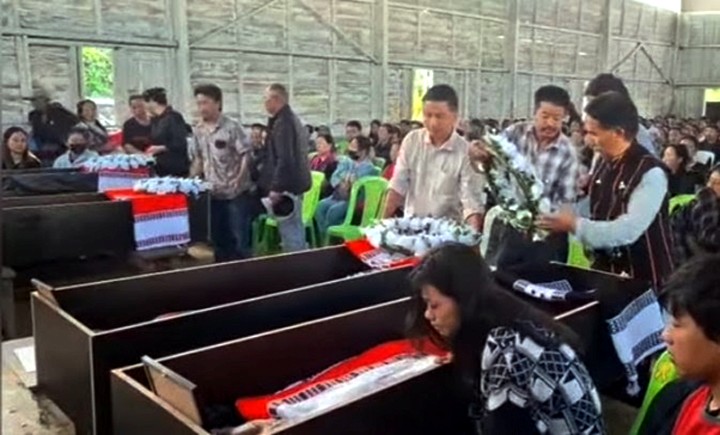
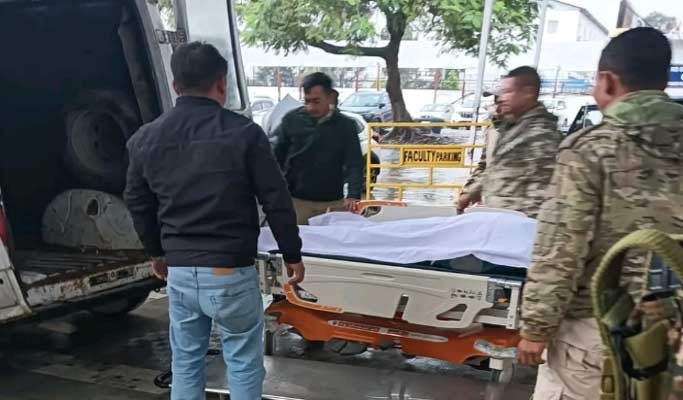
The killing of a suspected KCP-PWG cadre during a joint security operation in Imphal West raises questions extending beyond the circumstances of the encounter. At a time when the Imphal Valley has experienced months of relative peace, the operation brings renewed scrutiny to the priorities of the security establishment, the implementation of the Suspension of Operations agreement and the apparent asymmetry in the state’s response to armed violence across Manipur.
The killing of a suspected militant during a combined security operation at Yurembam in Imphal West district is an incident that deserves more than a routine security briefing. While the recovery of weapons and the arrest of eight alleged members of the Kangleipak Communist Party (People’s War Group), including its chairman, Laishram Ranjit alias Tamnganba, may be presented as an operational success, the circumstances surrounding the operation raise wider questions about the priorities, consistency and credibility of Manipur’s security architecture since the outbreak of the violent conflict on May 3, 2023.
The most significant aspect of the incident is not simply that one suspected militant killed during an alleged exchange of fire. It is that the operation took place in the Imphal Valley, which has experienced several months of relative peace, and involved a combined force of Imphal West Police Commandos and Central Reserve Police Force’s COBRA personnel. The operation also resulted in the arrest of a person who had been publicly presented by the government as a surrendered underground leader only four months earlier.
This raises an obvious question – what exactly happened to the surrender process, and what mechanisms were put in place to ensure that those who surrendered genuinely abandoned armed activities? If the chairman of an organisation that had formally surrendered with 46 cadres and deposited its weapons was subsequently arrested with seven alleged associates and weapons, the government owes the public a convincing explanation. A surrender ceremony cannot be treated as the successful conclusion of a peace process if the state has no effective mechanism to monitor compliance, rehabilitation and the subsequent conduct of surrendered cadres.
There is, however, a larger political and security question that cannot be ignored. Why does the security establishment appear capable of conducting coordinated combing operations, killing suspected militant, making arrests and recovering weapons in the Valley, while armed Kuki militant groups accused of continuing violence, maintaining territorial control and obstructing the movement of other communities in the hills have not faced comparable and sustained enforcement action?
This question is central to understanding the growing perception that Manipur’s post-May 2023 security architecture operates with unequal standards of accountability.
The Contradiction Between Surrender And Subsequent Arrest
The July 21 surrender ceremony was not an insignificant event. According to the official account published by the Press Information Bureau, 46 active KCP-PWG cadres surrendered before Chief Minister Yumnam Khemchand Singh and deposited 28 weapons, including AK-series rifles, INSAS rifles, pistols and an RPG launcher, along with explosives and ammunition. The government described the development as a major breakthrough in its efforts to restore peace.
Ranjit, who led the surrendering group, had publicly announced that KCP-PWG would abandon armed activities, extortion and unlawful detention. His subsequent arrest, therefore, is not merely an isolated law-and-order development. It exposes a serious weakness in the government’s surrender and rehabilitation policy.
There are several possibilities that the investigating authorities must clarify. Did Ranjit genuinely surrender but subsequently resume underground activities? Were the weapons recovered at Yurembam part of an undisclosed stockpile? Did some members of the organisation refuse to abandon armed activities despite the public surrender? Or was the surrender itself inadequately verified before the government celebrated it as a major security achievement and “Home Coming” of the armed cadres?
These questions cannot be answered through speculation. However, the government must explain how an individual publicly identified as the chairman of a surrendered armed organisation could subsequently be found in circumstances that resulted in his arrest alongside seven alleged cadres and the recovery of four weapons.
Equally important is the death of Khaidem Shyamkumar, aka SK, during the operation. The official circumstances surrounding the shooting have not been fully established in the information presently available. The description of the incident as an encounter or exchange of fire should not substitute for an independent determination of what happened.
The authorities must establish whether the deceased or other arrested individuals fired at the security personnel, whether the security forces exercised proportionate force and whether the operation followed established rules governing the use of firearms. A post-mortem examination, forensic examination of weapons, ballistic evidence, documentation of injuries and a transparent account of the sequence of events are essential.
The fact that the deceased was allegedly associated with an underground organisation does not diminish his entitlement to due process. Nor does it absolve the state of its obligation to establish the circumstances of his death. The rule of law must apply equally to suspected militants, surrendered cadres and civilians.
Notably, reports said that Shyamkumar was an ex-serviceman of the Assam Rifles.
The Question of Selective Security Enforcement
The larger concern, however, lies in the apparent contrast between the security establishment’s operational response in the Valley and its approach towards armed Kuki militant groups in the hill districts.
Since May 3, 2023, Manipur has witnessed an extraordinary fragmentation of its geographical and social space. What began as violent attacks against the Meiteis in Churachandpur by the Kuki-Zomi militants has evolved into a prolonged territorial and political confrontation, with large populations displaced, communities separated and ordinary movement between different parts of the state severely restricted.
For the Meiteis, the inability to travel freely through several hill areas and the continued restrictions on access to certain roads has become an enduring reality. The situation has also increasingly affected Naga communities, particularly in the context of the Kuki-Naga confrontation that intensified since February 2026.
The emergence of buffer zones, restrictions on civilian movement and the consolidation of community-based territorial control have effectively created geographical divisions within a state that constitutionally remains one historical, political and administrative entity.
This is particularly troubling because the demand for a separate administration by Kuki-Zomi groups and their representatives has remained a central issue in the conflict. The territorial separation being experienced on the ground cannot automatically be equated with a legally established political boundary. Nevertheless, when armed groups exercise coercive influence over roads, settlements and access routes, the practical consequences begin to resemble the territorial fragmentation that a separate administration would institutionalise politically.
The question is whether the Union and State governments have treated this development with the seriousness it demands.
The security establishment has demonstrated its capacity to conduct coordinated operations against alleged underground organisations in the Valley. Yet there is widespread public dissatisfaction over what is perceived as an absence of comparable action against Kuki militants accused of attacks on civilians, obstruction of highways, abductions, killings and the enforcement of territorial restrictions in the hills.
This perception cannot be dismissed merely as an expression of ethnic distrust. It requires an institutional response based on verifiable operational records – the number of combing operations conducted, arrests made, weapons recovered, camps inspected, violations investigated and prosecutions initiated across different geographical areas.
The security establishment must explain whether the same standards of enforcement are being applied to all armed organisations, irrespective of their ethnic affiliations, political demands or participation in government-sponsored peace arrangements.
If the answer is yes, the government should demonstrate it through transparent evidence. If the answer is no, the resulting asymmetry represents a grave failure of constitutional governance.
Does The Suspension of Operations Agreement Provide Immunity?
The Suspension of Operations (SoO) agreement with the Kuki National Organisation (KNO) and United People’s Front (UPF) is central to this debate.
The SoO arrangement is a negotiated security framework between the Government of India, the Government of Manipur and the two umbrella organisations representing several Kuki-Zomi militant groups. It was intended to suspend hostilities, facilitate political dialogue and establish mechanisms through which armed organisations could be brought into a negotiated peace process.
It was never intended to create a parallel security jurisdiction, legitimise territorial control or provide immunity from criminal accountability.
The revised ground rules announced on September 4, 2025, explicitly reiterated the territorial integrity of Manipur and the need for a negotiated settlement. They also provided for the relocation of seven designated camps, reduction in the number of camps, relocation of weapons to the nearest CRPF or BSF camps, physical verification of cadres and monitoring by a Joint Monitoring Group. Violations were to be dealt with firmly, including through a review of the agreement.
Subsequent reporting in August 2026 indicated another revision of the ground rules, again requiring the relocation of designated camps and reiterating Manipur’s territorial integrity.
These provisions raise an important question – how effectively are they being implemented?
A suspension of operations is not a licence to continue armed intimidation under the protection of a negotiated arrangement. It does not confer sovereignty upon armed groups, authorise them to regulate civilian movement or permit them to determine who can enter or leave particular geographical areas.
Nor does the SoO agreement, by itself, extinguish criminal liability for offences committed by individual cadres. A person accused of murder, abduction, extortion or another cognisable offence remains subject to investigation and the ordinary criminal justice process. Any special procedural arrangements under the agreement cannot be interpreted as blanket immunity.
The government must therefore answer whether the designated camps are being effectively monitored, whether the actual presence of cadres corresponds to verified lists, whether weapons are properly secured and whether alleged violations are referred to the appropriate investigative authorities.
If armed groups operating under the SoO framework are accused of participating in violence while their camps and activities remain inadequately scrutinised, the credibility of the entire peace process becomes questionable.
The fundamental issue is not whether the government should continue negotiations with KNO and UPF. Negotiations may be necessary to end the conflict. The issue is whether negotiations have been allowed to weaken the state’s obligation to enforce the law.
The Naga Question Exposes The Wider Failure
The deterioration of security along the hill corridors has also demonstrated that the consequences of the conflict are no longer confined to the Meitei and Kuki-Zomi confrontation.
The Kuki-Naga confrontation that became more violent since February 2026 has exposed another dimension of territorial insecurity. Naga civilians have faced killings, abductions, road blockades and restrictions on movement in areas where their communities have historically maintained settlements and access routes.
The November 14, 2026, ambush on National Highway-202, in which four Naga civilians, including a woman and her son, were reportedly killed, illustrates the continuing vulnerability of civilians travelling through the hill districts. The attack occurred near New Haven in Ukhrul district.
Earlier, Manipur Police reportedly informed the High Court that 58 FIRs had been registered concerning incidents along the Imphal-Ukhrul road corridor since the outbreak of the Naga-Kuki confrontation on February 8, 2026. The complaints included armed attacks, killings, abductions, detention of passengers, looting and obstruction of traffic.
These developments make it increasingly difficult to portray the security problem simply as a dispute between Meiteis and Kuki-Zomis. Naga communities, too, are experiencing the consequences of armed territorial assertions and restrictions on movement.
The constitutional responsibility of the state is to protect every citizen, irrespective of ethnicity or geographical location. The right to move freely throughout the territory of India, subject to constitutionally permissible restrictions, cannot be selectively enjoyed according to the identity of the community controlling a particular road or locality.
When armed groups can effectively determine which communities may travel through particular areas, the state is surrendering one of its most fundamental responsibilities.
The question, therefore, is not merely why security forces have conducted an operation against alleged KCP-PWG cadres in Yurembam in the valley. It is why the government has not demonstrated an equally visible and effective commitment to restoring unrestricted civilian movement and dismantling the coercive influence of armed groups elsewhere in the state.
Has Manipur’s Security Architecture Become Asymmetrical?
Since May 3, 2023, the security administration of Manipur has undergone a fundamental transformation. The centralisation of security decision-making, the expanded role of central forces and the growing influence of the Union Ministry of Home Affairs have significantly altered the relationship between the elected state government and the security establishment.
The appointment of a separate Security Adviser and the operation of a Unified Command structure have further raised questions about the actual distribution of authority between the elected state government and security officials.
The problem is not the deployment of central forces or coordination between different security agencies. Such arrangements may be necessary in a situation involving multiple armed organisations and a breakdown of public order. The problem arises when the security architecture appears to function without sufficiently transparent political accountability or consistent operational priorities.
A state cannot claim to be restoring constitutional order when its security institutions appear more effective in enforcing restrictions against one section of the population than in protecting all communities from armed intimidation.
This is particularly important in the context of the continued presence of buffer zones. Although these areas may have initially been conceived as temporary security arrangements to prevent direct confrontation between hostile communities, their prolonged existence has produced consequences resembling internal territorial boundaries.
For the Meiteis, access to several hill areas remains restricted or insecure. For Nagas, movement through certain areas has become increasingly dangerous. Meanwhile, the existence of armed formations, designated camps and political demands for a separate administration continues to complicate the restoration of normal inter-community relations.
The question that emerges is whether the security establishment is attempting to dismantle these divisions or merely managing them.
If the state conducts combing operations in the Valley but does not effectively challenge armed territorial control in the hills, it risks creating an impression that the security architecture is designed to contain one community rather than restore the territorial and constitutional authority of Manipur.
This is not to suggest that every Kuki individual or organisation is responsible for the actions of armed groups. Nor should legitimate political demands or civilian grievances be equated with militancy. Accountability must be individual and evidence-based. However, the government cannot use the complexity of ethnic politics as an excuse for failing to act against identifiable militant groups and individuals suspected of committing serious crimes.
There is also a distinction between the existence of the SoO framework and the conduct of armed groups outside it. Not every Kuki armed group is necessarily covered by the agreement and not every violent incident can automatically be attributed to a SoO signatory. The government must establish these distinctions rather than allowing the entire security situation to remain obscured by political ambiguity.
Are Kuki Militants Being Given A Free Hand?
This question, increasingly raised by civil society organisations and sections of the public in Manipur, deserves a direct answer from the Union and State governments.
There is no publicly established basis for concluding that the SoO agreement formally authorises Kuki militant groups to attack civilians, obstruct highways or pursue territorial separation through armed coercion. On the contrary, its revised ground rules explicitly reaffirm Manipur’s territorial integrity.
Yet, the gap between these formal commitments and the security situation on the ground has generated serious public distrust.
The government must clarify whether armed groups under the SoO framework have been investigated for alleged involvement in attacks, whether the Joint Monitoring Group has recorded violations, what action has followed those findings and whether any designated camps have been subjected to effective inspections.
It must also explain whether the security forces have been given clear operational instructions to prevent armed groups from exercising control over civilian movement.
If the government is unwilling or unable to enforce the ground rules against violations by signatory armed groups, the agreement risks becoming an instrument of political accommodation rather than a mechanism for peace.
Indeed, a negotiated arrangement that permits armed groups to retain coercive influence over territory while the state conducts aggressive operations against other underground groups would create a deeply unequal security environment.
Peace cannot be built by selectively disarming some armed organisations while accommodating the territorial ambitions of others.
The State Must Answer For Its Priorities
The Yurembam operation should not be condemned simply because it targeted an armed organisation associated with the Valley. If the KCP-PWG chairman and other alleged cadres violated the law after surrendering, the authorities were justified in investigating and arresting them. If they were found possessing illegal weapons, those circumstances must be examined through the criminal justice system.
But the death of Khaidem Shyamkumar who was also an ex-serviceman of Assam Rifles requires a transparent investigation, and the arrest of Ranjit demands an explanation of the government’s surrender and rehabilitation mechanisms.
More importantly, the incident should prompt a wider review of the state’s security priorities.
The government must publish credible information about enforcement of the SoO ground rules, the monitoring of designated camps, investigations into attacks on civilians, action against armed groups obstructing highways and measures to restore unrestricted movement across the state.
The Union government must also clarify the operational relationship between the Unified Command, the Manipur Police, central armed forces and the elected state government. Security decisions cannot remain insulated from democratic accountability, particularly when they have profound consequences for the territorial integrity and constitutional administration of the state.
The central question is whether Manipur’s security architecture is intended to restore the authority of the constitutional state throughout its territory or merely to maintain an uneasy equilibrium between competing armed and political interests.
The distinction is fundamental. Managing a frozen conflict is not the same as resolving it. Maintaining buffer zones is not the same as restoring peace. Conducting combing operations against underground cadres in the Valley is not evidence of an impartial security policy if comparable threats to civilian life and freedom of movement elsewhere are not addressed with equal determination.
The Meiteis cannot be expected to accept a security arrangement in which their own underground organisations are subjected to intensive operations while armed groups accused of attacking them or restricting their movement appear to enjoy greater political accommodation. Nor can the Nagas be expected to accept a situation in which their security and freedom of movement become secondary to negotiations between the Union government and Kuki-Zomi SoO groups.
The Constitution does not recognise different standards of security for different ethnic communities. The protection of life, liberty and freedom of movement is a responsibility owed equally to every citizen.
Ultimately, the Yurembam operation is more than a question of one suspected militant being killed and eight others arrested. It has exposed a larger contradiction in Manipur’s security policy – the state appears capable of exercising coercive power, but the public increasingly questions whether that power is being exercised impartially.
If the government can conduct coordinated combing operations in the Valley, why can it not demonstrate the same determination in preventing armed intimidation, territorial coercion and attacks on civilians in the hills for more than three-and-half years?
Until the Union and State governments answer this question through transparent action rather than official assurances, the perception of selective security architecture will continue to deepen.
Manipur does not need a security policy that merely manages the consequences of territorial division. It needs one that restores the authority of the constitutional state, guarantees equal protection to all communities and makes every road, settlement and district accessible to every citizen without fear.
Anything less would amount to institutionalising the very fragmentation that the government claims it is trying to overcome.

Senior Editor: Imphal Review of Arts and Politics