More than three-and-a-half years after the violence that erupted in Manipur on May 3, 2023, the most disturbing feature of the continuing crisis are not merely the recurrence of armed attacks, civilian casualties or the displacement of thousands of people. It is the apparent normalisation of insecurity and the inability or inaction of the governments at the Centre and in Manipur to restore the most fundamental obligation of the state – protecting the lives, properties and constitutional rights of its citizens.
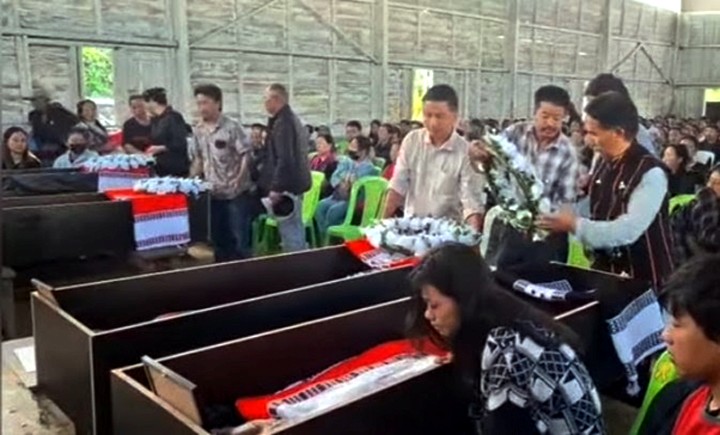
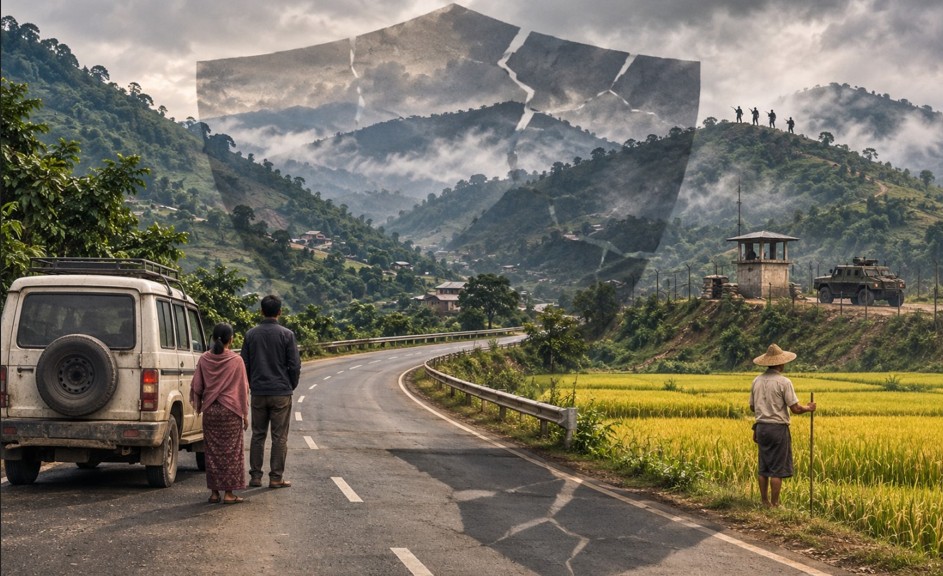
The latest incidents involving the killing of four civilians, including a mother and her son, in a suspected sniper attack by Kuki militants on vehicles travelling along National Highway-202 at New Haven, and the shooting of farmers near the Border Security Force (BSF) post at Sinakeithei in Ukhrul district, expose the disturbing depth of this failure. These are not isolated incidents, repeatedly said, that can be dismissed as unfortunate episodes in an otherwise improving security situation. They point to a continuing pattern in which civilians remain vulnerable even while travelling on national highways or attempting to cultivate their own agricultural land.
The identities and affiliations of the assailants in the New Haven attack, as well as the precise circumstances surrounding the firing, require an impartial investigation. Similarly, allegations concerning the response of BSF personnel at Sanakeithel (Sinakeithei) must be independently examined. Nevertheless, the recurring nature of these incidents raises a question that neither the Union Government nor the Manipur Government can indefinitely evade – how long will the people of Manipur continue to face killings and count attacks and counter-attacks, dead bodies and injured persons, instead of being assured of peace, security and the freedom to live without fear?
This is ultimately a question about the responsibility of the State, not simply the conduct of armed groups.
The State as An Observer of Recurring Violence
The New Haven attack is particularly disturbing because the victims were again ordinary civilians using a public highway. National highways are not supposed to become corridors of mortal danger where commuters must calculate the possibility of being shot before undertaking a journey. The killing of four people travelling in two separate vehicles, reportedly from Shangshak and Tashar villages, demonstrates how fragile civilian security remains in the state especially hill districts. The fact that a mother and her son were among those killed makes the human tragedy especially more painful. Their journey ended not because they were participants in an armed confrontation but because civilians continue to live and travel in an environment where armed violence remains a persistent threat.
The incident at Sanakeithel exposes another dimension of the crisis – the vulnerability of people trying to sustain their livelihoods. Newton Mahung was reportedly shot while harvesting paddy in fields near a BSF post. The village authority had allegedly requested security assistance nearly three weeks earlier, anticipating threats during the harvesting season. If these allegations are substantiated, the question of institutional accountability becomes unavoidable. Why was adequate preventive security not provided despite advance warning? Why should farmers have to depend on the uncertain response of security personnel while cultivating their own fields?
The villagers’ account that only approximately two per cent of Sanakeithel’s cultivable paddy land was cultivated this year is particularly revealing. It indicates that the conflict has moved beyond the destruction of houses and the displacement of populations. It is now directly threatening food security, agricultural livelihoods and the ability of rural communities to maintain their relationship with their own land.
The recurrence of firing in the Lungther Hill range is equally significant. In March 2026, a Tangkhul Naga woman and her son were reportedly trapped in agricultural fields for hours after suspected Kuki militants opened fire from elevated positions. They were subsequently rescued by Mahar Regiment personnel using armoured vehicles. The repetition of such incidents in the same geographical area raises serious questions about whether the authorities have undertaken an adequate assessment of vulnerable locations, fortified positions and the operational capabilities of armed groups.
These developments cannot be understood merely as a series of unrelated law-and-order incidents. They reflect a deeper institutional failure to establish a security environment in which civilians can travel, farm, work and conduct their ordinary lives without depending on military escorts or emergency rescue operations.
The Centre’s Responsibility Cannot Be Displaced
The Union Government cannot escape responsibility by describing Manipur’s crisis exclusively as an internal “ethnic conflict” or “communal violence” in a “long-standing historical grievances” or a matter of state law and order. But a pertinent question remains: Can the Centre describe the long-standing historical grievances between the Meiteis and Kuki-Zomi communities?
It is true that public order and police are primarily state subjects under the Seventh Schedule of the Constitution of India. However, the scale, duration and security implications of the Manipur crisis have made the Centre an indispensable actor. The deployment of the Army, Assam Rifles and Central Armed Police Forces, the operation of the Unified Command, the management of the Suspension of Operations arrangements with militant armed groups and the political handling of competing demands have all involved the Union Government.
The Ministry of Home Affairs (MHA) itself has acknowledged the extensive central intervention in Manipur, including the deployment of additional central forces, the continuation of an established Unified Command with the Security Advisor appointed by the Centre as the Chairman instead of the Chief Minister and the involvement of senior central authorities in managing the security situation.
The constitutional question, therefore, is not whether the Centre has a role but whether it has discharged that role effectively, impartially and accountably.
President’s Rule was imposed on February 13, 2025, following the resignation of Chief Minister Nongthombam Biren Singh. This was an extraordinary constitutional intervention, reflecting the inability of the elected state government to restore confidence and govern effectively amidst the prolonged crisis. The subsequent formation of a government under Chief Minister Yumnam Khemchand Singh in February 2026 gave false hope to many that an elected political leadership would restore administrative accountability and take responsibility for peace and security.
Yet the return of an elected government cannot itself be equated with the restoration of normalcy. Nor can the formation of a ministry be treated as evidence that the underlying conflict has been resolved.
The fundamental question remains whether the state government exercises effective authority over the entire territory of Manipur and whether its institutions can protect citizens without discrimination. An administration that cannot guarantee the safety of people travelling on national highways or cultivating fields in their own villages cannot claim to have restored normal governance merely because political institutions have resumed functioning.
The Centre must also explain the continuing security architecture in Manipur. The centralisation of security management, particularly through the Unified Command and the substantial involvement of central security institutions, has raised questions about the relationship between the elected state government and the actual exercise of security authority.
If the Centre retains decisive influence over operational security arrangements, it must accept corresponding political and administrative responsibility for their outcomes. If the state government has sufficient authority, it must demonstrate that authority through measurable action. Neither government should be allowed to shift responsibility to the other whenever civilians are killed.
Security Forces and The Question of Accountability
The Sanakeithel incident brings the role of central security forces into particularly sharp focus.
The presence of a BSF post near a location from which farmers were allegedly fired upon raises questions that deserve a transparent investigation. The villagers’ allegations of delayed intervention should neither be dismissed nor accepted without examination. The precise sequence of events, the deployment of personnel, the availability of communication and surveillance facilities, the distance between the security post and the firing location, and the time taken to respond must be independently established.
The Manipur Police statement indicates that security personnel comprising Ukhrul District Police, BSF and the 6th Manipur Rifles retaliated and evacuated the farmers. This official account establishes that a response eventually occurred, but it does not by itself answer the villagers’ central question about whether the attack could have been prevented or contained earlier.
Security forces must be evaluated not merely by the number of operations conducted, weapons recovered or personnel deployed, but by their ability to prevent attacks and protect civilian populations.
The distinction between reactive security and preventive security is crucial. If armed militant groups can repeatedly fire upon civilians from known elevated positions, retreat and continue to threaten agricultural activities, the authorities must explain why those positions have not been effectively neutralised or controlled.
The government must also investigate whether armed formations, fortified positions and weapons in vulnerable areas are being allowed to operate with impunity. Such an inquiry must be evidence-based and impartial, without presuming the guilt of an entire community.
Equally important is the question of accountability across security institutions. The BSF, Assam Rifles, Army, Central Armed Police Forces (CAPF) including CRPF, and state forces cannot operate as disconnected agencies whose responsibilities become unclear whenever an incident occurs. A unified security command must mean unified responsibility, coordination and accountability, not merely a centralised chain of operational instructions.
The Danger of Selective Security and Competing Victimhood
One of the most destructive consequences of the Manipur crisis is the emergence of competing narratives of victimhood. Meiteis, Kuki-Zomi communities and Naga communities have all experienced insecurity, displacement, killings and the disruption of everyday life, although the circumstances and patterns of violence have differed.
The latest incidents demonstrate that the crisis is no longer confined to the original violent conflict involving Meiteis and Kuki-Zomi communities. The Kuki-Naga tensions in Kangpokpi district and its neighbouring districts of Noney, Tamenglong, Senapati, Imphal East and Imphal West, and Ukhrul and Kamjong districts and the neighbouring areas have added another dangerous dimension to an already fragmented security environment.
The killing of four civilians at New Haven and the shooting of a Tangkhul Naga farmer at Sanakeithel must therefore be examined as part of a wider deterioration of civilian security. The state cannot protect one population while treating the insecurity of another as a secondary concern.
There must be no hierarchy of civilian suffering.
The government must resist the temptation to interpret every incident through the political demands or security narratives of particular communities. Such an approach risks turning public administration into an instrument of competing ethnic interests rather than an impartial constitutional authority.
At the same time, accountability must not be diluted by the argument that all sides have suffered. Every killing requires investigation. Every civilian attack requires a credible response. Every armed militant group responsible for violence must face the law, irrespective of its political connections, ethnic affiliation or relationship with any government-sponsored security arrangement.
This is particularly important in the context of the Suspension of Operations (SoO) agreements involving Kuki-Zomi militant groups. Such arrangements cannot become a substitute for law enforcement or a shield against accountability. Any violation of the law must be investigated, and the terms of such agreements must be enforced transparently.
The state must also address the widespread perception among sections of the Meitei and Naga populations that certain armed groups enjoy political or operational protection because of their perceived strategic usefulness. Perception is not proof of state complicity. However, when such perceptions persist for years, the government has a responsibility to restore confidence through transparent investigations, equal enforcement of the law and demonstrable action against armed perpetrators.
The Failure of The Language of Normalcy
Perhaps the most troubling aspect of the Manipur crisis is the widening gap between official claims of improving normalcy and the lived experiences of ordinary citizens.
What does normalcy mean when people cannot travel freely between districts? What does peace mean when farmers require armed protection to harvest their paddy? What does the restoration of law and order mean when civilians are repeatedly shot at on public roads and in agricultural fields? And what does governance mean when villagers have to question the effectiveness of security forces stationed within their immediate vicinity?
The resumption of public transport with security escorts, the reopening of highways, the holding of political meetings and the organisation of government programmes may be presented as indicators of improvement. But administrative activity is not necessarily evidence of peace.
A highway is not secure merely because vehicles are allowed to use it. A village is not safe simply because security forces are stationed nearby. Nor can a state claim normalcy when its citizens continue to live under the threat of armed attacks.
The government must recognise the distinction between the absence of large-scale confrontation and the actual restoration of peace. Manipur appears to have entered a condition in which violence can remain localised, intermittent and geographically contained without necessarily disappearing. Such a situation may create an impression of relative calm, but it does not resolve the underlying conflict. It produces what may be described as a frozen conflict, in which the immediate intensity of violence fluctuates while insecurity, territorial separation, mutual suspicion and armed mobilisation persist.
In this environment, every new attack threatens to trigger retaliation, counter-mobilisation and another cycle of violence. The state cannot continue responding to each incident as though it were an isolated emergency. It must address the conditions that make recurring violence possible.
From Managing Violence to Resolving The Conflict
The responsibilities of the governments at the Centre and in Manipur must now be defined in concrete terms.
First, the Union Government must assume political responsibility for an effective and impartial security policy throughout Manipur. The Unified Command must be made genuinely accountable for protecting civilians, securing vulnerable highways and ensuring that no armed group can establish fortified positions from which ordinary people are attacked with impunity.
Second, the Manipur Government must demonstrate that it is more than an administrative arrangement functioning under an inherited security crisis. The Chief Minister and his Council of Ministers must exercise their constitutional responsibilities, demand accountability from security agencies and ensure that the concerns of all affected communities receive equal attention.
Third, there must be time-bound, independent investigations into the New Haven killings and the Sanakeithel firing, alongside previous attacks on civilians in vulnerable areas. The findings must be made public to the extent permitted by law, and those responsible must be prosecuted. The allegations concerning the conduct and response of security personnel at Sanakeithel must also be examined independently.
Fourth, the government must guarantee the security of agricultural activities, particularly during cultivating and harvesting seasons. Farmers should not have to abandon their fields or surrender their livelihoods because armed groups control surrounding elevated positions. Security arrangements must be preventive, coordinated and sustained rather than improvised after an attack.
Fifth, the Centre must initiate a credible political process involving Meitei, Kuki-Zomi and Naga representatives, along with civil society organisations, to address the fundamental political and territorial disagreements underlying the conflict. Such a process must recognise the identity and entity of Manipur, the constitutional rights, historical concerns and legitimate security interests of all communities without allowing armed coercion to determine political outcomes.
The objective cannot simply be to negotiate an absence of firing. It must be to restore constitutional governance, freedom of movement, peaceful coexistence and confidence in public institutions.
Peace cannot be imposed through military deployment alone. But political dialogue without civilian security is equally meaningless. Both must proceed together.
How Long Must Manipur Count Its Dead?
The most fundamental issue before the country is whether the people of Manipur are entitled to the same protection of life, liberty and constitutional rights as citizens elsewhere in India.
For more than three-and-a-half years, families have buried their dead, displaced people have struggled to rebuild their lives, farmers have feared returning to their fields, students have experienced prolonged disruption and ordinary commuters have had to assess security risks before travelling. The names and numbers of the dead continue to accumulate, while explanations from the authorities repeatedly follow familiar patterns – investigations have been initiated, additional forces have been deployed, search operations are underway and the situation is being closely monitored.
These administrative statements may be necessary immediately after an incident. But they cannot constitute a permanent substitute for governance.
How many more civilians must be killed before the state acknowledges that its security arrangements are inadequate? How many more farmers must be shot before agricultural land is made safe? How many more highways must become vulnerable before freedom of movement is treated as a constitutional obligation rather than a security concession? How many more villages must live under the shadow of armed positions before the authorities act decisively?
Most importantly, how long must the people of Manipur continue counting attacks and counter-attacks, dead bodies and injured persons?
The question is not directed at one government alone. It is directed at the Union Government, which has exercised extraordinary influence over the state’s security management, and at the Manipur Government, which has the constitutional responsibility to govern the state and protect its citizens. Both must answer for the continuing failure to establish durable civilian security.
The people of Manipur do not need another announcement of peace, another security review meeting or another assurance that normalcy will return. They need to see the State functioning as a State – protecting every citizen, controlling armed violence, enforcing the law without discrimination and creating conditions in which people can travel, cultivate their land and live without fear.
The ultimate test of governance is not how effectively the authorities respond after civilians are killed. It is whether they can prevent those killings in the first place.
Until that test is met, Manipur will remain trapped in a cycle in which every new attack produces another casualty list, every counter-attack generates another grievance and every official assurance loses credibility.
The people of Manipur have counted enough dead bodies. The People of Manipur have witnessed enough killings. It is time for the State to stop counting casualties and start delivering peace.

Senior Editor: Imphal Review of Arts and Politics