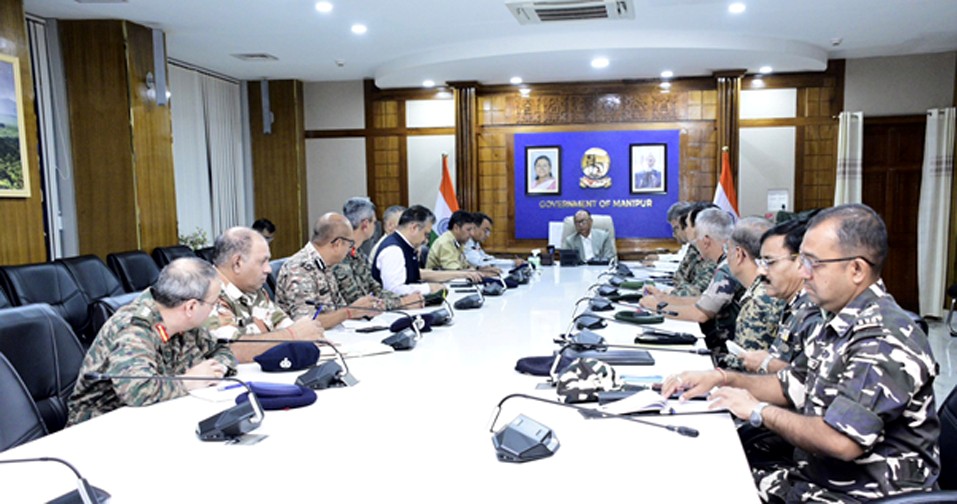
The security review meeting chaired by Chief Minister Yumnam Khemchand on November 3, 2026, at the Cabinet Hall of the Chief Minister’s Secretariat, Mantripukhri, raises a fundamental question about the State’s response to the continuing violence in Manipur – why has the government taken more than three-and-a-half years of conflict, repeated allegations of Kuki-Zomi armed-group involvement and renewed violence against Meitei and Naga civilians to arrive at the decision to identify armed groups suspected of perpetrating violence and consider declaring them unlawful?
At first glance, the Chief Minister’s instructions appear to signal a welcome departure from the prolonged ambiguity and apparent reluctance of the authorities to take decisive action against armed groups accused of attacking civilians. His direction to security agencies to identify active armed groups, investigate their involvement in recent violence and submit a detailed report, followed by the possibility of initiating action under the Unlawful Activities (Prevention) Act (UAPA), suggests an attempt to restore State authority against non-State armed actors. However, the significance of this announcement cannot be assessed independently of the political and security circumstances in which it has been made.
The central problem is not simply whether armed groups are involved in the violence. It is why their alleged involvement has remained inadequately investigated, publicly acknowledged or effectively addressed despite repeated complaints, representations and demands from civil society organisations (CSOs) and affected communities since May 3, 2023. The announcement also raises a more uncomfortable question – does the government intend to investigate all armed groups suspected of involvement in civilian violence, or will its proposed action be confined to organisations that are not engaged in peace talks or covered by the Suspension of Operations (SoO) arrangement?
The distinction is particularly consequential because the Chief Minister has specifically instructed security agencies to identify active armed groups, excluding those engaged in peace talks. This qualification introduces a potentially serious contradiction into the government’s stated commitment to civilian security. If an armed group is suspected of involvement in attacks against civilians, its participation in a peace process cannot, by itself, become a reason to exclude it from investigation or accountability. Peace negotiations may provide a political channel for resolving a conflict involving armed groups; they cannot confer immunity from criminal responsibility.
The Contradiction At The Heart Of The Government’s Announcement
The first issue concerns the government’s apparent treatment of armed groups engaged in peace negotiations. The SoO arrangement involving the Kuki National Organisation (KNO) and United People’s Front (UPF), representing several Kuki-Zomi militant groups, has been a central feature of Manipur’s security architecture. The arrangement was officially intended to facilitate negotiations, suspend hostilities and bring Kuki-Zomi armed groups into a political process. It was never intended to legitimise violence against civilians or create an alternative source of territorial authority.
The Ministry of Home Affairs’ September 4, 2025, announcement concerning the renegotiated tripartite SoO agreement is particularly relevant. It reiterated Manipur’s territorial integrity, required the relocation and reduction of designated camps, provided for the relocation of weapons to nearby CRPF or BSF camps, and stipulated stricter physical verification of cadres. It also stated that violations of the ground rules would be dealt with firmly, including through a review of the agreement.
These provisions demonstrate that the Union government itself recognised the need for monitoring and enforcing discipline within the SoO framework. Consequently, the question is not whether the government should respect the peace process, but whether it has adequately enforced the conditions attached to it.
The distinction between an armed group participating in peace negotiations and its individual members allegedly committing criminal acts must also be maintained. Participation in peace talks cannot provide blanket immunity to cadres, commanders or affiliated armed elements. If evidence establishes that persons associated with an organisation have participated in attacks, intimidation, extortion, abduction or the killing of civilians, appropriate investigative and legal mechanisms must be activated. Where evidence implicates an organisation’s leadership or operational structure, its institutional responsibility must also be examined.
This is where the Chief Minister’s exclusion of groups engaged in peace talks becomes problematic. It risks creating two categories of armed organisations – those outside negotiations, which can be investigated, and potentially subjected to legal action, and those inside negotiations, whose alleged involvement may remain within the political and administrative domain of the peace process. Such a distinction would undermine the principle of equality before the law.
It is important, however, to distinguish between the Chief Minister’s stated exclusion of groups engaged in peace talks and the broader category of groups covered by the SoO arrangement. The two are not necessarily identical. Nevertheless, given the centrality of the SoO framework to negotiations with Kuki-Zomi militant groups, the exclusion inevitably raises questions about whether these militant groups and their cadres will receive the same degree of scrutiny as other armed groups.
The government cannot simultaneously claim that protecting innocent civilians is its overriding security priority and treat participation in peace negotiations as a reason to exclude armed groups from scrutiny. Peace talks should determine the political future of armed movements, not the legal consequences of crimes committed against civilians.
There is also an important legal qualification to the Chief Minister’s statement. Section 3 of the UAPA empowers the Central Government, not a State Cabinet acting independently, to declare an association unlawful through notification in the Official Gazette. Such a declaration is subject to the statutory confirmation process under Section 4. The State government can investigate offences, collect evidence, register cases and recommend appropriate action, but it cannot independently exercise the Central Government’s Section 3 power.
This is particularly significant in Manipur, where the relationship between the State government and the Union Home Ministry has been an important dimension of the continuing conflict. If the Chief Minister genuinely intends to act against armed organisations responsible for civilian violence, his government must explain how it will pursue the necessary legal process with the Union government. Otherwise, the announcement risks becoming another expression of political determination without a clearly defined institutional mechanism for implementation.
Why Only Now? The Question of Delayed State Response
The most troubling aspect of the November 3 announcement is its timing. The armed dimension of the Manipur conflict did not emerge suddenly in October or November 2026. Since May 3, 2023, civil society organisations, displaced families, local representatives and sections of the public have repeatedly alleged that armed Kuki-Zomi militant cadres, including elements associated with the SoO framework, participated in attacks against Meitei civilians, their homes and villages.
These allegations were not confined to political speeches or public demonstrations. Complaints were submitted to police authorities, and demands were made for investigations into the alleged participation of armed cadres operating under the SoO arrangement. Several police complaints and First Information Reports (FIRs) filed with the Manipur Police following the outbreak of violence in May 2023 detailed specific instances of attacks, arson, and property destruction. Multiple community representations and official law enforcement complaints alleged that armed groups – including individuals identified by complainants as Kuki militants violating the SoO arrangement – were actively participating in coordinated offensives. Such a complaint is not proof of the allegations, but it demonstrates that the issue was formally brought to the attention of the authorities at an early stage.
The Coordinating Committee on Manipur Integrity (COCOMI), among other organisations, repeatedly raised the question of the involvement of armed Kuki elements in the violence. Its position has been that the existence of an organised armed network, coupled with the presence of designated militant camps and access to sophisticated weapons, cannot be separated from the pattern of violence experienced by Meitei civilians. The organisation has demanded accountability for alleged militant involvement and questioned the continued operation of the SoO arrangement without effective enforcement of its ground rules.
The issue is not whether every allegation made by COCOMI or other Meitei organisations should automatically be accepted as established fact. In a conflict marked by competing narratives, accusations and retaliatory violence, every allegation must be investigated independently. However, the authorities cannot dismiss repeated complaints simply because they originate from one side of an ethnic conflict. If allegations are serious enough to warrant a police complaint, they are serious enough to warrant a professional investigation.
The question therefore is why the government is only now directing security agencies to identify armed groups suspected of involvement in civilian attacks. Were intelligence agencies unable to identify these organisations during the preceding three-and-a-half years? Were security forces unaware of the locations of designated camps, the identities of cadres and the weapons held by them? Were complaints submitted by affected communities never examined systematically? Or did political and administrative considerations prevent the authorities from pursuing the matter with the urgency it deserved?
These questions become even more pertinent when one considers the subsequent expansion of violence into Naga-inhabited areas.
The Kuki-Naga confrontation, which escalated from February 2026, has exposed another dimension of the failure of Manipur’s security architecture. The killings, abductions, attacks on villages and ambushes involving civilians in Ukhrul, Kamjong, Noney, Kangpokpi and adjoining areas have demonstrated that the conflict is no longer confined to the original confrontation involving Kuki-Zomi and Meitei communities.
The February 2026 violence at Litan in Ukhrul district was followed by further incidents, including the killing of three Thadou church leaders in May, the abduction of civilians from both communities and subsequent killings. The situation deteriorated further in August and September, expanding the earlier conflict that began in May 2023.
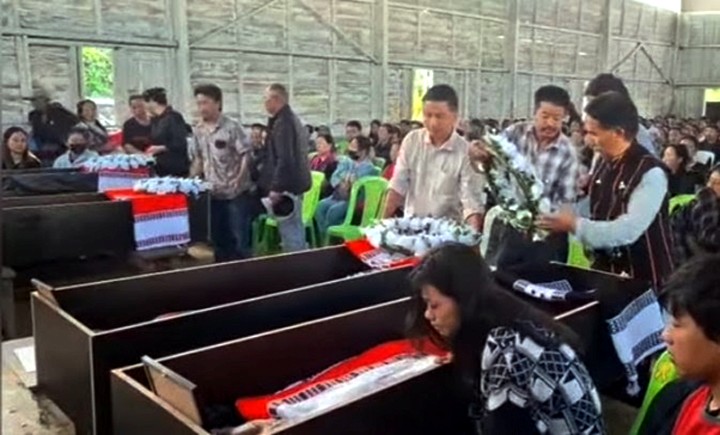
The killing of four Tangkhul Naga civilians at Pilong village in Kamjong district on September 24, 2026, allegedly by Myanmar-based Kuki National Army-Burma (KNA-B) militants, further intensified Naga concerns about cross-border armed activity. The Indian Express also reported that police attributed the attack to suspected KNA-B militants.
The United Naga Council (UNC) and other Naga organisations have repeatedly raised concerns about the security of Naga villages and the alleged activities of armed Kuki elements. Their objections are not merely about individual incidents. They concern the capacity of armed groups to move through vulnerable areas, threaten civilian settlements and operate across administrative and international boundaries without an effective deterrent.
The government’s delayed response is particularly difficult to understand because the Kuki-Naga violence had already become a serious security concern months before the November 3 meeting. The allegations against armed groups were not new, and the consequences of failing to address them were increasingly visible.
The October 19 attack near Nongsum Hills in Imphal East district provides another illustration. Three Meitei men were killed and three others injured when suspected Kuki militants allegedly opened fire on civilians who had gone to collect firewood in the Sunurok Uyok hills near Nongshum and Khongban Tangkhul, along the boundary with Kangpokpi district. The incident renewed fears of an escalation of violence after a period of relative calm.
There is, however, an important development in the immediate context of the Chief Minister’s announcement. Violence in October 2026 also claimed Kuki lives. Five Kuki men were killed in two incidents in Noney and Senapati districts towards the end of October, prompting protests and demands for action against the perpetrators. The police had not publicly identified those responsible for the two killings in Senapati.
This suggests that the November 3 announcement may have been prompted not merely by earlier complaints from Meitei and Naga organisations but also by the growing inability of the security establishment to contain violence involving multiple communities. The government is now confronting a situation in which armed confrontations, retaliatory actions and civilian casualties are undermining its claims of a return to normalcy.
Nevertheless, the timing raises a legitimate political question – would the government have issued this directive with the same urgency if the recent violence had not affected additional communities especially Kukis and generated renewed public pressure? The perception among sections of the public that the State responds more decisively when the security situation becomes politically or administratively costly is itself a reflection of the erosion of public confidence.
The SoO Arrangement and The Problem of Selective Accountability
The most consequential dimension of the Chief Minister’s instruction is its explicit exclusion of armed groups engaged in peace talks. In the Manipur context, this qualification inevitably draws attention to Kuki-Zomi militant groups operating under the SoO arrangement with the Government of India and the Government of Manipur.
The SoO arrangement is not an ordinary ceasefire between two sovereign parties. It is a negotiated security mechanism involving the Union and State governments and armed groups who never fight security forces. Its legitimacy depends on compliance with mutually agreed conditions. The arrangement cannot be allowed to become a protective umbrella under which armed groups or their cadres operate without accountability.
The September 2025 renegotiated agreement provides a useful benchmark. The Union government announced that the KNO and UPF had agreed to relocate seven designated camps away from vulnerable areas, reduce the number of camps, relocate weapons to nearby CRPF or BSF camps and undergo stricter physical verification. The Joint Monitoring Group was assigned responsibility for monitoring compliance, with violations to be dealt with firmly, including through a review of the agreement.
The obvious question is whether these conditions have been effectively implemented and whether the Joint Monitoring Group has investigated complaints of violations. Have weapons been properly verified and secured? Have designated camps been inspected regularly? Have cadres allegedly involved in civilian attacks been identified and questioned? Have the authorities examined whether some armed elements operate outside the effective control of their recognised leadership?
If these questions have not been adequately addressed, the November 3 announcement should be accompanied by a comprehensive review of the existing SoO mechanism rather than creating the impression that only armed groups outside the peace process warrant investigation.
There is also a distinction between the responsibility of an organisation and the criminal responsibility of its individual members. An organisation’s participation in peace negotiations cannot automatically establish its guilt in a particular attack. Equally, it cannot absolve the organisation or its members of responsibility when credible evidence points to their involvement.
The government must therefore avoid two opposite errors – collective attribution of criminal responsibility to an entire community and institutional protection of armed groups merely because they participate in peace talks.
This distinction is essential in Manipur, where the tendency to conflate ethnic identity with armed-group affiliation has contributed to deepening social divisions. Kuki-Zomi civilians cannot be held responsible for the actions of militant groups, just as Meitei or Naga civilians cannot be equated with armed groups operating in their names or geographical areas.
The rule of law must operate at the level of individuals and organisations for which evidence establishes responsibility, not at the level of ethnic communities.
The Larger Question of Managed Federalism and Constitutional Sovereignty
The November 3 meeting must also be examined against the broader institutional arrangements governing Manipur since May 2023. One of the recurring arguments advanced by sections of Manipur’s civil society is that the State has gradually lost effective control over its own security and territorial administration, with important decisions increasingly shaped by the Union Ministry of Home Affairs and the central security establishment.
The continued prominence of the Security Advisor, the Unified Command structure and central security agencies in determining security priorities has raised questions about the actual authority exercised by the elected State government. The presence of the Security Advisor, DGP, Indian Army’s 3 Corps commander, Assam Rifles, CRPF, BSF, SSB, ITBP and Intelligence Bureau representatives at the November 3 meeting demonstrates the extensive involvement of central security institutions in Manipur’s internal security management.
Their participation is understandable given the seriousness of the situation. However, it also raises a question about accountability. If the security agencies have been unable to prevent repeated attacks on civilians, who is responsible for explaining these failures? Is it the elected State government, the Unified Command, the central security establishment or the Union Home Ministry, which has exercised substantial influence over the security architecture?
The government cannot indefinitely distribute security responsibilities among multiple institutions while leaving the public uncertain about who is ultimately accountable for protecting civilians.
This is where the concept of managed federalism becomes relevant. Manipur’s security arrangements appear to have evolved into a system in which the State government retains formal constitutional responsibilities but operates within a security framework heavily influenced by central institutions. The November 3 meeting could therefore represent an attempt by the Khemchand government to reassert its authority. However, such an attempt will remain incomplete unless it addresses the institutional reasons behind the prolonged failure to control armed groups.
The Chief Minister must demonstrate that his government is not merely announcing a tougher policy but is capable of translating constitutional authority into effective action. If the State government is now prepared to identify armed groups and initiate action against them, it must also explain why the same determination was not demonstrated when similar allegations were repeatedly raised over the preceding years.
The Danger of Treating UAPA as A Political Warning
The invocation of the UAPA also requires careful consideration. The Act is a serious legal instrument intended to address unlawful activities and threats to the sovereignty, integrity and security of India. It should not be reduced to a rhetorical warning issued during a security meeting.
As already noted, the power to declare an association unlawful under Section 3 rests with the Central Government. The State Cabinet can recommend action and provide investigative findings, but the statutory declaration must follow the procedure prescribed by Parliament. The process requires specified grounds and is subject to the confirmation mechanism under the Act.
The government must therefore distinguish between three separate responsibilities – investigating criminal incidents, prosecuting individuals against whom sufficient evidence exists, and initiating the statutory process for declaring an organisation unlawful.
These are related but distinct processes. A group cannot be declared unlawful merely because its name appears in public allegations. Equally, the government cannot use the absence of a formal declaration as an excuse for failing to investigate criminal activities by its members.
There is a further danger of selective application. If the UAPA is invoked against armed groups outside the SoO framework while armed groups engaged in peace negotiations are effectively insulated from comparable scrutiny, the government will create an impression of politically determined law enforcement.
The credibility of the proposed action will depend on whether the same standards are applied to every armed organisation, irrespective of its ethnic affiliation, political influence or relationship with the government.
What The Government Must Do Beyond The Announcement
The November 3 directive should be converted into a time-bound and transparent programme of security accountability.
First, the government should commission a comprehensive investigation into major incidents of civilian killings, abductions, ambushes, arson and attacks on villages since May 3, 2023. The investigation should examine the alleged involvement of armed groups, including those operating under the SoO arrangement, without presuming guilt.
Second, the SoO ground rules must be effectively reviewed and enforced. The government should publish, to the extent permissible under security requirements, information about camp inspections, cadre verification, weapons monitoring and action taken against violations. The Joint Monitoring Group must be made answerable for the effectiveness of its monitoring.
Third, the government must investigate cross-border armed activities, particularly allegations concerning KNA-B and other Myanmar-based armed elements operating in the border areas. The security of Naga villages and other vulnerable settlements cannot be left to the initiative of local village volunteers or community-based security arrangements.
Fourth, investigations must be community-neutral. Allegations involving armed Meitei, Naga and Kuki-Zomi organisations must be examined according to the same evidentiary and legal standards. The killing of Meitei civilians near Nongsum Hills or Naga civilians in Pilong and other vulnerable villages deserves the same seriousness as the killing of Kuki civilians in Noney and Senapati.
Finally, the government must communicate its findings to the public. Security investigations may require confidentiality, but confidentiality cannot become a permanent justification for institutional silence. Families of victims deserve to know whether investigations have been conducted, whether suspects have been identified and whether prosecutions have been initiated.
From Security Announcements to The Restoration of Public Confidence
Ultimately, the November 3 security review will be judged not by the language employed by the Chief Minister but by the actions that follow.
The people of Manipur have witnessed numerous security reviews, assurances, peace initiatives and declarations of normalcy since May 2023. Yet the persistence of armed violence, continued displacement, fragmentation of communities and inability to guarantee safe movement across the State demonstrate that the underlying security crisis remains unresolved.
The government must understand that peace cannot be established through selective negotiations with armed organisations while the civilian population continues to live under the threat of violence. Nor can normalcy be restored merely by reopening highways for vehicles accompanied by security escorts, organising festivals, holding inaugurations and laying foundation stones, or announcing development programmes when people remain unable to travel between neighbouring districts.
The central question is whether the Khemchand government is prepared to confront the armed structures that have contributed to the fragmentation of Manipur, even when those structures are connected to political negotiations or enjoy the protection of an established security arrangement.
If the government is serious about protecting innocent civilians, it must investigate the allegations raised by COCOMI, UNC and other civil society organisations with equal seriousness. It must also investigate allegations against armed groups operating outside the SoO framework and ensure that no community is collectively blamed for the actions of particular militant groups.
The government’s responsibility is not to protect the political convenience of armed groups but to protect the constitutional rights and physical security of citizens.
The November 3 announcement could become an important turning point if it leads to impartial investigations, effective enforcement of SoO ground rules and prosecution of those responsible for civilian violence. But if the investigation is restricted to armed groups outside peace negotiations, while allegations against SoO-affiliated militant groups remain unexamined, it will reinforce the very perception that has undermined public confidence in the State – that Manipur’s security policy is governed less by the rule of law than by political accommodation and selective enforcement.
The people of Manipur are no longer asking for another security assurance. They are asking why the State has failed to protect them for more than three-and-a-half years and whether it has finally acquired the political will to act against all armed groups responsible for violence.
A government that cannot hold armed groups accountable, irrespective of their participation in peace negotiations, cannot convincingly claim to have restored constitutional sovereignty.

Senior Editor: Imphal Review of Arts and Politics