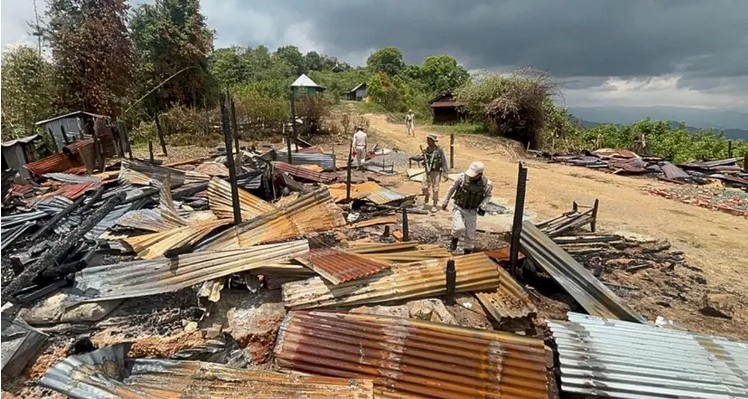
The violent rupture that engulfed Manipur on May 3, 2023 did not merely trigger an episode of violent conflict involving ethnic groups; it fundamentally reconfigured the architecture of governance in the state. What has emerged since then is not simply a weakened state government struggling to cope with crisis, but a qualitatively different political arrangement – one that increasingly resembles a system of managed federalism operating under the shadow of the Union Ministry of Home Affairs.
From the immediate aftermath of the violence to the present functioning of the government led by Yumnam Khemchand, the trajectory of political authority in Manipur reveals a consistent pattern – the formal structures of democratic governance remain intact, but their operational autonomy appears deeply circumscribed by central direction. The continuity across regimes – whether under Nongthombam Biren Singh, during President’s Rule, or under the present dispensation – suggests that the transformation has not been one of leadership alone, but of the underlying nature of federal power in the state.
The Structural Shift: Division of Authority and the Hill–Valley Security Regime
The events immediately following May 3, 2023 marked a decisive rupture in Manipur’s governance structure. The appointment of Kuldiep Singh who is a retired Indian Police Service (IPS) officer and former Director General of the Central Reserve Police Force (CRPF) as Security Advisor and Chairman of the Unified Command on May 4 effectively removed the Chief Minister from direct control of the state’s core security apparatus. This institutional shift was not merely administrative – it signalled the beginning of a reconfiguration of sovereignty within the state.
This transformation became clearer in June 2023, when an arrangement publicly articulated after a meeting between then Chief Minister N. Biren Singh and the Union Home Minister Amit Shah formalised a division of authority. Security in the hill districts, largely inhabited by Kuki-Zomi tribal populations, was placed under the effective purview of the Union Home Minister, while the Chief Minister was left to focus on maintaining law and order in the valley. This bifurcation was unprecedented in its explicitness, effectively creating parallel spheres of governance within the same state and undermining the principle of unified executive authority that underpins India’s federal system.
This arrangement institutionalised what was already emerging on the ground – a differentiated security regime reflecting deepening ethnic and territorial fragmentation.
In the valley, security evolved into a hybrid system involving state police, central forces, and local armed mobilisations. The distinction between formal and informal authority blurred considerably, as civil society groups, village volunteers, and armed formations assumed significant roles in maintaining local order. The state’s policing apparatus was not only overstretched but increasingly perceived through an ethnic lens, eroding its legitimacy.
In the hills, by contrast, the state’s presence became attenuated. Central security forces assumed a dominant role, while administrative access was often mediated through local armed groups and community organisations. Movement between the Kuki-Zomi dominated hills and the valley became severely restricted, effectively creating internal borders within the state. What emerged was a pattern of de facto “ethnic zones,” marked by territorial segregation and differentiated governance.
This dual security architecture did not merely reflect the conflict – it reinforced it. By operationalising distinct approaches to governance in the hills and the valley, the state implicitly acknowledged the fragmentation of its own authority. The idea of a unified territorial sovereignty gave way to a system of differentiated control, with the Union government playing a more direct role in areas where the state’s legitimacy was weakest.
At a deeper level, this shift underscores a more fundamental transformation – the state in Manipur has moved from shaping outcomes to managing a reality increasingly engineered through armed actions and community-based territorial control. Armed actors – both formal and informal – have become central to determining ground realities, while the state apparatus adapts reactively rather than directing events.
Political Crisis and the Path to President’s Rule
The erosion of executive authority quickly translated into political instability. As demands intensified from Kuki-Zomi groups for the removal of N. Biren Singh and imposition of President’s Rule – alongside calls for Separate Administration – internal dissent within the ruling establishment also grew. The possibility of a no-confidence motion created conditions ripe for a constitutional crisis.
The sequence of events that followed underscored the centrality of New Delhi in shaping political outcomes. Summoned by the Union Home Minister, N. Biren Singh travelled to Delhi and returned on February 9, 2025 accompanied by BJP national functionary Sambit Patra. From the airport, he along with Sambit Patra proceeded directly to the Raj Bhavan and tendered his resignation. The Assembly session scheduled to begin shortly thereafter was revoked, and President’s Rule was imposed on February 13, 2025.
While constitutionally valid, the manner in which this transition unfolded raises important questions about the locus of decision-making. The process did not appear to emerge organically from legislative dynamics within the state; rather, it bore clear signs of central orchestration.
President’s Rule: Centralisation Without Resolution
President’s Rule was expected to stabilise governance, restore administrative neutrality and resolve the Manipur crisis. However, while it consolidated central authority, it failed to address the structural crisis.
The underlying realities remained largely unchanged. Buffer zones persisted, ethnic divisions hardened, mobility remained restricted, and free movement along national highways continued to be totally disrupted. Tens of thousands of internally displaced persons remained in relief camps. The authority of the state continued to be uneven, particularly in hill districts where administrative presence remained limited.
In effect, President’s Rule deepened centralisation without reconstructing legitimacy. It reinforced dependence on central intervention while leaving unresolved the deeper fractures that continue to define the conflict.
The Return of Electoral Politics: Restoration or Compulsion?
The swearing-in of Yumnam Khemchand as Chief Minister on February 4, 2026 was widely seen as the restoration of democratic governance. Constitutionally, it marked the end of direct central rule. Politically, it signalled a return to normalcy.
Yet the functioning of the new government complicates this narrative. The ministry remains unusually small, with only five members in a sixty-member assembly (effectively fifty-eight due to two members passed away). This is a significant departure from the norm of up to twelve-member council of ministers for small states under the 91st Amendment of the Constitution of India.
The delay in portfolio allocation – finalised only on March 4, 2026 after consultations on March 2, 2026 involving the Governor Ajay Kumar Bhalla who came back from New Delhi after meeting Home Minister Amit Shah and other Union Ministers – and the continued absence of cabinet expansion point to deeper constraints. These are not routine administrative delays but indicators of a fragile and tightly managed political equilibrium.
More significantly, the composition of the ministry appears to reflect calibrated political engineering. The appointment of two Deputy Chief Ministers – Nemcha Kipgen whose husband is Chairman of Kuki National Front – KNF(P) which is one of the Kuki-Zomi militant groups under the Suspension of Operations (SoO) agreement with the Government of India (GOI) and Government of Manipur (GOM) and Losii Dikho – and the allocation of the Home portfolio to Govindas Konthoujam suggest balancing considerations shaped by actors beyond the state. Such decisions, traditionally within the Chief Minister’s prerogative, appear influenced by central calculations and other actors beyond the state.
The Persistent Shadow of the Centre
If the formation of the government hinted at the Centre’s choice, its functioning makes that influence more visible. The pattern of engagements between the Chief Minister and the Union Home Minister is particularly revealing.
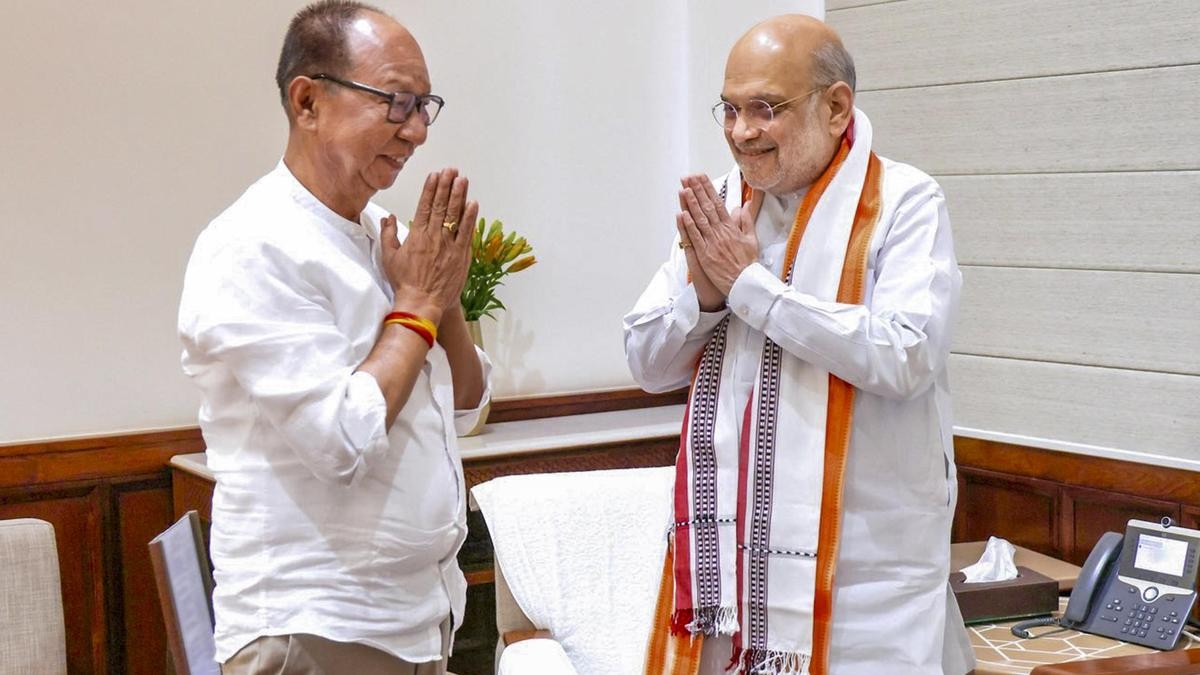
Within weeks of assuming office, Chief Minister Khemchand met the Union Home Minister first as a courtesy call in New Delhi to discuss peace and development initiatives, with the Centre assuring full support and directing priorities such as rehabilitation of internally displaced persons. Subsequent meetings have gone beyond consultation to direct oversight.
In March 2026, the Union Home Minister reviewed the security situation in Manipur and issued specific directives to the state government: to crack down on drug cartels which needs to be dealt as a national issue, recover looted weapons, and submit a detailed plan to the Ministry of Home Affairs. The meeting, attended by the Governor and senior officials, underscored the extent to which strategic decision-making remains anchored in New Delhi.
Even within nearly two months of the government’s formation, on April 1, 2026, the Union Home Minister instructed the Chief Minister to accelerate the peace process and approved the creation of an all-women police battalion, subject to a proposal from the state. These interactions reveal a pattern – the state government is not merely coordinating with the Centre; it is operating within a framework where key policy directions are set by the Union government.
The Governor as an Intermediary Node
The role of the Governor further embeds this structure. Since assuming office, Chief Minister Khemchand has repeatedly met Governor Ajay Kumar Bhalla, often immediately after returning from Delhi. The recurring pattern – Delhi meetings followed by immediate consultations at the Raj Bhavan – indicates a layered chain of coordination.
These interactions frequently involve discussions on security, administrative priorities, and cabinet expansion. The sequencing underscores a system in which the state executive is integrated into a centrally guided decision-making process.
In one instance, the Chief Minister rushed to Delhi following a summons by the Union Home Minister and, upon return, immediately briefed the Governor on the security situation and policy directions. This pattern reinforces the perception that the state’s executive authority is embedded within a broader structure of central oversight.
The Cabinet Question: Constraint as a Political Signal
The persistence of a five-member ministry is not merely an administrative anomaly; it is a reflection of structural constraint.
In a conflict-affected state, cabinet expansion is both necessary and politically risky. While expansion could enhance administrative capacity, it could also destabilise the fragile balance within the ruling establishment. Conversely, maintaining a small ministry reinforces perceptions of uncertainty and limited autonomy.
This tension reflects the broader reality – the Chief Minister’s ability to shape his executive team appears constrained by both internal political dynamics and external oversight.
Ethnic Polarisation and the Limits of Governance
The broader context of ethnic polarisation further complicates governance. The conflict has hardened territorial divisions, restricted mobility, and eroded trust in state institutions.
Moreover, emerging tensions between Tangkhul Nagas and Kuki groups in Ukhrul and Kamjong districts reveal that the conflict is evolving beyond its initial binary narrative. What began as a Meitei–Kuki confrontation is now expanding into a more complex and volatile configuration of competing territorial and political claims.
In such an environment, governance becomes a question of legitimacy. When state actions are perceived as influenced by external authority, this legitimacy is further weakened.
Managed Federalism: Concept and Reality
The developments in Manipur since May 2023 point to the emergence of what may be described as managed federalism. In this model, the formal structures of federal governance remain in place – there is an elected government, a functioning legislature, and a constitutional framework. However, the substantive autonomy of the state is constrained by sustained central intervention.
This is not direct rule in the conventional sense; it is more subtle and nuanced. Authority is exercised through a combination of institutional mechanisms (such as the role of the Governor and centrally appointed security officials), political processes (including the influence of national party leadership), and administrative oversight (through directives from the Ministry of Home Affairs).
In Manipur, this model has been shaped by the extraordinary circumstances of prolonged conflict. It reflects the interplay between conflict-driven fragmentation and the expansion of central authority. The breakdown of inter-community trust, unchecked activities of Kuki-Zomi militants, the presence of central security forces, and the fragility of state institutions have all created conditions in which central intervention appears both necessary and inevitable. Yet necessity does not negate consequence.
The Question of Autonomy
The central question remains whether the Government of Manipur currently exercises genuine executive autonomy.
The evidence suggests that autonomy is limited. Key domains – especially security and strategic policy – are heavily influenced by the Union government. Political decisions, including cabinet formation, appear shaped through consultations beyond the state, and administrative priorities are often externally directed from New Delhi.
The state government continues to function and play a crucial role in day-to-day governance, implementation of policies, and engagement with local communities. However, its capacity to independently shape outcomes is constrained.
Conclusion: Governance or Management?
Nearly three years after the violence of May 2023, Manipur finds itself in a paradoxical situation. The formal structures of democracy have been restored, yet the substance of federal autonomy remains uncertain. Although Article 355 of the Constitution mandates the Union to protect every State against external aggression and internal disturbance and to ensure that the Government of every State is carried on in accordance with provisions of this Constitution, the exercise of this responsibility in Manipur lacks transparency.
The government led by Yumnam Khemchand operates within a framework that reflects the characteristics of managed federalism – where authority is guided, shared, and often circumscribed by the Union government.
Such a system may offer short-term stability, but it raises deeper concerns about democratic accountability and long-term legitimacy. If the state government is perceived as an extension of central authority rather than an autonomous representative of the people, the process of rebuilding trust what the Chief Minister Yumnam Khemchand strives for becomes even more difficult.
Manipur today stands at a critical juncture. The challenge is not only to restore peace and rebuild institutions but to re-establish the principle of self-governance that lies at the heart of India’s federal system. The question that now confronts Manipur is not simply whether peace can be restored, but whether genuine federal autonomy can be rebuilt.
Until that happens, the central question will persist – Manipur may have an elected government, but it is no longer fully governing itself – it is managing a conflict within the constraints of a centrally directed federal order. The state will continue to function within the architecture of managed federalism – where governance exists, but sovereignty remains qualified.

Senior Editor: Imphal Review of Arts and Politics