The coordinated attacks on Choro, Namlee, and Wanglee villages along the Indo–Myanmar border in Manipur’s Kamjong district on May 7, 2026 are not isolated episodes of localised violence. They represent the continuing transformation of Manipur’s post-May 3, 2023 crisis into a wider project of territorial reconfiguration operating simultaneously across ethnic, political, military, and transnational dimensions. The attacks, allegedly carried out by cadres linked to the Kuki National Army-Burma (KNA-B) and the Myanmar’s People’s Defence Force (PDF), underline the increasingly cross-border nature of armed mobilisation in the region and expose the inability – or unwillingness – of the Indian state to address the deeper strategic logic driving the violence.
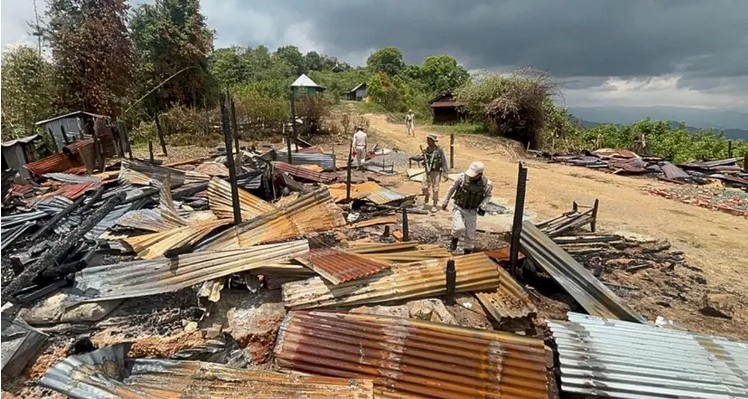
Reports emerging from Kamjong district indicate that the attacks began around 3:30 to 4:00 in the morning, targeting Tangkhul Naga villages located near the Indo–Myanmar border. Houses were torched, villagers were fired upon, civilians fled into forests, and allegations emerged of abductions, looting, drone-assisted attacks, and the use of sophisticated weapons including grenade-launching systems. Tangkhul Naga organisations described the incident not as an ethnic clash but as “external aggression” originating from across the international border. The local MLA Leishiyo Keishing also publicly characterised the attacks as cross-border aggression involving Myanmar-based armed actors.
The timing of the attacks has also raised serious questions regarding their larger political and strategic intent. Significantly, the coordinated assault on the Tangkhul Naga villages came on the very day when the Deputy Commissioner of Kamjong district had convened a public coordination meeting on peace and development involving various stakeholders of the district. According to the official meeting notice issued on May 5, 2026, the meeting scheduled for May 7 at the District Mini Secretariat in Kamjong was intended to facilitate coordination and liaison among different organisations and community representatives in the interest of peace and development. The invitees included Tangkhul Naga civil society bodies, Kuki organisations, student bodies, security officials, and administrative authorities. However, following the attacks on Choro, Namlee, and Wanglee villages in the early hours of May 7, the meeting itself had to be cancelled due to the deteriorating security situation. The coincidence between a proposed peace coordination initiative and the subsequent armed attacks has intensified suspicions among local communities that forces opposed to any stabilisation of the region or restoration of inter-community coordination sought to deliberately disrupt emerging possibilities of dialogue, coexistence, and administrative normalisation in the sensitive border district.
Importantly, this narrative of “external aggression” did not emerge only after the Kamjong attacks. Since the eruption of the violent conflict in Manipur on May 3, 2023, several civil society organisations, political leaders, intellectuals, security observers, and experts have increasingly argued that the crisis cannot be reduced merely to an internal ethnic conflict between communities within Manipur. Organisations such as the Coordinating Committee on Manipur Integrity (COCOMI) have repeatedly asserted that armed mobilisation involving Kuki-Zomi militant groups operating from Myanmar and Myanmar origin individuals heading Kuki-Zomi militant groups in Manipur under the Suspension of Operations (SoO) agreement with the Government of India and the Government of Manipur, large-scale cross-border movement, and the strategic use of the porous Indo–Myanmar frontier constitute one of the central dimensions of the ongoing crisis. The repeated allegations regarding infiltration, armed camps, narco-linked routes, and cross-border militant mobility have steadily strengthened the perception among many in Manipur that the violence possesses a significant transnational component. The Kamjong attacks have now brought this narrative into even sharper focus.
This distinction is politically significant. Since the eruption of violence against Meiteis by Kuki-Zomi groups on May 3, 2023 in Churachandpur, the dominant official narrative of the Government of India has consistently framed the crisis as an “ethnic conflict” between communities within Manipur. However, incidents such as the Kamjong attacks increasingly challenge that framework. When armed cadres allegedly cross an international border, conduct coordinated assaults on Indian villages, burn civilian homes, and retreat back into Myanmar, the issue ceases to remain merely communal. It enters the domain of sovereignty, border security, territorial control, and transnational armed politics.
The significance of the Kamjong attacks becomes clearer when situated within the broader trajectory of developments since May 2023. The violent conflict initially produced a large-scale demographic and territorial separation between Meiteis and Kuki-Zomis. Meiteis were effectively driven out of Kuki-Zomi dominated hill areas, while Kukis were displaced from Meitei-dominated valley areas. Yet what emerged afterward was not simply segregation but consolidation. In many hill areas, the forced disappearance of Meitei presence enabled the emergence of de facto Kuki-Zomi territorial control over large stretches of land and administrative spaces.
This process has increasingly aligned with the political imagination of a separate Kuki homeland variously called Zalengam, Kukiland, or Zoland. Though articulated differently by different organisations, the underlying territorial aspiration remains consistent: the creation of an integrated Kuki political homeland transcending existing state and international boundaries, incorporating Kuki-Zomi-inhabited areas across Manipur, adjoining regions, and parts of western Myanmar. The geographical logic of this imagination inherently requires territorial continuity, ethnic consolidation, and the weakening or removal of competing ethnic claims over contested hill regions.
Within this framework, the violence against Meiteis after May 2023 was not merely reactive communal retaliation. It also functioned strategically to establish exclusive territorial dominance in Kuki-Zomi-majority hill areas. Once that phase largely succeeded through the displacement of Meiteis from those regions, new tensions began emerging between Kuki-Zomi groups and Naga communities inhabiting strategically significant border zones.
The recent confrontations involving Liangmai Nagas, Inpuis, and Tangkhul Nagas must therefore be understood within this changing territorial context. The violence in areas such as Litan, Sanakeithel (Sinakeithei), and surrounding regions points toward expanding faultlines where Naga villages and settlements increasingly appear as obstacles to territorial consolidation. The February 7, 2026 Litan incident, subsequent displacement of Tangkhul Nagas, and the burning down of houses were not random episodes of lawlessness. They indicated intensifying contestation over control, presence, routes, and influence in key hill regions connecting Kangpokpi district, Ukhrul, Kamjong, and the Indo–Myanmar frontier.
The attacks on Tangkhul Naga villages in Kamjong fit precisely into this evolving pattern. The affected villages are not merely remote settlements; they occupy strategically sensitive positions along the international border. Control over such areas carries implications not only for local influence but also for cross-border mobility, refugee management, supply routes, insurgent movement, India’s counter-insurgency operations, and future territorial claims. Border villages become crucial nodes in any attempt to establish wider geopolitical depth for an ethnic homeland project operating across India and Myanmar.
The allegations surrounding Myanmar-based Kuki armed groups further reinforce this interpretation. Since Myanmar’s post-coup instability intensified after 2021, the Indo–Myanmar border has become increasingly porous. Armed actors, refugees, ethnic militias, and anti-junta forces have moved across the frontier with growing fluidity. And India does not oppose PDF. The PDF and KNA-B fight against the Manipur insurgents inside Myanmar. In this environment, the distinction between local insurgency, refugee flows, ethnic militancy, and transnational armed mobilisation has blurred significantly.
The Kamjong attacks reportedly involved KNA-B cadres allegedly supported by elements associated with the PDF. Although KNA-B later denied involvement and rejected reports linking it to the attacks, villagers and local eyewitnesses consistently pointed their fingers toward KNA-B cadres operating from the Myanmar side of the border. Eyewitness accounts reportedly stated that the attackers entered from multiple directions from Myanmar, spoke in Kuki language during the operation, and retreated back across the border after facing resistance. Blood stains discovered along the retreat routes reportedly reinforced local claims that some attackers were injured during the exchange of fire.
Adding another layer to the controversy, a Kuki-Zomi armed organisation called the Village Volunteers Eastern Zone (VVEF) subsequently claimed responsibility for the attacks on Namlee, Wanglee Market, and Choro villages, describing them as retaliatory operations against the NSCN Eastern Flank and its alleged allies. However, many local observers believe that though the attacks were operationally carried out by KNA-B cadres and associated armed elements from Myanmar, responsibility was strategically allowed to be publicly assumed by the VVEF in order to politically diffuse direct scrutiny regarding cross-border militant involvement. Such perceptions have further deepened suspicion among local communities that organised militant coordination across the Indo–Myanmar frontier is playing a far greater role in the evolving violence than officially acknowledged.
Whether every operational detail can be independently verified or not, the broader perception among Tangkhul Naga organisations and local residents is itself politically consequential. The widespread belief that Myanmar-based Kuki armed groups can enter Indian Territory, attack villages, and retreat with relative ease has deepened insecurity among border communities and intensified suspicion regarding the state’s security architecture.
Equally significant are the repeated allegations directed against the Assam Rifles and other Indian Security Forces. Multiple reports cited local anger over the absence of intervention despite nearby security deployments. Some villagers even alleged suspicious movements and prior surveys by security personnel before the attacks occurred. The NSCN (IM) had earlier accused Indian security forces of facilitating illegal immigration and indirectly helping Kuki militant groups. Whether these allegations are substantiated or not, their persistence reveals a profound collapse of trust between local communities and state security institutions.
This erosion of trust has major implications. In conflict zones, perception often becomes politically more consequential than official explanations. When local populations begin believing that security forces are either selectively inactive or strategically permissive toward particular armed actors, the legitimacy of the state itself becomes deeply compromised. In Manipur, this crisis of legitimacy has steadily intensified since May 2023.
The Central Government’s prolonged reliance on the SoO framework with Kuki-Zomi armed groups has also contributed to these perceptions. Originally stated as a mechanism for conflict management and ceasefire regulation, the SoO arrangement increasingly appears incapable of preventing armed mobilisation, territorial assertion, or militarised intimidation. Critics argue that armed cadres continue to retain organisational structures, mobility networks, and territorial influence despite formal ceasefire arrangements.
The Kamjong attacks therefore raise difficult questions about the practical consequences of these arrangements. If armed groups or their associated networks can allegedly participate in cross-border operations while operating within a broader political ecosystem shaped by ceasefire protections and fragmented enforcement, then the state’s entire conflict management model stands exposed as structurally weak.
The broader strategic danger lies in the gradual normalisation of parallel sovereignties. Since May 2023, large parts of Manipur have increasingly operated under fragmented territorial authority. Movement restrictions, ethnic checkpoints, armed volunteers, displaced populations, segregated administrations, and community-based security arrangements have transformed the state into a patchwork of competing ethnic zones. The Kamjong attacks demonstrate how this fragmentation is now extending into the international frontier itself.
The danger is not merely continued violence but the emergence of hardened territorial realities that may eventually outlast formal political settlements. Once communities are displaced, rival populations removed, and armed control consolidated, facts on the ground begin shaping future negotiations. Ethnic geography becomes militarised geography.
For the Tangkhul Nagas and other Naga groups, this creates growing anxiety regarding long-term demographic and territorial security. Naga organisations increasingly interpret recent attacks as part of a wider attempt to expand Kuki-Zomi dominance into mixed or strategically important Naga areas. This explains the increasingly strong language used by Tangkhul civil society bodies describing the incidents as external aggression and questioning the role of security agencies.
The demographic implications of the Kamjong attacks have become particularly sensitive. Reports indicate that after many original Tangkhul Naga residents fled from the affected villages due to the attacks and continuing insecurity, Kuki-Zomi refugees from Myanmar continue to occupy parts of the affected areas in Kamjong district. This has intensified fears among sections of the local population that violence, displacement, refugee settlement, and territorial transformation are becoming interconnected processes reshaping the demographic realities of the Indo–Myanmar frontier. For many observers, the issue is no longer confined merely to immediate security concerns but extends to long-term questions of territorial ownership, political control, and demographic re-engineering in strategically important border zones.
The emerging Kuki-Naga tensions also carry historical resonance. The memories of the devastating Kuki-Naga clashes of the 1990s remain deeply embedded within collective consciousness. That conflict left thousands displaced and created enduring distrust between communities. The current tensions risk reopening those historical wounds under far more complex geopolitical conditions shaped by the Myanmar crisis, cross-border insurgent mobility, and Manipur’s ongoing ethnic partition.
Another important dimension is the humanitarian transformation of border regions. The influx of refugees and undocumented migrants from Myanmar into Kamjong and adjoining districts has altered local demographic realities. Reports cited thousands entering the district since 2021 mostly late 2023, with refugee settlements established in villages including those later attacked. While humanitarian assistance remains necessary, the politicisation of refugee presence has intensified ethnic anxieties and security concerns. Border communities increasingly perceive demographic change as intertwined with armed mobilisation and territorial competition.
This convergence of refugee flows, insurgent networks, and ethnic territorial politics creates a volatile frontier environment. The Kamjong attacks reveal how quickly humanitarian spaces can become militarised spaces when governance structures weaken and competing nationalisms operate across porous borders.
The Government of India now faces a strategic dilemma it has thus far avoided confronting directly. It can no longer indefinitely describe every development in Manipur simply as ethnic violence disconnected from wider geopolitical realities. The allegations emerging from Kamjong point toward the growing regionalisation of the conflict involving cross-border armed actors, refugee flows, competing insurgent networks, and contested territorial aspirations extending beyond India’s borders.
The official reluctance to acknowledge these dimensions may partly stem from fears that doing so would internationalise the Manipur crisis and expose failures in border management. Yet denial carries its own dangers. As long as the underlying territorial and geopolitical drivers remain unaddressed, incidents like Kamjong are likely to recur with increasing intensity.
Equally troubling is the absence of a coherent political roadmap. The prolonged continuation of violence without meaningful political resolution has allowed armed logics to dominate civilian realities. Communities increasingly rely on ethnic militias, village guards, and informal armed structures because confidence in state protection has eroded. This militarisation of society further deepens segregation and fuels retaliatory cycles.
The Kamjong attacks therefore symbolise more than another violent episode. They expose the transition of Manipur’s crisis into a multi-layered conflict involving ethnic nationalism, transnational insurgency, demographic transformation, narcotic routes, border insecurity, and collapsing state legitimacy. The conflict is no longer confined to loosely described valley-versus-hill antagonism. It is reordering relationships among multiple communities while reshaping territorial power across the Indo–Myanmar frontier.
The situation also reveals the dangerous consequences of allowing unresolved conflicts to harden into territorial projects. Once violence begins serving strategic demographic objectives, civilian displacement itself becomes politically functional. Burned villages, emptied settlements, and fleeing populations are no longer accidental by-products of conflict but mechanisms through which new territorial realities are produced.
This is why the attacks on Tangkhul villages cannot be dismissed merely as sporadic border disturbances. They reflect the continuing evolution of a larger territorial struggle unfolding under the shadow of state paralysis. The repeated targeting of areas inhabited by Nagas after the consolidation of Kuki-Zomi dominance in former mixed zones increasingly reinforces fears that the geography of conflict is expanding according to strategic calculations rather than isolated local disputes.
At the same time, simplistic binaries must also be avoided. The region’s conflicts involve multiple armed actors, competing nationalisms, historical grievances, and overlapping territorial claims. However, acknowledging complexity cannot become an excuse for refusing to identify emerging patterns. The pattern visible since May 2023 increasingly points toward an organised reconfiguration of territorial power under conditions of prolonged instability.
The Indian state’s challenge is therefore not only restoring law and order but reasserting credible sovereignty. Sovereignty is not merely the presence of troops or security camps; it is the capacity to protect civilians impartially, control borders effectively, and prevent armed groups from determining territorial outcomes through violence. In Manipur today, that capacity is under severe strain.
If incidents like the Kamjong attacks continue without decisive political and security responses, the long-term consequences may extend far beyond Manipur itself. The Indo–Myanmar frontier could increasingly evolve into a zone where ethnic insurgencies, refugee crises, and transnational armed networks intersect in destabilising ways. Such a scenario would carry implications not only for Manipur but for India’s broader Northeastern security architecture.
Ultimately, the attacks on Choro, Namlee, and Wanglee villages reveal that Manipur’s violence is no longer episodic. It has become structural, territorial, and transnational. The conflict is steadily reshaping ethnic geography, political authority, and security realities across the region. Unless the deeper drivers of territorial reconfiguration, armed consolidation, and cross-border mobilisation are confronted honestly, the frontier violence witnessed in Kamjong may represent not an exception but a preview of the conflicts yet to come.

Senior Editor: Imphal Review of Arts and Politics