The continuing violence in Manipur since May 3, 2023 has entered a qualitatively different phase. What initially appeared as a catastrophic breakdown of inter-community relations between Meiteis and Kuki-Zomi groups has, over time, evolved into a prolonged and spatially structured conflict marked by territorial consolidation, restricted mobility, and competing political endgames. The more recent developments in Litan, Sanakeithel (Sinakeithei), Shangkai/Sharkaphung, Sikibung, and other adjoining villages in Ukhrul and Kamjong districts, and Zaimeng besides Konsakhul (Konsaram), Ireng, K. Lungwiram in Kangpokpi district adjoining Imphal West district suggest not merely episodic violence, but a deeper process of territorial reconfiguration. At the heart of this transformation lies a critical question: how should one interpret the response of the State – both the Government of India (GOI) and the Government of Manipur (GOM)? Is the State complicit, constrained, strategically ambivalent, or merely performative in its actions?
These questions assume urgency because the violence is no longer random. It appears patterned, directional, and politically consequential.
Territorial Engineering
The displacement of Meiteis from hill districts and their effective confinement within the Imphal Valley marked the first phase of the conflict. Over nearly three years, this spatial segregation has hardened into a de facto territorial order. National Highways – particularly NH-2 and NH-37 – have been effectively inaccessible for Meiteis, just as the Imphal-Ukhrul Road (NH-202) has become unsafe and unreliable for Tangkhuls. This mutual exclusion has not emerged spontaneously; it reflects a systematic erosion of shared spaces and the collapse of interdependence that once underpinned Manipur’s fragile social equilibrium.
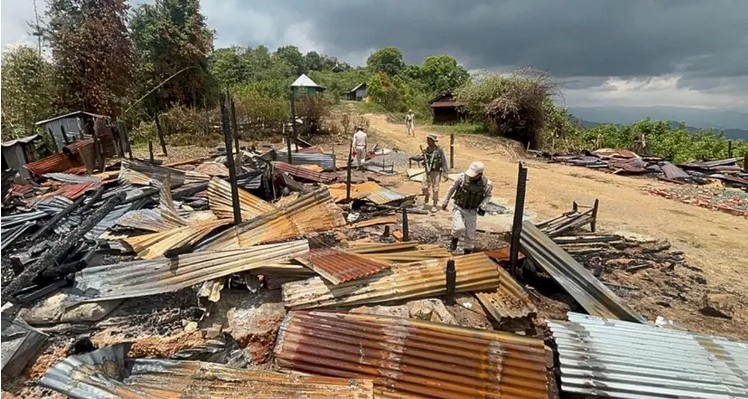
Recent incidents in in Litan, Sanakeithel (Sinakeithei), Shangkai/Sharkaphung, Sikibung, and other adjoining villages in Ukhrul and Kamjong districts, and Zaimeng in Kangpokpi district indicate that the conflict is expanding beyond the initial Meitei-Kuki binary into zones inhabited by Tangkhul and Liangmai who are categorised as Naga tribes. Allegations that Kuki militants are attempting to push out these communities to create contiguous territory introduce a decisive shift in the nature of the conflict. It is no longer confined to cycles of retaliation or defensive positioning; it is increasingly about spatial continuity and territorial consolidation. Such continuity is politically significant because it aligns directly with the demand for a Separate Administration by Kuki-Zomi groups. Territory, in this sense, is not merely geographic – it becomes the foundation upon which political claims are legitimised and negotiated.
The SoO Framework and Its Contradictions
A central element complicating the State’s response is the Suspension of Operations (SoO) agreement between the GOI, GOM and 25l Kuki-Zomi militant groups represented by the Kuki National Organisation (KNO) and the United People’s Front (UPF). The SoO framework was originally conceived as a confidence-building measure, allowing militant groups to remain in designated camps under a SoO arrangement while peace talks continued. However, the present situation exposes the deep contradictions embedded in this framework.
The persistence of armed attacks – reportedly involving drone-based explosives, rocket fire, machine guns, mortars, and coordinated assaults – raises serious questions about the enforcement of SoO obligations. If groups under SoO are engaging in hostilities, it indicates either a breakdown of monitoring mechanisms or a pattern of selective enforcement. The geographical spread of violence further suggests that militant groups retain operational mobility beyond designated camps, undermining the credibility of the SoO regime as an instrument of de-escalation. More importantly, the political context has fundamentally shifted. What was once an insurgency-management tool now operates within an active and expanding violent conflict dragging ethnic groups in where the incentives for territorial control are significantly higher. In such a scenario, the continued reliance on an unrecalibrated SoO framework appears increasingly untenable.
Security Operations: Containment or Optics?
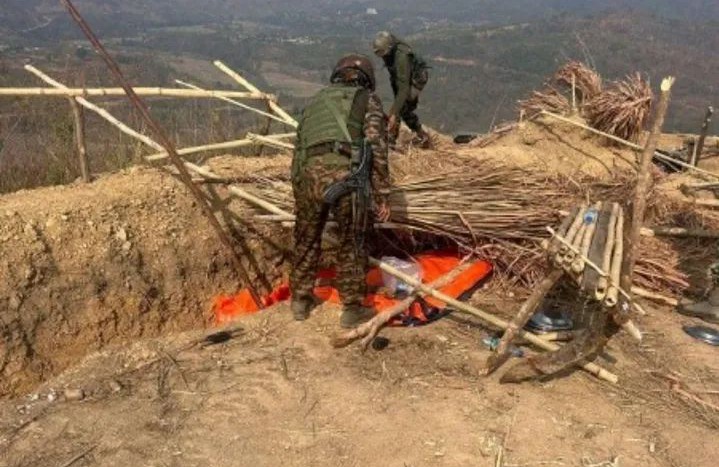
The demolition of 61 illegal bunkers from March 25 to 27, 2026 in Ukhrul and Kamjong districts represents one of the most visible recent actions by security forces. Conducted jointly by the Indian Army, Manipur Police, and Central Armed Police Forces (CAPF), these operations have been projected as evidence of the State’s commitment to restoring order. At one level, such actions are undeniably significant. The dismantling of fortified positions disrupts tactical advantages, signals intent, and may contribute to a temporary reduction in firing incidents.
However, the broader picture remains deeply ambiguous. Even as bunkers were being dismantled in Ukhrul and Kamjong, armed attacks continued elsewhere, including the firing on an Army post in Phougakchao Awang Leikai in Bishnupur district bordering Churachandpur. This simultaneity raises critical questions about the coherence and sustainability of the State’s strategy. Are these operations part of a long-term, coordinated campaign to dismantle militant infrastructure, or are they symbolic and episodic actions designed to project an image of control?
Equally significant is the framing of bunker demolition as affecting “both sides.” While this may be factually accurate in a narrow operational sense, it introduces a problematic equivalence in a politically charged environment. Such symmetry risks obscuring asymmetries in intent, strategy, and territorial objectives. In conflict situations, perception often outweighs operational detail. If communities perceive the State as neutral in contexts where they expect protection, that neutrality can be interpreted as abdication or even tacit complicity.
The Expansion into Naga Areas: A New Faultline
The expansion of tensions into areas inhabited by Tangkhul and Liangmai communities marks a potentially dangerous new phase opening new faultlines. The imposition of an economic embargo by Zingsho Katamnao Long (ZKL) against Kuki residents of Chassad village, followed by counter-threats from Kuki organisations, signals the emergence of a new axis of conflict. This development also effectively dismantles the narrative that the violence is confined to a Meitei-Kuki binary. Instead, it points toward a broader contest over territory, authority, and future political arrangements in the state.
For the State, this shift presents a profound strategic challenge. The entry of Naga groups into the conflict matrix risks transforming an already volatile situation into a multi-sided conflict, exponentially increasing the difficulty of resolution. Yet, the State’s response to these emerging tensions has remained largely reactive. There is little evidence of sustained mediation, preventive diplomacy, or institutional mechanisms capable of de-escalating inter-community tensions before they harden into conflict.
Law Enforcement and Selective Effectiveness
The State’s law enforcement actions, including arrests in connection with the Tuibong violence and the deployment of combined forces following armed attacks, demonstrate that the capacity for coercive action still exists. However, these actions appear episodic and symbolic rather than systemic. Residents’ allegations that security forces are present but ineffective highlight a deeper structural issue – the gap between deployment and enforcement. The presence of forces alone does not ensure deterrence if their operational mandates are constrained or unclear.
This raises a critical question: are security forces operating under restrictive rules of engagement that limit their ability to act decisively against SoO-bound groups or other Kuki-Zomi armed actors? If so, the State may be prioritising the preservation of SoO arrangements over immediate security imperatives. While such a trade-off may be rational within a negotiation framework, it carries significant risks. It can create zones of impunity where armed groups operate with relative freedom, eroding public confidence in the State and normalising a parallel order of authority.
Complicity, Constraint, or Strategic Ambiguity?
The perception of State complicity in the activities of Kuki-Zomi militants is shaped by several observable factors: the continuation of the SoO despite apparent violations, limited visible action against groups accused of aggression, the persistence of territorial changes on the ground, inconsistent security responses across regions, and what is widely perceived as an asymmetric approach to security between the hills and the valley. However, attributing outright complicity risks oversimplifying a far more complex and constrained policy environment.
An alternative reading suggests that the State is operating within a framework of strategic ambiguity shaped by competing imperatives. These include the need to sustain engagement with militant groups under the SoO, the risk of triggering wider escalation if SoO arrangements collapse, the political sensitivities surrounding competing ethnic demands, and the logistical challenges of conducting operations in difficult terrain. From this perspective, the State’s reluctance to act decisively may reflect an attempt to keep Kuki-Zomi armed groups within a negotiable framework.
Yet, strategic ambiguity is not without cost. In the absence of clear enforcement and visible accountability, it can be interpreted as weakness, bias, or even tacit endorsement. Over time, this perception can embolden armed actors, enabling them to shape realities on the ground faster than the State can respond.
The Politics of Separate Administration
The demand for a Separate Administration by Kuki-Zomi groups provides the political context within which these dynamics unfold. Territorial consolidation, if achieved, strengthens the plausibility and bargaining power of this demand by creating facts on the ground. The State’s response to this demand has been marked by caution and non-committal positioning. There has been neither formal acceptance nor a decisive rejection accompanied by a credible alternative framework. This ambiguity creates a political vacuum – one that armed actors are increasingly filling through territorial control and demographic engineering.
If such reconfiguration continues unchecked, the State risks being pushed into a reactive posture where political decisions are shaped by ground realities rather than by deliberate policy design. In such a scenario, governance becomes an exercise in accommodation rather than authority.
Federalism Under Strain
The crisis also places Indian federalism under significant strain. The apparent inability of the Government of Manipur to exercise full control over the situation, combined with the dominant role of the Government of India in security operations, suggests a dilution of state autonomy. At the same time, the reliance on a hybrid structure involving central forces, state police with a Security Advisor appointed on May 4, 2023 immediately after the eruption of violent conflict on May 3, 2023 creates a fragmented chain of command. This duality – centralized authority coexisting with decentralized execution – can produce gaps in coordination, accountability, and effectiveness.
Optics Versus Outcomes
A recurring feature of the State’s response is the tension between optics and outcomes. Operations such as bunker demolitions, arrests, and official statements serve important symbolic purposes. They signal intent, demonstrate activity, and seek to reassure various constituencies. However, the persistence of violence, the expansion of conflict zones, and the continued restriction of mobility indicate that these measures have not fundamentally altered the underlying dynamics.
For affected communities, the measure of success is not the number of operations conducted or bunkers dismantled. It is the return of Internally Displaced Persons (IDPs) to their homes, the restoration of safe and secure movement across districts and National Highways, and the re-establishment of normal life. By these metrics, the State’s performance remains deeply inadequate and, in many respects, indistinguishable from inaction.
Conclusion: A State at a Crossroads
The ongoing crisis in Manipur is no longer a conventional law-and-order problem. It represents a complex interplay of insurgency management, ethnic contestation, territorial control, and competing visions of political order. The State’s response reflects this complexity. It is neither wholly complicit nor decisively effective. Instead, it is characterized by a pattern of constraint, caution, selective intervention, and strategic ambiguity.
Yet, the trajectory of events suggests that this approach may not be sustainable. If territorial reconfiguration continues, if mobility remains restricted, and if new faultlines continue to emerge, the State risks losing not only operational control but also its legitimacy as a neutral and authoritative arbiter.
The central challenge, therefore, is not merely to manage violence but to reassert the State’s capacity to shape outcomes. This requires moving beyond reactive and symbolic measures toward a coherent strategy that integrates calibrated security action, credible political dialogue, institutional clarity, and enforceable accountability.
Without such a shift, the debate over whether the State is complicit or constrained may ultimately become irrelevant. The more consequential question will be whether the State still retains the capacity to shape outcomes in Manipur – or whether it has already been reduced to responding to a reality being systematically created through armed actions on the ground.

Senior Editor: Imphal Review of Arts and Politics