Civilizational Ethos, Ethical Leadership, and Inner Awakening. Rāma, the Rāmāyaṇa, and Their Urgent Relevance in the 21st Century—With Reflections on the USA–Iran Tensions through the Lens of Indian Knowledge Systems
“Rāma is the very embodiment of Dharma/righteousness.”
This assertion is not merely theological—it is philosophical, ethical, and profoundly political. For if Rāma is Dharma incarnate, then his life offers a normative framework for leadership, governance, and conflict resolution in any age, including our own.
The Timeless Invocation: When a Name Becomes a Nation’s Conscience
In the vast civilizational expanse of India, certain names are not merely uttered—they are experienced. They resonate across centuries, permeating philosophy, politics, art, and everyday life. Among them, the name Śrī Rāma stands as a luminous axis around which the moral imagination of Bhārata revolves.
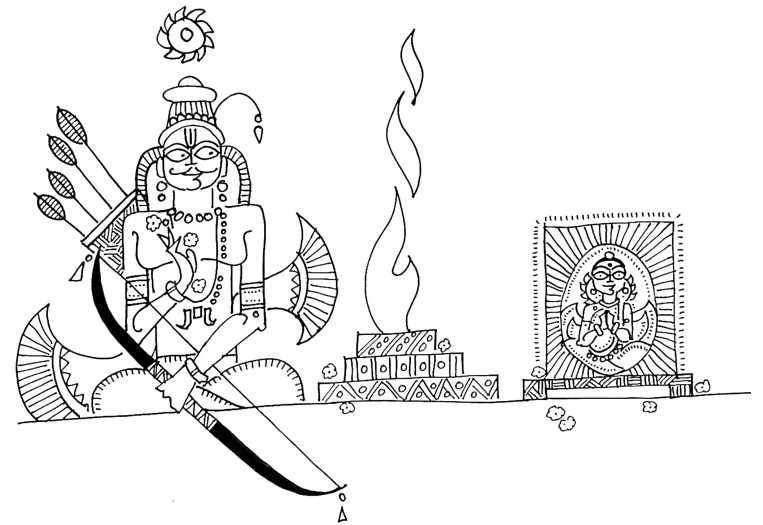
Rāma is not confined to temple sanctums or epic narratives; he is embedded in the ethical DNA of Indian society. From village lullabies to classical literature, from performative traditions like Rāmlīlā to contemporary public discourse, Rāma remains a living presence—a moral archetype continually invoked in times of both celebration and crisis.
The ancient declaration from the Vālmīki Rāmāyaṇa succinctly captures this enduring essence: Rāmo vigrahavān dharmaḥ (Rāma is Dharma/righteousness personified)
This profound assertion is not theological hyperbole; it is a civilizational truth. Rāma represents the embodiment of Dharma—that intricate, multi-layered concept encompassing duty, righteousness, justice, and cosmic harmony.
As India commemorates Rāma Navamī, the birth anniversary of Lord Rāma, the occasion invites not merely ritual observance, but national reflection: What does Rāma mean to contemporary India? And how can his ideals illuminate the path forward in an age marked by rapid transformation and ethical ambiguity?
Rāma Navamī: Festival, Faith, and the Renewal of Ethical Consciousness
Observed on the Navamī tithi of the bright fortnight of Chaitra, Rāma Navamī marks the culmination of Vasanta Navarātri and commemorates the divine birth of Rāma in Ayodhyā. Across the country—from the sacred ghats of Varanasi to the temples of South India, from urban centers to rural hamlets—the festival is celebrated with profound devotion and cultural vibrancy.
Devotees engage in fasting, recitation of sacred texts such as the Rāmāyaṇa and Rāmacaritamānasa, and participation in processions and community gatherings. Temples reverberate with bhajans, while households prepare traditional offerings like panakam and kosambari, symbolizing simplicity, purity, and the sāttvic ethos of Indian spirituality.
One of the most evocative rituals involves placing the image of infant Rāma in a cradle, gently rocking it while singing devotional hymns. This act is not merely symbolic; it reflects the intimate relationship between the devotee and the divine—a relationship characterized by love, Shraddha/ faith, and bhaav/ feeling.
Yet, to reduce Rāma Navamī to a series of rituals would be to overlook its deeper significance. At its core, the festival represents a renewal of ethical consciousness—a reminder that Dharma must be continually re-established, both within the individual and within society.
The Birth of Rāma: Myth, History, and Metaphysical Meaning
The narrative of Rāma’s birth, as detailed in the Bāla Kāṇḍa of the Vālmīki Rāmāyaṇa, begins with King Daśaratha’s yearning for an heir. The performance of the Putrakāmeṣṭi Yajña, the divine emergence of celestial nectar, and the subsequent birth of Rāma and his brothers form a story that is at once mythological and deeply symbolic.
From a philosophical perspective, Rāma’s birth represents the descent of the divine into the human realm—an avatāra undertaken to restore cosmic balance. This concept finds resonance in the Bhagavad Gītā: The Bhagavad Gītā (4.8) offers a cosmic articulation of this periodic renewal:
Paritrāṇāya Sādhūnāṁ Vināśhāya Cha Duṣhkṛitām; Dharma-Sansthāpanārthāya Sambhavāmi Yuge Yuge
To protect the righteous, to annihilate the wicked, and to reestablish the principles of dharma I manifest on this earth, age after age.
The idea that the divine manifests in times of moral crisis underscores a fundamental tenet of Indian thought: the universe is morally structured, and Dharma, though challenged, ultimately prevails.
Maryādā Puruṣottama: The Ethics of Restraint in an Age of Excess
Rāma’s enduring relevance lies not only in his divine origin, but in his human conduct. He is revered as Maryādā Puruṣottama—the Supreme Being who upholds the highest standards of ethical propriety.
In an era increasingly characterized by individualism, instant gratification, and moral relativism, the concept of maryādā—ethical restraint and disciplined conduct—assumes critical importance.
Rāma’s life offers a series of profound lessons:
- When confronted with the prospect of exile, he does not resist or rebel; instead, he accepts it with dignity, upholding his father’s honor.
- In his relationship with Sītā, he exemplifies loyalty and respect, navigating complex emotional terrains with integrity.
- As a ruler, he prioritizes the welfare of his subjects, embodying the ideal of raajadharm(duty of the king).
- In his battle against Rāvaṇa, he adheres to the principles of dharmayuddh (crusade, ensuring that even conflict is governed by ethical norms.
Rāma’s greatness, therefore, lies not in the absence of challenges, but in his response to them. He demonstrates that true strength is not the assertion of power, but the exercise of restraint.
The Rāmāyaṇa: India’s Ethical and Cultural Blueprint
The Rāmāyaṇa, attributed to Maharṣi Vālmīki, occupies a unique position in Indian civilization. Comprising approximately 24,000 verses, it is not merely a literary masterpiece but a comprehensive guide to life.
Its influence extends far beyond the realm of religion:
- In politics, it informs concepts of ethical governance.
- In family life, it offers models of relationships based on duty and affection.
- In art and culture, it inspires countless forms of expression, from classical dance to folk theatre.
The epic’s central message is encapsulated in a simple yet profound truth: Without Dharma, human existence loses its distinguishing essence.
What makes the Rāmāyaṇa particularly remarkable is its adaptability. It has been retold in numerous languages and cultural contexts—from Kamban’s Tamil version to Tulsīdās’s Rāmacaritamānasa in Awadhi—each iteration enriching the narrative while preserving its core values.
Symbolism and Psychology: The Inner Rāmāyaṇa
Beyond its historical and cultural dimensions, the Rāmāyaṇa can also be understood as an allegory of the human psyche.
- Rāma represents the higher self, guided by truth and wisdom.
- Sītā symbolizes purity and discernment.
- Rāvaṇa embodies ego, desire, and अहंकार.
- Hanumān signifies devotion, strength, and unwavering faith.
From this perspective, the battle between Rāma and Rāvaṇa is not merely an external घटना; it is an inner —a struggle between higher aspirations and base impulses.
Rāma Navamī, therefore, becomes an occasion for self-reflection. It invites individuals to examine their own lives, to identify the “Rāvaṇa” within, and to cultivate the virtues represented by Rāma.
The Upaniṣadic prayer remains ever relevant: “Lead me from darkness to light.”
Rāma Rājya: Governance, Justice, and the Idea of the Ideal State
Few concepts in Indian political thought have captured the imagination as powerfully as Rāma Rājya. Often invoked as an ideal of governance, it represents a राज्य where justice, prosperity, and harmony prevail.
In the Rāmāyaṇa, Rāma’s reign is described as a time when:
- Citizens are secure and content
- Justice is impartial and accessible
- The ruler is accountable and compassionate
While the notion of an ideal state may appear utopian, its underlying principles are deeply relevant to contemporary governance:
- Transparency and accountability
- Welfare-oriented policies
- Respect for law and ethical norms
In a democratic context, Rāma Rājya can be interpreted not as a literal blueprint, but as a moral aspiration—a benchmark against which governance can be evaluated.
Rāma in the Indian Knowledge System (IKS): An Interdisciplinary Presence
The Indian Knowledge System (IKS) offers a holistic framework within which Rāma is understood not merely as a religious figure, but as a multidimensional paradigm.
- In Dharmaśāstra, Rāma exemplifies Nyaay/Justiceand ethical duty.
- In Arthaśāstra, his reign reflects principles of statecraft and प्रशासन/Prashaasan/Administration
- .
- In Nāṭyaśāstra, the Rāmāyaṇa becomes a living tradition through performance.
- In Vedānta, Rāma is seen as a manifestation of the ultimate reality—Brahman.
The Bhakti movement further expanded Rāma’s reach, making him accessible to all, irrespective of caste or class. Saints like Tulsīdās transformed the narrative into a vehicle of devotion and social cohesion.
Rāma in Contemporary India: Between Faith and Public Discourse
In modern India, Rāma occupies a complex space—simultaneously a figure of deep personal devotion and a symbol within public and political discourse.
This dual presence underscores the need for a balanced and nuanced understanding. While faith remains a deeply personal matter, the ethical ideals associated with Rāma—truth, duty, compassion, and justice—have universal applicability.
At a time when public life is often marked by polarization and contestation, the figure of Rāma offers a unifying principle: the commitment to Dharma as a shared moral foundation.
Rāma Navamī in a Changing World: Relevance and Responsibility
As India navigates the complexities of the 21st century—globalization, technological change, social transformation—the celebration of Rāma Navamī assumes renewed significance.
It is not merely an occasion for cultural expression, but an opportunity to reaffirm values that are essential for sustainable progress:
- Integrity in leadership
- Responsibility in citizenship
- Compassion in social relations
Rāma Navamī reminds us that development must be accompanied by ethical depth, and that true progress lies in the harmonious integration of material advancement and moral wisdom.
Conclusion: The Eternal Ayodhyā Within
Ultimately, the story of Rāma is not confined to the past; it is a living narrative, unfolding within each individual and within the nation as a whole.
Ayodhyā, in this sense, is not merely a geographical location—it is a state of inner harmony, where thought, word, and action are aligned with Dharma.
As India celebrates Rāma Navamī, the message is clear: the true homage to Rāma lies not only in ritual, but in righteous living.
In invoking Rāma, India does not merely look back—it reimagines its future, guided by the timeless light of Dharma.
(Shri Ramchandra Krupalu Bhaj Man, Haran Bhava bhaya Darunam). Sri Ramachandra is merciful, worship the mind, destroy the terrible fear of death.
In invoking Rāma, we are not retreating into the past—we are charting a path toward a more ethical future. The true way of celebrating ‘Rāma Navamī & Nava Ratri’ would be to realize the significance of the present auspicious time ( Sangam Yuga, which is end of Kaliyuga – Iron Age and the beginning of Satyuga – Golden Age) and by pledging to discard all negative traits such as anger, greed, ego and lust and by leading a life filled of love, compassion, respect, humility, cooperation, responsibility, divinity to establish a Value Based Better Society of “Culture of Peace & Non Violence”.
Happy greetings on the auspicious festival of “Rāma Navamī & Chaitra Nava Ratri -Festival of the victory of Good Over evil”

The writer is Faculty, Brahma Kumaris, RERF & Professor (Ex- Dean & Head), Faculty of Education, Rajiv Gandhi Central University, Itanagar; Tel: 9436042658, 8837245051