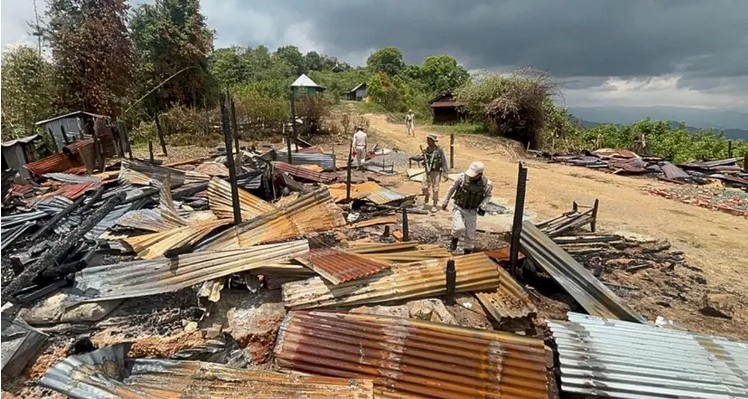
Last fortnight, a violent agitation erupted over a move to allow nomination of nontribal settlers in the election to the Garo Hills Autonomous District Council in Meghalaya, mandated by the Sixth Schedule of the Constitution. Two lives have been lost so far, and several properties damaged.
Meghalaya has three Autonomous District Councils, ADCs under Sixth Schedule, one each for the Khasi, Jantia and Garo tribes. ADCs are the equivalent of the local self-governance institutions under the Panchayat system, but exclusive for tribals and with more juridical powers under tribal customary laws.
This law was conceived of for Assam after Indian independence, when almost all of the Northeast, except for Tripura and Manipur, were part of Assam. The intended targets were Assam’s tribal hill districts beyond the British era Inner Line drawn by the Bengal Eastern Regulation, 1873. This line divided Assam’s hills and valleys not just in temporal space, but also in metaphoric time – between ‘modern’ and ‘premodern’, ‘law’ and ‘no-law’, as Buddhisatva Kar explains in When was the Postmodern?
The ADCs introduced a good measure of administrative autonomy to Assam’s tribal areas once designated as ‘excluded areas’ and ‘partially excluded areas.’ Most of them have now bifurcated to become full-fledged states, and the Sixth Schedule should have become redundant for them, and did become so in most except Meghalaya, making Meghalaya’s ADCs almost totally overlap with the state’s administration, except in the capital Shillong area.
In Assam’s Lushai Hills, now Mizoram, after gaining Union Territory status in 1987 the Sixth Schedule ADCs were allowed to lapse. In 1972 when Mizoram was upgraded to a state, three small pockets of non-Mizo population – Chakma, Lai and Mara, were again given ADCs.
The case of former Naga Hills district is peculiar. By the time of Indian independence, a strong movement for Naga sovereignty took shape, and the Sixth Schedule was also meant to pacify such discontents. Naga leaders however rejected this concession and insisted on sovereignty. Ironically, the Naga Hills were the first to be bifurcated from Assam to become a full-fledged state in 1963.
Arunachal Pradesh always had autonomy as the North East Frontier Agency, NEFA, though under the charge of Assam Governor during the British days. Today this tribal majority state is covered by the Panchayat system not Sixth Schedule.
The peculiar predicament of Meghalaya was predicated by its administrative structure under the British. These hills were classified as ‘partially excluded area’ not ‘excluded area’ giving the population some representation in the Assam provincial government, though through nomination by the Governor, not by popular choice.
Shillong was also the capital of undivided Assam, therefore inward migration bringing in a cosmopolitan tendency of its demography was inevitable. This resulted in a unique sense of insecurity amongst its original population, thereby prompting their felt need for Sixth Schedule protection even after separation from Assam to become a full-fledged state in 1972.
This brief historical background should make clearer the causes of the recent violent and ugly development in Meghalaya. Such flames obviously could not raged if there were nothing to burn in the first place. The Meghalaya case is in this sense just an extreme case of manifestation of an inherent anxiety shared across most of the Northeast. Similar troubles have erupted elsewhere in the region in the past and can again do so in the future given the spark, if corrective measures remain wanting.
From this vantage, the agitation in Nagaland in December last year by the Naga Students Federation, NSF, in coordination with the North East Students Organisation, NESO, against the Citizenship Amendment Act, CAA was also driven by this same anxiety. The same can be said of the current agitation in Manipur demanding the preparation of a National Register of Citizens, NRC, ahead of the national census exercise.
This wide opposition to CAA in the Northeast must however not be equated with the objections to it in other parts of the country. In the latter, the protest was against what was deemed discriminatory against Muslim immigrants who unlike immigrants of other faiths were not to be accorded a fast-track route to Indian citizenship. In the Northeast, the protest was against the provision for fast-track citizenship to any immigrant at all.
In Mizoram, the Mizo Marriage and Inheritance of Property (Amendment) Bill, 2026 passed on February 24 this year by the Mizoram assembly is yet another symptom of this underlying insecurity. Under this law, Mizo women who marry non-Mizo men are to lose their Mizo identity, and their children the Scheduled Tribe, ST, status.
In Assam, where assembly elections are barely two months away, the ruling BJP under chief minister, Himanta Biswa Sarma, have been trying to whip up this public anxiety, while also portraying it as solely the residue of Bangladeshi Muslim illegal influx to give it a nationalistic air in the hope of reaping electoral gains.
A civil servant at the time of India’s independence, Nari Rushtomji, a person intimately associated with the Northeast, has some valuable insights on this attribute of the region. In his book The Imperilled Frontiers: India’s North-Eastern Borderlands, he empathically watched the struggles of small indigenous groups negotiating the challenges of modernity and development, and observed that these changes must have to be regulated so that the pace of their march is not beyond the capacities of the demographically small communities to absorb without detriment to their social organisms.
Just as migration has been a human reality, integration of immigrants with host communities has been an organic part of social evolution. But the pace and size of population influx are also often what makes the difference between migration and colonisation.
India inherited a peculiar administrative cartography in the Northeast from the British. Considering social mobility is also a reality, communities in the Northeast too must be ready to leave behind the inherited pre-modern mindset as and when ready, and not begin to see the category as inherent right. A confluence of this readiness and Rushtomji’s caution probably is where all stakeholder can win together.
This article was first published in The New Indian Express. The original can be read HERE

Editor, Imphal Review of Arts and Politics and author