The escalating tensions between Tangkhul Nagas and Kukis in parts of Ukhrul and Kamjong districts in March 2026 have once again exposed the deepening complexity of Manipur’s conflict. What began in May 2023 as a violent confrontation largely framed in terms of a Meitei–Kuki divide has steadily evolved into a much more intricate and volatile political landscape. The recent crisis around Shangkai village, the abduction of Tangkhul civilians, the death of two Kuki men in Mapithel areas, and the subsequent ultimatums over territorial claims illustrate how quickly local incidents now escalate into larger ethnic confrontations.
Yet the significance of these developments extends far beyond the immediate violence. Increasingly, the conflicts emerging across Manipur’s hill districts appear intertwined with a deeper political question – the future territorial and administrative structure of the state. For many Kuki-Zomi organisations, the events since May 2023 have reinforced their demand for a separate administrative arrangement – variously described as a Union Territory or a political structure outside the jurisdiction of the Manipur government. Crucially, many of these groups have made it clear that they expect this question to be resolved before the next Manipur Assembly election due in early 2027.
This political timeline introduces a new dimension into the conflict. Violence, territorial consolidation, displacement, and negotiations are now unfolding under the shadow of an approaching electoral deadline. The interaction between these dynamics raises a troubling question – is the ongoing transformation of Manipur’s ethnic geography also shaping the political bargaining that will determine the state’s future?
Shangkai and the Escalation of Naga–Kuki Tensions
The immediate crisis began when two Kuki men – Thengin Baite from Thawai village and Thangboimang Khongsai, an internally displaced person residing in Shangkai – were reported missing after travelling to repair a damaged water pipeline. Their bodies were discovered the following day in a forested Mapithel hill areas overlooking Thawai village.
The circumstances of their deaths remain sharply contested. Kuki organisations claim that the two men were civilians engaged in routine village work and were killed by armed Tangkhul volunteers. Tangkhul civil society bodies, however, argue that the men were guarding poppy plantations and were killed in a confrontation during anti-drug anti-poppy plantation operations.
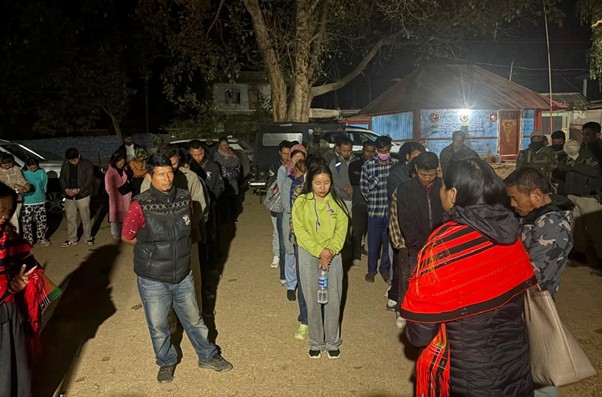
Even before the facts could be established, the situation escalated rapidly. Kuki villagers reportedly blocked the Imphal–Ukhrul road and detained around twenty-one Tangkhul civilians travelling along the route. The hostages included elderly passengers, women and students. They were held for several hours before being rescued through the intervention of district authorities and security forces.
Tangkhul organisations condemned the abduction as a serious human rights violation and alleged that valuables worth several lakh rupees were looted from the captives. Kuki groups defended their actions as a desperate attempt to return the missing villagers.
Soon afterwards, a Tangkhul organisation reportedly issued an ultimatum to the residents of Shangkai Kuki village, demanding that they vacate what it described as Tangkhul ancestral land. The notice asserted that the Kukis were merely guests and warned that failure to leave would invite “necessary measures.”
The dispute had thus moved quickly from a violent incident to a territorial confrontation.
The Fragile Geography of Manipur’s Hill Districts
The Shangkai episode illustrates the fragility of the geographical interface between Manipur’s ethnic communities.
The Imphal valley, mostly inhabited by the Meitei community, occupies barely ten percent of the state’s territory but contains the majority of its population including various communities and administrative infrastructure. Surrounding the valley are the hill districts inhabited by various tribal communities broadly categorised as Nagas and Kukis.
Historically, these communities maintained an active coexistence despite periodic tensions. However, the violence that erupted on May 3, 2023 fundamentally altered this equilibrium. Widespread attacks, counter-attacks and displacement created deep physical and psychological divisions between the valley and the hill areas dominated by the Kuki-Zomis.
Security forces subsequently established buffer zones separating Meitei areas from Kuki-Zomi-dominated regions. Many Meiteis were not allowed to return to villages in the hills, while large numbers of Kuki-Zomis remained displaced from parts of the valley.
The result was the emergence of a de facto territorial separation.
However, while the Meitei and Kuki-Zomi divide became sharply defined, the Naga–Kuki interface remained complex. In districts such as Ukhrul, Kamjong, Kangpokpi and parts of Imphal East, villages belonging to different communities lie in close proximity. These mixed zones have now become the most volatile frontiers of the conflict.
Violence in Interface Zones
The incidents in Shangkai are not isolated. Over the past year several clashes have occurred in areas where Naga and Kuki settlements coexist.
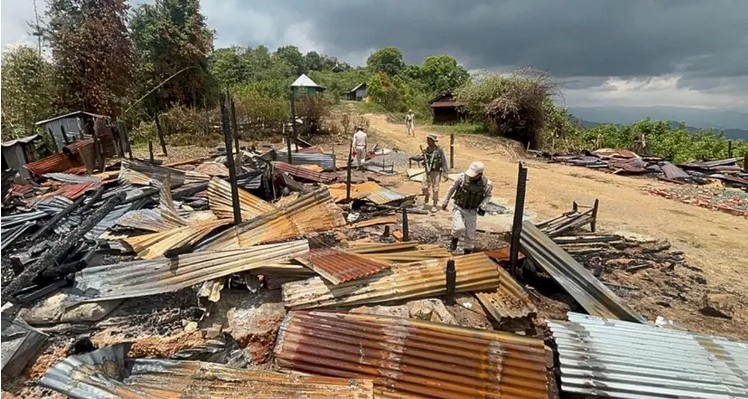
The violence that erupted in Litan in early February 2026, in which more than fifty houses belonging largely to Tangkhul families were burned, raised serious concerns about the possibility of escalating Naga–Kuki tensions. Earlier confrontations in villages such as K. Lungwiram, Ireng Naga village and Konsaram had already indicated growing friction.
These locations share a common feature – they lie in interface zones between different communities.
When violence repeatedly targets such areas, it raises the possibility that demographic and territorial considerations are shaping the conflict.
Historical Echoes of the 1990s
For many residents of the hill districts, the present tensions evoke memories of the Naga–Kuki conflict of the 1990s. That period witnessed large-scale violence, the destruction of hundreds of villages, deaths of hundreds and the displacement of tens of thousands of people.
The conflict was closely linked to competing territorial claims and insurgent politics. Entire communities were uprooted as armed groups attempted to establish control over strategic areas.
While the current situation differs in important respects, the recurrence of violence in mixed Naga–Kuki regions inevitably revives fears that history may repeat itself.
Territorial Consolidation and the Demand for Separate Administration
Since May 2023, Kuki-Zomi organisations and legislators have consistently argued that coexistence within the existing political structure of Manipur has become impossible. Their demand for a separate administrative arrangement – often framed as a Union Territory – has become the central political aspiration of the community.
The argument rests on two main claims. First, that the Manipur government, dominated by Meitei political leadership, cannot provide security to Kuki-Zomi populations. Second, that long-standing grievances regarding political representation, development and administrative autonomy require a structural solution.
However, the feasibility of such an arrangement depends heavily on territorial contiguity.
A viable administrative unit must possess a reasonably coherent geographical area. Scattered settlements across multiple districts weaken the political argument for a Separate Adminstration.
This is why the demographic composition of interface zones has become increasingly significant. If mixed regions gradually become ethnically homogeneous – through displacement, migration or intimidation – the territorial basis for a new administrative structure becomes stronger.
Displacement and Demographic Transformation
One of the most significant consequences of the violence since May 2023 has been large-scale displacement.
Thousands of people from both the valley and the hills continue to live in relief camps or temporary settlements. In many cases, displaced families have remained away from their original homes for nearly three years.
As time passes, the possibility of return becomes increasingly uncertain. Houses deteriorate or are destroyed, land is occupied by others, and new settlements emerge in previously uninhabited areas.
In this manner, displacement gradually reshapes the demographic landscape.
The longer the conflict persists, the greater the likelihood that these demographic shifts will become permanent.
Delhi’s Strategic Calculations
While the conflict unfolds within Manipur, the ultimate authority to reshape the state’s administrative structure lies with the Union government in New Delhi. Any decision regarding the creation of a Union Territory or Separate Administration would require parliamentary approval and therefore political consensus at the national level.
Delhi thus occupies a pivotal but cautious position.
On one hand, the Central government faces pressure from Kuki-Zomi organisations and legislators who argue that their security and political future cannot be guaranteed under the present arrangement. Several Kuki-Zomi MLAs have openly supported the demand for Separate Administration.
On the other hand, any move towards territorial reorganisation would face strong opposition from Meitei organisations including Pangals and many Naga groups, both of whom view the integrity of Manipur as non-negotiable.
For the Central government, the challenge is therefore to balance these competing pressures without triggering a broader political crisis in the Northeast.
The Electoral Calendar and Political Leverage
The approaching 2027 Assembly elections add another layer of complexity.
Kuki-Zomi leaders have repeatedly indicated that they want the issue of Separate Administration resolved before the elections. Their argument is straightforward – participating in an election under the authority of the Manipur government would undermine their demand for a political arrangement outside the state’s jurisdiction.
If the issue remains unresolved, there is a possibility that Kuki-Zomi organisations could call for a boycott of the elections or demand special arrangements for their areas.
Such a scenario would place the Central government in a difficult position. Conducting elections without participation from a significant section of the population could undermine the legitimacy of the democratic process.
The Limits of the Manipur Government
The role of the Manipur state government in addressing the conflict has also come under intense scrutiny.
While the government has taken steps such as requesting investigations by central agencies and deploying additional security forces, its capacity to resolve the political dimensions of the crisis remains limited.
Key decisions regarding negotiations with armed groups, the continuation of Suspension of Operations (SoO) agreements and the broader political dialogue with Kuki-Zomi organisations are largely controlled by the Union government.
This dynamic has led to a perception among many observers that the state government operates within a constrained political space.
Buffer Zones and the Institutionalisation of Separation
The buffer zones established by Central Security Forces were intended to prevent further clashes between communities. However, they have also had unintended consequences.
By restricting movement between different regions, these zones have effectively formalised the separation created by the initial violence. Meiteis cannot travel freely on National Highways, through large parts of the hills, while Kukis remain reluctant to return to areas in the valley.
Over time, temporary security arrangements risk becoming permanent boundaries.
Civil Society and Parallel Authority
Another striking feature of the conflict is the growing role of civil society organisations in managing local security and political negotiations.
Bodies such as the Tangkhul Naga Long, Kuki Inpi, Kuki-Zo Council (KZC), Committee on Tribal Unity (CoTU), Indigenous Tribal Leaders’ Forum (ITLF) and various tribal groups now play an active role in issuing ultimatums, negotiating with government officials and mobilising community responses.
While these organisations often act as representatives of community interests and negotiate with the Union government directly, their growing authority also reflects the weakening of formal state institutions.
The Risk of Multiple Ethnic Frontiers
If the current trajectory continues, Manipur may witness the emergence of multiple ethnic frontiers.
The first frontier already exists between the valley mostly inhabited by the Meiteis and the hill districts dominated by the Kuki-Zomis.
A second frontier may be developing between Naga and Kuki settlements in districts such as Ukhrul, Kamjong, Kangpokpi, Imphal East and Imphal West.
The creation of such frontiers would transform Manipur into a patchwork of segregated territories connected only by heavily militarised transport corridors.
Preventing Further Fragmentation
Reversing this trajectory will require more than short-term security measures.
The safe and dignified return of displaced populations is essential to restore the demographic diversity of affected regions. Equally important is the restoration of free movement across the state.
Transparent investigations into violent incidents and sustained political dialogue among all communities are necessary to rebuild trust.
Ultimately, however, the resolution of the conflict will depend on political decisions taken at the highest levels of government.
A State at a Crossroads
The tensions in Shangkai and other parts of the hill districts reveal how deeply Manipur’s social and political fabric has been disrupted since May 2023.
What began as a confrontation between two communities has gradually evolved into a complex struggle involving multiple ethnic groups, competing territorial claims and divergent visions of the state’s future.
As the 2027 elections approach, the pressure to resolve these questions will only intensify. For Kuki-Zomi organisations, the demand for Separate Administration represents a fundamental issue of political survival. For Meiteis including Pangal groups, indigenous tribal groups, and some Naga groups, however, the integrity of Manipur remains a non-negotiable principle.
Caught between these competing visions, the Central government faces a delicate and potentially explosive challenge.
The decisions taken in the coming months will not only shape the electoral politics of Manipur but may also determine whether the state moves toward reconciliation or deeper fragmentation.
Manipur thus stands at a critical historical juncture. The violence unfolding in villages such as Shangkai is not merely a local dispute; it is part of a larger struggle over territory, governance and identity. Whether that struggle culminates in renewed coexistence or the gradual redrawing of political boundaries will depend on how the complex interplay of violence, negotiation and electoral politics unfolds in the years leading up to 2027.

Senior Editor: Imphal Review of Arts and Politics