Demography Anxiety
The angst over inflow of migrants has never been fully resolved in the Northeast. Manipur has been no exception. This is understandable for as recent history is witness, ethnic communities inhabiting the region, in most cases demographically small, are vulnerable of being displaced and marginalised by influx from outside the Northeast region of communities far superior in number and exposure to the modern economy. No other has empathised more with this inherent fear than Nari Rushtomji, a civil servant in the crucial years before and after Independence. He was self-professedly in love with the region and true to his words, dedicated his entire career as an Indian administrator in the region.
Rushtomji in his book Imperilled Frontiers: India’s North-Eastern Borderlands[1] watched with dismay the struggle of small indigenous groups negotiating the challenges of modernity and development, wanting its benefits but also fearing its consequence of attracting work forces more experienced in the modern ways and superior in number therefore capable of easily displacing them completely. Before his very eyes, this exactly became the fate of places such as Sikkim and Darjeeling which was originally part of Sikkim but gifted to the East India Company on February 1, 1835[2] for an annual compensation of Rs. 3000, but subsequently increased to Rs. 6000 from 1846. All these made him conclude that while the march of development and population movements are universal phenomena, these changes must have to be regulated so that the pace of their march is not beyond the capacities of the demographically small local communities to absorb without detriment to their social organisms.
There is much to be had from this advice: One, the reality of racial and ethnic identities and the social frictions they are capable of causing, is not about to be erased anytime soon. Two, there are ways of getting around these problems, and this can be through sympathetic understanding of the problem, leading to framing of laws that can accommodate the needs for development and modernity, as well as ensure no autonomous identity of any community is destroyed. It must also be kept in mind that controlled influx of outside population is not a bad thing. If the migrants are willing to adapt to local customs or even integrate to them, then let it also be remembered that once upon a time the kings of the erstwhile kingdom of Manipur encouraged it, as indeed, all Paddy States in James Scott’s Zomian theatre is known to have done so.[3]
In Manipur, Bamons the Pangals are prime examples of this seamless assimilation process of identities. There are also many more varied ethnicities which have become indigenised and absorbed into local clans and surnames of Meiteis, in the process strengthening the society, bringing in fresh skills, ideas, work forces and genes. Meitei surnames, which are generally based on family occupations (Sanjenam, Sanasabam etc.) or titular (Rajkumar, Ningthoujam etc.). Name of Leikais and settlement colonies also indicate the same phenomenon (Kabo Leikai, indicating Kachin origin), (Pong Leirak, indicating Shan origin), (Takhel Leikai, indicating Tripura origin). If a systematic and extensive genome study were to be done, in all likelihood, this hypothesis will be proven true and especially the Imphal valley will turn out to be a melting pot of ethnicities from within and without the state’s boundary, just as many chroniclers, starting from the British days have surmised. In recent times genome studies of the larger migration canvas of India has revealed similar surprises and there can be no reason why Manipur will be an exception.[4]
This notwithstanding, it must be admitted identity divides are a reality. Literature has illustrated this dilemma in ways no other intellectual fields can. French existentialist author Albert Camus’ well known short story, The Guest[5] set against the backdrop of the Algerian resistance movement against French colonialism is one of these. In it, a white school teacher, by ancestry a Frenchman but in every other sense of the word, a son of the Algerian soil, who even disregards and disobeys government overtures to collaborate in the fight to subdue the rebellion, discovers to his profound sorrow how unbridgeable the divide between the races is in a graffiti message on the blackboard written by his students and directed at his racial alien status.
It is a beautiful picture of the human spiritual and psychological landscape Camus paints, bringing out its complex nuances. Social scientists have also done some fine reductive and constructive analyses on the matter. Sudhir Kakkar’s Colours of Violence: Cultural Identities, Religion and Conflict[6] in many ways is an explanation of such a divide. Kakkar, who calls himself a “pragmatic liberal and an agnostic mystic” based his conclusions on studies of the phenomenon of communal riots in India between the Hindus and Muslims. His finding is that there is something much deeper and fundamental in the identity divide than the usual explanation that it is a fallout of sinister machination of colonial politics.
Kakkar does not align with the rabid hatred and paranoiac sense of persecution preached by fanatical religious leaders, but all the same he takes pains to point out the shallowness of the liberal view of history as a function of the present – that the past will depend on the interpretation of the present to suit its conveniences. While this does happen, it fails to explain too many problematic points. Why would the identity divides persist amongst communities after generations of sharing and living together, as Camus so poignant brings out in The Guest, or why would affinities in familial and social bonding remain after generations of separation and radically different social engineering circumstances as in the case of East and West Germans, Kakkar asks in his book.
In the wake of the periodic rumbles of ethnic strife in states like Manipur and the Northeast in general, it would be pertinent for the governments here to begin thinking of policies to prevent more human tragedies. In this, it is important for the government to acknowledge both the instrumental as well as primordial factors in the making of group identities, and then evolve effective administrative policies. In these days of new found and loud nationalistic fervour, let the government, both in the state as well as the Centre, not forget this is not a question of being subversive to national interest. They must engage in this debate for a more comprehensive future demography policy. This should not be about putting a complete ban on migration, for as the world is witnessing today, even in the USA and other advanced European countries, this is next to impossible, but of safeguarding local communities. It would also be pertinent to remember this shield cannot also be unidimensional, and must be layered and graded according to the types of migrants. At one level, it must be for protection against foreign migrants, but it must not be forgotten that internal migration within the country, and indeed the state can also be problematic, and appropriate laws made to ensure these also do not result in social disharmony.
This layered approach to migration is not new and India is already familiar with such a policy. If the National Registry of Citizens, NRC, is meant to identify citizens, there are also laws such as the Inner Line Permit System, ILPS, aimed at protecting small vulnerable populations in the Northeast. The previous Congress government in Manipur also attempted to enact three laws though in vain as the three bills, together known as the Manipur People’s Bills, had to be abandoned because of protests from a section of its population who felt targeted. These three bills were aimed at making it virtually impossible for migrants to acquire landed properties in the state. As we all are familiar, there are also other new laws such as the Citizenship Amendment Act, CAA, the reception of which too has not been too smooth, all aimed at this layering of population control laws. Though many of these can prove to be draconian, therefore the need is to refine them to make them be in consonance with natural justice and universally accepted humanitarian standards.
Three Aborted Manipur Peoples’ Bills
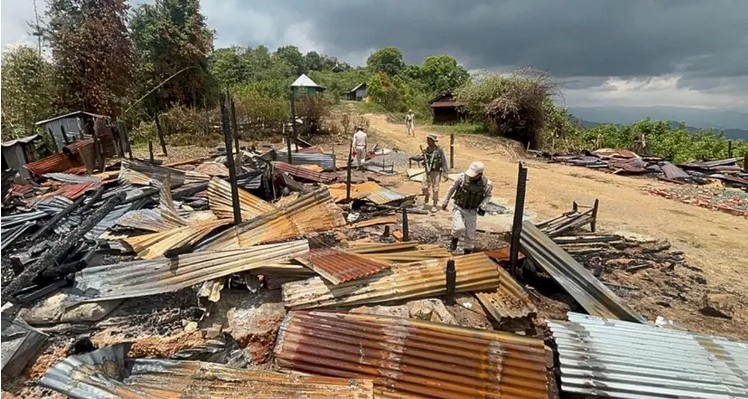
It would be pertinent here to briefly scan through the three Manipur Peoples’ Bills, then Congress state government tried to introduce in August of 2015 for these bills though they never got to become Acts, for the overture was also aimed at addressing the same demography anxiety in the face of influx of population from outside. The three bills, one original and two amendments of existing laws, were passed by the Manipur State Legislative Assembly but never received the Governor’s assent. This was on account of trouble which erupted in Manipur’s southern district, Churachandpur, which literally went up in flames, with irate mob burning down homes of their representatives for not allegedly protecting their interest in the Assembly, and these include the residences of senior cabinet minister and veteran politician, Phungzathang Tonsing. Nine people also died in the trouble which continued for months.
Earlier, in an ingenuous strategy to ensure at least a major portion of the demand for the introduction of the Inner Line Permit system to check influx of migrants passed the legislative process, especially the Governor’s scrutiny, the Manipur government had spilt the substance of the demand and spread it over three bills: the Protection of Manipur People Bill 2015; the Manipur Land Revenue and Land Reforms (Seventh Amendment) Bill 2015; and the Manipur Shops and Establishment (Second Amendment) Bill 2015 and passed them unanimously during a special Assembly session. The idea was, if the first and controversial bill ran into hurdles, the remaining two would not be held up with it. However, in face of the trouble in Churachandpur, all three did not get the Governor’s assent.
What was it that the hills were not happy about the three Bills? Part of the answer is, the migrant issue is alive mostly in the valley districts, which are open to all Indians to settle unlike the hill districts which are reserved for tribals. But this should have meant the hills were merely uninvolved. The Naga districts, were somewhat cooler to the issue and ended up simply watching the developments from a distance, in a response somewhat similar to the current crisis which erupted on May 3, 2023 at Torbung in Churachandpur district.
What had become glaring at the time in the course of the agitation was, the dominant community of the state, the Meiteis in valley were often given to arrogantly presuming foreknowledge of what other fraternal communities want or aspire for. The flames of anger that erupted in Churachandpur on that occasion proved how wrong this presumption had always been. It must equally be said, the hills also never tried to understand that the valley, now more than ever, needs room to be itself – the space which had been denied it for far too long. Today it feels besieged and pushed against the wall. The four valley districts where they live form only 10 percent of the state’s geographical area but is home to over 60 percent of the state’s population. The Meiteis are confined to the valley, although it must be said nowhere in the law is it specified they are forbidden to move to the hills but this belief has become embedded as a traditional outlook. On the other hand, hill population are free to move to the valley for the valley where modern land revenue laws have been introduced is open to settlement by all Indian, although now, the introduction of the Inner Line Permit System, ILPS, which came to be promulgated in the state on Janury 1, 2020, has introduced some barriers for non-indigenous and non-locals to do so.
Not only in terms of a shrinking living space, the Meiteis also now feel they have also been unduly disadvantaged by the reservation policy. As predominantly Hindus, they are left in the general category in the reservation scheme of the government. As a reaction, there is a growing demand among a section of them to also be clubbed tribal. Many of them are also moving away from Hinduism.
Of the three Manipur Peoples’ Bills, the two which sought amendments to existing laws, were very valley specific, so it ought not to have been any cause for worry for the hills. But in the Bill on amending the MLR&LR Act, there is a clause which says more areas of the state, still not under the law can be brought under it, and this could have sent wrong signals. MLR&LR Act 1960, although is applicable in the valley districts only, has nothing to do with the valley’s wishes or aspirations. It is just a modern, civic, land tenure system, incidentally introduced in the state by the Union government by an Act of the Parliament, for in 1960 Manipur was a Union Territory. It has worked well for the valley except that in its current state, it has allowed for their own land alienation, and this is what is sought to be corrected in the current amendment bill.
History of Land Administration in Northeast
A brief look at the history behind the different administrative models for the hills and the valley here should be interesting. The administrative mechanism evolved in Manipur by the British after they brought the kingdom under them in 1891 is almost a replication of their administrative model in their older province of Assam where they had revenue provinces administered directly by modern land revenue laws, and the non-revenue hills simply left “unadministered”.
By the Government of India Act 1919, these hills beyond the “Inner Line” were marked off as “Backward Tracts” and left largely unadministered but under the Governor’s direct rule and not the provincial government’s. By the Government of India Act 1935 the “Backward Tracts” were re-categorised into “Excluded Areas” and “Partially Excluded Areas”.[7]
The “Excluded Areas” were not given any representation in the Provincial Government, which had been given much more democratic powers by then, with the condescending explanation that these hills were still not ready for democratic governance. The “Partially-Excluded Areas” were however given some representations in the Provincial Government, but by nomination of the Governor and not by election.
In Manipur, the British did not draw an “Inner Line” separating the hills from the valley, but there is a great deal of replication of the regulation’s provisions. After Maharaja Churachand Singh, completed his education from Mayo College, Ajmer, and reached adulthood year, the British political agent who acted as regent on his behalf from 1981 since the ousting of the then ruling dynasty, stepped down to make way for the young prince to take over. In 1907, Maharaja Churachand Singh ascended the Manipur throne, and under the guidance of the British, evolved a new administrative mechanism. Under this system, as in the British province of neighbouring Assam, the Manipur provincial government ruled the valley districts, but the hills were kept under the President of the Manipur State Durbar, PMSD – a British officer who played the role somewhat akin to the Governor of Assam. Although not identical, this was the broad pattern of governance, tried and tested in Assam, that the British took to in many of their newly acquired territories.
Land and People in Northeast
One insight from the ongoing ethnic conflict in Manipur, and indeed the periodic explosion of similar violence in most other Northeast states, is the problem posed by widely different notions of land and ownership amongst different communities. It is ironic but illustrative that there are so many boundary disputes between these states although the notion of the modern boundary was unknown here before the Treaty of Yandaboo of 1826 by which the British annexed Assam and merged it with Bengal.
As Lord Curzon pointed out in his Romanes lecture 1907 titled Frontiers, [8] it is not just in the Northeast, but the world outside of Europe where the idea of artificially delineated boundaries were alien. There were natural boundaries determined by rivers, mountains, deserts etc., but even these were not the closely guarded and precise limits of national domains. Boundaries in this world also waxed and waned, depending on the powers of rulers and chiefs.
The British being thus unaccustomed to territories with no precise limits, ensured boundaries were drawn wherever they took over. While these boundaries served their purposes, they often left problems for those who inherited them. This history of Northeast boundaries is intriguing but for now, a look at the land-people relationship, which also complicated the British boundary making exercises in many ways.
British administrative institution introduced in Assam reflected the challenges of dealing with a mix of state-bearing populations coming under centralised bureaucracies of kingdoms, and non-state communities living in the uncharted hills and under no definite administration. Assam’s plains hence were much easier for the British to handle, unlike the hills where the authorities of each village, tribe and clan did not run beyond each’s closed communities. The British therefore introduced normal land revenue administration in the plains but left the surrounding hills as Excluded or Partially Excluded areas, and separated the two regions by an Inner Line, drawn by the Bengal Eastern Frontier Regulation 1873. In 1907, the British also introduced a similar administrative arrangement in their protectorate state of Manipur.
That communities living in different stages of economy, would have different outlook to land is a foregone conclusion. For the nomads, anywhere they pitch their tents is their land, but not so for settled agriculturists, feudal principalities or the modern state. When all of these communities with their different outlook to land live in the same geographical region and era, conflicts are only to be expected. One of Manipur’s major problems is this.
Anthony Sattin sketches this essential friction in Nomads: The Wanderers Who Shaped Our World.[9] He sees metaphors of this in mythologies such as the Egyptian Seth and Osiris, Homer’s Odyssey, but most interestingly in the first murder in the Bible where the son of Adam and Eve, Cain kills his brother Abel. Cain, is a tiller of the soil, and Abel a wandering shepherd. The primal nature of this friction is loudly evident.
In other words, this conflict over land is as ancient as the agricultural revolution that started 10,000 years ago after the last Ice Age receded, and after humans began domesticating crops to become food-secure—or as Yuval Noah Harari, in jest, after crops domesticated humans[10]. While there is no divinely ordained code of rectitude to decide which of these outlooks to land is most just, the reality is that the modern state is premised on a sedentary and enumerable population. Democracy itself would become ineffective if its population were to be constantly shifting and unenumerated. Good administration, too, would become impossible, with state infrastructure like roads, public health and education facilities constantly having to chase their wandering, proliferating villages.
If and when the Manipur crisis reaches an amicable resolution, all must realise the need come to terms with the new reality of sedentary lifestyle. This will transform the endemic land tussles between its different communities as well as with the state. While indigenous ways of life must be respected, a common denominator is also indispensable to ensure good administration.
The Manipur government must also reconsider its practice of giving recognition to new villages periodically. Because of a peculiar land holding tradition amongst the Kukis especially, whereby the chiefs own the village and the villagers are landless, there is a tendency for villages to leave and start their own villages. This is also one reason why Kukis felt most targeted when the government initiated an encroachers eviction drive from reserved and protected forests. Neighbouring Mizoram where Kuki-Zo kindred tribes live, is a shining example in this. Upon the introduction of the 6th Schedule of the Constitution, the autocratic rights of 259 chiefs were abolished on popular demand in 1954, giving stability to its villages.[11]
Prisons of the Past
Why is there so much apprehension of population influx in the Northeast? Apart from periodic outbreaks of inter-ethnic violence in the region, the fear of the “outsider” is virtually everywhere. Often this “outsider” is nebulous and ill defined. For some, the word that substitutes this term is Bangladeshi and now Chin-Kuki, without any qualification, but in the same breath the term can become rooted in indigeneity tending to exclude even bona-fide domiciles who no longer are “outsiders” but nonetheless remain the “other”, making this fear border the blindness of paranoia, diluting even advocacies of what are real about it.
The increasingly high-pitched demand for a National Register of Citizens in Manipur – an exercise proving to be a wasted effort in Assam; the calls for stricter Inner Line Permit System regimes in the hill states; the periodic explosions of ethnic clashes sometimes within a state and at other times between states – all would appear confounding to observers outside the region. But not so for those who have a sense of the postcolonial history of the place.
The ugly uproar not too long ago in Assam over the fusion of two pieces of cloth towels cum neck scarfs by a newly formed literary society – Bangla Sahitya Sabha – of the Bengali speaking community of Assam, is illustrative of this state of extreme sensitivity and intriguing understanding of the “other”.
Of the two fabrics at the centre of the controversy, one is the Assamese “phulam gamosa” a rectangular cotton fabric with distinctive motifs, traditionally a towel but today transformed into an intimate cultural marker and often used as a ceremonial neck scarf. The second is the Bengali “gamcha”, a similar fabric, though not as strong a cultural symbol of its users as the former. The literary body, ostensibly tried to create a symbol of fraternity of the state’s two major linguistic communities by splitting each of the two fabrics in half and stitching different halves together to have a hybrid version. This was used as ceremonial gifts during a function it organised on March 25, but in the face of a very strong backlash from the Assamese community who saw it as a cultural affront and insult, the literary body withdrew and tendered a public apology on March 28.
Those familiar with the colonial history of the region will know how this bitter sweet relation between these two communities in Assam was set in motion in the mid 19th Century. After the Treaty of Yandaboo 1826 which formally ended the Burmese occupation of Assam and Manipur, Assam (then virtually the entire Northeast with the exception of Tripura and Manipur) was annexed and made a part of the British Bengal province. The Assamese middle class still too weak to run their administration, the British encouraged and brought in people already exposed to their education and administration. These were Bengali middleclass chiefly from neighbouring Sylhet, Dhaka and Mymensing districts of East Bengal as Sajal Nag notes in his book Roots of Ethnic Conflict.[12] Soon enough, in the new power structure of Assam, an elite Bengali minority came to occupy a dominant position. They also came to treat the Assamese with a measure of condescension.[13] In 1837, this Babu class, used their influence to have Bengali declared as Assam’s official language, making it also the medium of instruction in schools, claiming Assamese was only a dialect of Bengali.
The nascent Assamese middle class were unable to counter this immediately, but a language agitation in the days ahead was only to be expected. When Assamese linguistic nationalism built around this protest got too hot, in July 1873, Assamese was restored as the official language of five valley districts of Assam – Kamrup, Darrang, Nowgong, Sibsagar and Lakhimpur. The next year on February 6, Assam was also separated from Bengal and made a separate chief commissioner’s province. However, probably again prompted by the administration’s continuing need for English educated Bengali middleclass, on September 12 the same year, the populous Sylhet district was added to Assam. Interestingly, this was resented by both the Sylheti Bengalis and Assamese for very different reasons. The Assamese because this would make Bengalis the majority in Assam, and Bengalis because for them it was a degradation to be removed from culturally and institutionally advanced Bengal and clubbed with backward Assam.
Alongside, there was another stream of migration in the same direction – that of land hungry Bengali peasantry, chiefly Muslim. The earlier wave of these migrants, as Amalendu Guha indicates in his book Planters’ Raj to Swaraj[14], carried no sense of a superior identity baggage and had no trouble switching to adapt and identify themselves as Assamese speakers. Identity friction in this manner became triangular, especially when Indian freedom drew close, and on this larger canvas, clash of religious nationalisms began overriding assertions of smaller linguistic identities. In Assam however, memories of the old and bitter linguistic rivalries lingered, so that when Radcliff was drawing his line, and Sylhet district’s only hope of remaining within India came to be its acceptance by Assam as its part, the Assamese leadership under revered Gopinath Bordoloi said no. In the Sylhet referendum in July 1947, by a thin Muslim majority, the district was awarded to East Pakistan, giving the issue of migration, which continues to this date, another hue.[15]
This inherent contradiction again came to the fore during the passing of Citizenship Amendment Act 2019. The strongest opposition to this Act – which seeks to segregate Hindu and Muslim migrants and evict only the latter while embracing the former – was in Assam. Obviously, Assam did not want any immigrants, Hindus or Muslims. Making the irony even deeper, Assam voted BJP which sponsored this hated CAA, to power not long after.
Is this demographic apprehension in the Northeast completely unreasonable? The Assam example is again illustrative. Assamese Speakers in Assam number about 15 million (Census 2011) compared to 9 million Bengali speakers. But if the larger region were to be considered, and Bangladesh’s 164 million Bengali speakers included, Assamese speakers would be a tiny minority. The fear of demographic marginalisation in the region hence is not altogether illegitimate. All these nuances need to be understood for a balanced assessment.
Meanwhile, while it is true the present is a product of the past, there must come a time for all to weigh reality and decide whether it is not time to break free from at least some of these prisons of the past.
Fluidity of Identity
The Northeast ethnic cauldron is known for boiling over routinely. This is only to be expected though, for even long before the arrival of modern administration brought by the British, this cauldron has always had a mix of “state carrying populations” and “non-state” tribesmen, resulting in a unique internal friction so well characterised by James C. Scott’s in his book Art of Not Being Governed: An Anarchic History of Upland South East Asia.[16] Much of the ethnic turmoil the region is witnessing today is a continuation and sometimes complications of this tension within.
As the non-state tribesmen wake up to the reality of the modern state and begin aspiring for one for themselves, they find their statehood already defined. Much of the insurgencies in the region, as well as the ethnic rivalries, are consequences of this unsettled identity question. The current ethnic violence in Manipur between the Kuki-Zo tribes and the Meiteis has elements of this though there were also other immediate triggers. That the Union and state governments have not done enough to resolve the crisis seven months into it, is another story.
Demonstrated in this unfolding drama is also the contention that identity is fluid and dynamic, and not by any means static or fixed. Identity, like so many attributes of the human story, is fiction. It has all to do with choosing to belong to one story or the other story of peoplehood and nationhood. As Yuval Noah Harari points out in Sapien: A Brief History of Humankind[17] and much before him by another scholar Benedict Anderson in Imagined Communities[18], humans have this unique ability to tell stories and on the basis of these stories unite to build communities.
This capability came apparently after the Cognitive Revolution humans went through 60,000 or so years ago, brought about by certain evolutionary neurological changes in the human brain circuitry, giving them the ability to create and understand symbols. From this viewpoint, community identities are not intrinsically determined, but depend on the ideas of community built and internalised by groups of people. Obviously, these stories can be accommodative or exclusive, and accordingly, identities can expand and grow, or else narrow down and rigidify.
The Treaty of Yandaboo 1826, by which the British ended the Burmese occupation of Assam by direct intervention, and in Manipur by indirect assistance, marked the start of the colonial era in the region. British Assam which then was the entire Northeast except for the kingdoms of Tripura and Manipur, came under the British and was merged with Bengal. Manipur was allowed to remain as a protectorate state.
From the start, expectedly, the pattern of British administration in Assam reflected the challenges of dealing with this mix of state and non-state communities. The plains of Assam which were already familiar with the centralised bureaucracy of a state were therefore much easier for the British to handle, unlike the non-state spaces where the authorities of each village, tribe and clan did not run beyond each’s closed communities. Hence, while the British introduced normal land revenue administration in the plains, they left the surrounding hills either unadministered, and after the Government of India Act 1919, as “Excluded” or else “Partially Excluded” areas.
The scant importance the British administration initially gave the region after their takeover in 1826 is also evident from the fact they withdrew most of their regular troops from there not long after the Burma debacle. In 1835 however, when the tea experiment by the Bruce brothers began meeting with phenomenal success, a British civil officer E.R. Grange conceived of the idea of raising a civil militia “less paid than the military, better armed than the police” to aid the British administration. This was the Cachar Levy and it met British needs well.[19] Three years later the Jorhat Militia[20] was also raised, but soon merged with the former. In the years ahead it came to be known by different titles depending on where they were posted. One of the incentives given to these militiamen, was that those who performed well would be absorbed in the Indian Army’s Gurkha Rifles and in time they became a fertile nursery for the latter. During World War 1, the original five battalion of this militia sent a total of 3174 soldiers and 23 Indian officers (now known as JCOs) to the Gurkha rifles for duties in Europe. For this contribution, at the end of the war, the unit came to be redesignated formally as a paramilitary force and rechristened the Assam Rifles.[21]
The two world wars had great impacts on the identity churnings in the Northeast. World War 1 experience was especially interesting for the contrasting ways it initiated identity formation amongst the Naga and Kuki tribes. The British administration raised a Labour Corps from among these tribesmen to be taken to Europe, however, while the Nagas cooperated, the Kukis in Manipur refused to be enlisted leading to what British chroniclers describe as the Kuki rebellion lasting 1917 to 1919. The delay in subduing the rebellion is generally attributed to the Assam Rifles sending away practically all its fighting force to the war in Europe. Indeed, the rebellion ended as the war in Europe concluded and troops returned. Nonetheless, this is an important chapter in the birth of a consolidated Kuki identity.
The Naga story is even more intriguing. Disparate Naga tribesmen who enlisted in the British Labour Corps discovered in Europe that they were treated as one and also different from even other Indians. As Naga author Charles Chasie writes in his book, The Naga Memorandum to the Simon Commission 1929, they returned enlightened by their experience in Europe and with the help of sympathetic British officials, formed the Naga Club in Kohima in 1918 to work for unity and friendship amongst Naga tribes and their message soon spread to the administered areas of Assam’s Naga hills first, and beyond in time. In 1929, the memorandum they submitted to the visiting Simon Commission is today considered an important marker of the rise of Naga nationalism. Among others, they told the Commission that Nagas were not Indians.
This is the mystique of the identity question. It does look simple and straightforward but it has also been behind some of the most bitter and bloody conflicts in history.
References:
[1] Nari Rushtomji, Imperilled Frontiers: India’s North-Eastern Borderlands, OUP India, 24 November 1983
[2] Townsend Middleton and Sara Shneiderman (editors): Darjeeling Reconsidered: Histories, Politics, Environments, (collection of articles) OUP India, 7 May 2018
[3] James C. Scott: Art of Not Being Governed: An Anarchic History of Upland South East Asia, first published Yale University Press, 2009, Indian edition published by Orient Black Swan 2013.
[4] https://www.science.org/content/article/where-did-india-s-people-come-massive-genetic-study-reveals-surprises? (last accessed on March 14, 2024)
[5] Albert Camus, Short story The Guest occurring in his collection of short stories published under the title Exile and the Kingdom, Penguin: first published in 1957, latest edition, 13 October 2013
[6] Sudhir Kakkar, Colours of Violence: Cultural Identities, Religion and Conflict, Penguin India, 14 October 2000
[7] Alexander Mackenzie, History of the Relations of the Government With the Hill Tribes of the North East Frontier of Bengal, Cambridge University Press, first published 1884, latest 2013
[8] George Nathaniel Curzon, Frontier, Romanes Lecture of 1907, Full text available here https://archive.org/details/dli.pahar.1821/mode/2up (last accessed on March 14, 2024)
[9] Anthony Sattin, Nomads: The Wanderers Who Shaped Our World, Publisher, John Murray (26 May 2022)
[10] Yuval Noah Harari, Sapiens: A Brief History of Humankind, Vintage (11 June 2015)
[11] Samrat Choudhury, Northeast India: A Political History, Harper Collins (26 July 2023)
[12] Sajal Nag, Roots of Ethnic Conflict: National Questions in North East India, Manohar Publishers and Distributors (30 December 2002)
[13] Anindita Dasgupta, Denial and resistance: Sylheti Partition ‘refugees’ in Assam, Published by Taylor and Francis, http://www.tandfonline.com/loi/ccsa20
[14] Amalendu Guha, Planter Raj to Swaraj – Freedom Struggle & Electoral Politics in Assam 1826-1947, Tulika Books, first published 1977, current edition, 14 December 2022
[15] Ibid 13
[16]James C. Scott, Art of Not Being Governed: An Anarchic History of Upland South East Asia, first published Yale University Press, 2009, Indian edition published by Orient Black Swan 2013.
[17] Yuval Noah Harari, Sapiens: A Brief History of Humankind, Vintage (11 June 2015)
[18] Benedict Anderson, Imagined Communities: Reflections on the Origin and Spread of Nationalism, Verso, originally published 1983, revised edition (13 September 2016)
[19] Col. L.W. Shakespeare, A History of Assam Rifles, Macmillan and Company, limited, 1929, republished by ARB Publications (1 January 2024)
[20] Ibid 15
[21] Ibid 15

Editor, Imphal Review of Arts and Politics and author