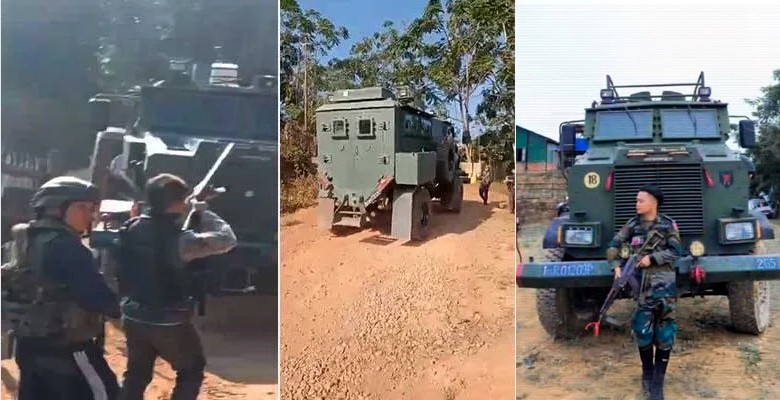
The violence that erupted in Manipur on May 3, 2023 which has completed three years in May 2026 did not simply produce a binary conflict between Kuki-Zomis and Meiteis. It has instead triggered a deeper and more complex restructuring of ethnic relations across the state. What is unfolding is not merely inter-community hostility but a fragmentation of the very idea of coexistence – one that now extends beyond the Kuki–Meitei divide to include renewed tensions between Kukis and Naga communities, particularly the Liangmai recently and Tangkhul Nagas as of now.
To understand this layered hostility, one must revisit not only the recent rupture of 2023 but also earlier intra-tribal and inter-ethnic conflicts – especially the Kuki–Naga clashes of 1992–98 and the often-overlooked Kuki–Paite conflict of 1997–98. Equally crucial is the long-standing contestations over identity within the broader “Kuki-Zo” fold itself, including the persistent resistance by Thadou groups, Hmar, and Zomi tribes such as Vaiphei and Paite to the imposition of a homogenized “Kuki” or “Kuki-Zo” nomenclature. These episodes are not isolated historical moments; they are unresolved fractures that continue to shape present alignments, mistrust, and political claims. The current crisis is therefore best understood not as an isolated eruption but as the convergence of long-standing contradictions and structural complications that have now reached a breaking point. Compounding this layered conflict is the growing perception that armed actors operating under the cover of formal arrangements with the state are reshaping ground realities in ways that further destabilize inter-community relations.
Immediate Trigger, Deeper Faultlines
The immediate trigger for the 2023 violence was the exploitation of controversy surrounding the demand of the Meiteis for Scheduled Tribe (ST) status. For Kuki-Zomi communities, this was perceived as a direct threat to constitutionally protected land rights in the hill areas, particularly in the context of state actions such as eviction drives in reserved forest areas and the war on drugs campaign including destruction of poppy cultivation in Kuki-Zomi dominated districts. What might otherwise have remained a political dispute escalated rapidly into widespread violence, revealing that the foundations of coexistence were already deeply eroded.
Yet, the intensity and speed of escalation point to deeper structural tensions. The conflict quickly moved beyond protest into organized violence, suggesting that communities were already mobilised – psychologically and materially – for confrontation. The ST issue thus acted less as a cause in itself and more as a catalyst that activated dormant anxieties over land, identity, and political control.
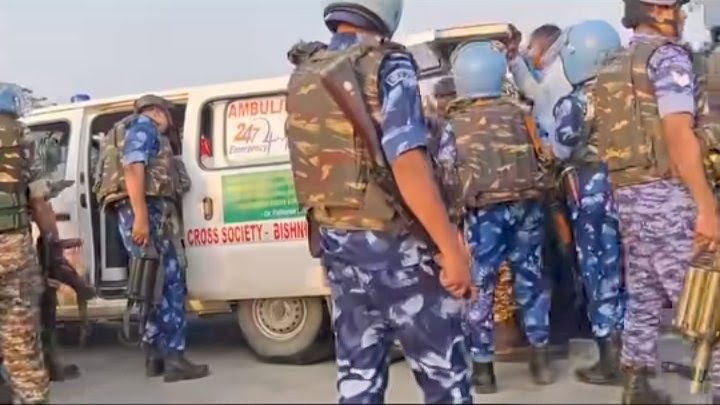
The events of May 3, 2023 marked a decisive rupture. Meiteis were pushed out from Churachandpur through targeted attacks, including the burning of houses, and similar patterns of displacement followed in other Kuki-Zomi dominated areas such as Kangpokpi, neighbouring areas of Kangpokpi district and Imphal East district, and the border town of Moreh. These actions were followed by retaliatory violence in the valley, leading to the displacement of Kuki-Zomis from Imphal. What emerged within days was not just violence but a rapid and near-complete ethnic re-segmentation of space. Alongside this, a critical and contentious perception began to take root – that armed Kuki-Zomi groups operating under the Suspension of Operations (SoO) agreement were able to retain organizational coherence and territorial presence during the crisis, raising questions among other communities about asymmetries in enforcement and response.
From Contestation to Separation
At the core of the Kuki–Meitei conflict lies a fundamental clash of territorial and political imaginaries. The Meiteis, historically the dominant political community of the Manipur kingdom, view the state as a territorially unified and multi-ethnic entity in which valley and hills are inseparably linked. The Kukis, the late migrants from Myanmar (Burma), historically referred to as Khongjai in Manipur records and increasingly lately articulating a “Kuki-Zo” political identity, assert claims rooted in specific hill territories and often expressed through demands for separate administrative arrangements. The High Court of Manipur direction to the Government of Manipur to consider for recommendation of ST status to Meiteis was therefore perceived not merely as an issue of classification but as a structural threat that could enable valley-based expansion into Scheduled Tribe protected hill areas.
This tension was compounded by the widespread perception among Kuki-Zomi tribes that state policies – particularly those targeting “illegal immigrants,” poppy cultivation, and forest encroachment – were selectively directed at them, even as concerns persisted among Meiteis regarding cross-border migration and identity claims. Such measures were interpreted in sharply different ways by different communities, deepening polarization. The result was a profound erosion of trust in state institutions, with each side increasingly viewing the state through their lenses.
Once violence erupted, the situation rapidly acquired the characteristics of a militarised conflict. Mobs grew up, weapons were looted, armed groups emerged, and communities organised themselves into defensive enclaves. The enforcement of buffer zones and blockades on National Highways further entrenched divisions restricting effectively the movement of Meiteis into hill areas and blocking access to the rest of the country by road. The most enduring consequence has been territorial segregation – Meiteis squishing in the valley and Kuki-Zomis consolidating in the hill districts.
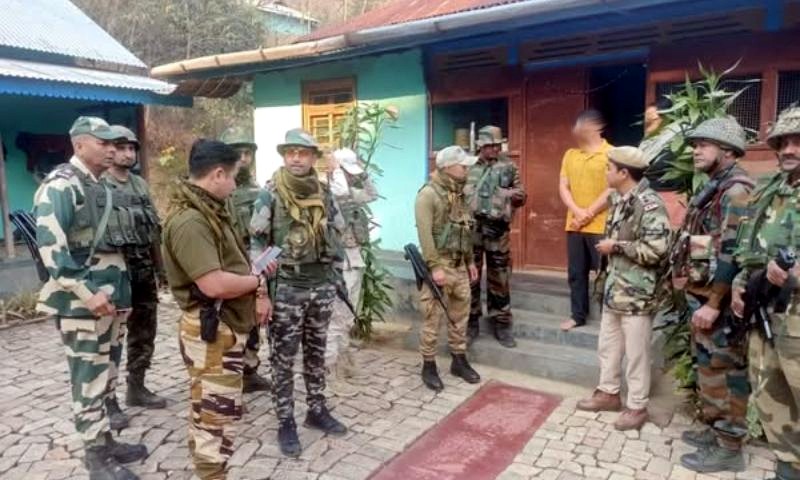
Within this militarised landscape, a major point of contention has been the role of Kuki-Zomi militant groups belonging to the umbrella groups – Kuki National organisation (KNO) and United People’s Front (UPF) – under the Suspension of Operations (SoO) agreement with the Government of India (GOI) and the Government of Manipur (GOM). There is a growing perception – particularly among Meiteis and Nagas – that these groups and Non-SoO militant groups of Kuki-Zomis have used the relative operational space afforded by the SoO framework to expand influence and consolidate territorial control during the conflict. Parallel to this is the criticism directed at Central Security Forces, which are widely perceived by the Meiteis and Nagas as having acted as passive or constrained actors – “silent spectators” – both during Kuki–Meitei clashes and in the ongoing Kuki–Tangkhul Naga clashes. This prevailing perception has significantly deepened distrust toward Central intervention mechanisms and contributed to the belief that the conflict is being unevenly managed.
Unresolved Histories of Violence
The roots of the present tensions lie deeply embedded in the conflicts of the 1990s, which reshaped inter-community relations in Manipur without resolving their underlying causes.
The Kuki–Naga conflict of 1992–98 was marked by intense violence driven by competing territorial claims and the assertion of exclusive ethnic homelands. Entire villages were destroyed, and large-scale displacement took place. Yet, the conflict ended as frozen conflict without a comprehensive political settlement, leaving behind unresolved grievances and competing narratives of victimhood that continue to inform present perceptions.
Equally significant is the Kuki–Paite conflict of 1997–98 from which Zomi nomenclature emerged, which exposed deep fissures within the broader “Kuki-Zo” spectrum. This intra-ethnic or inter-tribe conflict revolved around questions of identity, nomenclature, and political representation, challenging the assumption of a unified Kuki identity.
Beyond these violent episodes, there has been a longer and less acknowledged ideological conflict within the broader grouping often described as “Kuki-Zo”. Majority of the Thadou community have consistently resisted the imposition of a homogenized “Kuki” or “Kuki-Zo” identity, asserting distinct historical and ethnic self-identification. Similarly, Hmar groups and Zomi tribes – particularly Vaiphei and Paite – have rejected subsumption under a singular Kuki or Kuki-Zo label at various points. These contestations reflect deeper struggles over representation, legitimacy, and political authority.
Together, these conflicts – both violent and ideological – demonstrate that the present crisis is not only about inter-ethnic rivalry but also about unresolved intra-ethnic fragmentation. The past has not been reconciled; it has been layered into the present.
From Fragmentation to Consolidation
One of the defining features of the post-2023 situation is the attempt to forge a unified Kuki-Zo identity in the face of perceived external threat. This consolidation is both strategic and reactive, aimed at strengthening political claims and ensuring collective security. However, it exists in tension with the historical reality of internal divisions.
The legacy of the Kuki–Paite conflict and the continuing resistance from Thadou, Hmar, and Zomi groups highlight the fragility of this unity. While a common front in the form of Kuki-Zo Council (KZC) is projected in the context of the conflict with Meiteis, the underlying disagreements over nomenclature and identity remain unresolved.
This creates a paradox. On the one hand, there is a visible effort to project unity and coherence. On the other hand, residual mistrust and competing claims over identity persist beneath the surface. These internal complexities shape not only intra-group or inter-tribe relations but also how other communities perceive Kuki consolidation – often with skepticism.
Why Old Faultlines Are Reopening
The ongoing violent conflict between Kukis and sections of the Naga communities, particularly Liangmai and Tangkhul Nagas, must be understood as the reactivation of historical faultlines within a newly fragmented political landscape, and the greater design of Kuki-Zomis for their exclusive territory.
The ethnic segregation resulting from the Kuki–Meitei conflict has effectively redrawn Manipur’s internal geography. In this reconfigured space, territorial claims that were previously contained are now being asserted more aggressively. Naga groups continue to view significant portions of the hill districts as integral to their historical homeland, while Kuki groups assert parallel claims over many of the same areas. The weakening of state authority has removed the mechanisms that once mediated these overlapping claims, leading to renewed friction.
At the same time, the current phase is characterized by competitive ethnic consolidation. Kukis and Nagas are strengthening their respective political identities and territorial claims, while Meiteis continue to advocate for a unified multi-ethnic Manipur. In such a context, the assertion of one group is inevitably perceived as encroachment by another.
Here again, the question of armed groups operating under the SoO framework becomes significant. The Naga communities much like the Meiteis, express concern that Kuki-Zomi militant groups are leveraging this arrangement to extend influence into contested areas. The perceived inaction or restraint of Central Security Forces in responding to such developments has contributed to a growing sense of grievance among Nagas as well. This shared dissatisfaction – though arising from different political positions – has added another layer of complexity to the conflict.
The relative non-alignment of sections of the Naga community in the Kuki–Meitei conflict further generates ambiguity and suspicion, shaped by memories of past conflicts and present strategic calculations.
Structural Drivers
While ethnic identity is central to the conflict, structural factors play a critical role in sustaining and intensifying it. The persistent failure of the state to act as a credible and neutral mediator by exercising its sovereignty and monopoly of use of arms and forces has been a recurring feature across decades. Perceptions of bias – now extending to both State and Central Forces – have eroded institutional legitimacy, pushing communities toward self-reliance and militarisation.
The proliferation of arms and the normalisation of armed mobilisation have transformed the nature of conflict. Violence is no longer episodic but embedded within the social and political fabric under a greater design. Additionally, cross-border dynamics – particularly the transnational linkages of communities particularly Kuki-Zomis across India and Myanmar –have heightened anxieties over migration, security, and demographic change.
From Shared Polity to Parallel Existences
Perhaps the most unfortunate transformation is the shift from coexistence within a shared political framework to the emergence of parallel ethnic existences. Segregated territories, restricted movement, and the breakdown of economic and social interdependence have fundamentally altered the nature of society in Manipur.
This is not merely a situation of conflict but one of structural separation sustained by de facto divisions. Those who identify as Kuki or Kuki-Zo and some section of Naga communities are no longer negotiating terms of coexistence; they are reorganising themselves for sustained division.
The Limits of Simplistic Narratives
The complexity of the current crisis resists reduction to simplistic binaries. What is unfolding is a convergence of multiple, overlapping conflicts shaped by historical grievances, structural complications, competing political projects, internal identity contestations, and contested state responses.
The role of the SoO framework and perceptions surrounding the conduct of Central Security Forces further complicate this landscape, introducing questions not only of ethnicity but also of governance, enforcement, and legitimacy.
A Crisis Driven by Reconfigured Power and Distrust
The opposition of Kukis to Meiteis since May 2023 is rooted in deep-seated anxieties over land, identity, and political survival, shaped by long-standing demands for a separate homeland, structural factors, and sharpened by the events of the recent conflict. Their recurring tensions with sections of the Nagas – and the shadow of past intra-Kuki conflicts and identity contestations – reflect a broader crisis in which coexistence itself is increasingly strained.
What distinguishes the present phase, however, is not merely the persistence of ethnic conflict but the reconfiguration of power on the ground, driven by a combination of armed mobilisation, territorial consolidation, and the perceived uneven functioning of state authority. The role of Kuki-Zomi militant groups operating within and outside the Suspension of Operations (SoO) framework, alongside the widely held perception among Meiteis and Nagas that Central Security Forces have acted as constrained or passive actors, has fundamentally altered how different communities interpret both security and sovereignty.
This perception – whether contested or not – has had real political consequences. It has deepened distrust not only between communities but also toward the institutions meant to mediate conflict. As a result, the state is no longer seen as a neutral guarantor of order but as an uneven presence within a shifting conflict landscape. In such a situation, ethnic groups are increasingly compelled to rely on their own mechanisms of defence, further entrenching division.
Manipur today is therefore undergoing not just a phase of violence but a structural reordering of ethnic power and territorial control. The convergence of historical grievances, identity contestations, and perceived state inaction has created conditions where conflict sustains and reproduces itself.
Unless there is a credible restoration of trust through visibly impartial governance, a reassessment of frameworks such as the SoO in light of current realities, and a political process that respects the distinct identities of the ethnic groups while preserving the idea of a shared polity, the trajectory points toward deeper fragmentation. In seeking security through separation or exclusive ethnic consolidation, each community may ultimately be contributing to the dissolution of the very framework that once made coexistence possible for ages. And no ethnic group will be guaranteed a dignified existence and brighter future.

Senior Editor: Imphal Review of Arts and Politics