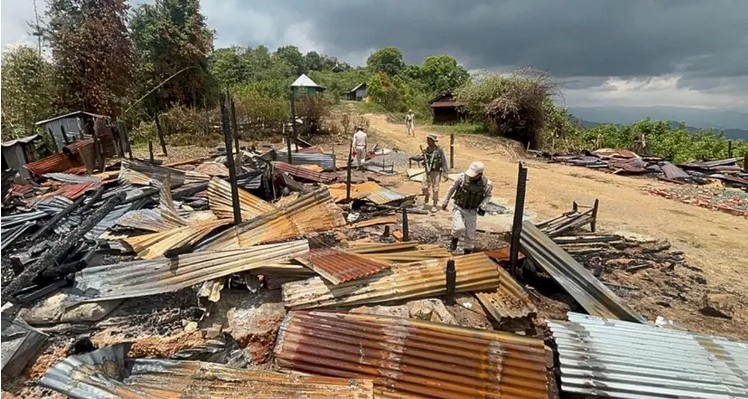
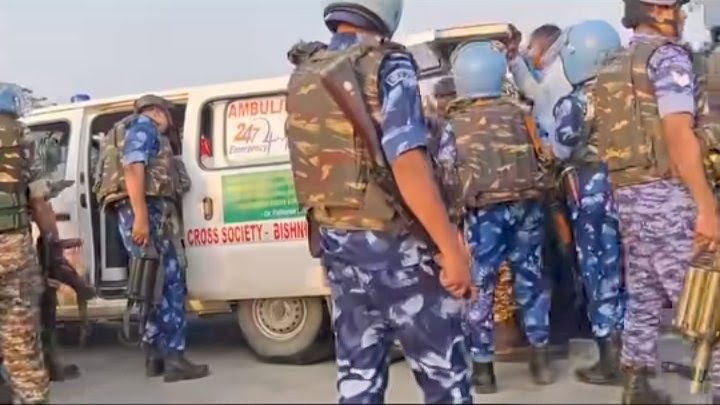
The unfolding sequence of events in Manipur following the April 7 Tronglaobi killings reveal not merely a continuation of violence, but a dangerous transformation in the nature of state–society confrontation. What began as a deeply emotional public response to the killing of two children in Tronglaobi has, through the combined responses of security forces and the state apparatus, evolved into a layered crisis in which legitimacy, trust, and governance capacity itself are under strain. The Thinungei incident on April 14, far from being an isolated clash, has added another volatile layer, exposing not only operational lapses but also political and administrative inadequacies at the level of the state.
At the core of this escalation lies a critical misjudgement – the failure to recognise the qualitative nature of the protests that erupted after the Tronglaobi tragedy. These were not routine disturbances. They were morally charged, socially widespread expressions of grief and anger. In such situations, the role of the state is not limited to maintaining order; it must also act as a responsive political authority capable of absorbing public emotion, signalling empathy, and providing credible pathways for justice. This is where the state’s response appears deeply inadequate.
While the government did convene meetings, issue condemnations, and appeal for calm, these actions remained largely procedural and reactive. They did not translate into visible, confidence-building interventions on the ground at the critical early stages. There was no immediate, strong political outreach to the protesting communities, no high-level presence at key protest sites to engage with civil society leaders, and no clear, time-bound roadmap communicated to the public regarding accountability for both the initial attack and the subsequent firing by security forces. In the absence of such measures, the space was quickly filled by unverified news or rumour, suspicion, and anger.
This vacuum of political engagement significantly shaped the trajectory of the protests. As demonstrations spread across the valley and – organised by local clubs, meira paibi groups, and civil society organisations under platforms such as the Coordinating Committee on Manipur Integrity (COCOMI) – the demands extended beyond justice for the victims to include calls for accountability of security forces, withdrawal of central security forces, and even resignation of political authorities. These are not merely escalatory slogans; they reflect a perception that the state is either unwilling or unable to assert meaningful control over the situation.
The response of the security forces must be situated within this broader context of state failure. The use of force against protestors – including tear gas and earlier instances of live firing – did not occur in a political vacuum. It occurred in an environment where the state had not effectively pre-empted escalation through dialogue, reassurance, or calibrated crowd management strategies. In this sense, the coercive response became a substitute for political engagement, with predictable consequences – instead of containing unrest, it deepened alienation.
The Thinungei incident further exposes the consequences of this gap between political authority and security action. The confrontation between protestors and individuals later identified as security personnel travelling in civilian vehicles and attire must be understood not only as an operational lapse but as a failure of governance oversight. In a highly volatile environment, it is the responsibility of the state government to ensure that all security operations – particularly those involving central forces – are context-sensitive, coordinated, and aligned with the prevailing ground realities.
The explanation that the personnel were on an “anti-narcotic mission” near Kwakta does little to resolve the deeper issue. Even if the objective was legitimate, the manner of execution raises serious concerns. Why was such an operation conducted in civilian dress and vehicles in an area already experiencing intense protests and full of suspicions of Kuki militants escorted by central security forces? Why was there no visible coordination with the Manipur Police or specialised agencies such as the Narcotics and Affairs of Border (NAB)? And crucially, why was the route and timing not reassessed in light of the ongoing unrest?
These questions point not only to operational misjudgement but also to a breakdown in the state’s ability to exercise effective oversight over security deployments within its jurisdiction. The absence of clear communication to the public regarding the identity and purpose of the personnel moving through Thinungei allowed suspicion to escalate into confrontation. In a conflict environment, such ambiguity is not neutral – it is dangerous.
The subsequent clarification by the Home Minister risks compounding this problem. By appearing to justify the movement of armed personnel in civilian attire through sensitive civilian zones, it inadvertently normalises a practice that blurs the distinction between civilian and security spaces. For a population already grappling with fear and mistrust, this blurring can have long-term destabilising effects. It undermines predictability, erodes confidence, and increases the likelihood of similar confrontations in the future.
At the same time, the state government’s response to the Thinungei incident has largely followed a familiar pattern – internet shutdown, imposition of curfew, enforcement of prohibitory orders, arrests of selected individuals, and appeals for calm. While these measures may be necessary from a law-and-order perspective, they are insufficient as a political response. They address the symptoms of unrest without engaging with its causes.
More importantly, they risk reinforcing the perception that the state’s primary mode of engagement with its citizens is coercive rather than communicative. The reliance on curfews and force, internet shutdown, in the absence of visible accountability or dialogue, can deepen the sense of collective grievance. In effect, the state appears present in its capacity to control at least in Imphal valley, but absent in its capacity to listen and respond.
This dual deficit – of political engagement and administrative coordination – creates a dangerous feedback loop. The initial tragedy in Tronglaobi generates public outrage. The state’s limited and procedural response fails to channel this outrage constructively. Security forces step in with coercive measures resulting several protestors injured, further escalating tensions. A poorly organised “anti-narcotic mission to Kwakta” passing through volatile route full of tensed public protests and security actions in Thinungei triggers another round of confrontation. Each stage feeds into the next, producing a cycle that becomes increasingly difficult to break.
The implications of this cycle are profound. At a fundamental level, it raises questions further about the nature of governance in Manipur in the current phase. Is the state still capable of shaping outcomes through a combination of political authority and administrative coordination? Or has it been reduced to a reactive entity, responding to crises largely through security measures while strategic decisions and operational dynamics are driven elsewhere?
The perception that critical decisions – particularly those involving central security forces –are taken without adequate involvement of the state government further complicates this picture. It reinforces the idea of a fragmented authority structure, where accountability is diffused and responsibility is unclear. In such a system, failures are difficult to attribute, and therefore difficult to correct.
Yet, it would be reductive to view the situation solely through the lens of failure. The events surrounding Tronglaobi and Thinungei also highlight specific areas where corrective action is both necessary and possible. The state must reclaim its role as the primary political interlocutor by initiating sustained dialogue with civil society groups, protest leaders, and affected communities, not just with the local Joint Action Committee (JAC) because the situation has already transcended beyond local JAC’s control and the incident is not an isolated case. This engagement must be visible, credible, and continuous – not limited to closed-door meetings or formal appeals.
Simultaneously, there must be a clear assertion of coordinated command over all security operations within the state. This does not necessarily imply exclusion of central security forces, but it does require integration, transparency, and accountability. Operations such as the one that led to the Thinungei confrontation must be subjected to strict protocols that take into account not only tactical objectives but also the socio-political context in which they are carried out.
Equally critical is the need for transparent and impartial inquiry into both the firing on protestors and the Thinungei incident. Without such accountability, official explanations will struggle to gain public trust, and each new incident will be interpreted through the lens of accumulated grievance.
Ultimately, the crisis triggered by the Tronglaobi tragedy and deepened by the Thinungei incident is not only about violence on the ground. It is about the erosion of a fundamental relationship – the relationship between the state and its citizens. Security forces can contain situations, but they cannot, on their own, restore legitimacy. That task belongs to the state as a political institution.
If the state continues to rely predominantly on coercive instruments that too in selective areas while remaining politically distant, the risk is not merely further unrest, but a gradual normalisation of distrust and confrontation. Conversely, if it can reassert its role through empathetic engagement, coordinated governance, and credible accountability, there remains a possibility – however fragile – of breaking the cycle that currently threatens to spiral further.

Senior Editor: Imphal Review of Arts and Politics