War and peace are opposite ends of the same spectrum. External wars as well as internal conflicts often result because definition and management of peace have been flawed. Peace is often projected as an absence of violence. To promote this vision, often societies and nations tend to hide or ignore frictions within and project the surface calm as peace. This is what peace scholar Johan Galtung refer to as “negative peace” and the trouble here is, frictions within a society are likely to remain despite this superficial semblance of peace. Since these inner frictions are not addressed adequately, residual disenchantments are likely to accumulate and get toxic. When these toxins reach a threshold, open conflict can be predicted to break out to rupture this surface calm. Wars therefore are in many ways a consequence of not too skilful or honest conception and management of peace. Arguably the greatest novel ever written, Leo Tolstoy’s War and Peace dwells at length on this duality.
The challenge then is in the way we manage and portray peace. In this mission, we need to be constantly reminded of the inner dynamic of the interplay between war and peace to appreciate both more fully. In fact, the two in an enigmatic way, give meaning to each other. It is one of those paradoxes of life where diametrically opposite values enhance the meaning of the other. Hence, without the possibility of war, or the trauma of having experienced it, peace would become routine and mundane, never needing a reminder of its importance, just as nobody ever needs a reminder that winter is colder than summer. Likewise, without the possibility of sin, virtue would have been bland; the idea of Heaven would have had little meaning had a Hell been beyond human imagination; mankind too would not have been longing for immortality and permanence had life not been transient and impermanent.
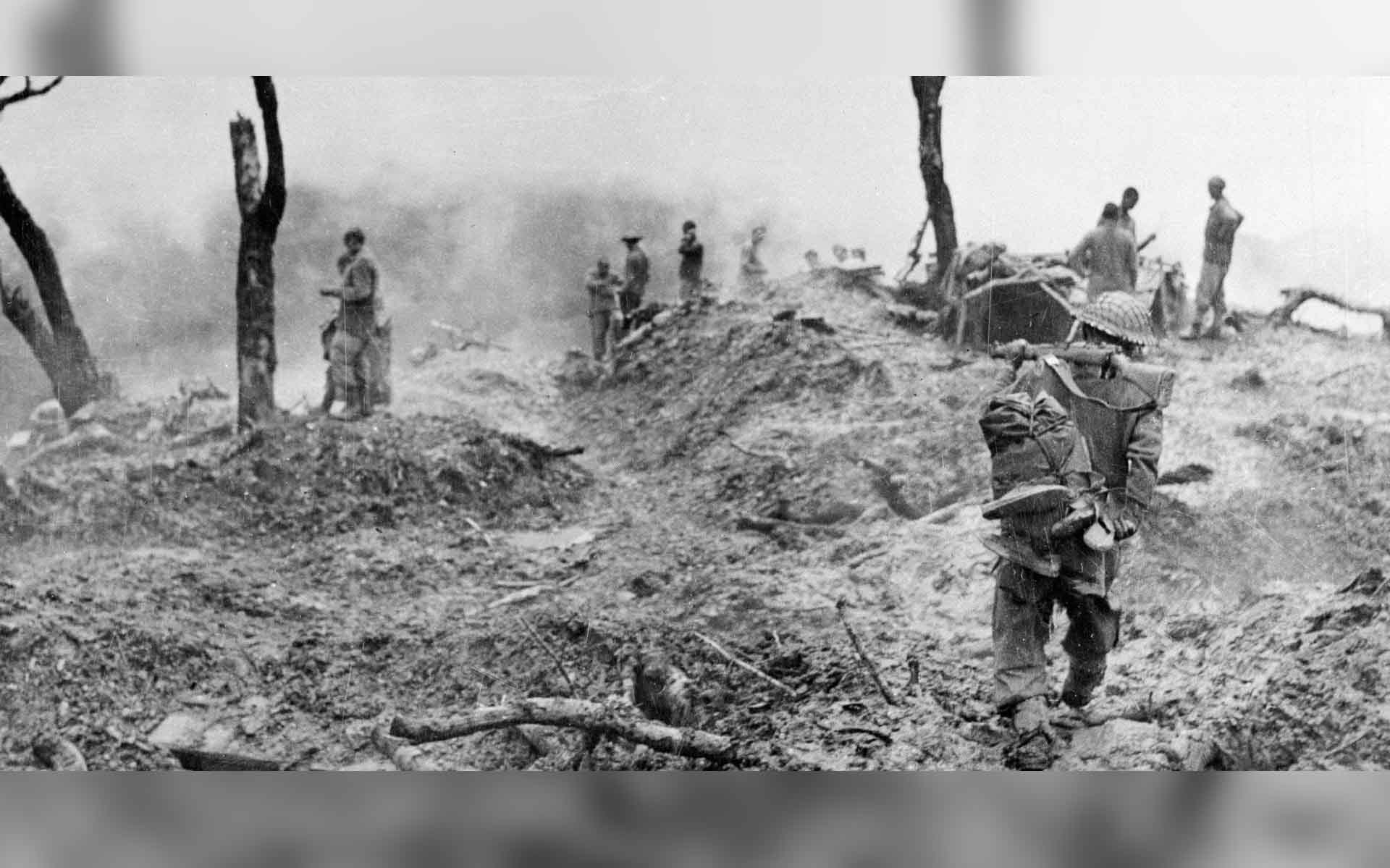
Any commemoration of war and conflict, hence must strive to represent this paradox of life so as to be meaningful and relevant. Commemoration of war hence must never amount to valorisation of war, or be reduced to a voyeuristic window for people to watch and draw pleasure without engaging the underlying trauma wars and conflicts are invariably linked to. This thought needs to be kept as a constant check in drawing up any scale for the violence Manipur witnessed when its hills and plains became one of the fiercest theatres of WWII. Such a project must not be reduced to a witch hunting exercise or a blame game either. On the other hand, it has to be about a celebration of the beauty of peace upon the knowledge of the calamity that its absence can amount to. This is the greatest lesson the history of Manipur’s WWII experience, as indeed all other experiences of extreme violence, can teach all. In visualising this chapter of the war, the other caution also has been to never under any circumstance allow the portrayal to serve as a promotion of what holocaust scholars and trauma historians have called “fidelity to trauma”, in which the purpose of memory becomes reduced to trapping the subjects in their traumatic past, disabling them to leave the past behind and move on.
The idea of course is close to the distinction Sigmund Freud makes between mourning and melancholy in his seminal essay “Mourning & Melancholia”. In Freud’s “Mourning” the mourner never allows the distance between himself and his loss to collapse. The mourner ensures that the dead and the living worlds remain separate, even though the mourner may have loved and therefore misses the dead he mourns. It is a way of coming to terms with what has been lost, even the most precious, and then moving on. The approach can be described thus: “You are dead and I am alive. I love you and will never forget you. I will always cherish your memory but I cannot be always with you. I am still alive and have to move on and meet the challenges of life ahead.”
Mourning hence is not about disowning the past, however traumatic, but about putting it in perspective. It is about bidding farewell and at the same time placing hope in life and in the prospect of rebuilding a future in the living world for those still alive. On the other hand, in Freud’s “Melancholia” trauma memory becomes a somewhat perverse narcissistic engagement in which the mourner does not simply mourn but begins to take an undeclared pleasure in the very fact of mourning. He also begins to blame the past for his present misery, incapacitating him to move on, in the end erasing all prospect of any positive resolution of the traumatic memory. It also becomes a way to abdicate responsibility of facing present challenges and preparing for the future. It becomes in short, a kind of victimhood syndrome that perpetuates a disabling psychological condition. It also generates unarticulated resentments, hopelessness, anger, hatred and other harmful residues of negative emotions.
The challenge in visualising any conflicts of the past, Manipur’s WWII experience included, keeping clear of this condition of “Melancholia”. True we cannot and must not disown our past, however traumatic, but this remembrance must also be a place of pilgrimage. This site in time must be were where people revisit past traumatic events, but leaving enough cues to not encourage them to fuse the past and the present as well as the prospects of future.
Although the past remains as the basis for any contemplation of the present and the future, the emphasis and priorities encouraged must be on the way forward. In the spirit of “Truth and Reconciliation” advocated as a trauma resolution approach by one of the foremost peacemakers the world has seen, Nelson Mandela, the message must be to remind all, especially the younger generation, of the magnificent regenerative capacity of life to rebuild and flourish even after having gone through the most traumatic of experiences. The effort must importantly be to encourage a celebration of the unshakable faith in the everyday humanity that Manipur possesses so abundantly despite all the troubles it has faced, and continues to face.
Post War Scenario
Put another way, the effort at all remembrance events is to focus on a post war history without losing sight of the epochal changes that the war brought to Manipur and its people, rather than concentrate on the war alone. Between the problem and the solution, the effort is to place the premium on the solution, but the irony is, and therefore what needs not be forgotten is that a solution becomes important only if there had been a problem, else we end up walking in an abstract and remote Kafkaesque world, with little or no connection the actual reality on the ground. That is, we must tell of the war that has happened, but without bitterness. Thankfully, this has been the spirt ordinary Manipuri always.
Manipur’s WWII experience was traumatic no doubt. It was a war of alien powers, though fought on its grounds, therefore the people of the state had no immediate stake in it. Nonetheless, it was a war of industrial scale, one of a kind which the region had not ever seen before. It was in this sense a rude awakening of what were essentially small idyllic societies into the modern materialistic age of immense possibilities, both in terms of destruction capabilities as well as progress and welfare.
The violence capabilities were demonstrated by the war in action right before the eyes of all in Manipur, but often the positive fallouts in terms of a new economy introduced, as well as the new windows thrown open through which endless torrents of new ideas poured in, transforming lives and outlooks for the better, often miss notice. As for instance, apart from the descendants of the feudal era nobilities who had vast landed properties, the first generation monetarily rich in Manipur were those who ventured into war time contract works. Likewise, many of the major bitumen-paved highways and roads we see today in the state are a legacy of the war. The war also left behind six airports in the Imphal valley. Three of these were all-weather, with a 1.7 km runaway each. These were Koirengei (which was at the time of the war the main airport), then there are Tulihal and Palel. The wartime airport at Tulihal now serves as the state’s only civil airport. The other three were fair weather airports with impacted earthen runaways, one at Kangla Siphai, Wangjing and Sapam. These fair weather airports have been reclaimed as paddy fields today. People’s outlook and approach to everyday life, economy, children’s education, higher studies, professions, enterprises etc., also took a new and radical turns. The war was the threshold Manipur walked through to enter its own brave new world.
The seeds of new ideas sown at the time are now beginning to bear fruits, even though expectedly there are myriad other problems unrelated to the war overwhelming the place. The war in this sense, besides so many other things, can also be seen as what has been referred to in the Bhagavad Gita, as a “Creative Destruction”.
Japanese view
For the Japanese, as Prof. Tohmatsu Haruo said during a function in New Delhi, the Japanese had little interest in opening a front in India and their primary objective in doing so was to cut off the route by which the Allied forces were funnelling in supplies to the Chiang Kai-shek’s Koumintang troops fighting the Japanese in China then.
This explanation however is short of convincing, considering the Japanese sent in three divisions of its 15th Army to this front, and in the end suffered an approximate 60,000 casualties, dead and wounded. They were also for unexplained reasons overconfident of victory and sent their soldiers with only three weeks’ supplies and virtually no logistic backup. The ground invasion now referred to as the Imphal-Kohima campaign, to the utter dismay of the Japanese, dragged on from March to July 1944. Was this confidence coming from the presence of the INA on their side? If so, is the very casual explanation of this invasion then the Freudian ego defence mechanism of ‘rationalisation’, meant to dodge guilt of a decision which proved disastrous?
The British saw it very differently. A poll conducted by the National Army Museum, London, in 2013, actually voted the Imphal-Kohima theatre as the most crucial in Britain’s war history ahead of Waterloo and Normandy. The initial rounds were polled online and all throughout, the frontrunners were Waterloo and Normandy, followed by Al Amein and Stalingrad. In the final round where experts voted, each shortlisted battlefield was defended by a military historian.
Robert Lyman defended the Imphal-Kohima case and argued that a defeat here could have meant a humiliating British exit from India. He also explained “the Indians weren’t fighting for the British or the Raj but for a newly emerging and independent India and against the totalitarianism of Japan.” It is quite likely this was again another Freudian ego defence mechanism, ‘sublimation’ at work, channelising what could have been a humiliating fear of a possible modern avatar of the 1857 Sepoy Mutiny inspired by the INA, and giving it instead the semblance of generosity on the part of the British?
Sarmila Bose, grandniece of Netaji Subhash Chandra Bose in an essay “INA in Manipur” in the book Shadow and Light: A Kaleidoscope of Manipur writes quoting sources that 8,000 soldiers of the Indian National Army entered Indian soil in March 1944 with the Japanese troops. The INA soldiers were spread out thin, attached to different units of three divisions of Japanese 15th Army, totalling 95,000 troops, setting out to fight and defeat 1,55,000 British and Allied troops ensconced in Imphal and Kohima.
She also writes in the same article that Gen. Renya Mutaguchi, commander of the Japanese 15th Army, and Netaji shared good chemistry. It is very likely Gen. Mutaguchi shared the INA’s belief that there would be large scale defection of Indian troops in the British Army to the INA. Reinforcing this belief would have been the fact that these were days of great disenchantment against the British Colonial administration in India. The Quit India Movement and the Bengal Famine characterised this mood. Even in Manipur, the British policy of rice export from the state led to the 1939 uprising by womenfolk known as Nupi Lan (Women’s War).
Field Marshal William Slim in his war diary, which subsequently was published as a book titled Defeat Into Victory, confirms that INA soldiers whom he condescendingly referred to as JIFFs (Japan Inspired Freedom Fighters), were distributing pamphlets urging Indian soldiers in the British Army to defect. This fortunately for the British and tragically for the INA did not happen, and the INA and Japanese continued to fight and lost to Indian soldiers of the British Army. But probably the threshold was close, and things could have been very different if the Japanese and INA prevailed on this front. If such a psychological breach did happen and Indian soldiers did begin defecting, this could have triggered a ripple effect, or maybe a tsunami, in the rest of India.
Timeline
Among many other things, the WWII experience shook up the foundation of the British colonial empires. The failure of the Stafford Cripps Mission in March 1942 to ensure full Indian support to the British war effort hastened this. The plan was to give Dominion Status, or full self-governance buy yoked together into a British Commonwealth for the nationalist Congress which commanded majority following in India, and the Muslim League, which commanded the support of a larger section of the Muslim minority. Congress rejected the proposal and launched the Quit India movement. Muslim League which was given the option to opt out of any future independent Indian Union, accepted it.
After the war, India found itself faced with another momentous existential challenge, more so because British India was not a simple unitary state, but more of a conglomeration of as many as 565 Princely States under British suzerainty. It was hence not just the Muslim League which wanted a separate Muslim Nation, but many of the Princely States were either reluctant or opposed to the idea of joining the new Union of India. Among the most prominent of these were Travancore, Junagadh, Hyderabad, Kashmir and so many more. Manipur was also among these. By 1947, all of these except three were integrated into India. The three were Sikkim, Tripura and Manipur.
Immediately after coming out of the turmoil of its own WWII experience then, politics in Manipur thickened in preparation for a place for itself in the new world order. There were many pulls and pressures within, between stakeholders to have the future of Manipur shaped as they visualise was best for the place. Broadly, these fell into three categories, though the lines that separated them were not always clear cut. One, with the winds of modernism having reached Manipur, there was a strong anti-Monarchy movement. Two, there were integrationists who believed Manipur’s future was with India. Three, those who believed Manipur should retain its sovereign status as a modern state.
After the war ended in 1945 with the surrender of the Axis forces, Manipur felt the need to remove all ambiguity to its status as a sovereign state. As a rapprochement, between the different interest groups, a process for voluntary abdication of absolute monarchy by the then king, Maharaja Bodhhandra Singh, to usher in its place a constitutional monarchy was set in motion. Hence on December 12, 1946 a Constituent Making Committee was constituted and formally by a Royal Order to draw up a constitution for Manipur.
On May 8, 1947 the Manipur State Constitution Act drawn up by this committee was passed and on July 26, 1947 adopted. The Maharaja thereafter was relegated to a Constitutional Ruler, abdicating his hold on legislative as well as executive authority for them to be henceforth vested with the Manipur State Council first, and then with the elected Manipur State Legislative Assembly which was sworn in and came into force from October 18, 1948.
The election of 53 members of the Manipur State Legislative Assembly, as per provisions of the Manipur State Constitution Act 1947, were held in four phases, June 11 and 18 for the valley areas, and July 26 and 27 for the hill areas.
Manipur’s aspiration to remain sovereign however clashed with India’s to unite all of what was once British India to become the modern Indian state. On August 11, 1947, just a few days before India was to be free of British colonial yoke, the Manipur king was made to sign the Instrument of Accession, by which the king pledged that he is agreeable to Manipur joining the Dominion of India even as it attains independence on August 15 midnight, 1947. The legality of this however is challenged, as the Manipur was then a constitutional monarchy and the king no longer had the right to negotiate independently of the Assembly on matters of the state.
By 1949, the Indian Union was impatient to bring all former Princely States into the Union. On September 21, 1949, Manipur King was again made to sign the Merger Agreement under house arrest at his Shillong residence, where he had gone on some business. This agreement became operational on October 15, 1949, and together with another former Princely State, Tripura, became a part of the Indian Union. Here too, the Manipur King’s authority to negotiate and sign agreements on behalf of the people without ratification of the elected Assembly remains a matter of sore controversy.
The last of the Princely States to remain outside the Indian Union, Sikkim, too was brought into the Union in 1975. Sikkim was brought into the Indian fold by the provision of Article 2 of the Indian constitution.
After merger with India, Manipur became a Part-C state, and not a full-fledged Indian state. From a sovereign state, with a responsible elected government, Manipur suddenly found itself under the administration of a single bureaucrat (Dewan) and his appointed council.
This led ultimately led to protests and when public agitation reached a critical threshold, Manipur was upgraded to a Union Territory in 1956 territorial council. When this was unable to pacify the discontent, in 1963 it was given a 30-member territorial assembly under the guardianship of a chief commissioner to give the local elite some say in the administration. The same year, on December 1, in the wake of a powerful secessionist movement, the Naga Hills District of Assam was granted full statehood.
When widespread discontents in Manipur refused to be allayed, full statehood was granted to it on January 13, 1972. Manipur is today a full-fledged state of India today. The Manipuri language too has since 1992 been recognized as a major Indian language and listed in Schedule 8 of the Indian Constitution.
The residue of discontents from its tumultuous recent history, as well as more caused by awakening of numerous ethnic identities, and politics that accompany them, are far from over, and these remain some of its biggest challenges to resolve.

Editor, Imphal Review of Arts and Politics and author