The Government of India (GOI), the Government of Manipur (GOM), and the two umbrella groupings of Kuki-Zomi militant outfits – United People’s Front (UPF) and Kuki National Organisation (KNO) – have signed a renewed the Suspension of Operations (SoO) agreement on September 4, 2025 in New Delhi, complete with a preamble and revised ground rules. Side-by-side, Ministry of Home Affairs (MHA)’s Press Information Bureau (PIB) release says the Kuki-Zo Council (KZC) has “decided to open” National Highway-02 for free movement of commuters and essential goods. On paper, the storyline is tidy. The step appears to be a neat pairing – extend the truce, unlock the artery.
However, the paper is already crinkling. Within hours, KZC issued two clarifications – the highway, they said, was never closed or blocked by them; the ask was not “reopening” but additional central security to ensure safe passage “while maintaining the sanctity of buffer zones”. In short: yes to movement in principle, but under the same security geometry that has effectively kept Meitei residents from crossing out of the valley since May 2023. Meanwhile, Thadou Inpi Manipur (TIM) representing Thadou stakeholders condemned the SoO extension, arguing it entrenches impunity for Kuki militant cadres; VVCC – the influential “Village Volunteers” structure of the Kuki-Zomis – rejected the highway decision as “null and void” and announced a boycott of KZC. And KWOHR called for a public rally for justice for Kuki-Zo victims. The Coordinating Committee on Manipur Identity (COCOMI) condemns the extension as “anti-people,” “illegitimate,” and imposed by a New Delhi-appointed administration under President’s Rule without the mandate of the Manipur Assembly.
The recent development is not a single storyline. It is three at once – New Delhi’s narrative of stabilization and progress; Kuki-Zo organized bodies’ narrative of security, buffers, and political negotiation for a separate arrangement; and a cross-community (and intra-Kuki) narrative of grievance, mistrust, and rejection.
The question is what the extension of SoO and the “free movement” claim really accomplish –especially on the eve of a high-stakes, heavily watched Prime Ministerial unconfirmed visit.
What the Renewed SoO actually says – and does not say
The page laying out the “Basic Principles” of the revised SoO states three anchor commitments:
- KNO/UPF and their constituents shall not associate with other armed groups or undertake offensive operations (ambush, raid, sniping, kidnapping, intimidation, etc.) against security forces, other groups, or the public.
- Security forces (Army/Assam Rifles, CAPFs, and State Police) shall not launch operations against KNO/UPF and their constituents as long as they abide by the agreement.
- This is the familiar SoO bargain, restated – reciprocal restraint in exchange for political dialogue under the Constitution. The PIB release adds new operational pledges – relocation of seven designated camps away from conflict-vulnerable areas; reduction in the number of designated camps; relocation of weapons to the nearest CRPF/BSF camps; and stringent physical verification of cadres to de-list foreign nationals if any. A Joint Monitoring Group will “closely monitor” enforcement and review violations “firmly” in the future.
These elements matter. They are the hard-edged parts of an armistice – camp dispersal, weapons control, biometric/physical verification, and a rules-based monitoring forum. If implemented credibly and transparently, each can reduce the on-ground risk of armed collusion, rapid mobilization, and cross-border movement that have marred earlier SoO phases.
Yet the documents also reveal three large silences.
First, there is no published enforcement timeline or metrics. “Relocate” and “reduce” are verbs without dates. “Stringent verification” is a promise without a process map – no details on who verifies whom, what constitutes disqualification, how the list is audited, or how disputes will be resolved.
Second, there is no explicit “civilian-first” assurance for communities that have alleged harm by SoO cadres during the 2023-25 violent conflict periods. TIM’s statement keys in on this – without strict accountability and movement restrictions, they argue, the extension risks deepening impunity. The agreement’s deterrent clause (“violations will be dealt with firmly”) is not accompanied by a public violation schedule or sanctions ladder.
Third, the SoO text – at least in the pages visible in public domain by chance/default – does not squarely address the “buffer zone” regime that has carved Manipur into de facto spheres of restricted movement. As a security tactic, buffers can be justified to separate combatants and cool tempers. As a long-term governance design, they signal partition by practice. The SBI of an armistice is how quickly it narrows buffers and restores neutral spaces (roads, government offices, markets) as shared, secure commons. On this, the new SoO is conspicuously quiet.
The National Highway That Isn’t A Bridge
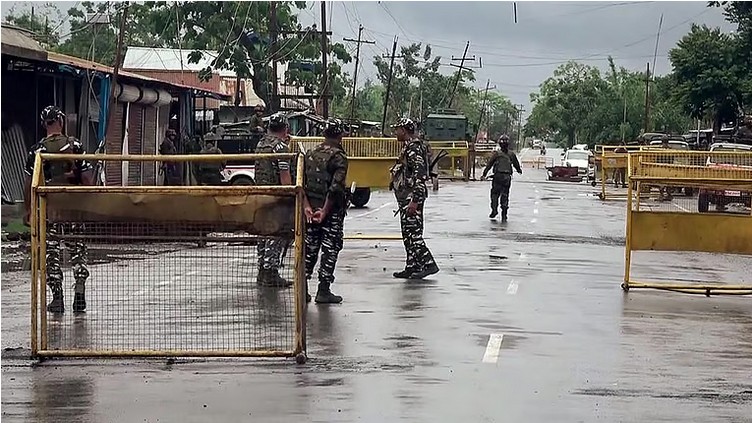
Highways, constitutionally and functionally, are national. They connect economies and families; they are the State’s most visible promise of territorial integrity and equal citizenship. NH-02 is not only the lifeline but also Manipur’s spine to the outside world. For the valley’s Meitei population, the persistent message has been blunt – you can travel up to the “buffer”; beyond that line, even with escorts, you face uncertainty. For hill communities, risk that makes any relaxation feel premature without overwhelming central security guarantees.
The PIB’s phrasing (“decided to open NH-02”) projects resolution. KZC’s clarifications recast it as continuity with conditions: the road has not been blocked, but movement must respect buffer protocols. That is not just semantic hair-splitting. It tells us the “free movement” announcement is, at best, an administrative decision to increase central security presence along the highway, not to dismantle the buffer geometry that differentiates who can travel where. In other words, the Centre is promising a managed corridor, not the restoration of universal access.
The danger here is theatre – convoys of essential goods escorted to prove a point ahead of a political visit, even while ordinary Meitei commuters remain effectively barred from crossing the buffer, and Kuki-Zomis remain anxious about retaliatory flows into “their areas”. If the highway continues to be a stage for competing narratives rather than a bridge between communities, both sides will see confirmation of their worst suspicions – one, that the Centre is normalising a partition-like status quo; the other that the Centre is rewarding militant umbrellas – the UPF-KNO – with political leverage.
A Fracturing Kuki-Zo Consensus and Why It Matters
The “Kuki-Zo” space is not monolithic. The Annexure-A list of constituents under UPF and KNO is long and diverse. The SoO binds “constituents,” but political and civil authority is diffused – church bodies, youth organizations, women’s groups, village councils, tribal-specific apexes, and militant umbrellas overlap and sometimes compete.
TIM’s detailed opposition and VVCC’s rejection of the KZC’s highway stance make this plain. TIM condemns the extension for enabling cadres (they specifically reference KRA links) to move freely and commit crimes across borders; they demand strict movement restrictions, Personal Security Officers (PSOs) for leaders for safety, and rehabilitation/skills programmes for cadres as conditions for peace. VVCC goes further – it labels the PIB storyline an “exchange” (open highway for SoO extension), rejects any free movement of Meiteis “within Kuki-Zo territories” until a separate administrative arrangement is recognised, and declares a boycott of the KZC – arguing SoO signatories do not represent “Kuki-Zo” political aspirations.
Two implications follow.
First, the State has negotiated peace with umbrella signatories whose authority is being openly contested by powerful grassroots formations. Implementation will be hostage to this contestation. A highway is only as open as those who control the ground at the chokepoints.
Second, within Kuki-Zo politics, the tension between security demands (protect buffer zones, control inflows) and political demands (separate administration) is sharpened by the Centre’s messaging. The PIB’s emphasis on “territorial integrity of Manipur” and “negotiated solution under the Constitution” blunts secessionist edges, but also risks being read as a bait-and-switch if parallel political talks do not advance. KZC, in its clarification, tactically welcomes the SoO extension while reiterating the hope for renewed dialogue on a separate administration; VVCC frames that as betrayal; TIM frames the extension as impunity. This triangulation is combustible.
The Valley’s Lens: Abrogation Ignored, Buffers Unmoved
On the Imphal valley side, Manipur cabinet and the Manipur Legislative Assembly resolutions to abrogate the SoO and the call by Meitei and Naga organizations to scrap it outright were political markers of deep distrust. The May 2023 violence, which began in Churachandpur and led to the mass displacement of Meiteis from Kuki-Zomi-dominated areas, has hardened perceptions that several SoO-covered cadres were active participants in attacks, arms looting, and village burnings. Against that memory, simply “renewing” the SoO, even with tougher ground rules, looks like a reward rather than a reset.
The buffer regime reinforces the perception of asymmetric rights – militants get camp protections and movement leeway; Meitei civilians cannot cross to their old homes, graves, or churches/temples/sacred sites across the line. The PIB promise of a freer NH-02, when immediately qualified by KZC’s buffer caveat, thus lands in the valley as another instance of the Centre dressing up the status quo. VVCC’s categorical “no free movement for Meiteis” inside “Kuki-Zo areas” merely vocalizes what Meitei families have experienced for more than two years.
Into this mix comes the COCOMI statement of September 5, 2025, which crystallizes the valley’s sense of betrayal. Calling the KNO and UPF “Chin-Kuki narco-terrorist groups,” COCOMI condemns the extension as “anti-people,” “illegitimate,” and imposed by a New Delhi-appointed administration under President’s Rule without the mandate of the Manipur Assembly. It argues that the GOI has wilfully disregarded the Assembly’s unanimous resolution of February 29, 2024 urging abrogation, thereby trampling democratic norms. Most strikingly, it frames the extension as India legitimizing narco-terrorism while holding the Meitei population “hostage at gunpoint” under the influence of armed groups. In this framing, SoO is not just appeasement but collusion, and “free movement” is a bargaining chip that mocks the constitutional right of every citizen to travel freely.
While the Arambai Tenggol has remarked that the renegotiated SoO agreement between Centre and Kuki militants is an initiative which is crucial for achieving peace and further expressed unwavering support to any government initiative aimed at restoring order and tranquillity within the state.
In a statement, Arambai Tenggol said “we stand steadfast in its dedication to fostering peace and normalcy across Manipur. Our organization has been actively cooperating and coordinating with the efforts of the Ministry of Home Affairs (MHA) and the State Administration to chart a positive path forward. We are unwavering in our support for any initiative aimed at restoring order and establishing lasting tranquillity within the state.”
Politically, extending the SoO without simultaneously announcing a credible, time-bound civilian return and restitution plan – escorted visits, property surveys, compensation schedules, legal processes – means the Centre has prioritized quieting guns over rebuilding a common civic space. That may be a necessary sequencing in a war-like moment, but it carries a cost: it tells those expelled that their right to return is secondary to the militant umbrellas’ right to bargain. While Arambai Tenggol welcome the renewed SoO COCOMI’s rejection thus sharpens the valley’s reading – this is not peace-building; it is hostage management.
The Law-And-Order Paradox
The SoO’s classic logic is “freeze while we talk.” In a textbook counter-insurgency grammar, it reduces contact between combatants (state and non-state), crimps opportunities for violence, and opens room for politics. But the Manipur crisis since 2023 is not a simple insurgency. It is a layered ethnic confrontation with armed participation on both sides, shadow patronage networks, trans-border flows of weapons, and geopolitics. In that context, freezing one umbrella’s cadres does not automatically freeze violence. It can even reallocate it – proxies, “volunteers,” and unaffiliated mobs carry the fight as suspected since May 3, 2025 while signatories remain formally compliant.
That is why accountability architecture matters more than ever. The revised SoO mentions a Joint Monitoring Group as was in the earlier agreements, but if it continues the old model – confidential meetings, opaque violation logs, and quiet reprimands – it will be dead on arrival in the court of public trust. The enforcement regime must look, and be, different – public dashboards of compliance (camp relocations completed, weapons moved, verification progress), independent observers, and automatic, pre-declared sanctions for specific violations (curtailed travel, camp suspension, funding freezes). Anything less will be spun as collusion.
Similarly, “foreign nationals” language in the PIB note is significant. But most of them are suspected now to be treated as Indian citizens and some of them holding even Indian Passports. Verification that leads to de-listing is sensitive in the Kuki-Chin cross-border context; it will require proof thresholds, appeal rights, and careful public communication to avoid inflaming identity anxieties. But it cannot be a rhetorical flourish; if invoked, it must be a measurable process. Before de-listing, establishment of Indian citizens in Manipur is a prerequisite.
What “Buffer Zones” Have Become and Why the SoO Ducks Them
KZC’s clarifications insist on respecting “buffer zones” between Manipur Central Valley and “Kuki-Zo areas”. Security forces might have shaped these buffers to lower the risk of direct confrontation. But the question is why the Central Security Forces used the concept of “Buffer Zones” instead of security barricade. Over time, however, they have ossified into a new cartography – villages reflagged, villages bulldozed to the ground, abandoned homes re-occupied, rival memorials erected. Buffer lines are now identity lines – and the more they harden, the harder political reconciliation becomes.
The SoO extension could have, and should have, directly addressed this. A modern ceasefire is not only about guns; it is about mobility. A robust agreement would have laid out phased targets for restoring neutral corridors (NH-02 and other connectors), modalities for escorted civilian crossings, protocols for reopening markets at designated nodes, and shared policing of those nodes by mixed companies of Central Security Forces – not by de facto local vetoes. Instead, the agreement leaves buffer politics to parallel communications – like KZC’s reminders and VVCC’s rejections – where maximalist claims metastasize.
This is the core strategic risk – you can extend a truce and still deepen a partition.
The Politics of Timing
The calendar matters. A Prime Ministerial visit in mid-September – if it materializes—creates incentive for all actors to shape perceptions in the run-up. For New Delhi, the SoO-plus-Highway storyline projects progress and federal control. For KZC and allied signatories, welcoming the SoO while insisting on security-first buffer rules preserves leverage and avoids being framed as spoilers. For pro-United Manipur and Coexistence groups and valley organisations, highlighting the asymmetry and the SoO’s alleged role in the 2023 violence keeps pressure on the Centre to match any militant gains with civilian guarantees. For TIM and VVCC, asserting independent lines prevents their constituencies from being subsumed under KZC’s representation.
Expect, therefore, a flood of optics – escorted convoys, photo-ops at highway segments, joint meetings of the monitoring group, and rhetoric of “normalcy.” Expect also counter-optics – statements of rejection, calls for justice rallies, allegations of selective enforcement, and fresh petitions that the Assembly’s abrogation demand was disregarded.
So the optics are not irrelevant. They can deter opportunistic violence in the short run. But they should not be mistaken for resolution, and they cannot substitute for verifiable change in the two domains that matter most – a) Armed groups’ capacity to act, and b) Civilians’ capacity to move.
What A Credible Path Would Require Right Now
Given the documents available so far and the moment, five steps could convert this extension from theatre into traction.
1) Publish the enforcement clock.
Announce dates – within days, not months – for each operational pledge – precise deadlines for camp relocations and reductions; a schedule for weapons shifts to CRPF/BSF custody; and milestones for physical verification, including who conducts it and with what oversight. Put the Joint Monitoring Group under partial sunlight: a monthly public bulletin, not a black box.
2) Make the highway a genuinely neutral corridor.
If NH-02 is to symbolize national integrity rather than negotiated passage through fiefdoms, it must be secured and managed exclusively by Central Security Forces along the sensitive stretch, with fixed, well-publicised convoy times for all civilians who wish to travel – Meitei, Naga, Pangal, Kuki-Zomi, and others – escorted without discrimination. “Respecting buffers” cannot mean ethnic triage at road-heads. Where risks are high, mandate pre-registration for travel windows and provide emergency call-outs staffed by bilingual operators. The first few weeks will require saturation deployment; that is the price of restoring a national commons.
3) Pair SoO renewal with a civilian return protocol.
For displaced Meitei residents from hill districts (and, in some pockets, Kuki-Zomi from valley peripheries), announce a sequenced, escorted visitation programme to properties, followed by legal documentation of loss, compensation schedules, and options for rehabilitation or exchange. Nothing signals seriousness more than enabling a bereaved family to cross the line, visit a burned homestead, and file an official claim without fear. That is not a capitulation to any side; it is a reassertion of the democratic Republic’s duty.
4) Create a cross-community grievance docket with fast-track adjudication.
TIM’s demand for accountability and VVCC’s categorical rejects are, among other things, symptoms of an information vacuum. Establish a secure, time-bound channel (physical counters and an online portal) for filing allegations of SoO violations post-May 2023, with forensic teams to investigate and a published summary of outcomes (sanctions, prosecutions, or dismissals). Pair this with legal aid booths for victims from all communities.
5) Clarify the political horizon with candour.
KZC says it supports SoO extension and hopes for dialogue on Separate Administration. The PIB reiterates Manipur’s territorial integrity. These positions can be reconciled in only one honest way: by committing to structured talks on greater autonomy, administrative devolution, and guarantees for land/identity protections “within” the Constitution, while ruling out territorial dismemberment. Ambiguity is not a strategy; it is an accelerant.
Reading the Subtext of Available Documents
A critical analysis should also read the posture in the documents’ phrasing.
Annexure-A (constituents list) of the renewed SoO agreement underscores the multiplication of armed brands under UPF and KNO. For the State, this makes collective enforcement both necessary and fragile. One rogue band can spoil compliance; one factional split can deny plausible deniability. Consolidation and disarmament pathways must be part of the next round.
The “Basic Principles” page locks in non-association with “other armed groups.” Given the realities since 2023, that clause is pivotal. If the monitoring group does not investigate and publicly attribute patterns of cooperation (e.g., shared checkpoints, common logistics), the clause will ring hollow. The onus cannot rest solely on FIRs in districts that remain polarised; it must flow from joint verification.
KZC’s clarifications are crafted to regain narrative control. By insisting NH-02 was never “closed,” they challenge the PIB’s framing and re-legitimate the “buffer” regime. By welcoming the SoO extension and invoking “separate administration” as a hope, they keep a foot in New Delhi’s tent and another in their movement’s base. This is smart politics, but it puts the Centre on notice: any gap between security guarantees and political progress will be weaponised as betrayal.
TIM’s media release draws a red line at impunity. Its rhetoric links the SoO to specific atrocities and names KRA, a SoO-affiliated group, in relation to a Thadou leader’s murder in Assam. Whether or not prosecution proves that case, the charge spotlights a structural flaw: the SoO’s shield can become a cloak when accountability pipelines are clogged. TIM’s call for PSOs for leaders and movement restrictions for cadres is an appeal for equal protection and equal constraint.
VVCC’s rejection is the most maximalist – no free movement for Meiteis “within Kuki-Zo territories” absent recognition of a separate administrative arrangement. It is also a negation of the national highway’s neutral character. The State cannot treat that claim as a mere press line; it is a direct contestation of sovereignty on a national road. Whether VVCC can enforce this in practice is a separate question; the point is that it will try.
KWOHR’s rally call reminds us that for many Kuki-Zo families the last 26 months are not abstractions but funerals, burnt churches, and missing men. Justice demands – recognition of crimes, accountability, and dignity – are not incompatible with security logic; indeed, they must be integral to it. The absence of a clearly articulated justice track in the SoO rollout is a missed chance to reassure victims across communities.
The PIB release tries to serve three masters: demonstrate progress (NH-02), reassure Manipur’s unity lobby (territorial integrity), and promise stricter SoO implementation (camp/weapons/verification). It does not, however, confront the buffer regime’s political meaning or the Assembly’s resolution to abrogate. In federal comity terms, that is a bruise waiting to be pressed.
The COCOMI’s statement issued on September 5, 2025 adds another dimension: a frontal accusation that GOI is legitimizing “narco-terrorist groups” under the SoO pact. It situates the extension not as a tactical miscalculation but as a betrayal of democracy itself, since President’s Rule in Imphal has overridden both Cabinet (March 10, 2023) and Assembly (February 29, 2024) resolutions for SoO abrogation. Unlike TIM’s focus on impunity or VVCC’s on sovereignty, COCOMI frames the issue as systemic collusion that undermines India’s own credibility in combating narco-terrorism. The implication is stark – for valley civil society, the SoO is not just a flawed ceasefire but an existential compromise imposed against the will of the people.
Anticipating the Next Fortnight
Between now and the speculated PM visit, three scenarios are plausible:
- Managed calm with choreographed passage. Convoys of essentials and some mixed civilian traffic move along NH-02 under heavy central security cover. There are small protests and social-media wars, but no major incident. The visit projects an image of regained control.
- Symbolic sabotage. A single violent incident sends all actors scurrying to their corners. Each blames the other, and the buffer regime tightens; the SoO’s credibility is punctured before it begins.
- Negotiated stalemate. Movement occurs, but only for goods; “free” remains a misnomer for ordinary commuters, especially Meiteis seeking to cross. The SoO remains technically in force; trust does not.
The State must prepare as if (2) is the adversary’s objective and (3) is the default drift. Only aggressive transparency and visible equality of protection can tilt the table toward (1).
The Constitutional Lens: Rights, Representation, and Responsibility
At its core, this is a constitutional contest.
Right to free movement: Article 19(1)(d) is not absolute; it yields to public order. But such restrictions must be reasonable, non-discriminatory, and temporary. A “buffer regime” that differentially restricts movement by identity without a published review clock fails that test over time. The Centre and the High Court should require a sunset schedule and periodic justification.
Representation: Who speaks for whom is the plague of every peace process. UPF/KNO signatories can commit cadres; they cannot deliver unanimous community consent. That is why a parallel civic track – women’s groups, church bodies, valley and hill elders, student unions, CSOs – must be formally plugged into the monitoring group’s feedback loop. This is not “too many cooks”; it is how you prevent spoilers from claiming they were excluded.
Responsibility: Security forces manning security lines have the hardest job. They also carry the Republic’s face. Every differential treatment at a checkpost – every turned-back Meitei family, every unescorted “local” pickup allowed through – etches a memory. The Centre must invest in rotation, counselling, and embedded oversight to keep these lines professional and humane. It must also be willing to hold its own to account when lapses occur. Impunity is not a community monopoly.
The Endgame We Should Care About
Ceasefires are a means, highways are symbols, and visits are performances. The endgame is whether Manipur’s citizens particularly Meiteis will travel to other parts of India by road and connect with their counterparts in the rest of the country, and children will once again go on school trips across the State without armed escorts, whether markets will hum with mixed vendors and shoppers, whether churches and temples will ring without fear, and whether politics will replace gunmen as the final arbiter of power.
Extending the SoO was not, in itself, an error to general understanding. But extending it without a clock, without public enforcement metrics, without a civilian-first mobility and justice plan, and while leaning on a highway optic that immediately buckled under clarifications – that is not strategy; it is crisis management.
If the prime minister does arrive in the second week of September, he should not cut a ribbon on NH-02. He should instead cut through the euphemisms. He should announce the hard, unglamorous steps that restore equality of protection and movement, and the safeguards that make this SoO a break from the last one. He should invite all victims to a transparent claims process. He should tell the monitoring group to meet in public once a month. He should speak directly to the Assembly’s sense of being overruled and lay out the constitutional basis for each security decision. And he should call on every armed cadre to choose – in deeds, not press lines – between politics and violence.
Until then, an “open” highway ring-fenced by buffers will remain what it is today: a road that connects two worlds without letting them meet.
Bottom Line
The renewed SoO contains stronger operational promises (camp and weapons relocation; cadre verification), but lacks timelines, transparency, and a civilian mobility/justice track.
The PIB’s “opening” of NH-02 is a managed-corridor assurance, not the restoration of universal access. KZC’s clarifications put buffers back at the centre; VVCC’s rejection and TIM’s critique fracture “Kuki-Zo consensus” and complicate implementation.
For the valley, the extension despite the Assembly’s abrogation call – and without a right-to-return roadmap – reads like reward without redress. Valley civil society, led by COCOMI, sees the extension as illegitimate, undemocratic, and collusive with narco-terrorist groups. For them, the decision disregards both Assembly and Cabinet resolutions, reduces free movement to a bargaining chip, and holds the Meitei people “hostage at gunpoint.”
Without urgent measures for accountability and civilian restitution, the extension risks entrenching partition rather than reconciliation.
Before the PM’s visit, the government’s focus should be measurable enforcement, neutral highway security, escorted civilian crossings, and an open grievance/claims pipeline. Anything less will be seen as optics.
Peace rarely arrives in headlines. It arrives in timetables, escort rosters, verified lists, and queues at claims counters. If this SoO is to mean more than previous ones, it must be judged not by what it promises in preambles, but by what it delivers at gates.

Senior Editor: Imphal Review of Arts and Politics