

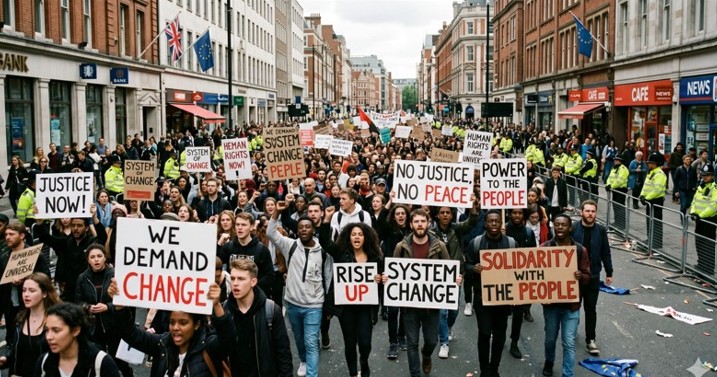
Public agitation has always been an integral feature of political life, from anti-colonial uprisings to contemporary movements against inequality, identity-based exclusion, and state excess. Yet what is often less examined is not the protest itself, but the grammar of power – the repertoire of strategies through which states respond to, reshape, and ultimately manage dissent. Across regimes and historical periods, authority has rarely relied on a single method. Instead, it operates through a calibrated combination of coercion, negotiation, co-optation, and increasingly, technological control. Over the past five decades, particularly in Western democracies, these techniques have undergone significant refinement, producing a more sophisticated architecture of what might be called managed dissent.
The most visible instrument remains coercion. States continue to invoke legal frameworks to criminalize protest, much as colonial regimes once did under measures like the Rowlatt Act. In contemporary contexts, this takes the form of anti-terror laws, emergency provisions, and expansive policing powers. Yet coercion today is often carefully calibrated. Western states have increasingly adopted so-called “less-lethal” methods, such as tear gas, rubber bullets, tasers, etc., designed to control crowds without the overt brutality that might provoke widespread outrage. Techniques such as kettling, where protesters are contained within confined spaces, exemplify a shift from indiscriminate repression to spatial and tactical management. The militarized police response during events like the Ferguson unrest demonstrated how even democratic states can deploy overwhelming force while maintaining a narrative of legality and order.
However, coercion alone rarely suffices. Indeed, excessive force can backfire, generating sympathy for protesters and eroding the legitimacy of the state. It is here that co-optation emerges as a subtler, yet equally potent, strategy. By incorporating dissenting voices into institutional frameworks, through advisory roles, policy consultations, or electoral participation, states transform opposition into partnership. The historical example of B. R. Ambedkar illustrates how radical critique can be translated into constitutional reform. In contemporary Western contexts, this process is often mediated through networks of NGOs, think tanks, and philanthropic funding, which shape both the language and the limits of dissent. What appears as inclusion may, in effect, function as containment.
Alongside co-optation operates the enduring logic of division. Movements derive strength from unity; states, therefore, have long sought to fragment them. While colonial governance relied on broad social cleavages, as dramatically exemplified by the Partition of India, modern strategies are increasingly granular. Digital technologies enable micro-targeting, allowing political actors to address, and often deepen, divisions within protest constituencies. Social media ecosystems amplify internal disagreements, producing what might be termed a condition of networked fragmentation, where solidarity is continually undermined by algorithmically driven polarization.
Equally crucial is the battle over meaning. As Michel Foucault observed, power operates not merely through force but through the production of truth. Governments and aligned media apparatuses shape the narrative around protest, framing it as disorder, extremism, or even threat. During movements such as Occupy Wall Street, public discourse often shifted from the substance of economic inequality to questions of legitimacy and lawfulness. In this discursive terrain, to delegitimize a movement is to weaken it at its core.
When confrontation risks escalation, states frequently pivot to negotiation. Agreements like the Good Friday Agreement, and many other instances of negotiations, demonstrate how dialogue and compromise can transform prolonged conflict into institutional stability. Yet negotiation is seldom a surrender of power. More often, it is a strategy of managed de-escalation, offering limited concessions sufficient to defuse immediate tensions while preserving underlying structures. Promises of reform, committees of inquiry, and incremental policy adjustments serve to pacify dissent without fundamentally altering the status quo.
Time itself becomes an instrument of governance. Bureaucratic delays, extended consultations, and procedural complexities can exhaust movements that rely on sustained momentum. As public attention shifts and internal divisions emerge, the initial energy of protest dissipates. This temporal strategy is particularly evident in responses to contemporary issues such as climate activism, where acknowledgment often substitutes for action, and urgency is gradually absorbed into the slow rhythms of policy-making.
At a deeper level, modern states sustain authority through what Antonio Gramsci described as hegemony – the blending of coercion with consent. Welfare measures, subsidies, and targeted benefits mitigate grievances and integrate discontented populations into the existing order. In Western democracies, this has evolved into a welfare–security nexus, where social provision coexists with expansive surveillance and policing. Citizens are simultaneously cared for and monitored, their material needs addressed even as their political behaviours are subtly regulated.
Perhaps the most significant transformation of recent decades lies in the rise of digital governance. Social media platforms, once celebrated as tools of democratic mobilization, now function as sites of both organization and control. Algorithms determine visibility, while data analytics enable the anticipation and disruption of protest before it fully materializes. This shift toward anticipatory governance marks a new phase in the management of dissent.
Finally, there is the subtle process of symbolic absorption. States often neutralize movements not by suppressing them, but by embracing their imagery and language. Slogans are adopted, leaders are commemorated, and causes are acknowledged in official discourse. Movements such as Black Lives Matter have entered mainstream vocabulary, even as the structural changes they demand remain contested. In this way, dissent is transformed into cultural consensus – recognized, even celebrated, but stripped of its disruptive force.
Taken together, these strategies reveal a fundamental paradox. Modern states, particularly democratic ones, must allow dissent as a marker of legitimacy; yet they must also ensure that such dissent does not exceed manageable limits. The result is not the elimination of protest, but its continuous modulation. Public agitation is fragmented, absorbed, narrated, delayed, and, when necessary, suppressed, until it becomes governable.
The history of protest, therefore, cannot be understood apart from the history of its management. Power does not merely confront resistance; it learns from it, adapts to it, and reshapes its possibilities. In the contemporary world, the most effective form of control may not be the silencing of dissent, but its careful orchestration, where voices are heard, but only within boundaries that power itself defines.
What distinguishes movements that successfully defy these layered strategies of control is not merely their capacity for mobilization, but their ability to sustain coherence under pressure. Across diverse contexts, from the campaigns of Mahatma Gandhi to the civil rights struggles led by Martin Luther King Jr., certain recurring features become evident: a moral or ideological clarity that resists delegitimization; organizational cohesion that prevents fragmentation; and a strategic adaptability that moves fluidly between protest, negotiation, and institutional engagement. Equally crucial is the capacity to shape public narrative and to endure over time, outlasting the state’s reliance on delay and fatigue. In many cases, successful movements also expand their arena of struggle, whether by forging broad social coalitions or by internationalizing their cause, thereby exceeding the confines within which power seeks to contain them.

The writer is Assistant Professor, Imphal College