In Manipur today, everyone from elders in village to students and even small children talk about the “SoO with Kuki groups”. The term has become part of everyday conversation, often mentioned with a mix of suspicion, frustration, or resignation. Simply put, the Suspension of Operations (SoO) is a ceasefire agreement signed in August 2008 between the Central Government, the Manipur Government, and Kuki-Zo insurgent groups. Originally rooted in an informal 2005 understanding between the Indian Army and some groups, the formal SoO sought to reduce direct confrontations with security forces.
Under this pact, the militant outfits agreed to stop attacking security forces and carrying out violent activities. In return, the security forces suspended offensive operations against them. The cadres were supposed to stay inside designated camps, receive monthly stipends, and eventually enter into a political dialogue to address their grievances. The agreement was never meant to be permanent. It was designed as a temporary measure to create space for talks while preventing daily bloodshed. Yet, over the years, it became the central reference point in discussions about hill-valley tensions.
Instead of achieving lasting deterrence against militancy, the pact inadvertently fostered competition among armed factions, enabled parallel governance, and contributed to the conditions that exploded into the ethnic violence of 2023–2026.
Intended Deterrence vs. Ground Realities
The core logic of SoO was straightforward: suspend offensive operations against Kuki insurgent groups in exchange for monitored camps, stipends, and eventual talks on demands (often including greater autonomy or a separate administrative arrangement for Kuki-Zo areas). An unwritten but important conditionality was also the cooperation by the Kuki insurgent groups with security forces in offensive operations against valley based insurgent groups (VBIGs), and denying VBIGs transit and bases in Kuki dominated areas. Ground rules prohibited recruitment, extortion, movement outside camps with arms, and involvement in civilian disturbances.
In practice, enforcement proved weak. Reports repeatedly surfaced of violations unauthorised camps, continued influence over civil society organisations, links to poppy cultivation and drug networks, and intimidation in hill districts. Weapons inspections sometimes found arms intact, and cadres allegedly maintained operational capabilities.
The pact froze active conflict with the state, and did help in operations against VBIGs, but it did not dismantle the organisational structures or ethnic mobilisation potential of the groups. This created a “neither peace nor war” limbo where armed outfits retained legitimacy and resources while operating in a grey zone.
What Went Wrong with the Centre’s Effort of Sama, Dama, Bheda, Danda?
For decades, the Central Government has relied on the ancient Indian strategic principles of Sama (conciliation and dialogue), Dama (incentives, financial benefits, and appeasement), Bheda (division or creating splits among groups), and Danda (use of force or punishment) to manage insurgencies in the Northeast.
In the case of the Kuki-Zo groups, the SoO heavily emphasised Sama (offering political dialogue) and Dama (providing camp allowances, stipends, and official recognition). There was limited success with Bheda (managing factionalism), and Danda (strict enforcement or punishment for violations) remained conspicuously weak due to enforcement challenges and political considerations. This approach brought a temporary pause in direct hostilities but failed to deliver sustainable peace. Critics argue that excessive reliance on Dama without credible Danda created moral hazard: groups faced little cost for violations, retained their armed structures, and even strengthened their influence through parallel governance in the hills. The absence of firm accountability allowed factional competition to grow rather than shrink. When the state later attempted stricter measures (closer to Danda), it triggered sharp backlash that spiralled into wider ethnic conflict.
In a state where almost every community has its own ethnic insurgent groups – Nagas, Meiteis, Kukis, and others – the Government of India chose to sign the SoO only with the Kuki-Zo groups. This selective approach itself created fresh divisions and deepened mistrust between communities. Signing the SoO was widely perceived not as a tool of deterrence, but as a partisan award for doing bad things. Groups that had taken up arms were given official recognition, financial stipends, and a seat at the negotiation table, while others who had not been as aggressive felt sidelined. Instead of discouraging militancy, it appeared to reward it – as long as the militants did not target security forces and instead victimized civilians. The Central Government’s well-intentioned effort thus produced the opposite of deterrence it institutionalised a grey zone where armed legitimacy persisted, ethnic consolidation continued, and trust between communities eroded. Having largely exhausted Sama and Dama, the question that now confronts New Delhi is stark and urgent: Will the GOI finally muster the political will to implement Bheda and Danda?
How SoO Created Competition Rather Than Deterrence
One unintended consequence was the proliferation and sharpening of competition among armed groups themselves. Manipur’s hills have long seen ethnic fragmentation: Kuki groups splintered in response to Naga assertions in the 1990s, and new outfits emerged as counters to existing ones. The SoO framework, by providing a form of official recognition and financial sustenance (through stipends and camp allowances) to signatory factions, arguably incentivised factionalism.
Groups or splinter factions could position themselves as “responsible” interlocutors to secure or retain SoO status, gaining access to talks and resources while rivals faced selective pressure. This dynamic encouraged competition for territorial control, influence over villages, and the narrative of representing Kuki-Zo interests. Rather than deterring violence, the pact sometimes amplified intra-ethnic rivalries and inter-group jockeying, especially in resource-rich or strategically sensitive border and forest areas.
Civil society bodies and political fronts linked to SoO groups gained visibility, sometimes blurring lines between militancy and mainstream activism. Critics contend this strengthened the hold of insurgent-linked networks on public life in the hills, rather than marginalising them. The availability of a ceasefire “umbrella” reduced the immediate cost of maintaining armed cadres, allowing groups to focus on long-term ethnic consolidation land claims, demographic assertions, and resistance to government policies, without fully disarming.
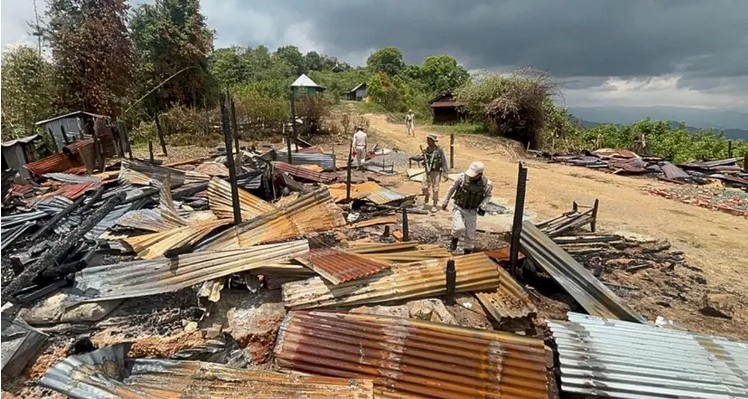
When the Manipur government under Chief Minister N. Biren Singh moved against alleged forest encroachments and drug-related activities in early 2023, protests erupted that authorities linked to SoO-influenced groups. This escalated into the broader Meitei-Kuki ethnic conflagration from May 2023, with hundreds killed, thousands displaced, and deep societal segregation. Armed elements on both sides resurfaced or were accused of involvement, highlighting how the SoO era had not neutralised militant capacities but redistributed them into ethnic fault lines. The agreement’s selective application and perceived one-sided benefits (primarily with Kuki-Zo groups) also bred resentment in the Meitei-dominated valley, framing SoO as a tool that empowered hill-based assertions at the expense of the state’s territorial integrity. Instead of deterrence through credible monitoring and progressive demobilisation, the pact arguably institutionalised a parallel power structure that competed with the state.
Biren Singh’s Shifting Stance: Personal Vindication and Political Irony
Then Chief Minister N. Biren Singh’s government repeatedly highlighted SoO violations, citing them as factors in unrest, including rallies and agitations. In March 2023, the state withdrew from the agreement with specific groups like the Kuki National Army (KNA) and Zomi Revolutionary Army (ZRA), citing their alleged role in disturbances. The Manipur Assembly later passed resolutions urging the Centre to fully abrogate the pact with Kuki-Zo groups, arguing it undermined peace and security. Biren Singh positioned his tough stance as necessary to restore law and order, protect forest lands, and counter what he saw as externally influenced or drug-linked activities. Post-violence, he and his allies framed the conflict partly as a consequence of unchecked SoO-era activities. This narrative served as a form of personal and political vindication: actions against encroachments and demands to scrap SoO were portrayed as prescient, even if they coincided with the outbreak of wider ethnic clashes. Yet this position carries notable irony and political baggage.
The original SoO framework was negotiated and signed during the Congress regime of Okram Ibobi Singh (2002–2017), with the formal tripartite agreement in 2008. Biren Singh, then a Congress MLA and part of the political ecosystem under Ibobi, operated within a system that sustained and periodically extended the pact. Okram Ibobi Singh, in all his three terms as Chief Minister (2002–2017), never publicly highlighted or strongly acted upon the SoO pact violations, despite occasional reports of ground rule breaches. Biren Singh himself served as a minister in Ibobi Singh’s cabinet and was part of the ruling Congress dispensation that routinely sustained and extended the tripartite agreement. He later quit Congress in 2016 amid intra-party revolt before joining the BJP and becoming Chief Minister in 2017.
After becoming Chief Minister in 2017, Biren Singh maintained pragmatic participation in the SoO framework throughout his entire first term (2017–2022). The agreement was routinely extended with central involvement and state consent, without any sustained public criticism or demand for abrogation from him. It was only in the middle of his second term, around early 2023, that Biren began vocally highlighting violations and pushing for withdrawal or non-extension. The afterthought claims that “the state” was not agreeable to the pact or that it was imposed without full state consent sit uneasily with this history. The tripartite nature meant the Centre held significant leverage, but the Manipur government under both Ibobi and early Biren eras was formally part of the agreements and extensions. Biren Singh himself, as an MLA in the Ibobi government, belonged to the ruling dispensation that backed the pact’s continuation.
Critics argue this timing reflects a shift driven more by rising ethnic polarisation and political expediency than by consistent long-term concern. This evolution emphasized how SoO became a political football. What began as a counter-insurgency tool evolved into a flashpoint: defended by some as a stabiliser during the Ibobi and early Biren years, and later condemned by others as a licence for parallel authority that ultimately fuelled competition and mistrust rather than genuine deterrence. The selective narrative of vindication sits uneasily against these historical continuities.
Lingering Lessons
The Manipur experience with SoO illustrates the risks of ceasefire agreements without robust verification, demobilisation timelines, or parallel governance reforms. Freezing violence can buy time, but when paired with ethnic mobilisation, weak enforcement, and competing territorial narratives, it can incubate deeper divisions. The 2023–2026 conflict, with its massive displacement and loss of life, exposed how such pacts may manage symptoms while allowing underlying armed ecosystems to adapt and compete. As of April 2026, the political landscape has shifted significantly. N. Biren Singh resigned in February 2025 amid mounting pressure, leading to nearly a year of President’s Rule. In February 2026, President’s Rule was revoked and Yumnam Khemchand Singh was sworn in as the new Chief Minister, with deputy chief ministers representing Naga and Kuki-Zo communities. Despite these changes and the SoO’s extension in September 2025 with revised (but weakly enforced) ground rules, demands for abrogation continue, while Kuki-Zo outfits press for a Union Territory. Renewed extensions reflect the Central Government’s efforts to salvage dialogue, yet the deeper challenge remains: translating suspension of operations into genuine deterrence requires dismantling incentives for factional competition and rebuilding trust across Manipur’s fractured hill-valley divide. Without that and without clearer movement toward Bheda and Danda, ceasefires risk becoming arenas for renewed power struggles rather than pathways to peace. The state’s burning literally and metaphorically serves as a stark reminder that political narratives around such agreements must confront historical continuities, not just selective vindication.

The author is Founder & Chairperson of ETA, Northeast Women’s Network