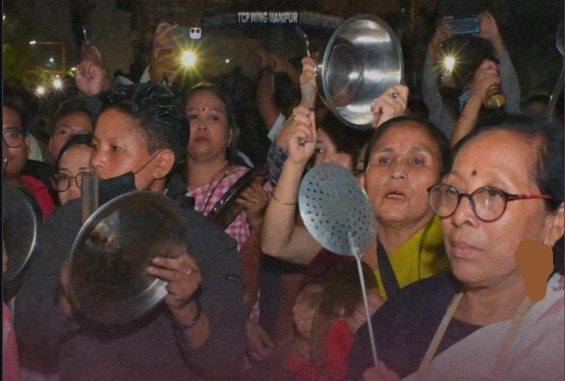
Sitting 1,700 km away from Manipur, in Delhi, on 23 October, between 7:30 pm and 8 pm, I freshly witnessed through my WhatsApp status feed people across Manipur using utensils such as kompak, khudeng, and pukham to beat out a collective rhythm. Manipur, with its reputation for kumhei erang wateh, and being the inquisitive person that I am, I asked my friends what was going on.
Some complained it as noise pollution. Some worried, as one should, about the animals and the elderly. Some danced. One comment described the action as a hysterical exhibition, while the masses understood it as collective solidarity against the silence of the institutions concerned.
From what I saw from far, the humour transpired. People participated with full vigour. Meira Paibis, people of all ages and various drum performers took to the streets. The sacred Kangla too had its holy beat. Outside Kangla, people climbed electric poles and enthusiastically beat out the rhythm. For some, the moment even turned into Thabal Chongba.
What struck me, however, was not merely the spectacle but the resistance that had provoked such massive participation. Humour, I began to think, was one of its collective manifestations. In a moment that could otherwise have been defined entirely by frustration, the act had made room for laughter. Coming to think of it, this collective manifestation had brought people together in a community of sorts.
The actions could be interpreted as anarchic, or understood through the dynamics of a power play. Yet, there was something remarkably accessible about the means through which people participated. The pukham, kompak, and khudeng, the beats, the dancing, and the laughter became a language understood across ages and sections of society. Humour strengthened the act, not by diminishing the seriousness of the resistance, but by making participation a shared experience.
Perhaps this is what makes humour such an interesting political tool. It can make dissent feel less intimidating, allowing people to participate through satire, exaggeration, and even play. With social media, memes, and AI-generated images and videos, the boundaries of political humour have become increasingly difficult to define. Such content can be morally, ethically, and sometimes legally questionable, yet this has not stopped people from creating and sharing it.
Humour offers a form of expression that may feel safer, even when the political questions beneath it remain serious. Coming back to Manipur, I find myself deeply grateful for those some people who got to laugh together, maybe some of them had not laughed in a long time!
This is not to dismiss the frustration of elders or the discomfort of the animals and those who are unwell, whose concerns deserve equal consideration. It is, rather, to recognise that resistance and laughter need not be mutually exclusive.
As the October and November hues arrive, almost every part of the country will be celebrating. In Manipur, however, we may still find ourselves unable to distinguish whether the sounds we hear are bombulas, the firecrackers of celebration, or the sounds of gunfire, tear gas, and bomb blasts. Yes, this chaos has become part of the identity of our home. When I think of the triggers and the many traumas that have pierced us, I wonder how we are taking it all in? Perhaps humour? Maybe these pukham, kompak, and khudeng will be remembered as a hilariously manifested act of resistance. Maybe, amidst all the frustration, the act has given people a reason to laugh together. In a land where being alive is the greatest privilege, may we laugh more as we heal.

The writer completed her postgraduation in Modern History from University of Delhi and her area of interest is in collective memory, historical trauma, conflict and healing relating to contemporary Manipur.