
The execution-style killing of a Meitei man in Churachandpur on January 21, 2026, filmed and circulated with political messaging, did not rupture peace in Manipur – it exposed the fiction that peace had returned at all. The act was not spontaneous, nor incidental, nor merely criminal. It was a calibrated act of terror, embedded within a larger pattern of coercive violence that includes the recent acts of violence – December 16, 2025 firing on Meitei settlements in Torbung and the January 5, 2026 bombing of Nganukon village – both in Bishnupur district bordering Churachandpur district. Together, these incidents reveal a deliberate strategy – to impose political outcomes through fear, to block rehabilitation and coexistence, and to hold democratic restoration or reinstatement of elected government hostage to militant demands, particularly the insistence on a Separate Administration as Union Territory with Legislature carved out of Manipur.
What is at stake is no longer only ethnic harmony or public order. What has collapsed is constitutional sovereignty itself. Manipur today is not simply disturbed; it is politically fractured, governed by overlapping and competing authorities where the Indian State’s writ is conditional, negotiated, and unevenly applied. In such a space, citizenship loses its substance. People remain Indian citizens on paper but live as stateless subjects within their own country, deprived of the most elementary guarantee of any republic – the right to life with dignity and protection.
The January 21 killing is emblematic precisely because of its symbolism. The victim, a Meitei man married to a Kuki woman, represented the most fragile yet essential antidote to ethnic absolutism – inter-community coexistence at the level of everyday life. His execution was accompanied by the caption “No peace, no popular government,” a phrase that strips away any ambiguity about intent. This was not a crime of rage; it was a political warning. It declared that normalcy, civilian rehabilitation, and reinstatement of elected government will be permitted only on militant terms. The gun, not the Constitution, the diktat, not the right, was asserted as the final arbiter.
This assertion did not emerge in isolation. On December 16, 2025, armed Kuki militants opened fire on Meitei settlements in Torbung when Internally Displaced Persons (IDPs) started to return, a village that has become a tragic symbol of Manipur’s unresolved conflict. The timing was significant. After years of extreme violence since May 3, 2023, there were tentative signs of de-escalation – limited civilian movement, cautious talk of rehabilitation, meetings for coexistence, and renewed speculation about restoring an elected government before the expiry of President’s Rule. The Torbung firing punctured that moment deliberately. It reminded displaced Meiteis that return would be punished, and it signalled to the State that any movement toward political normalisation would invite armed resistance.
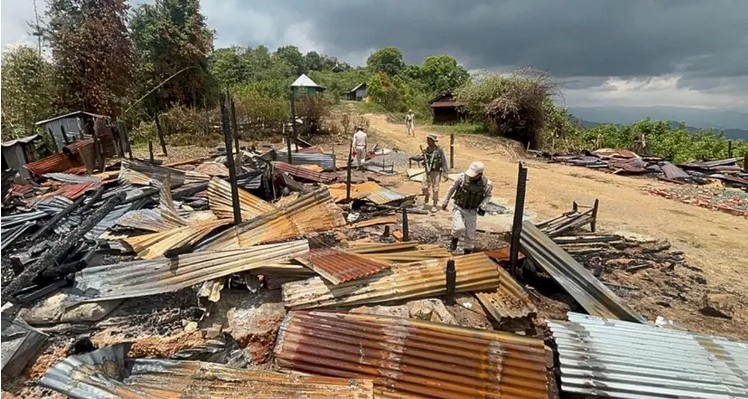
The January 5 bombings in Nganukon village followed the same logic. Bombs are not defensive instruments; they are tools of terror. Their use against civilian habitations cannot be explained as retaliation or spontaneous escalation. It was part of a sequence designed to sustain fear, prevent resettlement, and harden territorial divisions. When villages are bombed after months of relative calm, the intent is not survival – it is domination.
Read together – Torbung, Nganukon, and Churachandpur form a coherent political grammar of violence. The message is consistent – Meiteis cannot safely live, travel, or rebuild beyond narrowly defined zones; IDPs must remain displaced; coexistence is forbidden; and democratic processes will be disrupted until the demand for separation is conceded. This is not ethnic conflict in the conventional sense. It is terror as political negotiation.
Yet public discourse continues to dilute this reality by framing violence as “clashes” or “inter-community tension,” erasing the asymmetry between armed militants and unarmed civilians. This framing is not merely inaccurate – it is dangerous. It normalises coercion and obscures responsibility.
The distinction between the Kuki-Zomi militant groups under the SoO (Suspension of Operations) agreements with the Governments and Non-SoO groups further muddies accountability. In theory, SoO agreements are meant to reduce violence and create space for dialogue. In practice, they have produced a fragmented security environment in which armed groups operate with varying degrees of restraint imposed not by law but by political convenience. Whether the Churachandpur killing was carried out by a Non-SoO outfit such as the United Kuki National Army (UKNA) or by actors linked indirectly to SoO groups is, at one level, beside the point. The ideological objective is shared. Non-SoO groups function as enforcers and deniable instruments, while SoO groups benefit from the State’s reluctance to act decisively.
This arrangement has inverted constitutional logic. Executive agreements – lacking parliamentary sanction or constitutional standing – are effectively allowed to override fundamental rights. The right to life under Article 21, the freedom of movement under Article 19, and the equality before law under Article 14 have all become contingent, spatially restricted, and ethnically mediated. Such conditionality is the very definition of statelessness.
Statelessness here does not mean the absence of nationality. It means the absence of enforceable rights. A Meitei citizen cannot traverse National Highways within his own state. Large sections of Manipur’s hill districts are effectively out of bounds. Return to ancestral homes is blocked not by law but by armed veto. For Kuki-Zomis who oppose militancy or question the demand for Separate Administration, dissent carries lethal risk. Fear governs speech, movement, and association. When the State cannot guarantee rights across its territory, citizenship becomes hollow. This is statelessness without border crossing – a condition Hannah Arendt once described as the most radical form of political deprivation.
President’s Rule was imposed in Manipur on February 13, 2025 under Article 356, justified by the breakdown of constitutional machinery. In theory, this extraordinary measure empowers the Union to restore order, neutrality, and constitutional governance. In practice, President’s Rule in Manipur has functioned as an administrative suspension rather than a constitutional correction. Violence has continued. Militants remain armed. Civilians remain displaced. And executions occur under the watch of the Union government.
This raises an unavoidable constitutional question – what is President’s Rule for, if not to protect life and restore the rule of law? Article 355 imposes a duty on the Union to protect states against internal disturbance and ensure governance in accordance with the Constitution. That duty is not discretionary. It cannot be subordinated indefinitely to political risk management or geopolitical caution.
The persistence of militant violence under President’s Rule is therefore not merely a security failure; it is a constitutional failure. When the Union assumes direct responsibility for a state and yet cannot – or will not – prevent civilians from being abducted and executed, the legitimacy of that intervention itself comes into question.
Equally troubling is the impact on democracy. The prospect of restoring an elected government has been repeatedly floated, yet militant violence has intensified precisely to sabotage that outcome. The caption accompanying the January 21 execution – “No peace, no popular government” – should be read as a declaration of intent. Armed groups are openly asserting veto power over government formations as they dictated the voters to whom they vote in the last State Legislative Assembly elections in 2022. This strikes at the heart of representative democracy. If government formation can be prevented through terror, then sovereignty no longer resides with the people.
The Indian State’s response has been marked by hesitation and ambiguity. Massive deployment coexists with selective enforcement. Ceasefires are extended despite violations. Camps remain intact. Arms remain in circulation. Armed militants roam freely wherever they want. This is not a lack of capacity. It is strategic restraint, shaped by geopolitical considerations such as Myanmar’s instability, cross-border ethnic linkages, and counter-insurgency operations against the Meitei-led groups. These complexities are real, but they do not absolve the State of responsibility. Sovereignty that cannot be exercised because it is inconvenient is sovereignty already compromised.
The widespread perception of State complicity – frequently dismissed as conspiracy –emerges from this lived reality. When terror recurs without decisive response, when victims wait endlessly for justice, when Kuki militants grow bolder rather than weaker, citizens conclude that their lives are negotiable. Trust erodes not because of propaganda, but because of experience.
Perhaps the most corrosive consequence of this failure is social. The killing of a Meitei man married to a Kuki woman was also an act of internal repression. It warned Kukis who believe in coexistence that such beliefs are punishable. Militancy thus becomes not only anti-Meitei but anti-human, anti-civilian, anti-plural, and anti-democratic. It colonises identity and weaponises fear against its own community.
Manipur crisis therefore cannot be resolved through dialogue alone, especially dialogue conducted under coercion. Peace talks without disarmament are theatre. Rehabilitation without security is illusion. President’s Rule without constitutional enforcement is abdication.
The events of Torbung, Nganukon, and Churachandpur are not aberrations. They are symptoms of a deeper disease – the retreat of the constitutional State in the face of armed ethnic absolutism. If this retreat continues, Manipur risks becoming a permanent zone of suspended citizenship, not only the Assembly under suspended animation, where rights exist only on paper and sovereignty is fragmented among guns.
Can the Indian Republic afford this precedent? A state where citizens are executed on camera, highways are inaccessible, villages are bombed, and restoration of elected government are threatened by armed groups is not merely unstable – it is unmoored from constitutional order. Restoring peace in Manipur therefore requires more than calming rhetoric or managed ceasefires. It requires the reassertion of a simple, foundational principle – no armed group has the authority to decide who may live, where citizens may move, or whether democracy may function.
Until that principle is enforced, Manipur will remain what it increasingly resembles – a land where people carry Indian citizenship, but live without the protection of the Indian State.

Senior Editor: Imphal Review of Arts and Politics