
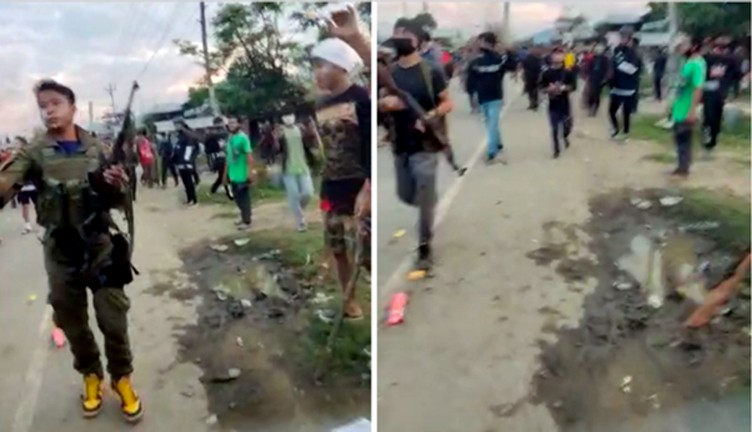
A new statement by a spokesperson of the United People’s Front (UPF), a Kuki-Zomi militant group under the Suspension of Operations (SoO) agreement with the Government of India (GOI) and the Government of Manipur (GOM), has reopened one of the most consequential and least examined questions surrounding the eruption of the violent conflict in Manipur on May 3, 2023.
In a video interview with The Hindu webcasted on September 18, 2026, Aron Kipgen, spokesperson of the UPF, said: “We were near an agreement with Centre on May 3, 2023.”
He went further. According to Kipgen, a crucial meeting between representatives of the Government of India headed by Union Ministry of Home Affairs (MHA) Security Advisor for the Northeast A K Mishra and Kuki National Organisation (KNO)-UPF leaders was held in Imphal on May 2, one day before the violence erupted. He said the Kuki-Zomi negotiating leadership was told that the 18-year-old peace process had reached a decisive stage and was close to a political settlement. He claimed that the violence derailed negotiations that could have culminated in an agreement in New Delhi. According to his account, the negotiations before May 2023 violence had focused on an autonomy arrangement with executive, financial and judicial powers, while the demand shifted after the violence towards separate administration, including a Union Territory with legislature or a comparable constitutional arrangement.
If accurate, this is not an ordinary statement.
It puts the political negotiations immediately before May 3 at the centre of the history of the conflict.
But Aron Kipgen’s statement must also be handled with precision. It does not, by itself, prove that the Government of India had already agreed to establish a separate Kuki-Zomi administration. Nor does it prove that the Centre had agreed to divide Manipur on ethnic lines.
What it does is potentially more important – it provides a first-person account from the KNO-UPF side that the negotiations were allegedly at a final or near-final stage immediately before the violence.
That account cannot simply be dismissed because it comes from one side of the negotiations. Nor can it be accepted as conclusive evidence.
It has to be tested against what was already publicly reported at the time.
And that is where the story becomes much more difficult to ignore.
The territorial-council formula existed before May 3
On May 22, 2023, The Indian Express reported that peace talks between the 25 Kuki-Zomi militant groups under the SoO agreement and the Government of India had been heading towards a conclusion before the violent clashes. The report stated that the groups had earlier agreed to a political settlement within Manipur but, following the violence, had shifted to demanding a separate administration.
More importantly, the report described the substance of the pre-May 2023 negotiations.
The peace talks had reportedly settled upon a model of providing “territorial councils” to the tribes of Manipur. The Kuki groups had proposed two territorial councils covering the ten hill districts – one for the Nagas and one for the Kuki-Zomi groups. The then Manipur government had proposed ten territorial councils, one for each hill district. The Centre had proposed a 2-2-1 formula, reportedly backed by the Zomi militant groups.
Furthermore, The Indian Express reported that a political settlement had been worked out by the end of April 2023 and that territorial councils were the proposed institutional mechanisms. The report said the Centre had proposed the 2-2-1 arrangement. It also reported that the proposal had subsequently become unacceptable to the Meiteis, while Kuki groups had moved towards a demand for a completely separate administration.
This establishes an important fact.
The idea of territorial political arrangements for different communities was not conceived after May 3. It was already part of the negotiations before the violence.
That is substantially different from saying that the Centre had secretly agreed to partition Manipur.
The evidence supports the existence of a negotiating formula. It does not, by itself, establish that the formula had acquired the status of a final constitutional agreement.
That distinction must be maintained.
But once it is maintained, another question becomes unavoidable.
How close was that formula to becoming an actual political settlement?
May 2: the missing day in the history of May 3
Aron Kipgen’s account makes May 2 potentially one of the most important dates in the history of the conflict.
If a meeting between KNO-UPF representatives and Government of India negotiators actually took place in Imphal on May 2, and if the parties were told that the 18-year-old process was approaching a decisive stage, then the day immediately preceding the outbreak of violence deserves considerably more attention than it has received.
The question is not whether a meeting took place merely as a matter of chronology.
The questions are:
What was discussed?
Who were the representatives of the Government of India?
Were there not representatives of Government of Manipur?
Who represented KNO-UPF?
What proposal was on the table?
Was the territorial-council formula still being negotiated?
Had the 2-2-1 proposal been accepted by the KNO-UPF side?
What issues remained unresolved?
Was there an understanding that the negotiations would culminate in New Delhi?
And what precisely did the phrase “near an agreement” mean?
These are not speculative questions. They are questions that should be answerable from government records, negotiating notes, minutes, correspondence and the testimony of participants.
If the Government of India and KNO-UPF were indeed close to an agreement on May 2, those records would be indispensable to understanding what happened on May 3.
Yet the public narrative of the conflict has largely treated May 3 as a beginning rather than as an event occurring in the middle of an already active political process.
That may be one of the reasons why the subsequent transformation of the conflict remains so difficult to understand.
What changed between May 2 and May 12?
The political transformation after the violence was extraordinarily rapid.
By May 8, 2023, the evacuation and transport of stranded Meitei community members from the Kuki-Zomi-dominated Churachandpur district to the Imphal Valley and members of Kuki-Zomi communities from Imphal to Kuki-Zomi-dominated hill areas was largely reported as completed or safely shifted under security protection.
On May 12, only nine days after the outbreak, all ten Kuki-Zomi MLAs of the ruling BJP and its allies issued a statement demanding a separate administration. They said the State had failed to protect their community and sought a separate administration under the Constitution.
This was a profound departure from the territorial-council formula reported to have been under negotiation before May 3.
The distinction is not semantic.
A territorial council implies a form of autonomy within the existing State.
A separate administration implies a fundamentally different relationship with the State of Manipur.
A Union Territory with a legislature would go still further.
This is the political transformation that requires explanation.
Before the violence, the reported negotiation was about autonomy within Manipur.
After the violence, the principal Kuki-Zomi political demand increasingly became separate administration from Manipur.
The question is therefore not simply why violence occurred.
It is also: How did the political objective change so dramatically within days?
One explanation is plainly visible in the record – the violence, displacement and destruction generated an acute sense of insecurity among Kuki-Zomi communities in the Imphal Valley after they drove away Meiteis from Churachandpur, Kangpokpi and Moreh, and hardened their political position. Contemporaneous reporting described the Kuki-Zomi negotiating position as having hardened after the violence, with separate administration replacing the earlier settlement within Manipur.
That explanation has to be taken seriously.
But it does not close the historical question.
It makes the May 2 meeting even more significant.
Did the violence derail an agreement or create the conditions for a different one?
This is where the new statement by Aron Kipgen assumes particular importance.
Kipgen says the violence derailed a political settlement that could have culminated in New Delhi.
Contemporaneous reporting says something broadly consistent with the first part of that account – before May 3, the Kuki-Zomi militant groups were moving towards a settlement within Manipur; after the violence, they demanded separate administration.
But there is an important difference between saying “the violence derailed the negotiations” and saying “the violence was intended to derail the negotiations.”
There is an equally important question that lies between those two propositions:
Was the violence intended to create or justify the conditions for abandoning the earlier autonomy-based settlement and advancing the demand for separate administration?
To make such a claim would require evidence of planning, intent, communication or coordination.
But the question itself cannot simply be dismissed.
The political sequence makes it legitimate to ask.
A territorial-council formula was reportedly being negotiated before May 3.
The KNO-UPF side was, according to its spokesperson and others, near an agreement with the Centre.
Violence then erupted on a massive scale.
Within days, the political position of the Kuki-Zomi leadership shifted from an autonomy-based settlement within Manipur to a demand for separate administration.
The violence therefore demonstrably changed the political bargaining environment.
Whether it was a consequence of political failure, an unforeseen eruption of accumulated tensions, an instrument consciously intended to alter the negotiating position, or some combination of factors remains a question for evidence, not assertion.
That is precisely why the May 2 meeting matters.
From territorial councils to separate administration
The most consequential change after May 3 was not merely the scale of violence. It was the transformation of the political vocabulary.
Before May 3, the reported negotiations centred on autonomy and territorial councils.
After the conflict, the demand became “separate administration”.
On May 12, 2023, all ten Kuki-Zomi MLAs issued a statement demanding a separate administration under the Constitution, arguing that their people could no longer safely exist under Manipur, and they are already separated geographically and physically.
This was followed by increasingly explicit demands for a Union Territory with legislature.
Paolienlal Haokip’s later demand for three Union Territories went even further. His proposal was explicitly based on recognition of the ethnic separation of the State.
Thus, the political trajectory after May 3 can be described as a movement from autonomy within Manipur to institutional separation from Manipur.
That does not mean that the former caused the latter.
It means that the violence altered the political conditions under which the negotiations were conducted.
This distinction is critical to understanding the present crisis.
The Centre’s 2-2-1 proposal is more significant than it appears
The reported 2-2-1 proposal deserves particular scrutiny because it provides the strongest bridge between the pre-May negotiations and the later political demands.
According to The Indian Express, the Centre had proposed two territorial councils for Kuki-Zomi tribes, two for Naga tribes and one for the Meiteis.
This does not amount to the creation of three separate administrations.
But it does demonstrate that differentiated political and administrative arrangements based substantially on community and territorial considerations were being discussed at the highest level of the peace process.
That fact has implications far beyond the Kuki-Zomi negotiations.
A territorial council does not exist in a vacuum.
Its boundaries, powers, finances and jurisdiction affect other communities.
Indeed, Naga representatives subsequently objected to the possibility that the territorial arrangement might be determined through negotiations involving only the Kuki-Zomi groups and the Centre.
That objection exposes the central constitutional difficulty.
Who has the authority to negotiate the territorial future of Manipur?
The Government of India can negotiate with insurgent organisations as part of a peace process. That is a political reality.
But negotiating with an armed group is not the same as obtaining constitutional consent from all communities whose territory, institutions and political rights could be affected by the eventual settlement.
This distinction becomes particularly important when the proposed settlement concerns territorial administration.
Was the Centre already prepared to divide Manipur?
This is where the argument needs to be made carefully.
It would be tempting to connect the pre-May territorial-council formula directly to later demands for three Union Territories and conclude that the Centre had already agreed to divide Manipur.
What the evidence does show is more limited but still highly consequential.
The Centre had reportedly proposed a territorial-council arrangement.
The Kuki-Zomi militant groups were negotiating a political settlement within Manipur.
The negotiations were reportedly close to a conclusion.
A KNO-UPF spokesperson now says that the parties were near agreement on May 3 and that a meeting took place on May 2.
After the violence, the Kuki-Zomi side abandoned the earlier territorial-council position and demanded separate administration.
These propositions can be placed together without converting them into an unproven conspiracy.
The strongest defensible conclusion is therefore:
Before May 3, the Centre and KNO-UPF were reportedly negotiating a form of differentiated territorial autonomy within Manipur; after May 3, the political demand moved towards separation from the existing State structure.
That is already a major historical fact.
It does not require the additional – and presently unproven – claim that the Centre had agreed to partition Manipur.
But did violence become the political bridge to separation?
This is the question that cannot be avoided.
The separate-administration demand did not appear in a political vacuum after May 3. It emerged in the immediate aftermath of killings, destruction, displacement and the collapse of trust between communities.
The ten Kuki-Zomi MLAs justified their demand precisely in terms of the alleged failure of the State to protect their community. They argued that their people could no longer live under Manipur and sought a separate constitutional administration.
That argument has an internal political logic.
But it also creates a historical paradox.
If the earlier negotiations had already produced a framework for greater autonomy within Manipur, then the violence did not merely create insecurity. It rendered the earlier political compromise increasingly difficult to defend.
This raises the harder question:
Did the violence merely produce the circumstances in which separate administration became the preferred demand, or was the creation of those circumstances itself part of a political strategy?
The distinction is fundamental.
The first proposition describes a consequence.
The second describes an intention.
The evidence currently available is sufficient to investigate the first. It is not sufficient to establish the second.
But the possibility cannot be excluded merely because it is uncomfortable.
In a conflict where territorial control, ethnic consolidation and political separation have become intertwined, the relationship between violence and political demands must be examined with particular care.
If violence produces displacement, displacement produces territorial concentration, territorial concentration produces claims of insecurity, and those claims are then used to demand separate administration, violence can acquire a political consequence even without proving that its perpetrators consciously intended that ultimate outcome.
That structural possibility itself deserves investigation.
The three-Union-Territory demand came later
This distinction becomes even more important when Paolienlal Haokip’s later demand is brought into the discussion.
The BJP MLA explicitly advocated the reorganisation of Manipur into three Union Territories for the Meiteis, Kukis and Nagas, describing it as political and administrative recognition of ethnic separation.
His proposal was therefore substantially more radical than the reported territorial-council arrangement under negotiation before May 3.
The two should not be conflated.
Yet there is a political continuity between them – both involve institutionalising differentiated territorial governance along community lines.
That continuity explains why the pre-May negotiations matter to understanding later demands.
The later three-Union-Territory proposal did not emerge from a political vacuum.
But neither can it simply be described as the implementation of an agreement already reached before May 3.
There was an intervening historical rupture.
That rupture was the violence.
The missing day may contain part of the missing history
Aron Kipgen’s account therefore gives May 2 an importance that should not be underestimated.
If the meeting occurred, it represents the last known point in the chronology before the political transformation of the Kuki-Zomi demand.
On May 2, according to Kipgen, the peace process was nearing a settlement.
On May 3, violence erupted.
On May 8 evacuation of Meiteis from Churachandpur and Kuki-Zomis from the Imphal Valley reported as completed.
On May 12, the Kuki-Zomi MLAs demanded separate administration.
The sequence does not prove that one event caused the next.
But it establishes a historical transition that requires explanation.
The Government of India-appointed Commission of Inquiry was tasked with examining the causes and spread of the violence and possible lapses by responsible authorities or individuals. Its existence reflects the seriousness with which the State itself regarded the need to establish how the violence began and spread.
The May 2 negotiations should form part of that broader historical examination.
If the meeting took place, the relevant records should be examined.
If the peace process was close to conclusion, the exact status of the negotiations should be established.
If a territorial-council formula had been accepted in principle, its precise terms should be known.
If KNO-UPF was preparing to travel to New Delhi for a final agreement, that too should be documented.
And if there was no relationship between the negotiations and the subsequent violence, the evidence should establish that as well.
The danger of allowing violence to become the author of constitutional change
There is a broader constitutional issue here.
Political violence should not become the mechanism through which territorial arrangements are renegotiated.
This is not an argument directed at one community alone. It is a general principle of constitutional government.
If violence produces a new territorial reality, and that territorial reality subsequently becomes the basis for political reorganisation, then violence has acquired an indirect constitutional consequence.
Manipur has already experienced much of this process.
Violence produced displacement.
Displacement produced physical separation.
Physical separation produced hardened territorial identities.
Hardened territorial identities strengthened demands for political separation.
And political separation is subsequently presented as the solution to the insecurity produced by the separation.
This creates a dangerous circularity.
The longer the conflict continues, the more difficult coexistence becomes.
The more difficult coexistence becomes, the stronger the argument for separate administration becomes.
The stronger the demand for separate administration becomes, the more difficult territorial reconciliation becomes.
This is how a conflict can evolve from an insurgency and law-and-order crisis into a constitutional and territorial crisis.
The Centre’s responsibility is therefore not simply to restore normalcy
The Government of India cannot address this history merely by asking whether roads are open, camps are functioning, elections can be conducted or representatives can return to the Assembly.
The deeper question is whether the political architecture of the State is being reshaped by realities produced during the conflict.
If the pre-May negotiations contemplated territorial councils, the public has a legitimate interest in knowing what was proposed and why.
If the violence subsequently produced demands for separate administration, the public also has a legitimate interest in knowing how and why the negotiating framework changed.
And if the present political debate is increasingly concerned with territorial separation, then the historical connection between the pre-May settlement proposals and post-May political demands becomes even more important.
The issue is not merely what Kuki-Zomi leaders want.
It is also what the Centre was prepared to offer before the conflict, what changed after the conflict, and whether the State is now being asked to constitutionalise territorial realities that emerged through violence.
The question New Delhi cannot avoid
Aron Kipgen’s statement should therefore not be used simply to claim that the Centre had already agreed to partition Manipur.
That would go beyond the evidence.
Its significance lies elsewhere.
It provides a direct account from a participant in the SoO negotiations that the process was allegedly near a settlement on the eve of the violence. That account is broadly consistent with contemporaneous reporting that the Kuki-Zomi groups and the Centre had been working towards a territorial-council settlement before May 3.
The central question is therefore no longer merely whether a territorial-council proposal existed.
It did.
The question is how close it was to agreement.
And the question after that is even more difficult:
Why did violent conflict erupt on May 3, 2023 in Churachandpur and spread across Manipur precisely when the Government of India and KNO-UPF representatives were reportedly engaged in negotiations in Imphal approaching a political settlement?
No responsible analysis should answer that question without evidence.
But no serious history of Manipur should leave it unasked.
And another question follows:
Did the violence merely derail an emerging autonomy-based settlement, or did it create the political and territorial conditions in which the demand for separate administration could be advanced as the only viable alternative?
The still more difficult question – whether anyone intended the violence to produce or justify that political outcome – requires evidence that has not yet been established.
That is the line that must not be crossed.
But neither should the question be buried.
May 3 cannot be understood only from May 3
The history of Manipur’s conflict cannot begin on the morning of May 3.
The Tribal Solidarity March was the immediate context of the eruption. The Supreme Court later recorded that large-scale violence broke out on May 3 after the ATSUM march opposing the demand for inclusion of the Meitei community in the Scheduled Tribes list.
But the political history of that day began much earlier.
It included the long-running SoO process.
It included negotiations between KNO-UPF and the Centre.
It included competing proposals for territorial councils.
It included unresolved hill-valley political relations.
It included the Meitei demand for Scheduled Tribe status and opposition to it.
It included encroachment of reserved forest and establishment unrecognised villages.
It included destruction of forest and poppy plantations.
It included competing claims over identity, territory and political representation.
And, according to Kipgen, it included a decisive negotiation on May 2.
The importance of this chronology cannot be overstated.
If an agreement was genuinely close on May 2, then May 3 was not simply the day a peace process failed.
It may have been the day an entirely different political trajectory began.
From negotiated autonomy to the politics of separation
The most striking change since May 3 is therefore not only physical.
It is conceptual.
Before the violence, the reported negotiating framework imagined that different communities could receive enhanced territorial autonomy within Manipur.
After the violence, political discourse increasingly began to imagine Manipur itself as a collection of mutually exclusive ethnic territories.
The demand for three Union Territories articulated by Paolienlal Haokip made that political imagination explicit.
The earlier territorial-council proposal did not necessarily imply such a division.
But it did establish that differentiated territorial governance was already being considered.
That is why the two moments should be studied together without being conflated.
The pre-May territorial-council formula may have been an attempt to preserve Manipur while accommodating competing demands for autonomy.
The post-May separate-administration demand challenged the very premise of a common political home.
Between these two positions lies the violence of May 3.
That is the historical rupture that demands explanation.
The unanswered question
Aron Kipgen’s statement has therefore done something important even if every part of his account remains to be independently verified.
It has brought the political negotiations of May 2 back into the discussion of May 3.
That is where the investigation should begin.
The available evidence does not establish that the Centre had already agreed to create separate administrations for the Kuki-Zomi community.
It does establish that a territorial-council model was reportedly under serious negotiation before the violence.
It does not establish that the violence was deliberately organised to derail those negotiations.
It does establish that the violence was followed almost immediately by a dramatic hardening of the Kuki-Zomi political demand – from autonomy within Manipur to separate administration.
The distinction between these propositions is not a technicality.
It is the difference between evidence and allegation.
But preserving that distinction should not weaken the investigation. It should make it stronger.
The most consequential question may therefore not be whether the Centre had already agreed to divide Manipur.
It is whether a political settlement within Manipur was within reach on May 2 – and whether the violence of May 3 destroyed it, transformed it, or exposed how fragile it had always been.
And beyond that lies the question that remains politically and historically uncomfortable:
Did the violence simply create the conditions in which separate administration became a demand, or was creating those conditions itself part of a deliberate political strategy?
There is not enough evidence presently available to answer the second question.
But there is more than enough evidence to demand that it be investigated.
Because if the answer were ever established it would change not merely the understanding of the May 3 violence.
It would change the understanding of the political transformation that followed it.
The issue, ultimately, is not simply whether a territorial-council agreement existed before May 3.
It is whether the political future of Manipur was already being negotiated on May 2 – and whether, within twenty-four hours, violence fundamentally changed the terms on which that future would thereafter be contested.
That is why the May 2 meeting must be brought out of the shadows.
That is the missing history that must be recovered.

Senior Editor: Imphal Review of Arts and Politics



1 thought on “What Was Being Negotiated Between SoO Kuki-Zomi Leaders and Government of India in Manipur on the Eve of May 3, 2023?”
Great insights and questions!
Comments are closed.