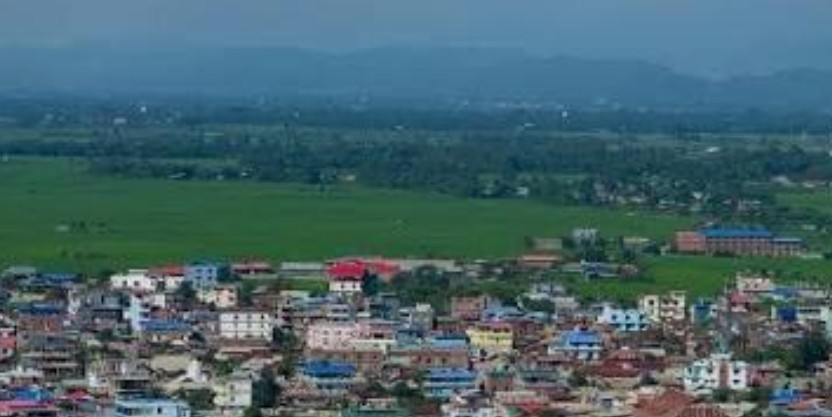
In the hill villages strung along the road from Kanglatongbi to Kangpokpi, mornings still begin the way they have for three generations: cattle led out to graze on reserved slopes first marked out by colonial officials in 1915, and pails of fresh milk carried down to roadside markets before the sun clears the ridge. The families who do this work belong to Manipur’s Gorkha community, whose two-hundred-year history in the state runs from frontier soldiering to a royal marriage, and now to the maize fields and small flour mills that dot the Senapati and Kangpokpi hills.
SOLDIERS OF THE KINGDOM
The Nepali presence in Manipur begins not with settlers but with soldiers. After the First Anglo-Burmese War of 1824–26 restored Gambhir Singh to the Manipur throne, Gorkha jawans from the 16th Sylhet Local Battalion were absorbed into his Manipur Levy. When the British Political Agency was established at Imphal in 1835, more Gorkhas arrived as guards, cooks and gardeners — a service population that would, over the following decades, help the Manipur durbar put downhill rebellions and guard the frontier.
By the 1890s, retired soldiers and graziers had begun settling permanently in the corridor between Koirengei and Kangpokpi. Named settlers — Subedar Gopal Singh Chhetri, Subedar Ran Singh Chhetri, Major Jit Bahadur Limbu among them — appear in the record at Kanglatongbi, Koirengei, Mantripukhri and Pangei by 1899. In 1915, the British formally set aside the Kanglatongbi–Kangpokpi Grazing Reserve, the ground on which much of today’s Nepali hill economy still stands.
A SUBEDAR WHO CHOSE THE KINGDOM
The community’s most storied figure is Subedar Niranjan Singh Chhetri. Once a sepoy in the British Indian Army’s 34th Native Infantry, he left that service to join the Manipur kingdom’s forces and was made a Subedar by Yuvraj Bir Tikendrajit Singh. When the Anglo-Manipur War broke out in 1891, Niranjan fought at Bir Tikendrajit’s side. After the British crushed the rebellion, he was hanged inside Manipur jail on 8th June 1891. In recent years, Niranjan Subedar’s memory has taken on fresh public weight: a statue raised in his honour at Kanglatongbi in 2021 stands as the community’s most visible claim to having bled for Manipur, not merely settled in it.
| “Gorkhas also contributed their might in safeguarding the freedom of Manipur.”
— Remarks made at the 2021 unveiling of the Niranjan Subedar statue, Kanglatongbi |
A PRINCESS FOR THE LAST MAHARAJA
If Niranjan Subedar’s sacrifice bound the community to Manipur through blood, the events of 18 June 1941 bound it through marriage. On that day, Maharaja Bodhchandra Singh — who would go on to become the last ruling king of an independent Manipur — married Ishwori Devi, a Nepali princess described in community histories as a cousin of the King of Nepal.
The wedding brought roughly forty-four Gorkha soldiers and attendants into Manipur in the queen’s retinue. They settled in and around Imphal, in what is now the Babupara area, grazing cattle and supplying milk to the royal household. Some later moved to the Kanglatongbi–Kangpokpi reserved areas, where many of their descendants remain today. Historians of the community credit the marriage with opening a fresh, palace-sanctioned channel of Nepali migration that continued until a foreigner permit system was imposed in 1946.
FARMING THE HILLS TODAY
Walk through Kanglatongbi, Charhazare or Kalapahar today and the inheritance of that settlement history is still visible on the ground. Grazing and dairying remain the backbone of the local Nepali economy — a direct continuation of the 1915 Reserve — with households milking cattle each morning and carrying the milk to markets in Kangpokpi and Imphal, much as families still do in the home villages of Nepal’s own hill districts.
Cultivation has broadened alongside grazing. From the early twentieth century, Nepali farmers took up maize as both a food grain and cattle fodder, along with vegetables and, where hill microclimates allow, small plots of wheat as a winter crop. As surplus grain grew, small local flour and grist mills sprang up to serve village clusters — grinding maize and wheat without the trek down to mills in the Imphal valley, and adding a modest but valuable stage of local processing to the hill economy.
LAND WITHOUT OWNERSHIP
This farming life rests, however, on uncertain ground — literally. Manipur’s land law bars non-tribal communities from buying land in the Hill Areas, which cover nine-tenths of the state, so Nepali cultivation there depends on colonial-era pattas and grazing-reserve allotments rather than freehold title. The Manipur (Hill Areas) District Council Act of 1971 added a further layer, bringing part of the Nepali-settled Kangpokpi tract under Autonomous District Council administration for a period lasting until around 2012, before court cases returned several settlement blocks to Panchayati Raj administration.
The result is a patchwork: Zila Parishad and Gram Panchayat units cover some Nepali villages, a Village Authority and Headman System governed the Irang cluster until 2008, and questions of jurisdiction resurface periodically in the courts. That uncertainty has, over the decades, drawn some families out of the more remote hill tracts and into a smaller number of larger, better-established settlements — even as grazing, dairying and grain milling continue to define daily life across the belt.
A STORY STILL BEING WRITTEN
Two centuries on from the first Gorkha jawans who marched into Manipur under Gambhir Singh, the community’s story remains one of incremental, hard-won belonging — soldier by soldier, marriage by marriage, patta by patta, sack of milled flour by sack of milled flour.
AT A GLANCE
| YEAR | MILESTONE |
| 1824–26 | First Anglo-Burmese War; Gorkha soldiers enter the Manipur Levy under Gambhir Singh. |
| 1835 | British Political Agency established at Imphal; Gorkha staff and guards accompany it. |
| 1891 | Anglo-Manipur War. Subedar Niranjan Singh Chhetri hanged alongside Bir Tikendrajit, 13 August. |
| 1915 | Kanglatongbi–Kangpokpi Grazing Reserve constituted for Nepali graziers. |
| 1941 | Maharaja Bodhchandra Singh marries Ishwori Devi, a Nepali princess, 18 June. |
| 1950 | Indo-Nepal Treaty and abolition of the foreigner permit system widen migration. |
| 1971 | Manipur (Hill Areas) District Council Act creates the ADC system in the hills. |
| 2011 | Census records 63,756 Nepali speakers in Manipur, concentrated in Senapati. |

The writer is a former Member of Parliament and a former Union Minister of State External Affairs and Education, Government of India.