The demand to end the proxy war in Manipur reflects a growing perception among sections of civil society and the general public that the continuing violence is not merely an ethnic confrontation between the Meiteis and Kuki-Zomi communities or Naga and Kuki-Zomi communities. At the heart of this perception is the suspicion that the Government of India is accommodating and using Kuki-Zomi armed groups as strategic proxies to counter indigenous insurgent movements, particularly those of the Meiteis and Nagas. The roles of the Suspension of Operations (SoO) agreement, alleged cross-border militant activities, the conduct of security forces and the prolonged failure to restore peace have reinforced this suspicion. The convergence of COCOMI and the UNC around the demand to end the alleged proxy war signals a significant development in Manipur’s civil society politics.
Beyond The Narrative of An Ethnic Conflict
The expression proxy war has acquired considerable political significance in Manipur because it challenges the conventional explanation of the crisis as an exclusively inter-community conflict between the Meiteis and Kuki-Zomi communities. It suggests that the violence has acquired dimensions extending beyond the immediate grievances, historical differences and competing political aspirations of the communities directly involved.
A proxy war, in its conventional understanding, occurs when a state or powerful political actor pursues strategic objectives through local armed organisations, political intermediaries or other non-state actors rather than engaging directly in open warfare. The armed organisations may have their own political motivations, but their activities can also serve the interests of a larger strategic project.
When civil society organisations in Manipur use this expression, they are making a serious allegation – that the prolonged instability is not simply the unintended consequence of ethnic hostility but is being sustained, exploited or manipulated by forces whose interests extend beyond the immediate violent conflict.
The Coordinating Committee on Manipur Integrity (COCOMI) has consistently questioned the explanation that the crisis is merely an ethnic confrontation. Its argument is that the scale, duration and geographical spread of the violence, together with the apparent inability or unwillingness of the authorities to bring it to an end, raise questions about the larger political and security framework within which the conflict is unfolding.
The United Naga Council (UNC), although initially maintaining a relatively cautious distance from the violent conflict involving Meitei and Kuki-Zomi communities, has increasingly expressed similar concerns from the perspective of Naga security, ancestral land, territorial identity and the activities of armed groups in Naga-inhabited areas.
Their convergence is significant because it extends the proxy-war discourse beyond the Meitei interpretation of the conflict. It suggests that concerns over armed organisations, security arrangements and the perceived failure of government institutions are creating common ground among different indigenous communities.
The term, however, represents a political and strategic assessment advanced by these organisations, not an independently established finding that the Government of India is directing the violence. The allegations require impartial investigation and evidence-based scrutiny.
COCOMI’s Interpretation: From Ethnic Confrontation to Proxy War
COCOMI’s use of the term proxy war predates the recent developments of 2026. On April 14, 2024, the organisation explicitly described the Manipur crisis as a proxy war allegedly waged by the Government of India through Chin-Kuki armed militant groups, which it characterised as narco-terrorist organisations. It argued that the violence against the Meiteis could not be understood merely as local ethnic hostility but had to be examined in the context of larger geopolitical calculations involving the Indo-Myanmar border and India’s strategic interests in the region.
This interpretation rests on several interconnected concerns.
First, COCOMI questions why a conflict that could have been contained through timely political and security intervention has continued for more than three years. The violence that erupted on May 3, 2023, was followed by widespread killings, destruction of homes, wiped out of villages, forced displacement, armed mobilisation and the emergence of geographical divisions between communities. More than 60,000 people were displaced, and large sections of the population continued to live in relief camps or under conditions of insecurity.
The question for COCOMI is not merely why the conflict began, but why it has remained unresolved despite the deployment of substantial central security forces, repeated interventions by the Union Home Ministry, President’s Rule and the subsequent restoration of an elected government.
The organisation interprets this prolonged failure to restore normalcy as evidence of a deeper political and security problem. It argues that successive interventions have concentrated more on managing the conflict than resolving its underlying causes. In this reading, the continuation of violence serves interests that do not necessarily correspond to those of the ordinary people of Manipur.
Second, COCOMI places considerable emphasis on the Suspension of Operations (SoO) agreement between the Government of India, the Government of Manipur and Kuki-Zomi militant groups. Formally signed in August 2008, the arrangement was intended to suspend armed operations by participating groups under agreed ground rules, with their cadres confined to designated camps and weapons kept under prescribed restrictions.
COCOMI contends that the SoO arrangement has outlived its original purpose and has become a mechanism through which the armed militant groups enjoy political accommodation and a degree of institutional protection without adequate accountability.
Its January 31, 2026, Manipur Kanba Khongchat (Save Manipur Rally) resolution explicitly linked the SoO arrangement to what it described as India’s proxy-war policy. The organisation alleged that the agreement had provided legitimacy and protection to Kuki-Zomi armed groups, enabling them to retain their organisational structures and exercise influence over civilian spaces.
The existence of the agreement does not, by itself, establish that the Centre is conducting a proxy war. Nevertheless, allegations that armed groups operating under the arrangement have violated its ground rules, participated in violence or maintained unauthorised armed activities demand transparent investigation. An agreement intended to facilitate peace cannot become an arrangement that weakens civilian security or undermines the rule of law.
Third, COCOMI connects the violent conflict with the wider problems of narco-terrorism, illegal poppy cultivation, cross-border networks and the security vulnerabilities of the Indo-Myanmar border. Its argument is that armed mobilisation cannot be understood independently of the political economy that sustains it.
Manipur’s geographical position, Myanmar’s continuing instability following the February 2021 military coup, the movement of armed organisations across the international border and illicit economic networks have complicated the state’s security environment. COCOMI suspects that armed networks and their political or strategic patrons may benefit from the prolonged fragmentation of Manipur.
At its May 3, 2026, Manipur People’s Convention, COCOMI called upon the state government to urge the Centre to end what it described as a proxy war against the indigenous people. It also demanded accountability for violence, action against narco-related activities and time-bound rehabilitation of internally displaced persons.
The Perception of Kuki-Zomi Militants As Strategic Proxies Against Meitei And Naga Insurgencies
Perhaps the most important dimension of the proxy-war argument is the widespread perception among sections of Manipur’s civil society and the general public that the Government of India has historically used, and continues to use, Kuki-Zomi armed groups as strategic proxies to contain, counterbalance or weaken the insurgent movements of the Meiteis and Nagas.
This perception is rooted in the history of insurgency in Manipur and the different political and security arrangements New Delhi has negotiated with armed organisations belonging to different communities.
In India’s Northeast, the Naga insurgency emerged in the 1950s, followed by the Meitei insurgency in the 1960s. The United National Liberation Front (UNLF), established in 1964, and subsequent Meitei insurgent organisations challenged India’s political authority in Manipur. The Naga movement, particularly the National Socialist Council of Nagalim (Isak-Muivah), pursued a political and territorial project extending beyond present-day Nagaland into Naga-inhabited areas of Manipur.
Kuki-Zomi armed organisations emerged prominently in the 1990s, particularly following the Naga-Kuki clashes, when Kuki settlements suffered attacks and displacement. Their emergence was initially presented as a response to Naga violence. Subsequently, several armed groups advanced demands for a separate political homeland or administration.
The historical sequence established a complex armed relationship in which Kuki-Zomi organisations became opponents of Naga territorial aspirations while also becoming participants in the wider insurgency dynamics of Manipur.
The subsequent policy of the Government of India towards these different insurgent movements has contributed to the perception of strategic selectivity.
The NSCN-IM entered into a ceasefire agreement with the Centre in August 1997 and subsequently engaged in prolonged political negotiations. Kuki-Zomi armed groups entered the SoO arrangement with the Assam Rifles first in 2005 and later formally with the Government of India and the Government of Manipur in August 2008, with their cadres accommodated in designated camps while negotiations continued. Meitei-led insurgent organisations, by contrast, largely remained outside comparable formal peace arrangements and continued to face counter-insurgency operations. The November 2023 peace agreement with the Pambei-led UNLF marked an exception, but the principal Meitei-led insurgent organisations have not collectively entered a similar political arrangement.
This difference has generated a fundamental question in public discourse – why have some armed organisations been accommodated within negotiated frameworks while others have continued to be treated primarily as targets of counter-insurgency operations?
The perception among sections of the Meitei public is that the SoO arrangement has provided Kuki-Zomi armed groups with organisational continuity, political access and a degree of institutional accommodation that could be exploited for purposes beyond the stated objective of peace negotiations.
More significantly, the International Crisis Group’s February 2025 report, Finding a Way Out of Festering Conflict in India’s Manipur, provides an important reference point for examining this perception. The report notes that Kuki-Zomi militant groups have reportedly collaborated with Indian forces in covert operations against other insurgents, including Meitei insurgents, since entering the SoO arrangement. It also records that the reported use of these armed groups in counter-insurgency operations generated widespread outrage among Meiteis.
The report further documents the perception among Meiteis that New Delhi had empowered Kuki-Zomi armed groups in a manner that would force Meitei militants to return from Myanmar and eventually enter peace negotiations with the Centre. It records this as a perception circulating among Meitei interlocutors, rather than establishing it as an official government policy.
This distinction is important. The reported collaboration provides a basis for examining the proxy-war allegation, but it does not establish that the Union government has systematically directed Kuki-Zomi armed militant groups to wage war against Meitei or Naga insurgents.
Nevertheless, the strategic logic underlying the public suspicion is clear. An armed organisation that has historically opposed one insurgent movement and subsequently entered into a security arrangement with the Indian state can potentially become a counterweight against other armed movements. In such a situation, the state may benefit from competing armed formations without directly assuming responsibility for every confrontation.
From this perspective, the Meitei and Naga concerns are interconnected. Both communities have experienced prolonged insurgencies and political negotiations with New Delhi. Both have territorial and political aspirations that have historically challenged aspects of the Indian state’s security and administrative framework. The perception that Kuki-Zomi armed militant groups are being politically accommodated while allegedly being used against these movements has therefore generated suspicion that the Centre is pursuing a strategy of managing one insurgency through another.
The Geopolitical Dimension And The Naga Security Question
Manipur’s geographical location adds another dimension to the proxy-war argument. Sharing an international border with Myanmar, the state occupies an important position in India’s Northeastern security architecture and its Act East Policy. Border management, insurgency, illegal immigration, refugee movements, transnational crime and connectivity with Southeast Asia intersect in this strategically sensitive region.
Myanmar’s continuing political instability has further complicated the situation. The conflict between the military regime and various resistance organisations has created insecurity along the border and opportunities for armed networks to operate across national boundaries.
COCOMI suspects that Manipur’s internal instability may be connected to strategic calculations that are not adequately disclosed to the public. In its interpretation, the state risks becoming an arena in which local communities bear the consequences of a larger geopolitical contest.
The UNC’s concerns have a somewhat different foundation. Its principal focus is Naga ancestral land, political identity, village security and the protection of Naga-inhabited areas. For much of the period following May 2023, Naga organisations maintained a relatively cautious position in the violent conflict involving Meitei and Kuki-Zomi communities. However, tensions and armed confrontations involving Naga and Kuki groups intensified in 2026, particularly in the hill districts bordering Imphal Valley and Indo-Myanmar border areas.
The UNC and other Naga organisations subsequently raised concerns about attacks on Naga villages, threats to civilian populations, destruction of property, extortion, restrictions on movement and the alleged activities of armed groups operating under the SoO arrangement.
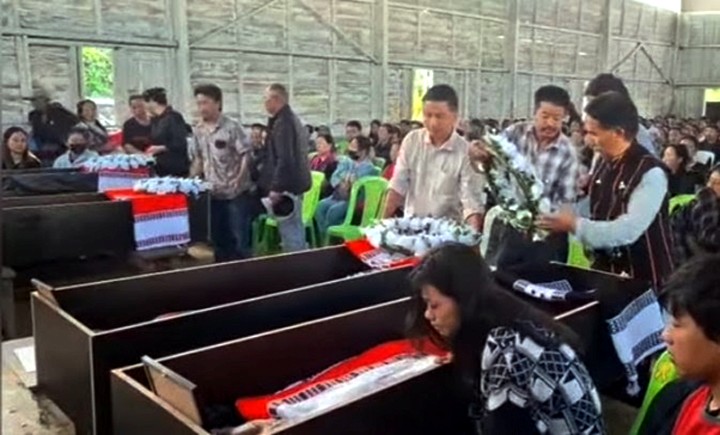
On May 9, 2026, the UNC, Naga Women’s Union and All Naga Students’ Association, Manipur (ANSAM), submitted a memorandum to Prime Minister Narendra Modi, describing the violence against Nagas as a proxy war. They alleged that Kuki militant groups operating under the SoO arrangement, together with the Myanmar-based Kuki National Army-Burma (KNA-B), were responsible for attacks on Naga-inhabited areas.
The memorandum raised concerns about attacks on Namlee-Wanglee, Z Choro and Kaka villages along the Indo-Myanmar border, including allegations of cross-border militant incursions and the use of sophisticated weapons.
These allegations require independent verification. Nevertheless, they demonstrate that the Naga organisations increasingly view the security situation as something more serious than sporadic inter-community clashes.
For the UNC, the activities of armed groups could threaten the security and territorial position of Naga-inhabited areas, weaken village institutions and undermine the traditional relationship between communities and their ancestral territories. The continuing uncertainty surrounding the Indo-Naga political settlement adds another layer to these concerns.
The Naga perspective therefore extends the proxy-war argument beyond the original Meitei-Kuki confrontation. It raises the possibility that armed groups accommodated under the SoO framework could also become instruments, directly or indirectly, for containing Naga political and territorial aspirations.
There is, however, insufficient publicly established evidence to conclude that New Delhi has systematically deployed Kuki-Zomi armed groups against Naga insurgents. The historical pattern, competing territorial interests and security arrangements have nevertheless contributed to this suspicion among sections of Naga civil society.
The SoO Agreement and The Question of State Accountability
The most important common ground between COCOMI and the UNC is their criticism of the SoO arrangement, the Assam Rifles and the manner in which the authorities have handled armed groups covered by it.
The renewed tripartite agreement of September 4, 2025, between the Union overnment, the Manipur government and the KNO-UPF groups introduced revised ground rules, including the relocation and reduction of designated camps, deposit of weapons with nearby central security force camps, physical verification of cadres and monitoring through a Joint Monitoring Group. The agreement also reiterated Manipur’s territorial integrity.
For COCOMI and other organisations opposing the arrangement, the central question is whether these provisions are being effectively enforced. If armed cadres can move outside designated camps, possess unauthorised weapons or participate in violence without consequences, the credibility of the entire arrangement is undermined.
The October 2026 developments surrounding the Shamushang (Sinai) camp operation in Kangpokpi district have intensified these questions. COCOMI alleged serious violations of the SoO ground rules and questioned the monitoring mechanism, the composition of designated camps and the accountability of armed cadres. These allegations have become an immediate trigger for its demand to abrogate the agreement.
The UNC has also questioned the role of the Assam Rifles, particularly in border and conflict-affected areas. It has alleged that the force has been perceived as partisan and insufficiently responsive to attacks on Naga-inhabited villages. Such allegations, along with competing accusations from other communities, have contributed to a wider crisis of public confidence in security institutions.
The issue is not simply whether the SoO agreement should continue. It is whether the Centre and the state government can demonstrate that the arrangement is being implemented in accordance with its stated objectives. An agreement intended to suspend armed operations cannot be allowed to become a source of insecurity for civilians.
At the same time, allegations against armed organisations must be investigated individually and impartially. The responsibility for violence cannot be collectively attributed to an entire ethnic community.
The Convergence of COCOMI and UNC
Perhaps the most consequential political development in October 2026 is the convergence of COCOMI and the UNC around the demand to end the alleged proxy war.
Meitei-Naga political relations have not been free from disagreements since the emergence of NSCN (IM), particularly over territorial integrity, the Naga political movement and competing historical interpretations. Nevertheless, both communities are considered brothers once settled together in the hills and have shared concerns over indigenous rights, land, identity and the constitutional position of Manipur.
Their recent convergence reflects the growing recognition that the security concerns of one indigenous community cannot be separated entirely from those of another when armed organisations and competing political interests affect the wider state.
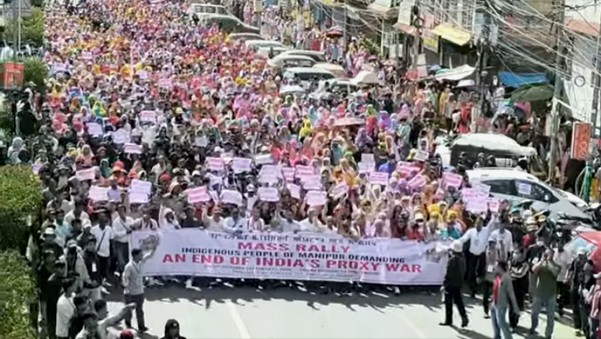
On October 27, 2026, the UNC endorsed the mass rally organised by COCOMI and other Naga civil society organisations for October 31 in Imphal.
The mass rally was jointly organised by COCOMI, the Joint Tribe Council Manipur, the Foothills Naga Coordination Committee, the Naga People’s Union, Imphal, and the Naga Humanitarian Aid Committee, among other organisations. Its four principal demands are an end to the alleged Government of India’s proxy war in Manipur, abrogation of the SoO agreement with Kuki militants, withdrawal of Assam Rifles from Manipur and resettlement of all internally displaced persons.
The mass rally/peaceful solidarity protests were also carried out in the four Naga district headquarters on the same day as the UNC earlier announced simultaneous peaceful solidarity protests at Naga district headquarters.
The October 31 Mass Rally symbolising hill-valley unity, is particularly significant. It represents an attempt to construct a common civil society platform across ethnic boundaries at a time when Manipur remains deeply divided.
The convergence should not be interpreted as an agreement between Meiteis and Nagas on every political question concerning Manipur. Rather, it demonstrates that concerns about Kuki-Zomi armed groups, the SoO agreement, civilian security and the functioning of security institutions have created common ground for collective action.
It also challenges the tendency to interpret every political mobilisation in Manipur exclusively through the Meitei-Kuki binary.
Ending The Proxy War Means Restoring Constitutional Governance
The proxy-war argument cannot, by itself, explain the entire complexity of Manipur’s crisis. The conflict has historical, political, ethnic and territorial dimensions. Competing claims over land, political autonomy, administrative arrangements, identity and constitutional safeguards cannot be reduced entirely to geopolitical manipulation.
The Kuki-Zomi demand for a separate political administration, Meitei concerns over territorial integrity of Manipur and constitutional protection, and Naga aspirations concerning ancestral land and political settlement represent distinct political questions. These require democratic dialogue and political interventions rather than an exclusively security-oriented approach.
It is equally important to distinguish the political aspirations of a community from the activities of armed organisations. The responsibility for violence must be established through evidence and individual accountability. Civilian populations must not be collectively blamed for the actions of militant groups and political leaders.
Nevertheless, the proxy-war argument cannot simply be dismissed as political rhetoric. The duration of the conflict, reported collaboration between armed groups and security forces, allegations of SoO violations, cross-border militant activities and the growing insecurity among different indigenous communities warrant comprehensive and independent examination.
Under Article 355 of the Constitution, the Union has a responsibility to protect every state against external aggression and internal disturbance and to ensure that its government is carried on in accordance with the Constitution. When a state experiences prolonged armed violence, mass displacement, restrictions on movement and the fragmentation of civilian life, the question of constitutional responsibility cannot be reduced to the effectiveness of individual security operations.
The Centre and the state government must provide credible information about the monitoring of designated camps, enforcement of SoO ground rules, investigation of alleged violations and security arrangements along the international border. The Centre must also establish transparent mechanisms for fixing responsibility for failures to protect civilians.
Equally important is the restoration of confidence among communities that have suffered displacement and insecurity. The safe return of internally displaced persons, restoration of unrestricted civilian movement, protection of vulnerable villages and dismantling of illegal armed infrastructure must become measurable priorities.
Ultimately, the demand to end the proxy war in Manipur is a demand to restore the primacy of civilian security, democratic governance and constitutional authority over competing armed and strategic interests.
The Union government must recognise that national security cannot be achieved at the expense of the security of people living in the border state. India’s strategic interests in Myanmar and Southeast Asia are legitimate, but they cannot justify prolonged civilian suffering, displacement or political marginalisation.
Manipur does not need a conflict managed indefinitely through security arrangements, political accommodations and competing armed interests. It needs a political settlement grounded in justice, mutual recognition, territorial security and constitutional democracy.
The expression Stop Proxy War may remain contested, and the allegations underlying it require independent verification. But the public anxiety it expresses, particularly the perception that one armed formation is being accommodated or used to contain another, cannot be ignored.
Ending the alleged proxy war must ultimately mean ending the conditions that allow armed organisations, opaque political arrangements and unaccountable security structures to determine the lives and future of Manipur’s people.

Senior Editor: Imphal Review of Arts and Politics