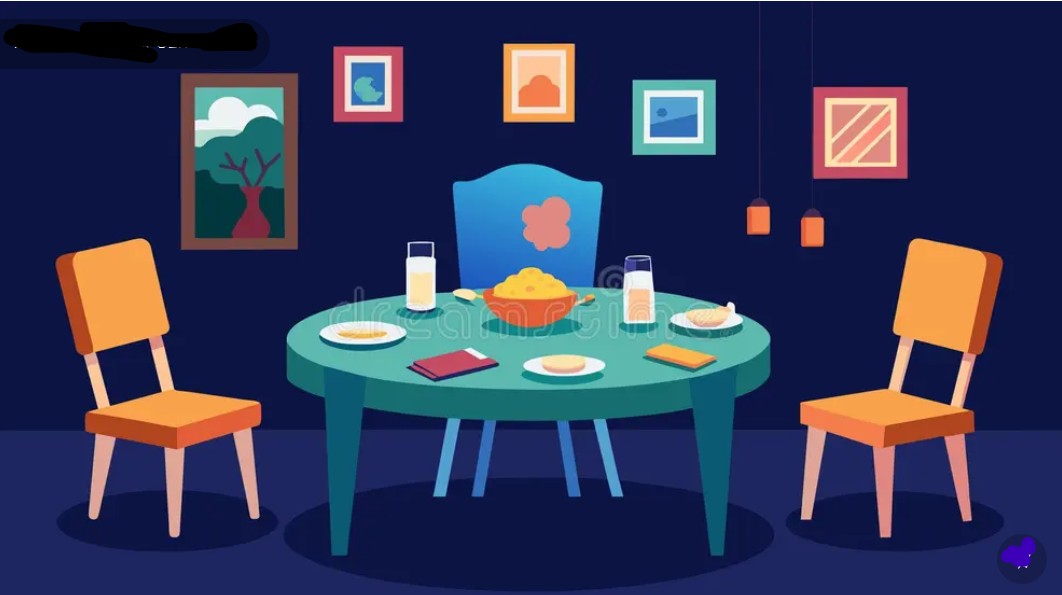
There is a seat at every dining table that somehow belongs to someone. No one ever assigns it, and no one needs to. Over the years, it simply becomes understood. It may be the chair at the head of the table where father always sits, asking about everyone’s day before the first spoonful of rice is served. It may belong to a grandmother who never begins eating until everyone else’s plate is full, or an older brother who somehow turns an ordinary dinner into an evening of laughter. We seldom notice these little rituals while they are unfolding because we assume they will always be there. The chair becomes so closely associated with the person that we no longer see it as furniture. It simply becomes their place.
Then, one day, the chair is empty.
Life has many ways of leaving a chair unoccupied. Sometimes it is for reasons that make us smile. A son leaves home to study, finds work in another city, and slowly builds a life there. A daughter marries and settles in another country, her visits measured by school holidays and airline tickets. We miss them, but our longing is gentled by the knowledge that they are living the future we once prayed for them.
At other times, life asks far more difficult things of us. A father whose steady voice once guided every family discussion is suddenly no longer there. A mother who seemed to hold the entire household together with quiet grace leaves behind a silence no one quite knows how to fill. A brother’s laughter becomes a story instead of a sound. A dear friend leaves this world long before anyone is ready to say goodbye. Every family carries its own version of these stories. They differ in detail, but they leave behind the same gentle reminder that none of us gets to keep the people we love forever.
Growing up, my father had one simple rule. However busy the day had been, we would have dinner together as a family. Lunch was rarely possible. School, work and the routines of the day often took us in different directions. But dinner belonged to the family. Looking back, I doubt any of us appreciated it very much as children. We were often eager to finish and return to our books, our games or whatever else occupied our young minds.
That is why the dining table has always fascinated me. It is one of the few places where life unfolds without ceremony. Birthdays are celebrated there. News is shared there. Differences are settled there. Forgiveness is sometimes found there. Prayers are whispered there. Children learn to listen, to disagree respectfully, to laugh at themselves, and to belong. We often think that the defining moments of a family happen on extraordinary days, but more often they are formed in hundreds of ordinary evenings that never seemed important while we were living them.
Growing up in Manipur, I have often felt that this is one of the quiet strengths of our people. We come from different communities, speak different languages, worship in different ways, and celebrate different festivals. Yet beneath those differences there remains a deep instinct to return home, to sit together, to ask one another how life has been, and to linger a little longer after the meal has ended. Whether it is during Christmas, Ningol Chakouba, Kut, Lui-Ngai-Ni, Yaoshang, Eid, or simply an ordinary Sunday when the family manages to gather, the table still has a way of reminding us that we belong to one another. In a world that seems to move faster with each passing year, that instinct is not something to outgrow. It is something to protect.
That is also why we should tell our children the stories behind the empty chairs. One day they will inherit our homes, but more importantly, they will inherit our memories. Unless we tell them who once occupied those places, they will see only old furniture. They will never know about the grandfather who always insisted that every meal begin with gratitude, the aunt who believed no guest should ever leave hungry, the uncle whose terrible jokes somehow became family treasures, or the sister who now lives on the other side of the world but never forgets to call home. Memory, like any precious inheritance, survives only when it is shared.
As I think about the years ahead, I wonder less about the empty chairs of yesterday and more about the chairs that are full today. Am I paying enough attention to the people who are still sitting around my table? Am I listening as carefully as I should? Am I lingering over conversations that will one day become memories? We spend so much of life preparing for the future that we often fail to notice we are living the moments we will miss the most.
One day, our own chair too will be empty. That is not a thought meant to make us fearful; it is one that should make us intentional. Long after our possessions have been divided and our achievements forgotten, someone may still remember how we made them feel around the table. Whether we made room for others. Whether we listened more than we spoke. Whether our presence brought peace, laughter, wisdom and kindness into the home. In the end, that may be the truest measure of a life – not the chair we occupied, but the memories we left behind for those who continue gathering after we are gone.
The older I grow, the more I believe that the richest homes are not those filled with beautiful things, but those filled with stories worth telling. Every empty chair is a reminder that someone once loved deeply, laughed freely, gave generously and became part of another person’s life. Its silence is not merely the silence of absence; it is also the quiet echo of gratitude.
Perhaps the greatest honour we can give those who once occupied these chairs is to live in such a way that, one day, our own empty chair will tell a story worth remembering.

Sam Khumanthem writes about home, identity, and the quiet complexities of life in Manipur. His work reflects a deep connection to place, shaped by both love and uncertainty.