
Part I: The Real Question is Not 1.4 Square Miles
The controversy that has engulfed Manipur following reports of a possible territorial adjustment along the India–Myanmar border has been presented largely as a debate over the exchange of approximately 1.4 square miles of land between Border Pillars 65 and 68 in Chandel district. Reports first published in The Diplomat and subsequently followed by other national media outlets have generated widespread concern after referring to an official proposal allegedly under consideration by the Government of India. More significantly, the Ministry of External Affairs has since acknowledged that discussions are indeed underway regarding unsettled sectors of the India–Myanmar boundary, although it has neither confirmed nor denied that any territorial exchange has been approved.
Public attention has naturally focused on the reported figure of 1.4 square miles (3.56 square km). Political parties, civil society organisations and constitutional commentators have begun debating whether any part of Manipur can legitimately be transferred in the pursuit of final boundary demarcation. The Coordinating Committee on Manipur Integrity (COCOMI) has already warned against any move that may alter the territorial integrity of the State, while the Government of Manipur has so far refrained from taking a definitive public position. The State’s Home Minister has merely stated that the Government will respond “at an appropriate time.”
Yet concentrating exclusively on the size of the land involved risks missing the far more profound constitutional and political questions raised by the controversy.
The issue before Manipur is not fundamentally whether 1.4 square miles should or should not be exchanged. The real question is whether the constitutional identity and territorial integrity of Manipur have gradually become negotiable whenever larger considerations of national security, border management, Myanmar policy, and India’s strategic competition with China demand accommodation. If that question is answered in the affirmative – even implicitly – the implications extend far beyond one disputed stretch of the international boundary.
This debate therefore deserves to be situated not within the narrow confines of cartography but within the larger framework of constitutional federalism, democratic accountability and the relationship between the Union and one of India’s oldest political entities.
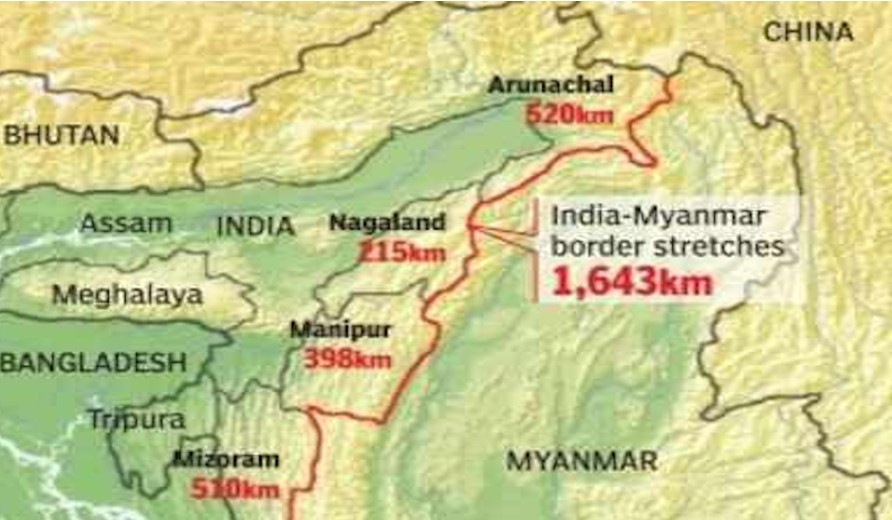
Every sovereign State possesses the authority to negotiate and settle international boundaries. Boundary demarcation is an accepted function of international law and diplomacy. No nation can indefinitely leave portions of an international frontier undefined, particularly where such ambiguities create opportunities for cross-border insurgency, illegal migration, narcotics trafficking or competing territorial claims. Successive Governments of India have repeatedly emphasised the importance of securing the 1,643-kilometre Indo–Myanmar border, particularly following the deterioration of security conditions in Myanmar after the military coup of February 2021. Border fencing, the withdrawal of the Free Movement Regime, strengthened surveillance infrastructure and accelerated border management have all been justified on grounds of internal security and national interest.
No serious observer disputes the legitimacy of these objectives. Every constitutional democracy has both the right and the responsibility to protect its international frontiers. The challenge arises when the pursuit of those objectives intersects with the constitutional identity of one of its constituent States.
It is precisely at this intersection that the present controversy becomes significant.
Unlike many other international boundary disputes, the present issue concerns territory that forms part of an existing State of the Indian Union. It is not an uninhabited maritime feature or an isolated tract of land lying outside constitutional administration. The reported area lies within Manipur, a State recognised under Article 1 of the Constitution of India and represented in Parliament through elected institutions. Consequently, any discussion concerning territorial adjustment inevitably raises questions not only of diplomacy but also of constitutional governance.
The Constitution undoubtedly vests the Union Government with responsibility for foreign affairs and international negotiations. Equally, however, the Constitution rests upon the principle that India is a Union of States rather than a unitary empire administering provinces at its discretion. The Supreme Court has repeatedly affirmed that federalism forms part of the Constitution’s basic structure, most notably in S.R. Bommai vs. Union of India, while later decisions concerning the Government of the National Capital Territory have reaffirmed that constitutional federalism requires mutual respect between the Union and constituent governments rather than unilateral executive dominance.
These constitutional principles become particularly relevant whenever international negotiations directly affect the territory, interests or political identity of a constituent State.
The question therefore is not whether New Delhi possesses diplomatic authority to negotiate with Myanmar. It unquestionably does.
The more difficult question is whether such negotiations can meaningfully proceed without transparent consultation with the people whose territory may be affected and without the active participation of the elected State Government entrusted with protecting their constitutional interests.
It is here that the silence of the Government of Manipur becomes increasingly difficult to understand.
The Ministry of External Affairs has publicly acknowledged that discussions concerning unsettled sectors of the boundary are underway. National media have reported extensively on the proposal. Civil society organisations have expressed concern. Public debate has intensified throughout the State. Yet the constitutional government of Manipur has not articulated whether it supports, opposes or seeks clarification regarding the reported proposal.
Governments are, of course, entitled to exercise caution while diplomatic negotiations remain ongoing. Silence, however, also carries constitutional consequences. When questions arise regarding the territorial integrity of a State, prolonged silence can easily be interpreted as acquiescence, uncertainty or institutional reluctance to engage with an issue of profound public importance.
A federal government is expected to pursue national interests. A State government, however, exists primarily to safeguard the constitutional, political and territorial interests of the State it represents. These responsibilities are not mutually exclusive. Rather, constitutional federalism presupposes that both levels of government will engage in dialogue whenever national objectives intersect with regional interests.
This expectation becomes even stronger in Manipur because territorial questions are inseparable from history.
Few regions in South Asia possess a historical memory of territorial transformation as deep as Manipur. Long before its merger with the Indian Union in 1949, Manipur existed as a historically recognised political entity with defined frontiers, diplomatic relations and treaty obligations. The memory of territorial contraction – whether associated with colonial interventions, the Kabaw Valley, or subsequent controversies surrounding border pillars – continues to shape political consciousness across generations. Consequently, even relatively small adjustments along the international boundary inevitably acquire symbolic significance far exceeding their geographical dimensions.
For many Manipuris, therefore, the present controversy is not measured in square miles. It is measured in historical memory.
This explains why public reactions have been immediate and emotionally charged. It also explains why assurances that the proposed adjustment may involve only a small tract of land have done little to diminish public concern. The anxiety is rooted less in arithmetic than in precedent. If one portion of territory can become negotiable in pursuit of strategic objectives, many inevitably ask whether future strategic calculations may invite similar reconsiderations elsewhere.
Such concerns cannot simply be dismissed as emotional nationalism.
Across the world, frontier regions have frequently discovered that their territories acquire strategic value far beyond their demographic or economic significance. Great powers have historically adjusted borders, negotiated buffer zones and redrawn frontiers in pursuit of larger geopolitical objectives. Whether in Eastern Europe during the Cold War, Central Asia after the collapse of the Soviet Union, or Southeast Asia amid competing spheres of influence, frontier communities have often found themselves carrying the burdens of national strategy.
India has consistently rejected such geopolitical practices when directed against its own territorial interests. It therefore bears a corresponding constitutional responsibility to demonstrate that decisions affecting the territory of one of its own States are guided not merely by strategic necessity but also by democratic legitimacy, transparency and respect for federal principles.
The controversy surrounding the India–Myanmar boundary thus raises a larger constitutional dilemma.
Is Manipur simply another administrative unit through which the Union may pursue national security objectives, or is it an equal constitutional partner whose territorial integrity commands the same political sensitivity that the Republic would accord to any other State?
The answer to that question will determine whether this controversy is remembered merely as a technical exercise in boundary demarcation or as a defining moment in the evolving relationship between constitutional federalism and strategic statecraft in contemporary India.
For ultimately, the debate is not about 1.4 square miles (3.56 square km) of land.
It is about whether Manipur’s place within the Indian Union is understood primarily through the language of constitutional equality or increasingly through the imperatives of national security, border management and geopolitical competition.
Part II: Territorial Integrity, Constitutional Federalism and the Burden of History
If the present controversy is viewed merely as a technical exercise in border demarcation, the public reaction in Manipur may appear disproportionate. Why should a reported adjustment involving only 1.4 square miles (3.56 square km) provoke such widespread political anxiety? Why should a proposal concerning a few border pillars generate debates extending from constitutional law to geopolitics?
The answer lies in history.
Territory, particularly in frontier societies, is seldom measured solely in geographical terms. It embodies collective memory, political identity and historical continuity. For communities that have experienced repeated territorial transformations, every subsequent adjustment is interpreted not as an isolated administrative act but as part of a much longer historical narrative. Manipur belongs to that category of political societies.
Unlike many constituent States of the Indian Union whose present territorial configurations emerged through post-independence linguistic reorganisation, Manipur entered the Union with a much older political identity. For centuries, it functioned as an organised kingdom possessing recognised frontiers, diplomatic relations with neighbouring polities, and a distinct political tradition. Even under British paramountcy after 1891, Manipur retained its juridical personality as a princely State rather than becoming a directly administered province. Its subsequent merger with India in October 1949 altered its constitutional status, but it did not erase the historical consciousness of territorial continuity that had developed over centuries.
This historical memory continues to shape contemporary political discourse.
The Kabaw Valley remains perhaps the most enduring example. Although the legal and political circumstances surrounding the Kabaw Valley differ significantly from the present controversy, its symbolic importance within Manipuri historical consciousness cannot be overstated. Generations have grown up regarding the valley not merely as lost territory but as a reminder that geopolitical settlements often leave enduring emotional and political consequences. Whether those historical claims remain legally enforceable today is beside the point. Their continued presence in public memory influences how contemporary boundary questions are interpreted.
Consequently, reports concerning possible adjustments near Molcham are not examined in isolation. They are filtered through accumulated historical experience.
The official record itself demonstrates that controversies surrounding the India-Myanmar boundary are not new. Successive governments have acknowledged unresolved stretches of the international boundary in Manipur, particularly around Border Pillars 64-68, 75-79 and 88-95. Cabinet committees, joint surveys and bilateral mechanisms have attempted to address these issues over several decades without fully resolving them. Earlier controversies involving Kwatha Khunou, Molcham and other border villages similarly generated public apprehension that territorial interests might be compromised, even though the Union Government consistently maintained that no Indian territory had been ceded.
This historical continuity explains why present assurances are received with caution.
The constitutional dimension is equally significant.
Much of the present debate has focused upon the Union Government’s authority over foreign affairs. Constitutionally, there is little ambiguity on this point. International relations, treaty-making and boundary negotiations fall squarely within the Union’s domain. Every sovereign nation must retain the capacity to negotiate international boundaries and resolve outstanding disputes with neighbouring States.
However, acknowledging the Union’s diplomatic authority does not end the constitutional inquiry.
India’s Constitution deliberately rejected the model of an overly centralised unitary State. Article 1 describes India as a “Union of States,” a formulation that reflects the constitutional significance of the States within the federal framework. Although Parliament possesses substantial authority under Article 3 to reorganise State boundaries, that power is exercised through constitutional legislation, parliamentary debate and consultation with the affected State Legislature. The framers recognised that territory is not merely an administrative variable but an integral component of federal constitutionalism.
The Supreme Court has repeatedly reinforced this understanding.
In S.R. Bommai vs. Union of India (1994), the Court declared that federalism constitutes part of the Constitution’s basic structure and therefore cannot be undermined through ordinary political expediency. Although the judgment primarily concerned the misuse of Article 356, its broader constitutional philosophy emphasised that States are not subordinate administrative departments existing solely at the pleasure of the Union. Rather, they are constitutionally recognised partners within India’s federal architecture.
That understanding evolved further in State (NCT of Delhi) vs. Union of India (2018), where the Constitution Bench stressed that constitutional morality requires respect for the representative institutions of constituent governments. The Court warned against excessive centralisation and reaffirmed that cooperative federalism is essential for the effective functioning of the Republic. More recently, in Government of NCT of Delhi vs. Union of India (2023), the Court again emphasised that democratic accountability requires elected governments to retain meaningful authority within their constitutional spheres.
These decisions do not directly determine how an international boundary should be negotiated. Nevertheless, they establish an important constitutional principle – federalism is not merely a matter of administrative convenience but an enduring constitutional value.
Viewed through this lens, the present controversy acquires a different character.
The issue is not whether New Delhi may negotiate with Myanmar. It unquestionably may.
The issue is whether constitutional federalism demands a higher standard of consultation, transparency and democratic engagement whenever those negotiations directly concern the territory of an existing State.
This question becomes even more compelling because the Government of Manipur itself occupies a constitutionally significant position.
State governments are not passive observers of constitutional developments affecting their territories. They are entrusted with representing the interests of the people who elected them. While foreign affairs remain a Union subject, the defence of a State’s constitutional interests is fundamentally a political responsibility that cannot simply be delegated to New Delhi.
It is here that the present silence of the Manipur Government becomes increasingly difficult to reconcile with constitutional expectations.
Since reports of the proposed adjustment emerged, public debate has intensified throughout the State. Civil society organisations have sought clarification. National media have questioned the implications of the proposal. The Ministry of External Affairs has acknowledged ongoing discussions regarding unsettled sectors of the border. Yet the Government of Manipur has largely confined itself to procedural restraint, indicating only that an official response will come at an appropriate time.
Diplomatic sensitivity undoubtedly warrants caution. But constitutional accountability requires more than silence.
A State Government need not prejudge international negotiations. Nor must it publicly oppose every initiative undertaken by the Union Government. It does, however, possess an obligation to reassure its citizens that their territorial interests will be protected, that any negotiations affecting the State will be conducted transparently within constitutional norms, and that their concerns are being actively represented before the Union Government.
Silence creates uncertainty. Uncertainty invites speculation. Speculation gradually erodes public trust.
This sequence is particularly dangerous in Manipur, where trust between institutions and society has already been profoundly strained by more than three years of violent conflict involving ethnic groups, prolonged displacement, contested security policies and competing political narratives. Against such a backdrop, ambiguity concerning territory inevitably acquires political consequences far beyond the immediate issue under discussion.
Indeed, one of the most striking aspects of the present controversy is how quickly it has evolved into a wider debate concerning the relationship between Manipur and the Indian Union.
The questions now being asked extend well beyond border demarcation.
If strategic considerations require territorial accommodation, what institutional safeguards exist to ensure that the interests of frontier States are adequately represented?
Should Parliament play a greater role before executive negotiations involving State territory reach advanced stages?
Should State Legislatures receive formal briefings whenever international negotiations have potential territorial implications?
Can democratic legitimacy be maintained if affected populations learn of possible adjustments primarily through media reports rather than constitutional processes?
These questions are neither anti-national nor obstructionist.
They arise naturally within every mature federal democracy because they concern the distribution of constitutional authority between different levels of government.
Ultimately, constitutional federalism is tested not during periods of political harmony but during moments when national strategy and regional interests appear to diverge.
The controversy surrounding the India-Myanmar boundary has brought precisely such a moment before the Republic.
Whether it becomes an example of cooperative federalism or managed federalism or a cautionary tale of strategic centralisation will depend not only upon the final outcome of any negotiations but equally upon the constitutional process through which those negotiations are conducted.
For constitutional legitimacy is measured not only by the decisions governments eventually make, but by the manner in which those decisions are reached.
It is at this point that the debate moves beyond constitutional doctrine into the wider realm of geopolitics. For if the constitutional questions concern how decisions are made, the strategic questions concern why they are being contemplated at this particular historical moment.
Part III: Geopolitics, Strategic Accommodation and the Future of India’s Eastern Frontier
The controversy over the proposed boundary adjustment cannot be understood in isolation from the rapidly changing geopolitical environment in India’s eastern neighbourhood. If constitutional federalism explains why the issue has generated such deep concern within Manipur, geopolitics explains why it has emerged at this particular historical moment.
Over the past decade, India’s strategic engagement with Myanmar has undergone a profound transformation. Myanmar is no longer viewed merely as India’s eastern neighbour. It has become an indispensable component of New Delhi’s security architecture, connectivity strategy, and Indo-Pacific policy. The country’s geographical position makes it the land bridge between South Asia and Southeast Asia, the gateway to India’s Act East Policy, and an arena of increasing strategic competition between India and China.
For New Delhi, stability along the India-Myanmar frontier has consequently acquired significance extending far beyond bilateral relations.
The military coup in Myanmar in February 2021 fundamentally altered this strategic landscape. The subsequent civil war fragmented political authority across much of the country, weakened central administrative control, expanded the influence of numerous armed organisations, and created an increasingly unstable frontier stretching across Arunachal Pradesh, Nagaland, Manipur and Mizoram. The conflict also generated refugee flows, intensified transnational criminal networks, complicated counter-insurgency operations, and further blurred already fragile border management mechanisms.
For India, these developments created an unprecedented strategic dilemma.
On the one hand, New Delhi has consistently expressed support for democracy and political stability in Myanmar. On the other hand, geographical realities compel India to maintain functional engagement with whichever authority exercises effective control over the territory adjoining its Northeastern frontier. Unlike distant powers whose engagement with Myanmar may remain largely diplomatic, India shares a 1,643-kilometre international border whose security directly affects its internal stability.
This strategic compulsion has inevitably elevated border management to the forefront of national security policy.
It is within this broader context that India has accelerated border fencing, withdrawn the Free Movement Regime, strengthened surveillance systems, expanded security infrastructure and intensified efforts to complete the demarcation of unresolved stretches of the international boundary. Official explanations have consistently linked these initiatives to concerns over illegal immigration, narcotics trafficking, arms smuggling, insurgent movement and organised transnational crime.
Individually, each of these objectives is understandable.
Collectively, however, they reveal a significant shift in the manner in which the India-Myanmar frontier is increasingly being conceptualised – not merely as an international boundary but as one of India’s principal national security frontiers.
The emergence of China as the dominant external actor in Myanmar has further intensified these calculations.
China’s expanding economic investments, strategic infrastructure projects, access to the Bay of Bengal through the China-Myanmar Economic Corridor, and longstanding relationships with several armed organisations operating inside Myanmar have substantially altered the regional balance of power. For India, maintaining influence in Myanmar has become an essential component of preventing strategic encirclement in the eastern Indian Ocean region.
Consequently, New Delhi’s policy towards Myanmar today is influenced not only by bilateral concerns but also by broader Indo-Pacific geopolitics.
It is here that Manipur assumes an importance far exceeding its geographical size.
The State has increasingly become the physical interface through which several national objectives converge simultaneously.
It is the route through which India seeks to operationalise its Act East Policy.
It is an essential corridor connecting mainland India with Southeast Asia.
It constitutes a critical component of India’s counter-insurgency architecture.
It has become central to policies concerning border fencing and migration management.
It is directly affected by developments inside Myanmar.
It is also situated on one of the principal strategic axes through which India seeks to balance China’s growing regional influence.
Each of these priorities may individually serve the national interest.
Yet their cumulative effect is that Manipur is increasingly viewed through a strategic lens.
This transformation carries important constitutional implications.
Throughout history, frontier regions have often borne disproportionate strategic burdens. Their territories become sites of military deployment, diplomatic negotiation, economic corridors and geopolitical competition. Decisions affecting them are frequently justified by reference to national necessity rather than local consent. While such dynamics may sometimes be unavoidable, democratic constitutionalism requires that they remain subject to public accountability rather than executive convenience.
The concern emerging in Manipur today reflects precisely this tension.
Many citizens increasingly perceive that decisions affecting the State are being shaped less by the constitutional relationship between the Union and one of its constituent States than by strategic calculations extending well beyond Manipur itself.
Whether that perception is entirely accurate is almost secondary.
In constitutional democracies, public confidence depends not only upon governmental intentions but also upon institutional transparency. If affected populations begin to believe that strategic objectives consistently override their constitutional interests, trust inevitably deteriorates.
Recent developments reinforce these perceptions.
The prolonged deployment of central security forces.
The creation of buffer zones separating communities after May 2023.
The suspension of the Free Movement Regime.
The acceleration of border fencing.
The continuing emphasis upon cross-border security.
The discussions concerning unresolved boundary sectors.
Viewed independently, each measure may be justified by compelling security considerations. Viewed collectively, however, they create an impression that Manipur is increasingly being administered as a strategic frontier whose primary function is to advance national security objectives.
This perception deserves careful examination.
Every sovereign State expects frontier regions to contribute to national security. Equally, however, every constitutional democracy owes corresponding obligations to those very regions. Strategic necessity cannot become a substitute for constitutional legitimacy.
Indeed, one of the enduring lessons of comparative federalism is that national integration is strengthened not by treating frontier territories as strategic buffers but by ensuring that their populations remain confident participants in the constitutional compact.
Canada’s management of its northern territories, Germany’s approach towards its Länder, Australia’s relationship with its border regions and Spain’s accommodation of historically distinct autonomous communities all demonstrate that security considerations are ultimately more durable when accompanied by meaningful political consultation and institutional trust.
India’s constitutional tradition has long embraced this philosophy.
The Republic has repeatedly affirmed that unity is sustained not through administrative centralisation but through democratic federalism. This principle becomes especially important in politically sensitive frontier States where historical identity remains deeply intertwined with territorial consciousness.
It is therefore insufficient for the debate surrounding the India-Myanmar boundary to focus exclusively upon whether 1.4 square miles should or should not be exchanged.
That question, important though it is, addresses only the immediate controversy.
The more enduring question concerns the constitutional philosophy that informs such decisions.
Can the territory of a constituent State become an instrument of strategic accommodation without fundamentally altering the federal relationship envisioned by the Constitution?
Should national security considerations always prevail when they conflict with regional political sentiment?
How should constitutional democracies reconcile the imperatives of geopolitics with the principles of federal equality?
These are not questions directed against India’s national interest.
On the contrary, they are questions intended to strengthen it.
For history repeatedly demonstrates that durable national security is ultimately built upon constitutional legitimacy rather than strategic expediency alone.
Frontier populations that trust their constitutional institutions become the strongest guardians of national sovereignty.
Those who feel excluded from decisions affecting their own territories often become increasingly alienated from the institutions meant to represent them.
It is therefore in India’s own long-term strategic interest that questions concerning Manipur’s territory be addressed with the highest standards of constitutional transparency, parliamentary accountability and democratic consultation.
The present controversy offers the Union Government and the Government of Manipur an opportunity to reaffirm those principles.
The Government of India should clearly explain the precise status of discussions concerning the unresolved boundary sectors, the constitutional processes that would govern any future adjustment, and the safeguards that exist to protect the interests of the State. Equally, the Government of Manipur must move beyond studied silence and articulate an unequivocal constitutional position on behalf of the people it represents. In a federal democracy, silence on questions of territorial integrity is not neutrality; it risks being interpreted as abdication of political responsibility.
Ultimately, the debate is not about resisting every boundary settlement or opposing every national security initiative. Nor is it about denying the strategic complexities confronting India along one of its most sensitive frontiers.
It is about ensuring that constitutional federalism does not become the first casualty of geopolitics.
For if Manipur’s territorial integrity comes to be perceived as negotiable whenever larger strategic considerations arise, the Republic risks sending an unsettling message to all its frontier States – that constitutional equality may yield to geopolitical necessity.
The measure of India’s constitutional maturity will not be found in how effectively it fences its borders or negotiates international boundaries. It will be found in whether, while pursuing legitimate national interests, it continues to treat every constituent State not merely as strategic geography but as an equal partner in the constitutional Union.
The controversy surrounding the reported 1.4 square miles will eventually pass. Boundary negotiations may conclude, diplomatic understandings may evolve, and governments may change.
The constitutional question, however, will remain.
Is Manipur merely India’s eastern frontier?
Or is it, first and foremost, an equal State of the Union whose history, identity and territorial integrity deserve to be treated not as variables in strategic policy but as enduring constitutional commitments?
How India answers that question will define not only the future of Manipur but also the character of Indian federalism in an increasingly uncertain geopolitical age.

Senior Editor: Imphal Review of Arts and Politics