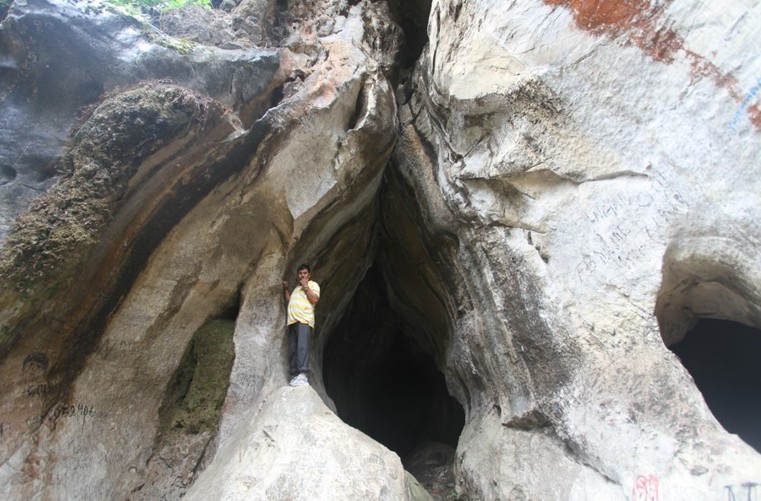
Long before the Valley of Manipur held its first rice paddy, small bands of people were already sheltering in the limestone caves that honeycomb Manipur’s border hills. Today those same caves — Khamgkhui in Ukhrul, Tharon in Tamenglong, Songbu in Chandel, and a scatter of lesser-known sites — are being looked at with fresh eyes, not just by archaeologists but by tourism planners who see in them the makings of a new hill circuit for adventure travellers.
The caves owe their existence to geology. Manipur sits on the Indo-Burma Range, where the slow collision of the Indian and Burmese tectonic plates has folded bands of limestone into the state’s outer hill ranges over millions of years. Rainwater, slightly acidic from dissolved carbon dioxide, has spent that time quietly eating through the rock, hollowing out chambers, tunnels and halls wherever the limestone is thick and well jointed. The valley floor, by contrast, is alluvial silt — no limestone, no caves, which is why every documented cave site in Manipur sits in the surrounding hill districts rather than in the Valley of Manipur itself.
Windows into the Stone Age
For archaeologists, that geology has been a stroke of luck. Cave sediments preserve artefacts far better than open hillside soil, and Manipur’s caves have delivered some of Northeast India’s clearest evidence of prehistoric life. Khamgkhui’s lower layers have produced choppers, blades, scrapers and worked bone tools; Tharon has yielded a distinctive pebble-tool assemblage linked to the Hoabinhian tradition, a Mesolithic culture first identified in Vietnam nearly a century ago. Radiocarbon dates from a related open-air site on the Thoubal River put some of this material at roughly 4,500 years old, with cruder Palaeolithic tools going back tens of thousands of years further.
Archaeologists reconstruct a rough sequence from this evidence: hill-dwelling foragers using caves as shelter through the Palaeolithic and Mesolithic, followed by a gradual Neolithic-era shift toward the fertile Valley of Manipur, where corded-ware pottery and early farming settlements appear by around 2000 BCE. That movement from hill cave to valley village, researchers argue, laid the demographic groundwork for the historical kingdom of Manipur, whose chronicles describe rulers uniting valley and hill communities centuries later.
From Relic to Route
For now, most of this history is known only to specialists and to the Naga and other hill communities who live around the caves and have kept their own traditions about them alive — Tharon, known locally as Kalemki, still hosts community gatherings inside its chambers; Khamgkhui is tied in Tangkhul Naga folklore to a guardian spirit and sheltered villagers from Japanese air raids during the Second World War.
What is new is the push to link these sites into a single, promotable circuit. A district-by-district version is already taking shape informally: Khamgkhui and the nearby Mova cave near Ukhrul town; Tharon in Tamenglong, already part of the state’s official hill-tourism listings; Songbu and other, less-documented caves in Chandel; and a possible new site in Noney district, where the state has separately signalled interest in eco-tourism development. Officials and heritage advocates say pairing these caves with existing draws — Ukhrul’s Shirui Lily festival, Tamenglong’s waterfalls and lakes — could give visitors a reason to spend several days in hill districts that tourism has largely passed over.
Getting It Right
Turning scattered caves into a functioning circuit will not be simple. Basic infrastructure — safe paths, lighting, trained local guides — exists at only a handful of sites. Several caves host bat colonies and other fauna; conservationists point to the eviction of bats from Khamgkhui in the name of tourist-friendliness as a cautionary example rather than a model. And because caves like Tharon and Khamgkhui remain living cultural sites, not abandoned ruins, most heritage advocates argue any circuit has to be built with the consent and continued authority of the villages and tribal institutions that consider them their own — with the state archaeology department involved early enough to protect what excavation potential remains.
Done carefully, backers say, the payoff is unusual: a tourism product that doubles as a history lesson, letting visitors walk into the same chambers where Manipur’s story is thought to have begun.
At a Glance: Manipur’s Cave Circuit
- Khamgkhui Cave, Ukhrul — Palaeolithic tools, WWII shelter, Tangkhul Naga folklore.
- Mova (Hundung Mova) Cave, Ukhrul — 100-person main chamber, drip-formed limestone.
- Tharon Cave (Kalemki), Tamenglong — Hoabinhian tools, Liangmei Naga site, 1946 royal inscription.
- Songbu & Phukoi Ningthou (Sajik Tampak), Chandel — early lithic tools, remote and less developed.
- Reported site, Noney district — unverified; pending confirmation with district authorities.

The writer is a former Member of Parliament and a former Union Minister of State External Affairs and Education, Government of India.