
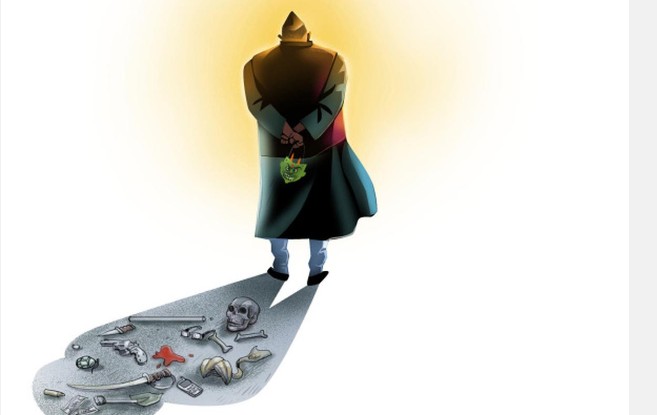
The one spectre which has always come back to haunt government establishments in Manipur is “how do you put the genie of fake encounter back into the bottle?” Genies, as we know are spirits made popular by Arabian Nights tales, which are kept safely bottled up but often released by individuals greedy for power and money to use the supernatural powers these spirits possess to advance their own personal interests.
Often, the spirits stay free longer than desired to torment their releasers. Often the latter, who were keen to release these spirits, find they are abjectly unable or incapable to drive them back into the bottle. In Manipuri there is a saying which alludes to the same disaster: “Bhoot sanaraga bhoot loisinba heitaba”.
Nobody will doubt how this piece of wisdom that so aptly explains the damage political greed, avarice, insecurity, selfishness and incompetence can do to an entire state and its people, applies very much to the present predicament Manipur is left in. Timely and appropriate actions, including firm but proportionate use of the state’s legitimate power of coercion, would have saved all the broken homes, lost lives and all-round bitterness that Manipur is now steeped in.
In this case too, the genie was freed from the bottle, and the handlers were completely overwhelmed and incapable of making it return back into the safety of the bottle.
There have been many such cases before, but politicians are notoriously infamous for not learning from history, thereby condemning not just themselves but entire populations to periodic returns to dark episodes of history.
Not too long ago, the Manipur political establishment struggled to exorcise itself from having used killer cops to fight its dirty war of brutally, silently and systematically eliminating insurgent suspects through stage encounters. Everybody remembers how the then government found itself sandwiched between the devil and deep sea, when one of its executioner policemen decided to spill the beans.
Thounaojam Herojit Singh, once a dreaded killer cop, confessed how he was responsible for the fake-encounter killings of over a hundred captives. He was a steadfast loyalist of the police establishment and whatever policies it adopted, until a sensational report on one of his broad daylight killings on July 23, 2009, on the busy BT Road appeared in the now defunct Tehelka Magazine, breaching a chink in the police armour.
It may be recalled, Herojit had claimed he first decided to come open after the organization he put his entire faith in turned its back on him when the going got tough. He had said it had become evident to him at one point that his bosses were ready to make a scapegoat of him in order to save their own skins.
Herojit’s damning claim was not just that he was a killer cop specialised in fake encounters, but that he was acting on the orders of his higher ups. The hints he had given was that this hierarchy of command went very high up.
That case went far, but not far enough to reach a satisfactory and just conclusion. One of the doubts that remained uncleared was, how high did the chain of command in this nightmarish chapter in Manipur history go up? Equally, how extensive was this collaborative crime in this sordid chapter in the state’s history? For instance, did it the policy have New Delhi’s approval? These are question which probably will never be answered.
The disturbing fact is also, as the famous Nuremberg trials after World War II, have shown us, the moral stains of these crimes do not always have to be in terms of direct complicity, but also by complicity of silence. Equally disturbing is also that those complicit can also be perfectly respectable, god-fearing family men, as Hannah Arendt has so startlingly revealed in her coverage of the trial of Adolf Eichmann for the New Yorker, later published as a book titled Eichmann in Jerusalem: A Report on the Banality of Evil.
As for Herojit, if he was driven by remorse and a need to atone his own guilt at having participated in this horrendous murderous policy, then may the heavens forgive him. However, if he had been led to believe his confessions to the crimes, and the claims of his having merely followed orders from his leaders, will clear him legally, he will probably find himself still haunted by the ghosts of his crimes.
Again, taking a leaf out of the holocaust trials, we now know that there is today a universally accepted standard of moral rectitude regarding such matters in the “Nuremberg Principles”, which essentially say that the excuse “I was following orders” in matters of grave crime against humanity, cannot be tenable in the eye of the law.
Every human being, regardless of the hierarchy in any organization or society at large, cannot surrender their moral agency and must remain a moral being especially when gross injustice is being perpetrated before their eyes. At such moments, they must still be able to stand up to their moral callings and be able to refuse to be part of the crimes. This, we all know is easier said than done. The banality of evil being what it is, more often than not, even very ordinary people, with loving families, have been part of these crimes by their remorseless indifference.
What Manipur is witnessing today, in the wake of the unprecedented murderous ethnic conflict involving first Meiteis and Kuki-Zos, which now has dragged in the Nagas as well into the vortex, is without doubt a repeat of this same harrowing tale. Many, if not most in the state, even those who were not directly involved in any cognizable crimes during these dark days, would know in their heart of hearts, that the banality of evil had touched, if not lived in them too.

Editor, Imphal Review of Arts and Politics and author