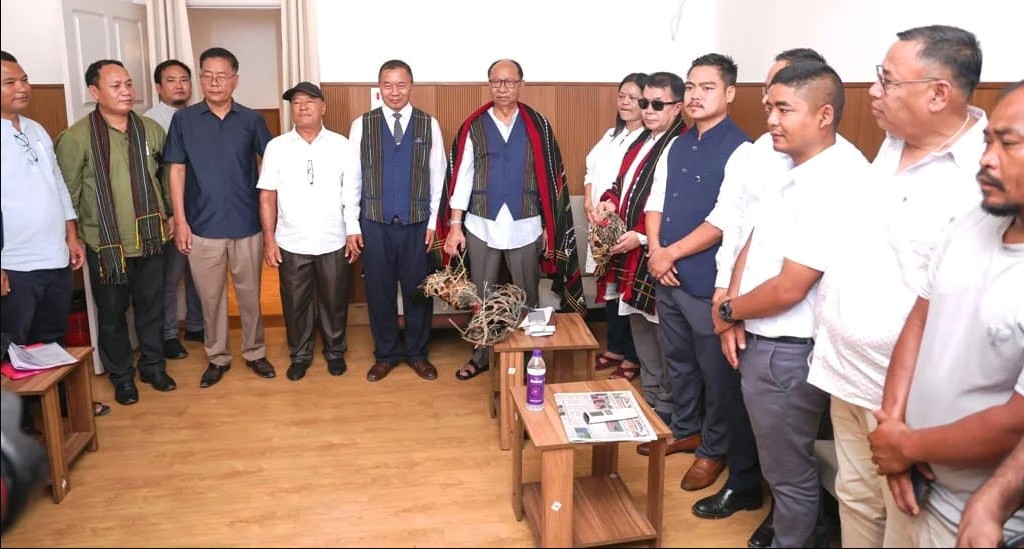
For more than three years after the eruption of violence on 3 May 2023 first in Churachandpur, Manipur appeared trapped in a frozen conflict. Roads remained psychologically and physically divided, communities became geographically segregated, political negotiations stagnated, dialogue initiatives of the Ministry of Home Affairs (MHA) seems withdrawn, and public discourse hardened around mutually exclusive narratives. Against this backdrop, two developments deserve to be examined together rather than in isolation – first, the historic “Roadmap to Peace: Covenant of Coexistence and Community Understanding” signed between the Thadou Inpi Manipur (TIM) and Meitei civil society organisations in August 2025, and now the visit of representatives of the Unified Zou Organisation (UZO), Zomi Chief Association (ZCA) and the Zomi Council (ZC) to Imphal on July 31, 2026 to meet Chief Minister Yumnam Khemchand.
Viewed independently, each event appears symbolic. Viewed together, however, they may represent the gradual emergence of a new architecture of peacebuilding driven not by governments or armed actors but by sections of civil society prepared to take political and social risks for coexistence.
This possibility deserves careful examination.
The Thadou Initiative Changed the Political Grammar
In my earlier analysis of the Thadou-Meitei Covenant, I argued that the agreement was historically significant not simply because Thadou leaders came to Imphal for the first time after the conflict, but because both sides consciously accepted substantial political risks.
The Thadou leadership faced criticism from sections that viewed any independent engagement with Meitei organisations as undermining wider tribal solidarity.
Likewise, Meitei civil society organisations also faced criticism from those who believed dialogue should only follow complete restoration of security and justice.
Nevertheless, both sides consciously chose engagement over continued isolation.
That decision fundamentally altered the political grammar of the conflict.
Instead of asking whether coexistence remained possible, they asked how coexistence could gradually be rebuilt.
That distinction is crucial.
The present visit by Zomi organisations should therefore not be interpreted as an isolated courtesy meeting with the Chief Minister. Rather, it should be understood as potentially extending the same political logic into a broader segment of Zomi civil society.
Notably, Zomi emerged as a common nomenclature of seven kindred tribes – Paite, Gangte, Simte, Sukte, Mate, Vaiphei and Zou due to the Kuki-Paite conflict of 1997-98.
The Significance of the Zomi Delegation
Several aspects distinguish the recent visit.
Unlike previous interactions mediated primarily through government officials or security arrangements, representatives of three important Zomi organisations travelled together from Churachandpur to Imphal, publicly acknowledged the need to strengthen mutual confidence among communities, and openly supported efforts aimed at restoring lasting peace.
Perhaps the most striking statement came from Mary Jones, Secretary (Information and Publicity) of the Zomi Council, who observed that after nearly three years they were finally able to visit Imphal again and described the experience as an encouraging sign.
That observation reflects something deeper than physical movement. It reflects the beginning of psychological reconnection.
Throughout the conflict, movement between Churachandpur and Imphal became more than a transportation issue. It became an indicator of whether communities still trusted one another sufficiently to share public space.
In conflict studies, restoration of shared civic space is often considered one of the earliest indicators that deeply divided societies may slowly be moving beyond active conflict.
Complementary Rather Than Identical
The relationship between the Thadou initiative and the Zomi visit should not be understood as identical. Nor should one be viewed as replacing the other. Rather, they are complementary.
The Thadou initiative emerged primarily from civil society with key roles of Thadou Inpi Manipur (TIM) and Coordinating Committee on Manipur Integrity (COCOMI), and culminated in a jointly negotiated Covenant of Coexistence.
The present Zomi initiative is centred on re-engagement with constitutional institutions through dialogue with the elected State Government while simultaneously expressing commitment to improving inter-community relations.
One operates horizontally between communities. The other operates vertically between communities and the State. Peacebuilding requires both. Successful post-conflict societies rarely rely upon a single channel of reconciliation.
Instead, they combine multiple tracks – community dialogue, political negotiations, administrative confidence-building, religious engagement, educational exchanges, women’s initiatives and youth participation.
Seen in this light, the Thadou Covenant and the Zomi visit may represent different but mutually reinforcing components of a wider peace process.
The Courage to Engage and the Cost of Peacebuilding
One of the most important lessons from the Thadou initiative remains highly relevant to understanding the recent visit of the Zomi organisations. Peacebuilding in a deeply polarised society is seldom politically rewarding. More often, it requires individuals and organisations to confront suspicion, hostility and, in extreme cases, even violence from within their own communities. Those who extend the first hand of dialogue are frequently accused of compromising community interests, legitimising the other side, or weakening long-held political positions. In societies fractured by prolonged conflict, reconciliation often demands greater courage than confrontation.
This reality was tragically illustrated by the fate of Nehkam Jomhao, Chairman of the Thadou Literature Society (Assam). In August 2025, Jomhao travelled to Imphal to participate in the historic Road to Peace: Covenant of Coexistence and Community Understanding convention between representatives of the Thadou community and Meitei civil society organisations. His participation symbolised a willingness to reopen channels of dialogue at a time when distrust between communities remained profound.
According to statements issued by the Thadou Students’ Association (TSA) and other Thadou civil society organisations, Jomhao’s advocacy of inter-community dialogue, together with his public assertion of an independent Thadou identity distinct from the Kuki political umbrella, placed him in direct opposition to the positions of certain Kuki militant groups and their political supporters. Shortly after returning to his residence at Manja village in Karbi Anglong district of Assam, he was abducted on August 30, 2025 and subsequently murdered.
Investigations by the Assam Police led to the arrest of several individuals, including cadres allegedly associated with the Kuki Revolutionary Army (KRA), in connection with the abduction and killing. The incident generated widespread condemnation from Thadou organisations, Meitei civil society bodies and numerous democratic organisations across the region. It also reignited public debate over the continued operation of the Suspension of Operations (SoO) agreements with armed Kuki groups and raised uncomfortable questions about the security environment confronting those who advocate dialogue across entrenched ethnic divides.
Nehkam Jomhao’s death transformed the Thadou-Meitei peace initiative from a symbolic gesture into a reminder that reconciliation in Manipur carries genuine risks. His murder demonstrated that attempts to build bridges between communities are not merely contested politically; they can also invite violent retaliation from actors who perceive coexistence as a threat to their ideological or exclusive territorial objectives. In this sense, Jomhao became one of the most poignant casualties not simply of the conflict itself but of the struggle for peace.
Yet the risks were not borne by the Thadou side alone.
Several leaders of Meitei civil society organisations who participated in the Covenant of Coexistence also faced criticism from sections of the Meitei public. Their detractors argued that dialogue with Thadou organisations was misplaced because, notwithstanding the Thadous’ assertion of a distinct ethnic identity, many still regarded them as part of the larger Kuki family. Since influential “Kuki-Zo” organisations continue to demand a Separate Administration or Union Territory carved out of Manipur, critics questioned whether engagement with Thadou leaders might inadvertently legitimise broader political objectives that many Meiteis fundamentally oppose.
These criticisms reflected a genuine dilemma rather than a simple ideological disagreement. They highlighted the difficulty of distinguishing between communities asserting independent identities and the wider political narratives within which they are often placed. Nevertheless, the Meitei organisations that participated in the peace initiative maintained that dialogue should not be held hostage to maximalist political positions and that coexistence with those willing to engage remained indispensable for the long-term stability of Manipur.
It is against this backdrop that the recent visit of representatives of the Unified Zou Organisation, the Zomi Chief Association and the Zomi Council acquires deeper significance. Like the earlier Thadou initiative, the Zomi leaders’ journey to Imphal is unlikely to be free from criticism within their own constituencies. Some may view engagement with the State Government and public expressions of coexistence as politically premature or inconsistent with prevailing ethnic demands. Others may question whether confidence-building should proceed before larger constitutional and political disputes are addressed.
Precisely because such reservations exist, the willingness of these organisations to travel collectively to Imphal, publicly advocate mutual trust among communities and support efforts towards restoring peace should be recognised as an important political step. It does not resolve the underlying disagreements that continue to divide Manipur, nor does it imply consensus on constitutional questions. Rather, it demonstrates a recognition that the pursuit of peace cannot indefinitely await the resolution of every political dispute.
The experiences of the Thadou initiative and the present Zomi engagement therefore point to a common conclusion – meaningful peacebuilding requires leadership prepared to accept criticism from within its own community in order to rebuild confidence across communities. Such leadership inevitably assumes political risks. The history of divided societies across the world suggests that durable peace is seldom initiated by those who wait for unanimous approval. It is more often advanced by those prepared to endure criticism; misunderstanding and even personal sacrifice in the belief that dialogue remains preferable to perpetual conflict.
Yet Symbolism Alone Will Not Build Peace
At the same time, symbolism cannot substitute for substantive reconciliation.
The restoration of confidence requires measurable progress.
Internally displaced persons must eventually return with safety and dignity to their original homes and villages.
Freedom of movement on all the National Highways and roads in Manipur must become ordinary rather than exceptional.
Markets, schools, colleges, universities, and hospitals must once again become genuinely shared institutions.
Inter-community interactions should occur without elaborate security arrangements.
The constitutional promise of equal citizenship cannot coexist indefinitely with ethnically segmented public spaces.
Consequently, the Government should institutionalise these encouraging initiatives rather than treating them as isolated public events. The selective security architecture of the Government should change immediately.
Regular community dialogue forums, youth exchanges, joint women’s peace initiatives, interfaith platforms and district-level confidence-building mechanisms should follow.
Otherwise, today’s optimism may gradually dissipate.
Engaging All Stakeholders
There is, however, one important limitation that should be acknowledged honestly.
If the objective is lasting peace throughout Manipur, the process cannot remain confined to interactions between Meitei organisations and selected sections of either the Thadou or Zomi communities.
The Naga communities constitute an equally important pillar of Manipur’s multi-ethnic society.
Recent violence involving Tangkhul and Liangmai Nagas, restrictions affecting movement along National Highway 202 and National Highway 2, and the broader deterioration of Naga-Kuki relations demonstrate that Manipur’s crisis has evolved into a far more complex multi-layered conflict than it appeared in 2023.
The logical next stage of peacebuilding must therefore involve structured participation by Naga civil society, student bodies and traditional institutions.
Without that expansion, reconciliation risks remaining partial.
A Roadmap Rather Than Isolated Events
The greatest lesson emerging from both developments is that peace cannot depend solely upon governments. Nor can it depend exclusively upon security operations. Civil society must become an equal partner.
The Thadou initiative demonstrated that dialogue between communities remains possible.
The Zomi visit suggests that broader sections of tribal civil society may also be willing to re-engage.
The challenge now is to transform these individual initiatives into an integrated roadmap.
Such a roadmap should include reciprocal community visits, institutionalised dialogue platforms, youth and student exchanges, women’s peace forums, church-mediated reconciliation, joint economic initiatives, safe restoration of unrestricted movement, rehabilitation of displaced families and transparent mechanisms for resolving local disputes before they escalate.
Only then can isolated confidence-building measures mature into a genuine architecture of coexistence.
Conclusion
The visit of the Unified Zou Organisation, Zomi Chief Association and Zomi Council to Imphal should therefore be interpreted not merely as an official meeting with the Chief Minister but as the possible continuation of a process that began with the Thadou-Meitei Covenant of Coexistence in 2025. Both initiatives reflect a recognition that waiting indefinitely for political settlements cannot substitute for rebuilding relationships among communities themselves.
The Thadou initiative demonstrated that civil society could assume the risks of initiating dialogue. The Zomi visit indicates that this willingness to engage may now be widening beyond a single community. Whether these developments eventually reshape Manipur’s political landscape will depend on whether they remain isolated gestures or evolve into an inclusive, multi-community peace process embracing Meiteis, Thadous, Zomis, Nagas, Pangals and every indigenous community of the State.
If the Thadou-Meitei Covenant demonstrated that civil society could initiate dialogue despite deep mistrust, the murder of Nehkam Jomhao revealed the heavy price that such initiatives can exact. The subsequent visit of the Zomi organisations to Imphal suggests that, notwithstanding these risks, sections of Manipur’s tribal leadership remain willing to pursue engagement rather than permanent estrangement. Whether these scattered initiatives mature into an inclusive peace process will depend not only on governmental facilitation but also on whether leaders across Meitei, Thadou, Zomi, Naga, and Pangal communities are prepared to display the same courage that Nehkam Jomhao ultimately paid for with his life. In the history of conflict resolution, peace has seldom advanced without sacrifice. Manipur’s challenge is to ensure that such sacrifices are neither forgotten nor rendered futile. Peacebuilding is not merely desirable – it is costly, contested, and therefore politically significant.
Lasting peace in Manipur will not emerge from military stabilisation or administrative management alone. It requires courageous civil society leadership willing to take political risks for coexistence, sustained governmental facilitation, and an unwavering commitment to rebuilding the shared civic space that violence has fractured.

Senior Editor: Imphal Review of Arts and Politics