The approach of the 2027 Manipur Assembly election is producing a striking political paradox. At a time when the State remains deeply divided by the unresolved conflict that began on May 3, 2023, and questions of territorial integrity, constitutional protection, demographic change, displacement, security and political accountability dominate public discourse; the political space outside the major national parties is becoming increasingly fragmented.
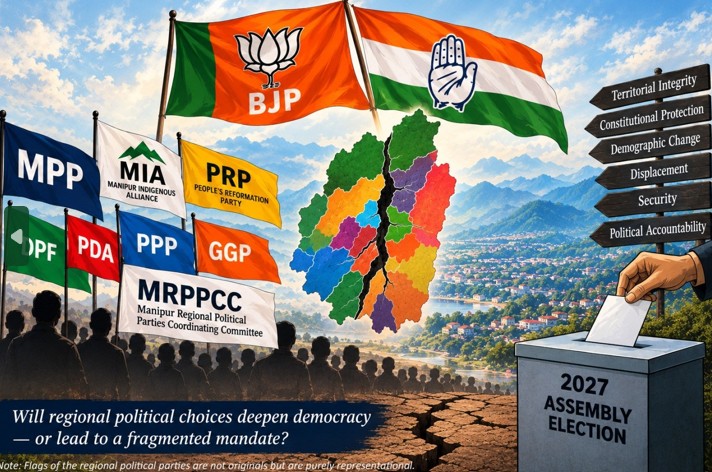
The reorganisation of the once-influential Manipur People’s Party (MPP) as a regional political force has been accompanied by the emergence of new parties and the revival or reorganisation of existing formations. The Manipur Indigenous Alliance (MIA) was established on September 16, 2026, while the People’s Reformation Party (PRP) was launched on September 24. At the same time, several regional parties have sought to coordinate their strategies through the Manipur Regional Political Parties Coordinating Committee (MRPPCC).
The MRPPCC was established at the initiative of Manipur Meeyamgi Ihou (MAMI), a youth platform, with facilitation from the Manipur Alliance for Economic and Financial Reforms (MAMEF). Senior Advocate Khaidem Mani serves as its chairman. Its constituent parties are the Democratic People’s Front (DPF), People’s Democratic Alliance (PDA), People’s Political Party (PPP) and Good Governance Party (GGP).
The emergence of the MRPPCC is significant because it represents an attempt to prevent regional political pluralism from becoming electoral fragmentation.
This proliferation of parties cannot simply be dismissed as another cycle of small-party politics. It reflects a deeper search for political alternatives after more than three years of conflict. But it also raises a central question for 2027 – will the multiplication of regional political choices strengthen democratic representation, or will fragmented votes create conditions in which an established national-party formation can assemble a government with regional partners?
The answer will depend less on the number of parties than on whether they can translate their programmes into constituency-level organisation, coordinate candidates and, above all, negotiate before polling rather than only after the results.
The Return of Regional Politics
Manipur has a long history of regional political mobilisation. After Manipur was granted Indian statehood, the MPP belongs to that tradition, but the political circumstances confronting the State in 2026 are fundamentally different from those of earlier periods.
The crisis since May 2023 has transformed Manipur’s political vocabulary. Questions once treated primarily as matters of administration or development are now intertwined with security, territory, identity, demography and constitutional arrangements. The demand for peace is inseparable from questions of political representation. Demographic change is connected with demands for an updated National Register of Citizens, while territorial integrity has acquired sharper political meaning amidst physical separation and the emergence of buffer zones.
Against this background, the emergence of new regional parties represents an attempt to reclaim political agency within Manipur.
Yet regionalism itself is not politically homogeneous. Different formations approach the crisis from different perspectives. Some emphasise territorial integrity and indigenous rights; others focus on governance, corruption, democratic decentralisation and social justice; still others approach politics through particular community or regional constituencies.
The important development, therefore, is not simply that more parties are being created. Manipur’s regional political space is being reorganised at a moment when the established political order itself is under considerable strain.
New Formations And The Search For A Regional Alternative
The Manipur Indigenous Alliance (MIA) was established at Meitram, Imphal West, on September 16, 2026, with the stated objective of bringing indigenous communities together to protect their land, heritage, identity, institutions, livelihoods and future. Its founding constitution describes it as a democratic, constitutional and peaceful political organisation committed to social justice, decentralised governance, economic opportunity, environmental protection and sustainable development.
Its founding conference elected Soraisam Surendra Singh as president and Gaidingmei Golmei as vice-president, with Khaidem Devchand Singh, Raingam Keishing and BK. Joyson among those elected to key organisational positions.
The MIA’s political significance will depend on whether its broad concept of indigenous unity can be translated into an inclusive electoral platform. In a Manipur where political identities have hardened along community and territorial lines, a statewide indigenous platform will have to address the distinct historical and political concerns of different communities while maintaining its stated commitment to constitutional and peaceful politics.
The Democratic People’s Front (DPF) traces its origins to the Manipur Democratic People’s Front (MDPF), established on April 25, 2011, by the late Gurumayum Tonsana Sharma. The party changed its name from MDPF to DPF at a special general assembly on April 18, 2025, followed by its formal public convention as a rebranded regional entity on July 2, 2025.
Led by Dr. Narengbam Rajivkumar, who was re-elected president for another three-year term in June 2026, the DPF describes its ideological orientation as democratic socialism, with “integrity and peace” as its central motto and an objective of building an inclusive Manipur.
Established as a regional alternative to national parties, the DPF has announced its intention to contest at least 30 Assembly constituencies. It has advocated restoring peace through dialogue with regional and ethnic stakeholders and has supported implementation of the NRC in Manipur.
Its significance, however, extends beyond its own electoral ambitions. The DPF is a constituent of the MRPPCC, along with the PDA, PPP and GGP, which are seeking to coordinate regional politics and work towards a common minimum programme ahead of the Assembly election.
The DPF’s declared intention to contest at least 30 constituencies also brings it directly into the arithmetic of the 60-member Assembly. Contesting half the Assembly is not merely a bid for symbolic representation; it is an attempt to establish a significant electoral presence. At the same time, participation in the MRPPCC suggests recognition that expanding individual party organisation and preventing destructive competition among regional parties are two different objectives.
The decisive question is whether coordination will extend beyond a common minimum programme to actual constituency-level arrangements.
The People’s Democratic Alliance (PDA), founded in 2012 led by BD Behring Anal, is one of the older regional formations participating in the MRPPCC. It has centred its politics on regional interests and local political concerns. Former Deputy Chief Minister and National People’s Party leader Yumnam Joykumar Singh was elected its president for the 2026–2029 term.
The PDA brings organisational experience to a coordination effort otherwise increasingly populated by newer formations. Its challenge will be to convert that experience into electoral relevance while working with other regional parties without surrendering its separate political identity.
The People’s Political Party (Meeyamgi Leingak Lup) has positioned itself as a regional alternative centred on local empowerment, indigenous values, social justice and sustainable development. It argues for a political system more responsive to Manipur’s particular circumstances rather than excessively dependent on centralised political structures.
Its participation alongside the DPF, PDA and GGP in the MRPPCC places it within the broader attempt to coordinate regional politics ahead of 2027. But, as with the other parties, the central question is whether agreement on regional issues can be translated into constituency-level cooperation. Common political positions will have limited electoral effect if constituent parties nominate competing candidates in the same constituencies.
The Good Governance Party (GGP) was launched in Imphal on July 28, 2024, amidst the continuing conflict. Led by Yambem Laba, former chairperson of the Manipur Human Rights Commission, the party emerged from dissatisfaction with the handling of the crisis by the State and Central governments. Its motto, “Manipur First,” reflects its emphasis on placing the State’s interests at the centre of its political agenda.
Senjam Surjit is the working president, Phijam Brojen the vice-president and Sanabam Raghumani the general secretary. Many of its members came from outside established party and electoral networks, giving the party an attempt at presenting itself as distinct from conventional political organisations.
The GGP has emphasised responsive governance and direct engagement with conflict-affected areas, including Moreh and Jiribam. It has also supported updating the NRC before the Census, placing demographic concerns alongside governance and security.
Its participation in the MRPPCC with the DPF, PDA and PPP brings together parties with different organisational histories but overlapping concerns about governance, peace, demographic change and Manipur’s political interests. The test is whether the Common Minimum Programme can become an electoral strategy capable of reducing unnecessary division.
The PRP And The Politics of 40 Constituencies
The People’s Reformation Party (PRP), launched in Imphal on September 24 under President Andy Mangsatabam, has announced plans to contest 40 Assembly constituencies in the valley.
Its manifesto focuses on peace, public order, territorial integrity, a gun-free Manipur, IDP concerns, constitutional safeguards, fair representation and updating the NRC before the Census, alongside youth participation and public accountability.
The PRP’s 40-seat strategy gives it a clearly defined electoral ambition, but also places the problem of opposition fragmentation at the centre of its campaign. Its candidates could face Congress as well as several regional parties seeking overlapping sections of the electorate.
The party has indicated that it will not enter a pre-poll alliance and would remain in opposition if it fails to secure the 31 seats required for a majority. That position makes the arithmetic of 2027 particularly significant.
If several parties divide the same pool of votes, a candidate can win a constituency without securing a majority of the votes cast, while the aggregate support for opposing forces remains insufficiently concentrated to produce 31 seats.
Consider a hypothetical constituency in which three major candidates receive 35 per cent, 32 per cent and 25 per cent of the vote. The candidate with 35 per cent wins under India’s first-past-the-post system, even though 57 per cent of the votes went to the other two candidates.
The same arithmetic can operate across dozens of constituencies.
The relevant question, therefore, is not simply whether there is anti-incumbency or opposition to the BJP. It is whether votes opposed to a BJP-led formation are sufficiently concentrated within individual constituencies to produce victories.
A party can secure a significant statewide vote share and win relatively few seats if its support is dispersed. Conversely, a party can win more seats with a smaller statewide vote share if its support is concentrated efficiently.
The importance of regional coordination lies precisely in this conversion of votes into seats.
The 2024 Lok Sabha Lesson
The 2024 Lok Sabha election provides an important but limited reference point. Congress won both Lok Sabha constituencies in Manipur, demonstrating that the BJP could suffer a major electoral setback in the State amidst the continuing conflict.
But the parliamentary result cannot simply be projected onto the 2027 Assembly election.
A Lok Sabha constituency contains numerous Assembly segments. An Assembly election is fought constituency by constituency, where candidate identity, local organisation, community networks, personal reputation, development issues and tactical voting can substantially affect outcomes.
The 2024 result therefore demonstrates significant electoral discontent with the BJP, but it does not establish that Congress or an INDIA-aligned formation will reproduce that performance across all 60 Assembly constituencies in 2027. Nor does it establish that regional-party fragmentation will necessarily benefit the BJP.
What it does demonstrate is that Manipur’s electoral landscape is competitive and that the next Assembly election cannot simply be treated as a continuation of the previous one.
BJP and Regional Partners
The BJP nevertheless enters the 2027 contest with experience of working with regional parties in Manipur.
The present Assembly’s political configuration has included the BJP, NPP, NPF, JD(U), Kuki People’s Alliance and other formations. Relationships have not always been stable. NPP withdrew support from the Nongthombam Biren Singh government in November 2024, while NPF continued its relationship with the BJP-led government. KPA’s relationship with the BJP also changed after the outbreak of the conflict. Both NPP and KPA are now part of the treasury bench of Chief Minister Yumnam Khemchand.
The broader lesson is that electoral alliances and governing alliances are not necessarily identical. A party may contest independently and subsequently cooperate with another formation; conversely, a party that supported a government at one stage may later withdraw that support.
This makes the post-election arithmetic particularly important.
The BJP’s possible advantage does not necessarily depend on winning 31 seats by itself. If the Assembly is fractured, its ability to negotiate with regional parties could become relevant to government formation.
The 31-Seat Threshold
The most consequential number in the 2027 election is therefore 31.
If Congress or an INDIA-aligned formation reaches 31 seats, it can form a government without depending on post-election support from numerous smaller parties.
If Congress and its allies fall short while regional parties win a significant number of seats, the Assembly could become fragmented. In that situation, the BJP and its existing or newly negotiated regional partners could seek to assemble the 31 legislators necessary to form a government.
The same arithmetic could work in the opposite direction. Regional parties could support Congress or another opposition formation if they choose to do so.
Regional parties, therefore, do not automatically belong to either side of a post-election divide. Their importance lies in their potential to become decisive in a hung Assembly.
This is why the position of parties such as the DPF, PDA, PPP, GGP and PRP on post-election cooperation could become almost as important as their manifestos.
The Pre-Poll Alliance Question
The most consequential question for the opposition and regional parties may consequently be whether they can reach some form of pre-poll understanding.
Such an arrangement need not require regional parties to surrender their separate identities. They could retain their individual programmes while agreeing on a common minimum programme and constituency-level seat adjustment.
For instance, participating parties could agree that in particular constituencies only one of them would contest against the principal rival, while another party would contest elsewhere and its partners would refrain from fielding candidates.
Such arrangements are politically difficult because every party wants to expand.
The DPF’s plan to contest at least 30 constituencies and the PRP’s plan to contest 40 demonstrate the scale of the problem. The PRP is not currently a constituent of the MRPPCC, and if both ambitions are pursued without coordination, substantial overlap could occur.
Electoral coordination also carries risks. A party may lose an opportunity to test its own strength. Local aspirants may resist alliance decisions, and voters may not automatically transfer their support from one party to another simply because their organisations have agreed to cooperate.
A pre-poll alliance can therefore address vote splitting while creating another challenge – maintaining organisational discipline and ensuring voter transfer.
Regional Politics Beyond A Binary Contest
The rise of regional parties also means that the 2027 election should not be reduced to a binary contest between the BJP and Congress.
Manipur’s political geography is more complicated.
Kuki-Zomi-dominated areas have their own political formations and alliances. Naga areas have established political relationships involving parties such as the NPF and NPP. The valley contains Congress, BJP, JD(U), NPP and a growing number of national and regional formations.
These political geographies overlap with the consequences of the conflict.
The political aspirations of Meiteis, Naga communities, Kuki-Zomi communities and other communities cannot simply be subsumed under one generic definition of regionalism. A genuinely statewide political project would have to address their competing concerns while confronting the fundamental question of whether coexistence within a common constitutional and territorial framework can be restored.
This makes the MIA’s stated ambition particularly significant. Its effort to unite indigenous communities around land, heritage, institutions and political rights will ultimately have to confront the difficult question of what political framework can accommodate communities whose political positions have become sharply divergent.
From Regionalism to Governability
The multiplication of parties creates another question that receives less attention – what happens after the election?
Winning seats is different from forming and sustaining a government.
A regional party may win several constituencies but remain far short of a majority. If no major formation crosses 31 seats, regional legislators could become central to government formation. They could use that position to seek commitments on peace, rehabilitation, constitutional safeguards, demographic issues, economic reconstruction, decentralisation or accountability.
That could strengthen regional representation.
But fragmented mandates could also encourage short-term bargaining without producing a coherent governing programme.
The credibility of new regional politics will therefore depend not merely on the number of seats won but on the clarity of its commitments concerning government formation.
Voters may reasonably ask each party – if no formation wins 31 seats, what will you do?
Will it support a government only on the basis of a publicly stated common minimum programme? Will it remain in opposition? Will it provide issue-based support? Will it join a coalition? Will it negotiate with whichever formation can form the government?
These questions could become increasingly important as polling approaches.
Fragmentation: Pluralism or Division?
The emergence of the MIA, DPF, GGP, PPP, PRP and other regional formations should not automatically be interpreted either as democratic renewal or as electoral fragmentation.
It can be both.
New parties can bring new leadership, ideas and accountability. They can offer alternatives to national parties and create political space for issues that larger organisations may overlook.
But proliferation can also divide votes among candidates appealing to similar sections of the electorate.
The MRPPCC represents an attempt to address precisely this problem. The participation of the DPF, PDA, PPP and GGP indicates that at least some regional parties recognise that coordination may be necessary if regionalism is to have a meaningful effect on government formation.
The harder task is to move from coordination of political positions to coordination of electoral strategy.
The BJP’s Possible Route Through A Fractured Assembly
The concern among many anti-BJP political forces is that fragmentation could ultimately benefit the BJP. This concern is better understood as an electoral scenario than as a prediction.
If Congress or an INDIA-aligned coalition fails to secure 31 seats while several regional parties win enough constituencies to prevent any single opposition formation from reaching the majority mark, the BJP could seek to construct a government through its own seats and support from regional parties.
The arithmetic is straightforward:
BJP seats + existing alliance partners + post-election regional support = 31 or more.
But the reverse is equally possible:
Congress/INDIA seats + coordinated regional parties + post-election support = 31 or more.
Fragmentation therefore does not automatically produce a particular government. The decisive variables would be the distribution of seats and the willingness of regional parties to enter post-election arrangements.
The central issue is not simply whether an anti-BJP vote exists. It is whether that vote is organised sufficiently to produce a legislative majority.
The Real Contest Begins Before Polling
Manipur is entering the 2027 election in an unusual political condition. The State has returned to elected government after President’s Rule, but the conflict remains unresolved and becomes multi-layered and multi-dimensional, and political and territorial divisions remain deeply entrenched. National parties continue to possess substantial organisational resources, while new regional formations are rapidly entering the field.
The MIA is seeking to create a broader indigenous political platform. The PRP is preparing for a major electoral contest in the valley. The DPF is pursuing an ambitious 30-seat strategy while participating in the MRPPCC. The PDA, PPP and GGP are seeking coordination through the same mechanism.
Their significance will ultimately be determined constituency by constituency.
For the BJP, the challenge is to retain its political base and maintain workable relationships with regional partners. For Congress and other opposition forces, the challenge is to convert the political discontent demonstrated in 2024 into Assembly constituencies. For regional parties, the challenge is more complex – they must demonstrate that regionalism can produce not merely political voices but a viable alternative for governing Manipur.
For the MRPPCC, the central test is whether its Common Minimum Programme can develop into a meaningful electoral arrangement.
The decisive number remains 31.
If an opposition formation or alliance crosses that threshold, the fragmented regional landscape assumes one political significance. If no formation reaches 31 and regional parties hold the balance, post-election negotiations become central.
In that situation, the BJP could seek to assemble a majority with existing or new regional partners. Regional parties could equally become the basis of an alternative government if they coordinate with Congress or another opposition formation.
The 2027 election, therefore, cannot be reduced to a question of whether Manipur has an anti-BJP mood or whether new regional parties are emerging. The more consequential question is whether political forces seeking an alternative to the BJP can convert dispersed political sentiment into a coherent legislative majority.
The proliferation of regional parties creates both an opportunity and a danger.
It creates an opportunity because Manipur’s political discourse is no longer confined to the established national-party framework. New formations are bringing questions of indigenous rights, territorial integrity, peace, demographic protection, decentralised governance, social justice and political accountability into the electoral arena.
But it becomes a danger if political pluralism turns into electoral fragmentation.
The distinction will be determined largely by what the parties do before polling day.
If they compete independently everywhere, the election could produce a fragmented mandate in which no opposition formation commands 31 seats. If they retain their identities while coordinating selectively, they may reduce vote splitting without eliminating regional political pluralism. If they develop a credible common minimum programme and transparent post-election commitments, they could offer voters something more substantial than another cycle of electoral bargaining.
The question before Manipur’s regional parties is therefore not whether they should exist separately. It is whether separate political identities can coexist with a common democratic strategy.
That may be the central political question of the 2027 Assembly election.
Ultimately, the significance of the new regional formations will not be measured simply by how many candidates they field or how many votes they receive. It will be measured by whether they can translate the demand for political change into a governing alternative – and whether, after three years of conflict, they can help make the Assembly once again a meaningful arena for addressing Manipur’s political crisis.

Senior Editor: Imphal Review of Arts and Politics