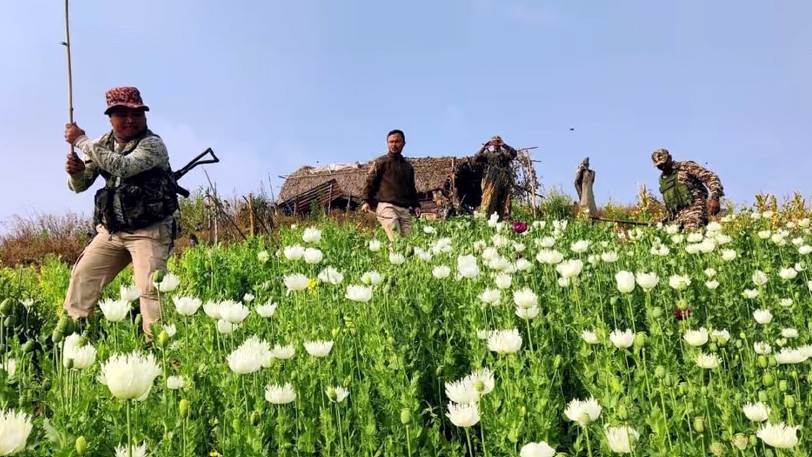
The discovery of 307 hectares of forest land under illegal poppy cultivation in Churachandpur, Senapati and Chandel districts, announced by Principal Chief Conservator of Forests Anurag Bajpai on October 9, 2026, presents a disturbing picture of the continuing failure to contain illicit cultivation in Manipur. The suspension of 12 employees of the Thoubal Forest Division in connection with alleged tree felling, the establishment of bamboo plantations over 255 hectares of the identified poppy-affected land, and the department’s continuing surveillance of vulnerable forest areas indicate that the government is taking administrative measures. Yet the larger question remains unanswered – why has poppy cultivation persisted despite years of the government’s War on Drugs, repeated eradication drives, public pledges by village authorities and substantial seizures of narcotics?
The latest disclosure should not be treated merely as a report about illegal farming or forest degradation. It demands an examination of the political economy that sustains narcotics cultivation, the institutional weaknesses that allow it to continue, and the relationship between illicit economic interests, land, militant groups and the protracted violent conflict that erupted in Manipur on May 3, 2023. Poppy cultivation is not, by itself, a sufficient explanation for the conflict. The violence has multiple historical, political, ethnic and territorial causes. Nevertheless, the narcotics economy, the contest over land and the failure of effective governance are important dimensions of the wider crisis that cannot be ignored.
The Contradiction At The Heart Of The War On Drugs
Manipur’s War on Drugs, launched in 2018 under the government of Nongthombam Biren Singh, was presented as a determined campaign against illicit cultivation, drug trafficking and the destruction of forests. Its objectives were widely supported by communities concerned about substance abuse, the future of young people and the ecological consequences of clearing forested hills for commercial cultivation.
However, the continuation of poppy cultivation after years of enforcement raises questions about the campaign’s effectiveness. In my earlier article, “War on Drugs Appears to be a Mirage of Eradication Masking a Deeply Entrenched Political Economy of Narcotics in Manipur”, I argued that the repeated destruction of poppy fields and seizure of narcotics could create an appearance of decisive action without dismantling the economic and institutional structures that sustain cultivation.
The distinction is fundamental. The destruction of a plantation measures an enforcement operation; it does not establish that the land will remain free of poppy in subsequent seasons. Similarly, the seizure of narcotics demonstrates that a consignment has been intercepted, but it does not reveal whether the wider trafficking network has been dismantled. Arrest statistics, acreage destroyed and the market value of confiscated drugs are important indicators, but they cannot independently establish the success of a drug-control policy.
The latest figure of 307 hectares must therefore be understood alongside the government’s previous record. The Forest Department has reportedly monitored illegal poppy cultivation since 2018, while successive operations by police, forest personnel and security forces have destroyed extensive plantations. My December 2025 analysis documented repeated eradication operations across several hill districts, including Ukhrul, Kangpokpi, Senapati and Churachandpur. The continued discovery of cultivated land raises questions about whether eradication has been followed by sustained surveillance, prosecution and ecological restoration.
Nevertheless, the newly reported figure should not automatically be interpreted as proof that cultivation has increased by a particular amount. The department has said that surveys are continuing, and no comparable district-wise baseline or comprehensive time series accompanies the announcement. A more reliable assessment would require the area under cultivation, the area destroyed, the land recultivated in subsequent seasons and the number of cases resulting in successful prosecution.
Without these measurements, the government risks evaluating its campaign by the visibility of enforcement rather than by a demonstrable reduction in illicit production.
Beyond Cultivators: Who Sustains The Narcotics Economy?
Poppy cultivation is often discussed as though it were an isolated agricultural activity undertaken by individual farmers. This obscures the economic relationships that can make large-scale cultivation possible.
A commercial plantation requires access to land, labour, seeds, agricultural inputs and arrangements for transporting the harvest. Depending on its scale, it may also involve financiers, intermediaries, buyers and networks capable of protecting operations from disruption. These relationships must be investigated rather than presumed. The discovery of cultivation on forest land does not, by itself, establish who organised it or whether particular officials, village authorities or armed groups were involved.
Yet the scale of the problem makes these questions unavoidable. Where extensive plantations persist over several seasons, enforcement agencies must establish who controls access to the land, who finances production, who purchases the output and who benefits from its movement through the illicit market.
Village chiefs and customary institutions deserve particular scrutiny where they exercise authority over land allocation and local access. But scrutiny must be evidence-based and individualised. Customary authority is not synonymous with criminal involvement, and the existence of poppy cultivation in a particular community cannot justify collective blame. The appropriate question is whether identifiable individuals knowingly facilitated illegal cultivation or obstructed lawful enforcement, and whether the evidence supports prosecution.
In my earlier article, “Despite Pledges by Villagers Against Poppy Plantation and Government’s Continued War on Drugs, the Scourge Still Rampant in Manipur Hills”, I examined the gap between public commitments to eradicate poppy cultivation and its continued presence. Such pledges can mobilise communities, but they cannot substitute for transparent monitoring, credible enforcement and an economic programme capable of making alternative cultivation viable.
A declaration that a village or district is drug-free is meaningful only when it is supported by independently verifiable evidence. Otherwise, declarations risk becoming symbolic exercises that leave the underlying incentives unchanged.
The same standard must apply to the state. If public authorities announce an eradication drive, they should disclose its geographical coverage, the results of follow-up inspections, the status of criminal investigations and the steps taken to prevent recultivation. Accountability must extend beyond the people found cultivating poppy to anyone whose proven involvement enables the illicit economy to operate.
The Conflict since May 3, 2023: Land, Security and Weakened Oversight
The relationship between poppy cultivation and Manipur’s violent conflict requires careful analysis. It would be inaccurate to reduce the conflict between Meiteis and Kuki-Zomi communities to a struggle over narcotics or to claim that poppy cultivation alone caused the violence that began on May 3, 2023. The conflict has involved competing political demands, fears over identity and security, disputes over land and constitutional arrangements, and a profound breakdown of inter-community trust.
Nevertheless, the narcotics economy forms part of the wider political and economic environment in which the conflict has unfolded.
In my December 2025 article, I argued that the emergence of buffer zones and the restriction of access to sensitive areas following the outbreak of violence have complicated the enforcement of forest and drug-control laws. Where security conditions prevent routine access by forest personnel, revenue officials, investigators and other civilian authorities, the state’s capacity to monitor land use is necessarily weakened.
This does not establish that every buffer zone protects poppy cultivation or that armed actors in any particular area are necessarily involved in the narcotics trade. It does, however, identify a serious governance risk. When territory becomes difficult for civilian authorities to access, illegal activities can become harder to detect and investigate. The risk is especially significant where forest land is remote, administrative presence is weak and security arrangements restrict movement.
A prolonged conflict can also distort enforcement priorities. Security agencies may understandably concentrate on preventing armed confrontations, protecting civilians and securing transport routes. Forest surveillance and investigations into illicit cultivation may consequently receive less consistent attention. If such conditions persist, the distinction between an area that is difficult to govern and an area in which illegal activity is effectively beyond scrutiny becomes increasingly important.
The concept of a frozen conflict helps explain this danger. A conflict may become less visibly violent in certain locations without restoring ordinary administration, public confidence or accountability. If buffer zones become enduring barriers to civilian governance, the consequences extend beyond the immediate management of violent conflict involving ethnic groups.
The relevant policy question is whether the state can restore impartial civilian oversight without exposing communities to renewed violence. Forest protection, anti-narcotics operations and criminal investigations must be organised in ways that protect residents, respect legal procedures and avoid turning enforcement into another source of ethnic suspicion.
The government must also ensure that action against poppy cultivation is not selectively directed at particular communities while comparable offences elsewhere escape scrutiny. Unequal enforcement can reinforce perceptions that drug control is being used as an instrument of political pressure rather than as a consistent application of the law.
The Regional Dimension: Manipur and Myanmar
Manipur’s narcotics problem cannot be understood entirely within the boundaries of the State. Its location along the international border with Myanmar places it within a wider regional environment shaped by illicit trade, armed conflict, changing agricultural markets and the movement of drugs across borders.
My article, “While Poppy Cultivation Declines in Myanmar, It Has Significantly Increased in Manipur Over the Last 15 Years, Says TNI Report”, discussed the findings of the Transnational Institute’s 2021 report, Poppy Farmers Under Pressure. The report examined the causes and consequences of changing opium cultivation patterns in Myanmar and included research relevant to India’s Northeast.
The regional picture is not static. The United Nations Office on Drugs and Crime reported that Myanmar’s estimated opium cultivation rose to 47,100 hectares in 2023 before declining by approximately 4 per cent to 45,200 hectares in 2024. Despite that decline, cultivation remained at a high level. The UNODC also identified significant regional differences, including an increase in Chin State in 2024. These figures concern Myanmar, not Manipur, and should not be used as a substitute for reliable measurements of cultivation within India. They nevertheless demonstrate the continuing importance of the regional opium economy.
The broader lesson is that illicit cultivation responds to economic incentives, political instability, enforcement patterns and changing market conditions. Suppression in one location does not necessarily eliminate demand or the networks connecting production to consumers. Cultivation can persist or shift when farmers lack viable alternatives or when the risks and rewards of illicit production change.
Manipur’s position along the Myanmar border therefore demands cooperation between Indian enforcement agencies, forest authorities and relevant border-management institutions. Such cooperation should include intelligence-sharing on trafficking networks, financial investigations, scrutiny of supply chains and action against those who profit from illicit trade.
At the same time, the government should not treat border geography or ethnic connections across the international boundary as evidence of criminality. Border communities have diverse livelihoods and social relationships. Effective enforcement must be directed at demonstrable illegal conduct, not at ethnic identity or cross-border kinship.
Nor should the focus on poppy obscure other narcotics-related activities. Opium cultivation, heroin trafficking and the movement of synthetic drugs are connected in some parts of the regional illicit economy, but they are not interchangeable activities. Each requires appropriate evidence, intelligence and investigative methods.
Forest Destruction Cannot Be Repaired By Plantation Statistics Alone
The Forest Department’s announcement that bamboo has been planted across 255 hectares of the identified land offers an important starting point for ecological restoration. But plantation coverage is not equivalent to the recovery of a forest ecosystem.
The department has stated that nearly 78 per cent of Manipur’s geographical area is classified as forest land, while forest cover accounts for approximately 74 per cent. These categories should not be confused: land classified as forest and land that meets the technical definition of forest cover are different measures. The figures also need to be interpreted in light of the methods used in the relevant forest assessment.
Illegal clearing for poppy cultivation can damage natural vegetation, disturb soil, increase erosion and affect water systems. The ecological consequences depend on the location, slope, intensity of clearing and subsequent land management. Replanting bamboo may provide useful ground cover and biomass, but it cannot automatically restore the biodiversity, soil structure and ecological functions of a natural forest.
The government’s proposal to explore plant species that might inhibit poppy growth also requires scientific evaluation. Any such approach should be assessed for ecological suitability, effectiveness and possible unintended effects. There is no substitute for preventing illegal clearance in the first place.
The reported diversion of approximately 600 hectares for development projects last year raises a related question. Development projects may serve legitimate public purposes, but the cumulative environmental costs of land diversion, illicit clearing, timber extraction and fire damage need to be assessed transparently. Plantation programmes should not become a convenient accounting mechanism that treats all forms of forest loss as interchangeable.
The suspension of 12 employees of the Thoubal Forest Division over alleged tree felling is also significant. It demonstrates that the department has initiated disciplinary action in response to suspected wrongdoing. However, suspension is an interim administrative measure, not proof of guilt. The inquiry must establish the facts, identify individual responsibility and follow due process.
The same principle should govern investigations into illegal poppy cultivation. Administrative action against frontline employees cannot replace an examination of whether supervisory failures, inadequate monitoring, external interference or deliberate complicity contributed to illegal activity. Accountability should be proportionate to evidence and extend to all levels of responsibility where warranted.
Why Alternative Livelihoods Must Be More Than A Promise
In my article, “Manipur Government’s War on Drugs 2.0 Needs to Have Holistic Approach With Clear Objectives and Policies”, I argued that eradication must be accompanied by a credible programme of alternative livelihoods.
This remains central to the present debate. Poppy cultivation can offer attractive returns relative to legal crops, particularly where farmers face limited market access, poor transport infrastructure, inadequate public investment and uncertainty over the profitability of alternatives. These conditions do not justify illegal cultivation, but they help explain why eradication alone may fail to produce lasting change.
Alternative livelihood programmes must therefore be designed around the realities of hill agriculture. Farmers need crops suited to local soil and climatic conditions, access to quality planting material, reliable extension services, credit, storage facilities, roads and assured access to markets. A crop that grows successfully but cannot be sold at a remunerative price is not a sustainable substitute.
The state should also recognise that cultivators are not necessarily the principal beneficiaries of the narcotics economy. Where financiers and intermediaries capture a disproportionate share of the returns, simply persuading farmers to switch crops may leave the more powerful economic interests untouched.
The government must distinguish households that depend on cultivation for income from those who organise, finance or profit from illegal commercial operations. Farmers willing to abandon poppy cultivation should receive practical support, while those responsible for organised criminal activity should face lawful investigation and prosecution.
Community participation is equally important. Village authorities, women’s organisations, churches, youth groups and civil society organisations can help monitor cultivation, encourage alternatives and communicate local concerns. Their participation must be voluntary, transparent and accompanied by safeguards against intimidation or collective punishment.
Alternative livelihoods should also be evaluated over several agricultural seasons. The relevant indicators are not the number of meetings held or the number of farmers who sign declarations, but whether household incomes remain viable, recultivation declines and forest ecosystems recover.
From Symbolic Eradication to Accountable Governance
The announcement of 307 hectares under poppy cultivation should prompt a comprehensive review of Manipur’s anti-narcotics policy. Such a review must move beyond the familiar cycle of detecting fields, destroying plants, issuing statements and discovering new plantations in subsequent seasons.
First, the government should publish a verified district-wise inventory of poppy cultivation on forest land, including the legal status of the land, the dates of detection and the results of follow-up inspections. Public reporting should distinguish newly detected cultivation from previously identified areas and land that has been recultivated.
Second, investigations should trace the financial and organisational relationships behind large-scale plantations. Evidence-based action against financiers, traffickers, buyers and other facilitators is essential if the government intends to dismantle the economic structures that sustain illicit production.
Third, forest surveillance must be strengthened through regular field inspections, appropriate technological monitoring and coordination between forest personnel, district administrations and security agencies. Areas affected by conflict require carefully designed access arrangements that protect both officials and local residents.
Fourth, the government should publish measurable outcomes from alternative livelihood programmes and ecological restoration projects. Independent assessments can help determine whether bamboo plantations are surviving, whether natural vegetation is recovering and whether participating households have achieved viable incomes.
Fifth, disciplinary inquiries and criminal investigations must be impartial. Neither official position nor customary authority should confer immunity from the law, but allegations must be supported by evidence and investigated through established procedures.
Finally, drug-control policy must be integrated with the wider restoration of governance in Manipur. Security measures may be necessary to prevent violence, but they cannot permanently substitute for civilian administration, transparent institutions and the rebuilding of public trust. The state must be able to protect forests and enforce the law across all districts without discrimination.
Conclusion
The discovery of 307 hectares of forest land under illegal poppy cultivation is a warning that Manipur’s War on Drugs remains confronted by structural problems. The planting of bamboo across 255 hectares, the suspension of 12 forest personnel and continuing surveillance are relevant administrative measures, but their significance will depend on what follows.
The decisive question is whether the government can move from the periodic destruction of plantations to the sustained dismantling of the economic and institutional arrangements that permit illicit cultivation to survive. That requires investigations into financial networks, impartial enforcement, scientifically grounded forest restoration, viable alternative livelihoods and renewed civilian oversight of areas affected by conflict.
The violent conflict that began on May 3, 2023, must not be reduced to a narcotics dispute. Yet neither can the narcotics economy be separated from the questions of land, security, governance and accountability that shape the state’s present crisis. Where conflict restricts access, weakens oversight and erodes confidence in public institutions, the conditions for persistent illegal activity become more difficult to address.
Manipur needs a War on Drugs that is measured not by the number of acres destroyed or the value of narcotics seized, but by demonstrable and sustained reductions in cultivation, trafficking and environmental damage. It must also protect communities from indiscriminate suspicion and ensure that those who profit from illicit production cannot evade scrutiny through political influence, institutional weakness or the insecurity created by prolonged conflict.
The ultimate test is whether the state can restore the rule of law while protecting both the forests and the people who depend on them. Without that transformation, the discovery of another poppy plantation will remain evidence of a recurring failure rather than a turning point in Manipur’s struggle against the narcotics economy.

Senior Editor: Imphal Review of Arts and Politics