The Taliban’s opium ban and Myanmar’s expanding narcotics economy reveal how changes in one part of the region can reshape illicit markets elsewhere, placing Manipur and India’s northeastern frontier under growing pressure.
The drug crisis confronting Northeast India cannot be understood simply as a problem of addiction, policing or border security. It is also part of a wider regional economy shaped by armed conflict, political instability, weak governance and the ability of illicit networks to adapt when governments attempt to suppress them.
Two developments illustrate this changing landscape. In Afghanistan, the Taliban’s prohibition on opium cultivation has sharply reduced production from its pre-ban levels. In Myanmar, meanwhile, opium cultivation has expanded, while industrial-scale methamphetamine production and trafficking have made the country a major source of synthetic drugs reaching regional markets.
For Manipur, which shares an international border with Myanmar, these developments raise an important question: when drug production is disrupted in one region and expands in another, how does the resulting reorganisation of illicit markets affect India’s northeastern states?
The evidence does not establish that the Taliban’s ban directly caused the expansion of Myanmar’s drug trade or the flow of narcotics into India. It does, however, point to a regional market undergoing significant change, with consequences that deserve closer attention.
Afghanistan’s prohibition and the changing opium economy
In April 2022, the Taliban authorities announced a prohibition on opium poppy cultivation and the production, use and trafficking of narcotics. The effects on cultivation became particularly pronounced in 2023.
According to the United Nations Office on Drugs and Crime (UNODC), Afghanistan’s estimated opium cultivation fell from approximately 233,000 hectares in 2022 to 10,800 hectares in 2023, a decline of about 95 per cent. Cultivation subsequently rose modestly to 12,800 hectares in 2024 before falling to an estimated 10,200 hectares in 2025. The 2025 estimate remained dramatically below the pre-ban level.
The prohibition has therefore substantially disrupted Afghanistan’s traditional opium economy. However, a reduction in cultivation within one country does not necessarily translate into an equivalent reduction in global demand for heroin and other opiates.
Drug markets are international, and supply chains can respond to shortages through stockpiles, changes in trafficking patterns, alternative suppliers and shifts in prices. These adjustments take time and vary across substances and markets.
The distinction matters. Afghanistan’s opium prohibition concerns the cultivation of poppy and the associated opiate economy. It should not be confused with a general ban on every category of narcotic production, nor does it mean that all Afghan drug trafficking has ceased.
The wider question is what happens when an established supplier’s production contracts while demand for opiates persists.
Myanmar’s expanding narcotics economy
Myanmar has emerged as an increasingly important part of this story. According to UNODC’s Myanmar Opium Survey 2025, the area under opium poppy cultivation increased from 45,200 hectares in 2024 to 53,100 hectares in 2025, a rise of 17 per cent and the highest estimated level in a decade.
The expansion has occurred amid prolonged armed conflict, economic insecurity and weakened governance following the military takeover of February 2021. For rural households facing displacement, disrupted livelihoods and limited access to legal markets, opium cultivation can become an economically attractive, if dangerous, source of income.
UNODC has also identified the contraction of Afghan opium production as a factor that may influence demand and supply dynamics in Myanmar. Its 2024 survey warned that changes in global supply chains following the Afghan ban could create incentives for further expansion in Myanmar. The 2025 survey subsequently documented a substantial increase in cultivation. These findings establish a credible relationship between changing regional market conditions and the risks facing Myanmar, although they do not prove that the ban alone caused the increase.
Yet opium is only one component of Myanmar’s illicit drug economy.
The country is also a major source of methamphetamine, a synthetic stimulant produced through chemical processes rather than harvested from poppy fields. Methamphetamine production in the wider Golden Triangle has benefited from organised criminal networks, access to precursor chemicals and the protection or opportunities created by areas where state authority is limited.
This distinction is central to understanding the threat to India. The Afghan ban may influence the international opiate market, but the methamphetamine reaching Northeast India belongs to a different production chain. The two developments intersect within the wider regional narcotics economy; they should not be treated as one continuous supply chain.
The Myanmar – India corridor
India’s northeastern frontier is particularly exposed to these changes because of its geography. Arunachal Pradesh, Nagaland, Manipur and Mizoram share international borders with Myanmar, placing communities and enforcement agencies along a frontier where formal trade, social connections and illicit movement coexist.
UNODC’s Synthetic Drugs in East and Southeast Asia 2025 documents growing westward trafficking of methamphetamine from Myanmar towards South Asia, including Northeast India. The report identifies Mizoram as an important entry and transit area, with onward movement towards other parts of India and the Bangladesh border.
The scale of seizures illustrates the seriousness of the problem. According to the International Narcotics Control Board’s 2025 annual report, Indian authorities seized 8.2 tonnes of amphetamine-type stimulants in 2024, most of which were believed to be methamphetamine. This was approximately five times the amount seized in 2020. The figure measures seizures, not total consumption or the full volume trafficked, but it indicates the scale of the enforcement challenge.
Manipur is situated within this broader environment. Its proximity to Myanmar makes it vulnerable to cross-border narcotics networks, while its internal social and security challenges complicate efforts to distinguish the effects of drug trafficking from those of local political and economic conditions.
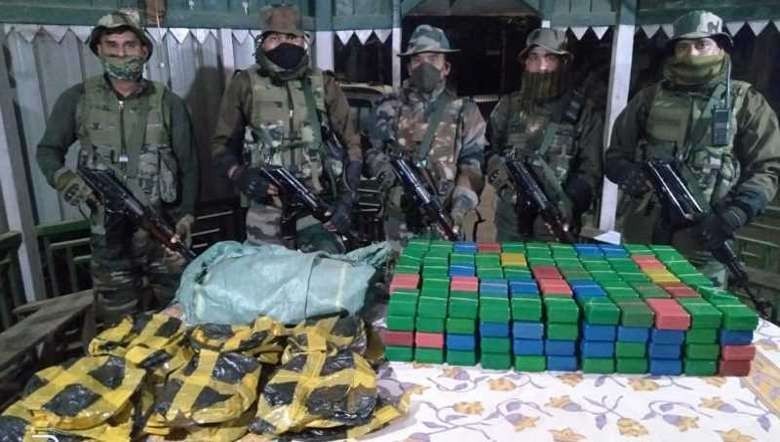
A major seizure in the Imphal-Guwahati enforcement network in March 2025 demonstrated that the problem is not confined to small quantities of narcotics carried across remote border paths. India’s Narcotics Control Bureau reported the seizure of 102.39 kilograms of methamphetamine tablets during one operation, as part of a wider set of actions involving an international drug cartel. Government of India, Press Information Bureau, 16 March 2025.
Such cases higilight the importance of examining the networks that finance, transport and distribute drugs, rather than focusing exclusively on individual couriers or users.
Is the Afghan ban shifting the drug trade towards India?
The reduction in Afghan opium production has altered the conditions of the international opiate market. Myanmar’s expanding poppy cultivation offers evidence that other producing regions are becoming increasingly significant as the market adjusts. UNODC’s findings support the possibility that shortages and price changes associated with Afghanistan’s reduced output have strengthened incentives for cultivation elsewhere.
However, three separate developments must be distinguished.
First, the Taliban’s prohibition has sharply reduced Afghanistan’s opium production. Second, Myanmar’s opium cultivation has increased amid conflict and economic instability, with shifting international demand among several relevant factors. Third, Myanmar-origin methamphetamine is moving westward into India through established trafficking networks.
These developments are related at the level of regional drug-market dynamics, but they are not interchangeable. There is insufficient evidence to conclude that Afghan heroin shortages have directly diverted methamphetamine production towards India, or that the Taliban’s ban is the principal cause of drug trafficking into Manipur.
A more defensible interpretation is that the region’s illicit markets are adapting simultaneously to different pressures. While the opiate trade responds to changes in poppy cultivation and heroin availability, the synthetic-drug trade continues to expand through production and distribution networks with their own drivers.
The implication for India is nevertheless significant, reducing supply in one country cannot, by itself, resolve a regional problem when other production centres remain active and trafficking networks can reorganise.
Beyond seizures: a regional response
For Manipur and the wider Northeast, an effective response must combine border enforcement with intelligence-sharing, financial investigation, public-health interventions and cooperation with neighbouring countries.
First, Indian agencies need a clearer picture of the networks behind the trade. Seizure data should be analysed alongside precursor-chemical movements, financial flows, repeat trafficking patterns and links between consignments. The objective should be to identify the organisers and financiers who sustain distribution, not merely the people caught transporting drugs.
Second, cooperation between India and its neighbours is essential. Myanmar’s prolonged conflict and fragmented control across parts of its territory make conventional enforcement more difficult. Information-sharing, coordinated investigations and monitoring of precursor chemicals can help address parts of the supply chain that individual states cannot effectively tackle alone.
Third, the demand side requires equal attention. Treatment services, harm reduction, rehabilitation and community-level prevention are necessary complements to interdiction. A strategy measured only through seizures risks overlooking the social damage caused by addiction and the vulnerability of communities caught between trafficking networks and enforcement operations.
Finally, the Afghan experience offers a broader lesson. Prohibition can sharply reduce cultivation, but sustained disruption of illicit markets requires attention to livelihoods, demand, stockpiles and the possibility of production shifting geographically. Myanmar’s experience demonstrates how conflict and economic insecurity can reinforce dependence on illicit cultivation even when neighbouring markets are under pressure.
A changing regional threat
The significance of the Taliban’s opium ban for Northeast India lies not in a simple claim that one prohibition has redirected all narcotics towards Myanmar. It lies in the wider lesson that drug markets do not respect national boundaries and rarely remain static when supply conditions change.
Afghanistan’s opium economy has contracted dramatically. Myanmar’s poppy cultivation has expanded, and the country remains a major source of methamphetamine moving towards South Asia. India is exposed to both the changing opiate market and the established westward flow of synthetic drugs.
For Manipur, this is not merely a distant geopolitical development. It is a border-security, public-health and governance challenge whose origins extend beyond the state itself.
The response must therefore look beyond the next seizure or enforcement operation. Understanding how production, demand, organised crime and regional instability interact is essential to addressing a problem that is increasingly transnational in both its causes and its consequences.

The writer is a geopolitical and open-source intelligence (OSINT) analyst and Lead Intelligence Analyst at the Centre for New Age Warfare Studies (CNAWS). His work focuses on militant ecosystems in Pakistan, including Tehrik-i-Taliban Pakistan (TTP) networks, Baloch insurgent groups, and extremist information networks.