
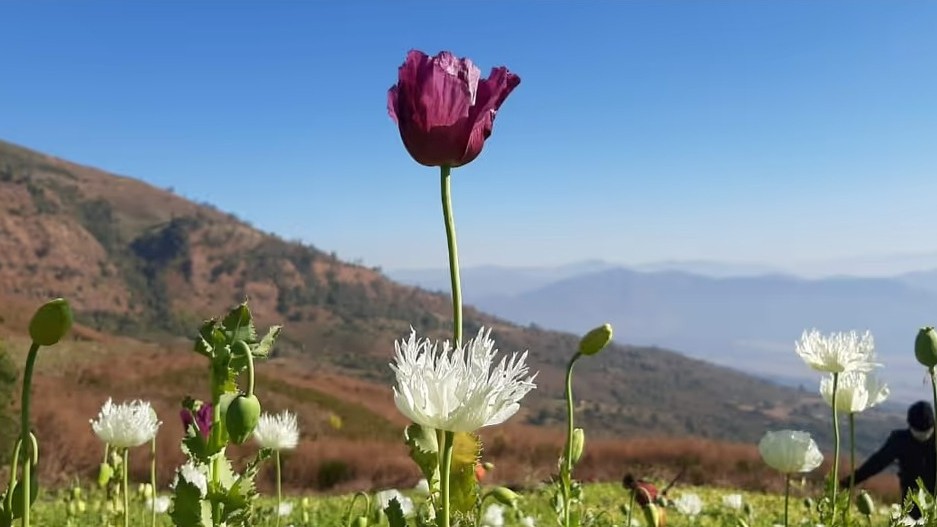
Even as the Manipur Police periodically announces the destruction of hundreds of acres of illicit poppy cultivation, along with Narcotics and Affairs of Border (NAB), Forest Department and Central Security Forces – some after the armed Zeliangrong United Front (ZUF) who has been going on peace talk with the Government of India already destroyed recently – and the seizure of massive quantities of narcotics, the reality unfolding in Manipur’s hill districts tells a far more disturbing and contradictory story. The state’s much-publicised “War on Drugs,” launched in 2018 under former Chief Minister Nongthombam Biren Singh, increasingly resembles a cycle of symbolic enforcement rather than a sustained dismantling of the narcotics economy. Despite official claims of success measured in acres destroyed and drugs seized, poppy plantations continue to expand, regenerate and migrate deeper into the hills of Kangpokpi, Ukhrul, Senapati, Churachandpur and Tengnoupal.
For more than seven years, Manipur’s “War on Drugs” has been projected as a moral, civilisational and administrative crusade – one aimed at saving forests, protecting youth and dismantling a transnational narcotics economy rooted in the hill districts of the state. Official briefings regularly announce the destruction of hundreds of acres of illicit poppy cultivation, the seizure of narcotics worth Crores of rupees, and the arrest of drug traffickers. Yet behind these statistics lies a far more uncomfortable truth – poppy cultivation in Manipur has not declined. It has expanded, adapted and embedded itself deeper into the political and security architecture of the state.
Since the launch of the campaign in 2018 under former Chief Minister N. Biren Singh, enforcement agencies including the Manipur Police, Narcotics and Affairs of Border (NAB), Forest Department and Central Security Forces have destroyed what the government claims to be more than 18,600 acres of poppy cultivation between 2017 and 2023. By the logic of enforcement arithmetic, this should have produced a visible and sustained decline. Instead, every new cultivation season reveals fresh clearings, regenerated fields and newly established poppy zones across Kangpokpi, Ukhrul, Senapati, Churachandpur and Tengnoupal. Authorities have conducted extensive destruction drives across major poppy-growing districts, including Ukhrul, Kangpokpi, Senapati, and Churachandpur.
In December 2025 alone, operations destroyed a total of approximately 559 acres of poppy fields across several locations, with 140 acres cleared in a single operation on December 17 in Ukhrul District. In earlier 2024 operations, around 110 acres were destroyed in the Khamasom hill ranges.
In Kangpokpi District, in late 2024 and December 2025, security forces destroyed roughly 42 acres and another 63 acres of poppy cultivation in various operations. A November 2025 operation destroyed 53 acres in the Koubru reserve forest area.
Around 110 acres were destroyed in joint operations across the northern hill ranges in November 2025, and a survey identified 13 hectares of cleared land for future cultivation in September 2025 in Senapati District.
In Churachandpur and Tengnoupal Districts, nearly 18 acres of poppy were destroyed in a combined operation in November 2025.
Manipur Police and related agencies also continuously report significant drug seizures and arrests, often linked to cross-border trafficking from Myanmar.
Widespread operations across hill districts, with a focus on Kangpokpi, Ukhrul, and Senapati are reported. The Director General of Police (DGP) for Manipur, Rajiv Singh, has repeatedly vowed “ruthless” action against all offenders, including any police personnel found to be involved in the drug trade. The police have also disposed of large quantities of seized narcotics including over 332 kg in a single event in September 2025.
This persistent contradiction exposes the central failure of the War on Drugs – it has prioritised spectacle over structure. Destruction drives have become highly visible events, while the political economy that enables poppy cultivation remains largely untouched.
At the heart of this economy lies village authority that is village chiefs. In Manipur’s hill districts, particularly in Kuki dominated areas, village chiefs exercise decisive control over land allocation, settlement, cultivation and access. The authority to permit or deny land use rests with the chief. Large-scale poppy cultivation – spanning tens or hundreds of acres – cannot plausibly occur without the knowledge, consent or facilitation of village chiefs. In reserve forest areas, without keeping a blind eye by the forest department, security forces, and district administrations, poppy plantations cannot be carried out. Such cultivation requires land allocation, labour mobilisation, storage infrastructure, security arrangements and supply-chain coordination.
Yet the War on Drugs has long avoided confronting this reality directly. Instead, it has relied heavily on extracting public pledges from village chiefs and civil society organisations (CSOs), transforming enforcement into a politics of declarations. By 2022, almost every hill district had publicly declared itself “drug-free” or pledged support for the campaign. Kangpokpi district, widely recognised as one of the epicentres of poppy cultivation, formally joined this chorus in May 2022, when CSOs and village chiefs announced a ban on poppy cultivation and declared the district a Drug-Free Zone.
What followed, however, was not decline but proliferation. Poppy cultivation in Kangpokpi expanded rapidly in the years after the pledge, confirmed repeatedly by subsequent destruction drives. This gap between rhetoric and reality was not accidental. As documented in earlier analyses, such declarations often functioned less as instruments of reform than as shields against scrutiny – symbolic compliance that preserved existing power structures while securing political goodwill, development incentives and administrative insulation.
The arrest of a serving village chief in Kangpokpi in November 2025 on charges related to opium possession briefly punctured this façade. It confirmed what many observers including the author of this article had long argued – village authority is not merely negligent but structurally embedded in the narcotics economy. Yet the exceptional nature of such arrests only reinforces the pattern of selective enforcement. If village authority is central to cultivation, why are such arrests so rare? Why do they occur only after years of open cultivation? And how many others remain untouched?
These questions cannot be answered without situating Manipur within a wider regional transformation. Research by the Transnational Institute (TNI) shows that while opium cultivation has declined in Myanmar over the past two decades due to shifting global drug markets, ceasefire arrangements and enforcement strategies, it has simultaneously expanded in Northeast India, particularly Manipur. This shift was facilitated by porous borders, shared ethnic networks, weak state presence and the monetisation of customary authority.
In Manipur, poppy cultivation is no longer a marginal subsistence activity. It is integrated into a regional narcotics economy linked to heroin production, methamphetamine trafficking and cross-border supply chains. Cultivation is sustained not merely by poverty but by political marginalisation, armed conflict and the absence of credible governance alternatives.
Despite this, the War on Drugs continues to treat poppy cultivation as an isolated criminal activity. Destruction drives focus on fields rather than financiers. Huts are burned, fertilisers seized and FIRs registered, but cultivators are rarely apprehended on site. Official reports routinely note that no farmers were present during operations, as though vast plantations cultivate themselves. Responsibility is deferred, ownership remains “under verification,” and accountability dissolves into procedure.
This already fragile enforcement framework suffered a decisive blow after May 3, 2023, when the violent conflict engulfed Manipur and security forces imposed buffer zones across large swathes of the hill-valley interface. Introduced ostensibly to prevent further clashes, buffer zones have fundamentally altered the geography of governance in the state. While they may have reduced direct confrontation in certain areas, they have simultaneously frozen accountability.
In theory, buffer zones are neutral spaces of separation. In practice, they have become securitised zones of restricted access, where civilian movement, forest oversight and administrative monitoring are curtailed in the name of law and order. Forest officials, revenue staff, anti-poppy activists, journalists and even district officers frequently find themselves unable to enter or verify areas designated as sensitive.
For poppy cultivation, this securitisation has produced unintended but predictable consequences. Areas that were once intermittently accessible – even if weakly governed – are now effectively sealed off. Poppy plantations located within or adjacent to buffer zones enjoy passive protection, not because they are legal, but because reaching them is operationally inconvenient or politically risky. Illegality, in such spaces, does not disappear; it becomes invisible.
This is where the concept of frozen conflict becomes analytically decisive. A frozen conflict does not resolve tensions; it stabilises them at a low-intensity equilibrium that benefits certain actors. In Manipur, buffer zones have frozen not only ethnic confrontation but governance itself. They have stabilised a political economy in which poppy cultivation thrives precisely because oversight is suspended and intervention selectively avoided.
Poppy does not provoke immediate confrontation, generates substantial income and operates comfortably within a securitised landscape where enforcement is episodic and accountability deferred. Buffer zones thus do not merely coexist with the narcotics economy; they actively shape it.
At the same time, buffer zones have recalibrated power relations between the state and local authorities. While formal sovereignty remains with the state, de facto control over land use increasingly rests with village chiefs and informal power structures mainly armed militants. Customary authority operates with minimal scrutiny, even as it publicly aligns itself with state-led campaigns like the War on Drugs. Compliance becomes rhetorical; autonomy remains practical.
In this environment, the language of community participation and voluntary eradication loses meaning. Communities cannot be genuinely mobilised against poppy cultivation when access itself is restricted and enforcement appears selective. Declarations by CSOs and village chiefs therefore acquire a performative character – designed to signal alignment with the state while preserving territorial and economic control.
It is against this backdrop that the December 2025 declaration by Kangpokpi CSOs and village chiefs to impose a complete ban on poppy cultivation from 2026 must be critically assessed. History demands scepticism. Similar pledges were made in 2022 with little effect. The timing of the new declaration – following intensified destruction drives and the arrest of a village chief – raises legitimate questions about intent. Does this represent a genuine rupture, or is it a pre-emptive manoeuvre to evade renewed scrutiny and legal consequences?
The declaration speaks of moral responsibility and social harm, and promises strict action against violators. Yet without independent monitoring, transparent enforcement mechanisms and integration with formal legal processes, such assurances remain circular. Chiefs policing chiefs within the same authority structure that enabled cultivation offers little confidence of transformation.
The deeper failure of Manipur’s War on Drugs lies in its reluctance to confront political costs. Genuine eradication would require dismantling the nexus between village authority and narcotics, holding revenue and forest officials accountable for systematic blindness, restoring civilian oversight in buffer zones, and addressing the conflict-driven marginalisation that makes illicit cultivation economically rational. Development packages and alternative livelihoods, while necessary, cannot substitute for political accountability.
In its current form, the War on Drugs has produced spectacle rather than transformation. Acres are destroyed, drugs seized, arrests announced and pledges celebrated, while the underlying system regenerates with remarkable efficiency. Poppy fields reappear and expand where forests once stood. Village authorities retain control over land. Buffer zones quietly convert illegality into invisibility.
Until Manipur confronts the convergence of village authority, securitised space and frozen conflict, poppy cultivation will continue to flourish in the shadows of enforcement. The question is no longer whether poppy can be destroyed – it demonstrably can – but whether the political will exists to dismantle the structures that allow it to thrive. Without that reckoning, the War on Drugs will remain what it increasingly appears to be a mirage of eradication masking a deeply entrenched political economy of narcotics in Manipur.

Senior Editor: Imphal Review of Arts and Politics





1 thought on “War on Drugs Appears to be a Mirage of Eradication Masking a Deeply Entrenched Political Economy of Narcotics in Manipur”
A much needed article
Comments are closed.