Before we talk about climate change, let’s start by asking ourselves one question: How many trees have I planted in my lifetime?
It is an uncomfortable question, but an essential one because climate change and its effects are being felt across the globe, affecting humans, animals and the entire ecosystem. And it cannot be controlled or tackled in only one part of the world. For example, India’s neighbouring country Bhutan is widely known as the only carbon-negative country in the world, meaning it absorbs more carbon dioxide than it emits. Does that mean the country is not affected by climate change? No. Bhutan, too, has felt the effects of a changing climate, since Climate Change doesn’t recognise borders.
Manipur is no exception. The small state has experienced the negative impacts of climate change in the form of erratic and intense monsoons causing severe flash floods, shifting rainfall seasons disrupting paddy agriculture and warmer temperatures affecting fish habitats in Loktak Lake. A collective effort is necessary to tackle what has been described as one of the biggest threats to humankind. We have seen the effects. But how much have we contributed to tackling them?
At COP26, India committed to achieving net-zero emissions by 2070, setting out a broader climate roadmap in which nationwide reforestation and afforestation are expected to serve as important carbon sinks. But how much can an individual contribute by planting trees?
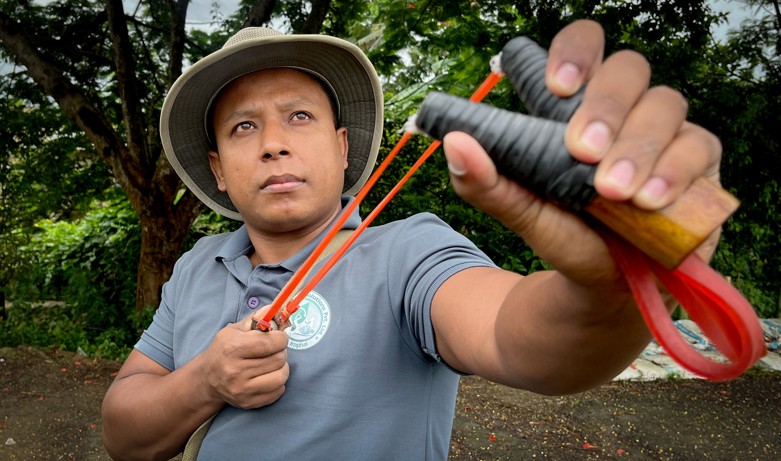
Around 50 kilometres from Imphal, in the village of Kwakta, lives 32-year-old Anish Ahmed, who has been working to tackle climate change with a slingshot and seed balls that he prepares over several months. His target for 2026 is ambitious: to plant at least two lakh trees. He says he has already planted 1.7 lakh.
Ahmed took me for a walk and began showing me the trees he had planted in his locality. “For this year, I am aiming to plant at least 2 lakhs trees. I have already planted 1.7 lakh trees and will complete the target or even exceed it,” he said. He did not begin planting trees recently. As a schoolboy, he knew only that planting trees was good for the environment. He had heard it from his grandfather and other people around him. At the time, however, he did not know how powerful tree planting could be in tackling climate change. From a young age, he began planting trees.
Over the years, he has been firing seed balls into the hills, often staying there for days with one mission: to grow trees. He recently returned after spending several days in the hills planting trees. The nearby Thangjing hill range remains his priority, and he has also planted trees in Nongmaijing Ching and reserve forest areas around Imphal.
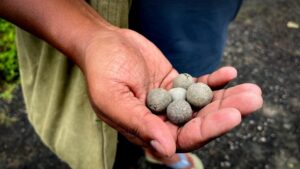
When asked how many seed balls he had prepared and dispersed in his lifetime, Ahmed proudly said the number must have already crossed 1.9 million (19 lakhs). His motivation came from what he began learning as a teenager. “When I was in Class 12, I learned about mass deforestation in Manipur, the increase in carbon dioxide, and the threat of climate change across the world. I learned that tree plantation is one of the key ways to tackle climate change since trees absorb carbon dioxide,” he said.
His mission goes beyond the number of trees he has already planted. “There are roughly 35 lakh people in the state. I want to plant trees, even if I have to do it all alone. I will plant one tree for every resident, which would be roughly 35 lakh trees, and more,” he said.
But planting millions of seed balls does not necessarily mean millions of trees will grow. Ahmed has experimented with his methods, drawing on his education, his reading of research on tree plantation, other scientific knowledge and his own experience. He holds a master’s degree in Geography from Manipur University. When he started firing seed balls, the success rate was low.
“When I started the journey of firing seed balls to plant trees, the success rate was very low. Maybe around 20 to 30 seed balls out of every 100 must have grown into trees. But by applying my research and findings and incorporating what I have studied, the success rate grew to above 90 percent,” he said.
For Ahmed, success depends not only on preparing the seed balls but also on when and where they are released.
“I have to check the weather forecast and the place where the balls would land. If I have a drone, I would rather survey the areas, and that would increase the success rate if I know the area well,” he said. His method has also changed. “I used to fire a single barrel with just one variety of tree, but now the seed ball consists of two or more seeds of different varieties, increasing the success rate,” he said.
Ahmed does not work alone now. He invites children from his locality, teaches them how to make seed balls and often takes them out to plant trees. He also teaches them about climate change, its effects and how they can contribute to protecting the environment. Children in his locality have now started preparing saplings and seeds and often give them to him. His message is simple: climate change is real, and citizens can take steps to slow it down. Ahmed has also visited schools and participated in various state events in collaboration with different authorities. His efforts continue.
Around 35 kilometres from Ahmed’s home, along the same Tiddim Road in Nambol, lives 84-year-old environmentalist Dr Khangembam Shamungou. Recently, Shamungou was honoured with the Lifetime Achievement Environment Award 2026 by the Manipur Government on World Environment Day. He stressed that climate change is real and that Manipur is experiencing its effects.
Asked about the effectiveness of tree planting, Shamungou, a former Head of the Zoology Department at D.M. College of Science in Imphal, first spoke at length about the changing climate and its causes. “Climate change is a burning topic that has been talked about around the world,” he said.
Then, he recalled how the seasons once felt different in Manipur. “In Manipur, we used to consider six months as winter and the other six as summer. We have experienced that before. But over the last 20–30 years, the effects of climate change have been felt in Manipur. Now, the hotter months have stretched while the winter months have become shorter. It feels like eight months are hot and only four months are cold. The proportion is like that now,” he said.
He also remembers the winters of his childhood. “When we were young, we witnessed ice sheets on roofs. Elderly people used to keep water on plates, and it would turn into ice in the morning. We have seen that. But now, even though we get winter for around four months, the cold we experienced when we were young is no longer there,” he said.
The changes are not limited to temperature. “Not just the cold, rainfall is also no longer normal like before, and it has affected agricultural activities. This is one of the big questions. This is the result of climate change,” he said.

Shamungou attributes much of the problem to the way development has treated nature. “Humans, in the name of development, have neglected nature and taken up various developmental works, destroying trees, forests and the natural environment. This is one of the major reasons behind the escalating climate change,” he said.
He also pointed to the role of greenhouse gases, particularly carbon dioxide.
Greenhouse gases, mainly carbon dioxide, are present in high concentrations in the atmosphere, leading to climate change. Nature used to keep greenhouse gases in balance, and vast forests and trees played a major role in maintaining this balance by absorbing excess gases, including carbon dioxide, and releasing oxygen. The atmosphere was stable, and climatic and environmental conditions remained intact. Now, it’s the opposite,” he lamented.
For Shamungou, restoring forest cover is therefore an important part of responding to climate change. “So, if we restore the forest cover and trees, we would be able to reduce the impact of climate change that we are facing. This could not be achieved immediately but we can do it gradually,” he said.
But he makes an important distinction between planting trees and growing them. “Every year, under the United Nations, there have been various initiatives and programs to tackle climate change like World Environment Day, World Wetland Day, International Biodiversity Day. Among these programs, tree plantation is one of the big efforts. Tree plantation is being done, but if we don’t make the effort to make it grow, then what’s the point of planting trees?” he said.
“We are organising various programs, from tree planting to awareness activities in schools, but the objective is not just ‘planting trees’; our motto now is ‘Let’s grow the trees.’” For Shamungou, the objective should be survival, not simply numbers. “For example, if we plan to plant 1,000 trees, the effort should not just be to plant 1,000 trees, but to make sure we successfully grow all 1,000. The objective should be growing, not just planting,” he said.
Population growth and the demand for land, housing and work have increased pressure on nature, he said. “As the population continues to grow, there is increasing pressure to provide jobs and places to live, leading to the destruction of nature. In such a situation, if our objective is to plant, for example, one lakh trees, our main objective must be to ensure that all one lakh trees survive and grow, rather than merely planting them,” he said. His central message is clear: planting is not enough. The trees must grow.
“If we make the world greener by increasing tree and forest cover, it would help mitigate global warming and climate change. To minimise the impact of climate change, there needs to be abundant tree and forest cover,” he said.
Shamungou also emphasises the importance of wildlife and birds in maintaining forests. “There should be a long term plan of protecting wildlife and importantly birds,” he said. In remote hill areas, he points out, many trees have not been planted by humans.
“Did humans plant them?” he asked.
He explained that birds and animals help disperse seeds after consuming fruits, allowing trees to grow naturally. “There are many birds and animals that eat fruits and naturally disperse the seeds through their droppings, helping new trees to grow,” he said. For Shamungou, nature conservation therefore extends beyond tree-planting campaigns. It also requires protecting the natural systems that allow forests to regenerate.
He offered another example of the importance of making trees grow, pointing to Kenyan environmentalist Wangarĩ Maathai, who won the Nobel Peace Prize in 2004.
“Why did this woman win the prize for planting trees? She founded the Green Belt Movement, focusing not just on planting trees but also on ensuring that the trees grow and contribute to a greener environment,” he said.
Maathai founded the Green Belt Movement in 1977, a grassroots environmental organisation that empowered rural women to plant trees, combat deforestation, restore damaged ecosystems and improve their local livelihoods.
Shamungou believes Manipur can also encourage such forms of participation. “There have been initiatives to plant saplings. There is an easier way of planting trees using a slingshot and seed balls. After organising such events, who has checked whether they have been monitored to see if they are successful?” he asked.
He said seed dispersal can be encouraged, including among children, but the location and timing must be considered carefully. Underlining that tree plantation is only one part of a much larger responsibility, Shamungou points to various acts and other laws intended to protect nature and the need for proper implementation.
“We have the Wildlife Protection Act, Forest Conservation Act, Environmental Protection Act, and many others. But whether these laws are fully implemented in every nook and corner of the state is a big question. Apart from government laws, there are also customary laws. I wish the state’s laws are implemented in all areas. Only then will nature conservation be effective,” he said.
Manipur has seen numerous tree-planting programs in which lawmakers, elected representatives and government officials have participated. On July 18, 2026, Manipur Chief Minister Yumnam Khemchand announced that around 15 lakh saplings had been planted across the state within two weeks as part of the 77th Van Mahotsav Celebration 2026 and the Ek Ped Maa Ke Naam 3.0 campaign.
The number is substantial. But how many of those saplings survived and successfully grew? That is the question that should follow every planting campaign. Government authorities must focus on growing trees, not merely planting them, as Dr. Shamungou argues. The threat posed by climate change is shared by humans, plants and animals, and the effort to mitigate its effects cannot belong to governments alone.
Following the footsteps of Nobel laureate Wangarĩ Maathai, Manipur’s own Anish Ahmed, Dr. Khangembam Shamungou, and countless others who have chosen to confront climate change in their own way, we can all begin with something modest: plant one sapling, and then make sure it grows.
The familiar saying remains as relevant as ever: “The best time to plant a tree was 20 years ago. The next best time is now.”
(This feature is published under the 7th State Level Media Fellowship Programme on Climate Change, under the sponsorship of the Department of Environment and Climate Change, Government of Manipur.)

The writer is a media scholar and professional