Prologue: When Divinity Is Born in the Darkness of Human History
There are festivals that decorate the calendar, and there are festivals that illuminate the conscience of civilisation. Shri Krishna Janmashtami belongs magnificently to the latter category. It is the sacred remembrance of the divine birth of Shri Krishna, traditionally celebrated on the eighth lunar day (Ashtami) of the dark fortnight of the month of Bhadrapada. The symbolism of Krishna’s birth at midnight is profoundly evocative: when darkness appears most impenetrable, the possibility of light is silently gestating within it.
The traditional narrative situates Krishna’s birth amidst political oppression, fear, imprisonment and the tyranny of Kansa. Yet the philosophical message transcends mythology and historical imagination. Every age has its Kansa—sometimes manifesting as injustice in society, sometimes as greed in institutions, sometimes as violence in relationships, and often as lust, anger, attachment, greed and ego within the human psyche.
Thus, Janmashtami invites humanity to ask a timeless question: When will Krishna be born within the consciousness of humankind? The Bhagavad Gita (4.7–8) articulates the perennial principle of divine intervention in the following immortal verses:
Whenever righteousness declines and unrighteousness ascends, the Divine principle intervenes for the restoration of Dharma. These verses have become among the most influential articulations of ethical restoration in the Indian philosophical imagination.
Krishna in the Indian Knowledge System: A Confluence of Knowledge, Action and Devotion
The Indian Knowledge System does not compartmentalise knowledge into mutually isolated disciplines. It envisions life as an interconnected continuum of self, society, nature and the Supreme Reality. Within this magnificent intellectual and spiritual architecture, Shri Krishna represents an extraordinary synthesis of metaphysics, ethics, psychology, governance, education and spirituality.
The Bhagavad Gita, consisting of eighteen chapters and traditionally recognised as a profound philosophical dialogue within the Mahabharata, harmonises diverse pathways including Jnana Yoga (knowledge), Karma Yoga (selfless action) and Bhakti Yoga (devotion). It remains a foundational text for understanding the integrated worldview of Indian civilisation.
Krishna’s genius lies not merely in preaching renunciation but in teaching engaged spirituality. He does not ask Arjuna to abandon the battlefield of life; rather, He teaches him how to enter it with purity of intention, clarity of intellect and detachment from selfish expectations. The celebrated teaching of Bhagavad Gita (2.47) is:
Karmaṇy-Evādhikāras Te Mā Phaleṣhu Kadāchana;
Mā Karma-Phala-Hetur Bhūr Mā Te Saṅgo ’Stvakarmaṇi’
The philosophical essence is profoundly contemporary: human beings possess responsibility over their actions, but not absolute sovereignty over their outcomes. In an age overwhelmed by performance anxiety, competition, uncertainty and obsessive comparison, this principle becomes a powerful psychological instrument. It teaches excellence without anxiety, responsibility without attachment and action without egocentric obsession.
The Charioteer as the Supreme Symbol of Transformational Leadership
One of the most extraordinary dimensions of Krishna’s personality is His role as a charioteer. The Lord who could command kingdoms chooses to guide rather than dominate.
This symbolism contains an immortal lesson for contemporary leadership.
True leadership is not authoritarian possession of power; it is the sacred responsibility of awakening the highest potential of others. Krishna does not fight Arjuna’s battle for him. He removes confusion, clarifies vision, expands consciousness and ultimately allows Arjuna to choose.
This dialogical pedagogy makes the Gita an unparalleled model of transformative education. Krishna listens to Arjuna’s despair before offering wisdom. He addresses emotional paralysis before demanding action. He transforms confusion into discernment.
Modern education can draw deeply from this pedagogical paradigm. The teacher should not merely fill the student’s mind with information but should awaken viveka—the faculty of wise discrimination. The Sanskrit ideal beautifully declares (Vishnu Purana, 1.19.41): “Sa Vidyā Yā Vimuktaye” – “That alone is true knowledge which liberates.” Education, therefore, according to the deeper Indian vision, is not merely employability; it is emancipation from ignorance, fear, prejudice, weakness and inner bondage.
Krishna and the Brahma Kumaris Vision of Spiritual Awakening
From the contemplative perspective of Brahma Kumaris philosophy, Janmashtami can be interpreted as a profound call for inner rebirth. The essential spiritual question is not simply: When was Krishna born? It is also: Can Krishna-like qualities be born within me?
Purity, peace, love, joy, wisdom and spiritual sovereignty are understood as intrinsic qualities of the awakened soul. The Brahma Kumaris tradition particularly emphasises the practice of Rajyoga meditation, through which the individual learns to experience the self as a conscious, incorporeal soul and establishes an elevated relationship with the Supreme Soul.
The symbolic midnight of Janmashtami may therefore be understood psychologically: when the human soul experiences the darkness of ignorance, the remembrance of the Divine becomes the dawn of inner awakening. So Janmashtami particularly emphasises overcoming inner vices and cultivating elevated virtues, presenting the festival as an invitation to transform consciousness rather than merely perform external celebration.
The five great inner adversaries— Kam (lust), Krodh (anger), Lobha (greed), Moh (attachment) and Ahingkar (ego)—continue to generate innumerable forms of personal and collective conflict. The contemporary world has conquered outer space but often remains insufficiently victorious over its own inner universe. Thus, the real Mahabharata continues within the human consciousness. The battlefield of Kurukshetra becomes a metaphor for the battlefield of the mind.
The Flute of Krishna: Harmony as a Philosophy of Life
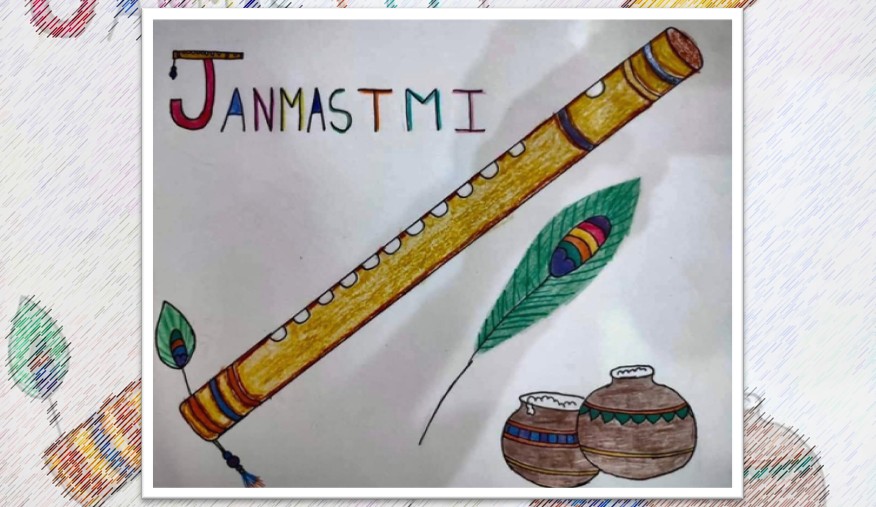
Krishna’s flute is among the most enchanting symbols in Indian civilisation. It produces music because it is hollow. The symbolism is spiritually magnificent. A mind filled with arrogance cannot become an instrument of divine wisdom. A heart crowded with hatred cannot radiate unconditional love. An intellect imprisoned by prejudice cannot receive universal truth. To become like Krishna’s flute is to become internally empty of ego and externally expressive of harmony.
The world today desperately requires such harmony. Humanity confronts polarisation, ecological anxiety, technological disruption, violent conflict and moral uncertainty. The solution cannot emerge exclusively from political institutions or technological inventions. It requires a renaissance of consciousness. Krishna’s flute therefore becomes a metaphor for spiritual ecology—the harmony of the individual with the self, society, nature and the Supreme.
Janmashtami and the Contemporary Crisis of Human Consciousness
The twenty-first century is technologically magnificent but spiritually restless. Artificial intelligence has expanded human capability, yet emotional intelligence and ethical responsibility have not always expanded proportionately. Janmashtami offers an urgently relevant corrective. Krishna teaches (Bhagavad Gita, 2.48) equilibrium: “Samatvaṁ Yoga Uchyate ”- “Equanimity is called Yoga.”
This teaching possesses extraordinary relevance for contemporary mental well-being. Success and failure, praise and criticism, gain and loss, pleasure and pain should not become permanent dictators of human consciousness. The spiritually mature individual develops what may be called inner sovereignty. Brahma Kumaris philosophy similarly emphasises the movement from body-consciousness to soul-consciousness, from reaction to response, from dependence to inner power, and from negativity to the cultivation of original spiritual qualities. The true celebration of Janmashtami, therefore, is not exhausted by fasting, decoration, music or ritual. These may enrich the cultural celebration, but the deeper fulfilment lies in character transformation.
From Krishna Consciousness to Social Transformation
Shri Krishna was simultaneously playful and profound, affectionate and intellectually penetrating, politically aware and spiritually transcendent. His life refuses simplistic categorisation. This multidimensionality offers an important lesson: spirituality is not withdrawal from life; spirituality is the art of elevating life. The Gita calls upon humanity to perform action for the larger welfare of society. The concept of (Lokasangraha)—the welfare and cohesion of the world—provides an ethical foundation for responsible citizenship and leadership.
India’s contemporary aspiration for Viksit Bharat can gain moral depth when material development is accompanied by: ethical leadership, compassionate citizenship, ecological responsibility, value-based education, gender dignity, spiritual well-being, and harmony among diverse communities. Development without values may generate prosperity without peace. Knowledge without wisdom may produce intelligence without responsibility. Power without purity may become exploitation. Krishna’s message offers the necessary synthesis: competence must be illumined by conscience.
Epilogue: Celebrating the Birth of Krishna Within
Shri Krishna Janmashtami is ultimately a festival of hope in the midst of darkness. The prison of Mathura symbolises every form of human bondage. Kansa represents the tyranny of destructive consciousness. Vasudeva represents courage. Devaki represents sacred endurance. The midnight represents the crisis of civilisation. And the birth of Krishna represents the emergence of divine possibility.
The enduring message is that darkness is never the final chapter of human destiny. The celebration of Janmashtami becomes spiritually meaningful when every individual resolves: Let wisdom be born where ignorance exists. Let love be born where hatred exists. Let purity be born where vice exists. Let courage be born where fear exists.
Let peace be born where conflict exists.
The immortal ideal of the Gita may finally be realised not merely through recitation but through incarnation in conduct. As the wisdom of Indian civilisation reminds humanity, the greatest temple is the purified human heart, the greatest worship is elevated action, and the most authentic Janmashtami is the moment when the Krishna-like consciousness of love, courage, wisdom and righteousness is born within the soul. In this sense, Shri Krishna Janmashtami is not merely the remembrance of a divine birth in sacred history—it is an eternal invitation to the rebirth of humanity itself.

The writer is Faculty, Brahma Kumaris, RERF & Professor (Ex- Dean & Head), Faculty of Education, Rajiv Gandhi Central University, Itanagar; Tel: 9436042658, 8837245051