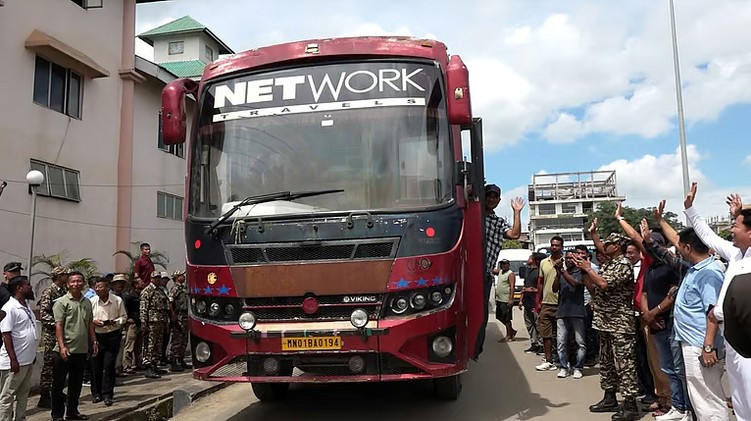
The resumption of public transport along National Highway 2 from Imphal towards Dimapur and Guwahati on August 21, 2026, after more than three years of interruption following the outbreak of violence in Manipur on May 3, 2023, is an important development. Two buses and five Wingers carrying 125 passengers travelled along the route on the first day of the resumed service, crossing Kuki-dominated Kangpokpi and proceeding towards Naga-inhabited Senapati before entering Nagaland.
The Manipur government described the resumption as an important step towards restoring normal life and strengthening connectivity. The development deserves to be welcomed. After more than three years in which movement between communities and districts became severely restricted, the sight of public passenger vehicles travelling once again carrying passengers including Meiteis along NH-2 is significant.
But the significance of the development lies precisely in the questions that remain unanswered.
The central question is not simply whether a bus travelled from Imphal to Guwahati via Dimapur on NH-2 on August 21. It did.
The more consequential question is whether the constitutional freedom of citizens to move through their own state has genuinely been restored.
That distinction is crucial.
For more than three years, National Highway 2 has been much more than a transport route. It has become one of the most visible symbols of Manipur’s ethnic partition, the erosion of state authority and the emergence of informal territorial controls. As argued in the earlier analysis, Weaponising National Highways in Manipur: The Crisis of Constitutional Governance and the Failure of the State, highways are not merely infrastructure. They are public spaces through which citizens, goods, humanitarian assistance and the authority of the State move. When access to them becomes subject to ethnic control, coercion or negotiated permission, the issue becomes one of constitutional governance itself.
The August 21 journey should therefore be welcomed without prematurely declaring the return of normalcy.
The first journey is an achievement.
It is not yet proof of normalcy.
A Highway That Became a Boundary
National Highway 2 is one of Manipur’s principal lifelines. The Imphal-Dimapur route connects the state capital with Nagaland and the wider national transport network. It is generally preferred by commuters and transporters because it is shorter than the alternative Imphal-Jiribam route along NH-37, and more convenient connecting Guwahati.
National Highway 37, entering Manipur through Assam’s Barak Valley, remains another vital artery. But it has frequently faced disruptions including landslides and more extortion demands from different organisations. NH-2 has therefore assumed an even greater importance for the movement of people and goods.
Before May 3, 2023, an ordinary passenger travelling from Imphal towards Dimapur did not normally have to ask which ethnic community controlled the territory through which the highway passed. The highway was public infrastructure. Its use was a matter of ordinary civilian life.
That changed dramatically after the outbreak of violence.
As Manipur became increasingly divided between areas dominated by different communities, roads that had once connected the state became associated with separation.
The consequences were economic and social.
When highways become unreliable, transport costs rise. The movement of essential commodities becomes more difficult. Medical journeys become uncertain. Students face difficulties travelling. Traders lose access to markets. Families are separated.
But the political consequence is even more serious.
When citizens cannot move freely across their own state, the territorial unity of the state begins to exist more strongly on paper than in everyday experience.
This is why the highway crisis cannot be treated merely as a law-and-order or transport problem.
A road can be physically present while its constitutional function has disappeared. A highway can remain on the map while becoming inaccessible to sections of the population.
And once access becomes associated with ethnicity, a national highway begins to resemble a territorial boundary.
That is the danger that Manipur has confronted since May 2023.
The Long History of Failed Reopenings
The August 21 service is not the first attempt by the government to restore public transport.
On December 23, 2023, Manipur State Transport buses were ceremonially flagged off towards Churachandpur and Mao. The initiative was accompanied by considerable publicity and presented as a step towards restoring movement.
The result exposed the limits of administrative declarations.
The Imphal-Churachandpur MST bus reportedly returned from Phougakchao Ikhai in Bishnupur district amid opposition and blockage. The Senapati-bound bus reportedly returned from Kanglatongbi after volunteers associated with the Committee on Tribal Unity obstructed the service.
The message was stark – a bus could be flagged off from Imphal, but the government could not guarantee its passage throughout the route.
Another attempt was scheduled for December 4, 2024, to launch MST services along the Imphal-Dimapur highway. That attempt did not become operational amid continuing security concerns, local tensions and uncertainty about passenger movement.
Then came March 8, 2025.
That episode is particularly important because after the imposition of President’s Rule in Manipur on February 13, 2025, the Union Home Minister on March 1, 2025 had announced that free movement on roads would be ensured from March 8, 2025.
The Federation of Civil Society (FOCS) organised a peace march from Imphal towards Senapati along NH-2. The march was stopped at Sekmai by the authorities amid fears of confrontation in Kangpokpi.
At the same time, the State Government attempted to operate two MST buses under paramilitary escort – one towards Churachandpur and another towards Senapati through Kangpokpi.
The Senapati-bound bus reached Kangpokpi. But violence followed.
Reports said protesters attempted to stop the bus, roads were blocked, private vehicles were set ablaze and stones were pelted. Security forces used force. At least one person was killed and several others were injured.
The events of March 8 demonstrated the enormous gap between announcing free movement and actually ensuring free movement.
The government could issue an order. It could deploy security forces. It could flag off a bus.
But none of these automatically guaranteed that ordinary civilians could travel.
That history makes the August 21 resumption significant – but it also means that the latest initiative must be judged by what happens after the inaugural journey.
August 8: A Political Commitment
Chief Minister Yumnam Khemchand’s visit to Kangpokpi on August 8 was an important precursor to the August 21 resumption.
In the presence of Deputy Chief Minister Nemcha Kipgen and Saitu-Gamphazol MLA Haokholet Kipgen, the Chief Minister announced the resumption Imphal-Dimapur bus service for all communities on NH-2.
The location of the announcement was politically significant.
Kangpokpi is one of the districts most directly associated with the prolonged breakdown of movement between the valley and the hills. An announcement made there carried a message that the government intended to restore mobility not merely from Imphal outward, but through areas where the question of movement had become politically contested.
The service, however, became operational only on August 21.
There is nothing inherently unusual about a delay of thirteen days between a political announcement and implementation. After more than three years of conflict and failed attempts, the government would necessarily have to undertake security assessments, coordinate forces and transport authorities and make arrangements for passengers.
The more important issue is what happened – or did not happen – in the public domain during those thirteen days.
The Question of the 125 Passengers
The government has said that 125 passengers travelled on the first day in two buses and five Wingers.
That is encouraging. It demonstrates that there is demand for the route.
But it also raises a legitimate question: how did those 125 passengers know that the service was operating on August 21?
Was the service publicly announced in advance? When did ticket booking begin? Where could passengers purchase tickets? Was there an official timetable? Were tickets available to anyone on a first-come, first-served basis? Were the passengers ordinary members of the public who independently booked their seats?
There is no basis to allege, without evidence, that the passengers were government-sponsored persons or volunteers of the ruling party. Such an allegation would be speculative.
But the absence of clear public information creates precisely the kind of speculation that transparency could prevent.
If the service is a public service, the public should know how to use it.
This is especially important in a conflict-affected state where public trust in institutions has already been badly damaged.
The government may legitimately withhold sensitive security information. It does not follow that basic administrative information about a public bus service must also be withheld.
There is a difference between operational secrecy and administrative opacity.
The exact deployment pattern of security forces may need to remain confidential.
The existence of the bus service, its timetable, ticketing system and frequency do not.
If security considerations required the authorities to limit publicity before the inaugural journey, the government should explain that clearly.
Transparency would strengthen the credibility of the reopening rather than weaken it.
A Bus Journey Is Not Yet Free Movement
This is perhaps the most important distinction in assessing August 21.
A protected convoy can move through an insecure area. That demonstrates the capacity of the State to move people under protection. It does not necessarily demonstrate the restoration of normal civilian mobility.
There is nothing wrong with security escort at this stage. After three years of conflict, extraordinary security precautions may be unavoidable. But they must be understood as a transitional mechanism. The long-term objective cannot be permanent exceptionalism.
If every public bus journey requires extraordinary security mobilisation, special political coordination and a carefully managed passenger movement, then the State has created a protected corridor – not yet a normal highway.
The distinction matters because Manipur’s conflict has created a geography of de facto separation.
Buffer zones, displacement, fear, ethnic segregation and community-based restrictions have resulted in areas that many citizens now experience primarily through ethnic categories.
A road passing through a particular district can increasingly be perceived as passing through “their” territory.
This is a profound transformation.
A national highway is not supposed to belong to one community. Nor does a district cease to be part of the constitutional territory of the State because one community forms its demographic majority.
The purpose of government is precisely to ensure that demographic geography does not become a substitute for constitutional geography.
The Constitutional Question
The Constitution provides citizens with the freedom to move throughout India, subject to restrictions permitted by law. The freedom is not absolute. Public order, security and other legitimate considerations may justify restrictions.
But there is an important constitutional distinction between a temporary restriction imposed through lawful authority and a prolonged condition in which citizens cannot safely use public infrastructure because the State is unable to guarantee passage.
That distinction goes to the heart of the Manipur crisis.
For more than three years, the State formally remained territorially intact. Yet many citizens experienced large portions of the State as inaccessible.
This created a dangerous gap between formal territorial integrity and lived territorial integrity.
The map remained unchanged. The experience of citizenship changed.
That is why restoring highways is part of restoring constitutional governance.
The State does not demonstrate sovereignty merely by possessing police stations, district offices or administrative boundaries.
It demonstrates sovereignty when citizens can travel, trade, communicate and seek services throughout its territory under the protection of law.
The restoration of NH-2 therefore has a constitutional dimension that goes far beyond transportation.
The Problem of Territorial Veto
This becomes particularly important in relation to the unresolved demand for separate administration of the “Kuki-Zo” political movement.
The demand itself is a political issue. But there must be a clear distinction between making a political demand and exercising an extra-constitutional veto over public infrastructure.
A community may raise a demand. But it cannot thereby acquire an indefinite right to determine who can travel along a national highway.
As long as Manipur remains constitutionally one State and NH-2 remains a national highway, the right to use that road cannot depend upon the permission of an ethnic organisation.
This principle must apply irrespective of which community is involved.
If the continuation of NH-2 depends upon an informal agreement between the government and particular community organisations, the road remains politically conditional.
Such an arrangement may be useful as a temporary confidence-building mechanism.
But it cannot be the final constitutional arrangement.
Otherwise, the State would effectively acknowledge that its authority over public infrastructure is contingent upon political consent outside the constitutional structure.
That would reproduce the very problem the reopening is supposed to solve.
Can the Reopening Survive the Separate Administration Demand?
This is perhaps the most difficult question facing the government.
The reopening of NH-2 can succeed in the short term even while the political conflict remains unresolved.
But can it remain open if the demand for separate administration continues?
The answer must be yes. Otherwise, public movement itself becomes hostage to the outcome of political negotiations.
Political negotiations may take months or years. Citizens cannot be expected to suspend ordinary life for that duration.
The government may need dialogue, confidence-building and security arrangements to maintain the route. But the fundamental principle cannot be negotiable – citizens’ access to a national highway cannot depend upon the resolution of every political dispute in the State.
Indeed, restoring movement may itself contribute to conflict transformation.
When roads reopen, markets reconnect. When markets reconnect, economic dependence across community boundaries becomes possible. When people travel, social interaction returns. And when interaction returns, the psychological barriers produced by prolonged separation may gradually weaken.
Thus, maintaining NH-2 may be both a constitutional obligation and a peacebuilding instrument.
The Test Is Reciprocity
The reopening must also be genuinely reciprocal.
Free movement cannot mean merely that Meitei passengers are able to travel from Imphal through Kangpokpi towards Dimapur. It must mean Meiteis can move freely throughout the State.
It must equally mean that Kuki-Zomi citizens can travel openly towards Imphal and other parts of the State.
Naga citizens travelling along NH-2, NH-202 and other routes must likewise enjoy the same protection.
The principle has to be universal – Every citizen must have the same right to use every public road.
This is the only sustainable basis for reopening. Security must therefore be provided without discrimination. Blockades must be addressed without discrimination.
Attacks on transport operators must be investigated without discrimination. Extortion must be treated as extortion irrespective of the identity of the victim.
The credibility of the State depends on whether citizens believe that the same law applies to everyone.
From Exceptional Security to Ordinary Law and Order
The government should therefore see August 21 as the beginning of a phased process.
In the first stage, extensive security may be unavoidable. In the second, the service must become regular and predictable. In the third, extraordinary security arrangements should gradually be reduced as the security environment permits.
The final objective should be an ordinary highway governed by ordinary law and order.
The transition will not be easy. A single incident could trigger renewed fear. A rumour could provoke a blockade. An attack could cause passengers to stop travelling. Political rhetoric could again make movement contentious.
That is precisely why the State must develop institutional mechanisms rather than depend upon ad hoc arrangements. The Transport Department should publish the timetable and ticketing arrangements. The government should establish a mechanism for reporting disruptions. When a service is cancelled, the reason should be communicated. When threats are made against passengers or transport operators, legal action should follow. When blockades occur, the State must demonstrate that public infrastructure cannot be appropriated through coercion.
This is how public confidence is rebuilt. Not through declarations. Through predictability.
The Danger of Premature Normalcy
There is a temptation in every prolonged conflict to seize upon a visible improvement and declare that normalcy has returned. That temptation must be resisted.
The resumption of a bus service cannot erase the underlying conflict. Displacement remains. Fear remains. Competing political claims remain. Ethnic segregation remains. The demand for separate administration remains. The psychological boundaries created over three years cannot disappear because a bus crosses a district boundary.
But the reopening can become an important part of reversing those divisions. That is why it should be treated neither as insignificant nor as conclusive. It is a beginning. And beginnings matter.
Five Questions the Government Should Answer
The August 21 operation leaves several questions that deserve clear public answers.
First: Why was the resumption on August 21 not publicly announced through a normal government transport notification?
Second: How did the 125 passengers learn about the service and how were their tickets booked?
Third: What is the regular timetable, frequency and ticketing system for the route?
Fourth: What security arrangements are being provided, and is there a plan to transition from extraordinary escort to ordinary law-and-order protection?
Fifth: What institutional guarantee exists that the service will continue even if political tensions, blockades or disagreements over territorial claims re-emerge?
These are not questions designed to undermine the reopening. They are precisely the questions that must be answered if the reopening is to become credible and sustainable.
The Real Meaning of August 21
The importance of August 21 ultimately lies in what happens next.
If buses continue to run tomorrow, next week and next month, the significance of the reopening will grow.
If citizens can openly buy tickets and travel without special political arrangements, it will grow further.
If the route remains open during periods of political disagreement, the restoration of state authority will become more credible.
If eventually the security presence can be reduced because ordinary law and order has returned, the transformation will be complete.
The most convincing evidence of normalcy will therefore not be another ceremony.
It will be repetition. An ordinary bus; An ordinary timetable; Ordinary passengers; An ordinary journey.
No political negotiation. No ethnic permission. No uncertainty about whether the road is open. No question about whether a citizen has the right to pass.
That is what a national highway should mean.
The August 21 journey has demonstrated that the physical barrier can be breached. The more difficult task is to make that breach permanent.
The government should therefore welcome the resumption but avoid presenting it as the restoration of normalcy.
It is better understood as the first serious test of whether constitutional authority can once again make public space genuinely public in Manipur.
For more than three years, the question was whether a bus could cross Kangpokpi.
Now that question has been answered. The next question is far more important –
Can the State ensure that the bus can cross tomorrow, next week, next month and next year – regardless of ethnicity, political affiliation or unresolved demands over the future political structure of Manipur?
If the answer eventually becomes yes, August 21, 2026, may indeed be remembered as a turning point.
If not, it will remain another isolated demonstration of what is technically possible in a State whose constitutional authority remains contested on the ground.
The road has reopened.
Now the State must prove that it can keep it open.
And only then will the journey from reopening a highway to restoring constitutional authority truly have begun.

Senior Editor: Imphal Review of Arts and Politics