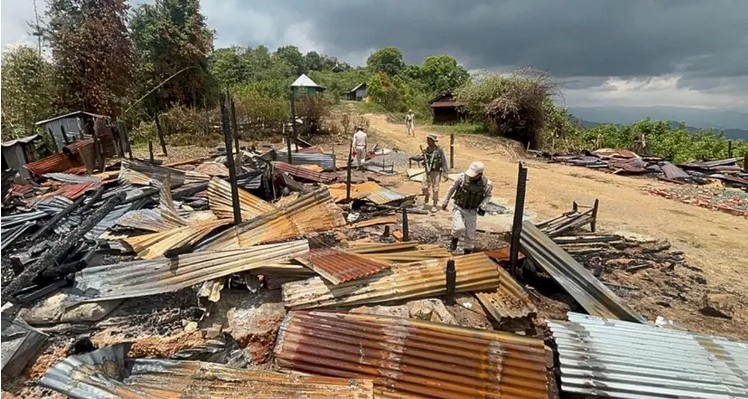

The prolonged violent conflict in Manipur, which began on May 3, 2023, has fundamentally altered not only the state’s security landscape but also the relationship between the State and its citizens. Much has been written about ethnic violence, displacement, destruction of villages, the proliferation of armed groups and the collapse of public trust. Comparatively less attention, however, has been paid to one of the conflict’s most enduring and politically consequential features – the weaponisation of National Highways and other public roads as instruments of coercion.
Roads are not merely transport infrastructure. In political geography and conflict studies, they constitute strategic lifelines that determine the movement of people, goods, humanitarian assistance, state authority and military logistics. Throughout history, control over roads has often translated into control over territory and populations. Yet in a constitutional democracy, this strategic importance imposes an equally important obligation upon the State. Public highways belong neither to governments nor to communities. They belong to the Republic and are held in trust for every citizen without distinction.
It is against this constitutional principle that developments in Manipur since May 2023 demand serious examination.
For more than three years, large sections of Manipur have witnessed varying degrees of restrictions on civilian movement, disruptions to transport and repeated interference with the free use of highways and inter-district roads. These disruptions have become sufficiently prolonged that they are no longer exceptional episodes arising from temporary unrest. Rather, they have evolved into a structural feature of the conflict itself.
The consequences extend far beyond inconvenience. Highway restrictions determine who may travel safely, which communities receive essential commodities, where commercial activity can occur, which students can access educational institute, how government services are delivered and, ultimately, which citizens are able to exercise the constitutional freedom of movement in practice rather than merely in theory.
The central question, therefore, is no longer why organised groups seek to control roads. That phenomenon is well understood in conflict literature. Armed or organised actors frequently attempt to dominate communication routes because mobility translates into political leverage.
The more difficult question is why the constitutional State has permitted this condition to persist for such an extended period.
Constitutional Sovereignty and the Rule of Law
The Indian Constitution guarantees equality before the law, equal protection of the laws and the freedom of movement throughout the territory of India, subject only to reasonable restrictions imposed by law. National Highways, maintained through public resources and administered under national legislation, cannot legally become instruments through which competing groups regulate the movement of citizens according to ethnic identity.
The prolonged inability – or perceived unwillingness – of the State to ensure uninterrupted civilian access to public highways raises important constitutional questions.
If citizens require security escorts to travel within their own state, and even when escorted by security forces the ethnic identity of the commuters are questioned by the blockaders, constitutional rights have already been substantially diminished.
If transport operators must calculate ethnic risks before accepting commercial assignments, the market itself has become subordinated to conflict.
If humanitarian supplies depend upon negotiated passage rather than legal entitlement, public authority has effectively yielded ground to informal power.
These developments represent not merely a law-and-order problem but a challenge to constitutional governance itself.
Roads as Instruments of Political Coercion
Political scientists increasingly describe modern conflicts as contests over governance rather than merely territory. Infrastructure becomes a mechanism through which competing actors demonstrate authority, impose costs upon rivals and influence political negotiations.
The experience of Manipur since May 2023 reflects many of these characteristics.
Restrictions on highways have affected civilian movement, economic activity and social interaction. Communities have become increasingly isolated from one another. Commercial routes have fragmented. Psychological boundaries have gradually hardened into territorial realities.
In such circumstances, highways cease to function as public infrastructure and instead become instruments of political signalling.
Every successful disruption communicates two messages simultaneously – first, that organised groups possess sufficient capacity to regulate civilian mobility; and second, that the State either cannot or will not prevent such regulation.
Both messages weaken public confidence in constitutional institutions.
Selective Outrage and the Crisis of Consistency
Recent developments surrounding protests over the brutal abduction and killing of six members of the Liangmai Naga community have once again focused public attention upon highway disruptions. Demands for justice following such grave crimes deserve impartial investigation and prompt prosecution. Justice for victims cannot be conditional upon ethnic identity.
Yet the public debate has simultaneously exposed another uncomfortable question.
Many observers have noted that highway disruptions affecting Meitei civilians since May 2023 have often failed to generate comparable political urgency or sustained public condemnation. Whether this perception is entirely accurate is almost secondary. In conflict societies, perceptions themselves become political realities.
Communities measure not only what governments do but also when governments act, how consistently they act and for whom they appear willing to act.
If highway blockades become unacceptable only when particular communities are affected while similar restrictions imposed upon others become normalised, confidence in the impartiality of governance inevitably deteriorates.
The rule of law cannot be selectively applied without undermining its own legitimacy.
The Humanitarian Cost
The weaponisation of roads produces humanitarian consequences that frequently receive insufficient attention.
Transport disruptions affect food security, medical referrals, educational access, commercial supply chains and employment. Every additional checkpoint, diversion or closure increases transaction costs that are ultimately borne by ordinary civilians.
Drivers transporting food, medicines and other essential commodities occupy a particularly vulnerable position. They are civilians performing functions indispensable to society. Violence against transport operators, irrespective of who commits it, extends the conflict directly into the civilian economy and undermines the humanitarian obligations expected in any democratic society.
Moreover, the cumulative economic consequences of prolonged transport restrictions can exceed the immediate physical damage caused by many individual violent incidents.
Markets shrink. Prices rise. Investment disappears. Inter-community commerce declines.
Economic interdependence – often one of the strongest foundations for peaceful coexistence – gradually erodes.
The Political Economy of Prolonged Blockades
Conflict studies demonstrate that prolonged disruptions frequently create new political economies. Scarcity generates opportunities for profiteering, informal taxation, monopolistic control over transport and expanded influence for armed actors.
Consequently, blockades sometimes outlive their original political objectives because they become embedded within broader systems of economic and political power.
This possibility deserves careful examination in Manipur.
The longer highways remain vulnerable to organised disruption, the greater the incentives for multiple actors to preserve rather than resolve the conditions that sustain their influence.
This creates a dangerous paradox.
Conflict becomes self-perpetuating not solely because communities remain divided but because instability itself begins to generate political and economic advantages for particular interests.
The State’s Unequal Presence
Perhaps the most troubling feature of the present situation is not merely the existence of armed actors but the uneven visibility of the State.
In some areas, governmental authority remains relatively effective.
In others, public authority appears substantially constrained.
Citizens inevitably interpret these differences through political and ethnic lenses. The result is declining confidence that constitutional institutions provide equal protection to all communities.
Whether these perceptions accurately reflect governmental intentions is ultimately less important than their cumulative political effect.
Trust, once lost, becomes extraordinarily difficult to rebuild.
Beyond Ethnic Narratives
Reducing the highway crisis to competing ethnic accusations ultimately obscures the larger constitutional issue.
The primary failure is not that different communities seek strategic advantage during conflict. Such behaviour, however regrettable, is widely documented in divided societies.
The primary failure is that constitutional institutions have not consistently prevented public infrastructure from becoming instruments of coercion.
Governments exist precisely to ensure that essential public goods remain insulated from ethnic competition or organised groups.
When highways become contested political spaces, governance itself becomes contested.
Restoring Constitutional Authority
The restoration of free movement cannot depend upon temporary political understandings or negotiated accommodations among competing groups.
It requires the reassertion of constitutional authority through consistent, impartial and lawful governance.
This means guaranteeing uninterrupted civilian access to National Highways.
It means investigating attacks upon transport operators irrespective of the identity of perpetrators or victims.
It means prosecuting those responsible for abductions, killings, extortion and intimidation without political calculation.
It means rejecting every attempt to convert public infrastructure into instruments of ethnic bargaining.
Most importantly, it requires reaffirming a principle that should never have become controversial – every citizen possesses an equal constitutional right to travel upon every public highway or roads within Manipur without fear, discrimination or coercion.
Conclusion
The continuing weaponisation of National Highways is not simply another consequence of the conflict. It has become one of its defining characteristics.
Every blocked highway weakens economic recovery.
Every disrupted transport route deepens social fragmentation.
Every failure to enforce equal access diminishes constitutional legitimacy.
Ultimately, the issue extends far beyond the ethnic groups involved.
It concerns whether the Indian State retains the capacity and the will to exercise impartial constitutional authority over its own public infrastructure.
Peace in Manipur cannot be measured solely by reductions in armed confrontations.
It must also be measured by whether ordinary citizens – regardless of ethnicity – can once again travel freely upon the roads built in their name, protected by the Constitution and secured by the State.
Until that objective is realised, the highways of Manipur will remain not merely routes of transportation but enduring symbols of a constitutional order struggling to assert itself in the midst of one of independent India’s most complex internal conflicts.

Senior Editor: Imphal Review of Arts and Politics