
The ethnic conflict in Manipur has reached a point from where there is no tangible way left than to turn back. For the sake of those exposed to mayhem, hopefully this will be the case. To still not think of reconciliation and healing even at this juncture would be a betrayal of an innate Freudian death wish in them all.
Till February 7, on the edge of completing three years on May 3, the conflict was largely confined to two ethic groups, the Meiteis in the Imphal valley and the Kuki-Zo group of tribes who are spread thin across all the districts of the state but concentrated in the lower hills surrounding the central Imphal valley.
After February 7, the Nagas who live on the higher reaches of the mountains have been dragged into the conflict in a big way, complicating the equation. A brawl at Litan, a foothill village along the Imphal-Ukhrul road, in which a Tangkhul Naga private tutor returning after taking an evening class ran into two drunk Kuki youth who took offence at him pointing his torch at them, and badly beaten him up.
Patch up efforts fell through for reasons that differ depending on which side is giving the explanation, and by February 9, open confrontations exploded and spread. It also rekindled dangerous old frictions between the Kukis and Zeliangrong Nagas in Kangpokpi and Tamenglong districts.
Things took a nightmarish turn after a May 13 ambush by unknown militants along a stretch of a road between two Kuki villages in Kangpokpi district – Kotlen and Kotzim – killing three respected Thadou pastors of the Thadou Baptist Association, TBA, and injuring five others. The entourage was returning to Kangpokpi from Churachandpur where the TBA had organised a peace conclave.
Kukis allege the ambush was the handiwork of Naga militants. Nagas however countered this saying it was the outcome of factional fights within the Kukis. They point out that a section of the Thadou population have been claiming they are not in the Kuki fold, thus causing frictions within. This section of Thadou tribe have been reaching out for a settlement of the ethnic problem in the state.
Whatever the truth behind the ambush, it provoked tragic repercussions almost immediately. Kukis accosted 20 Naga villagers returning to their village Konsakhul while passing through Kuki village Leilon Vaiphei. Nagas too in reciprocation took 28 Kuki hostages from Taphou and Hengbung Kuki villages.
On the third day of the kidnapping, both sides release 14 captives each, essentially women, children and older men, on humanitarian ground. This left 6 Nagas still in Kuki custody and 14 Kukis in Naga custody.
A dangerous stalemate followed, but 27 days later, on June 9, responding to insistent appeals from all quarters, Naga captors released the remaining 14 Kuki captives with them, bringing hope. Kuki captors however did not reciprocate prompting a combined operation by a team of central and state security forces at Leilon Vaiphei and nearby areas on June 10 and recovered the badly mutilated and decaying corpses of the 6 Naga captives.
In all likelihood, intelligence reports were available that the Nagas had not eliminated their captives but the Kukis have. Which is why there were urgent pressures on the Nagas to release their captives, for if it became known that the 6 Nagas in Kuki custody had been killed, the lives of the 14 Kukis in Naga custody could also have become endangered.
Much atrocities have happened on all sides during the three years of the conflict, but none can match the chillingly cold-bloodedness of the execution of the 6 Naga captives. No boastful angry claims of vengeance, no hateful swears, no bargains for concessions as hostages normally are used for. They were simply eliminated and made to disappear.
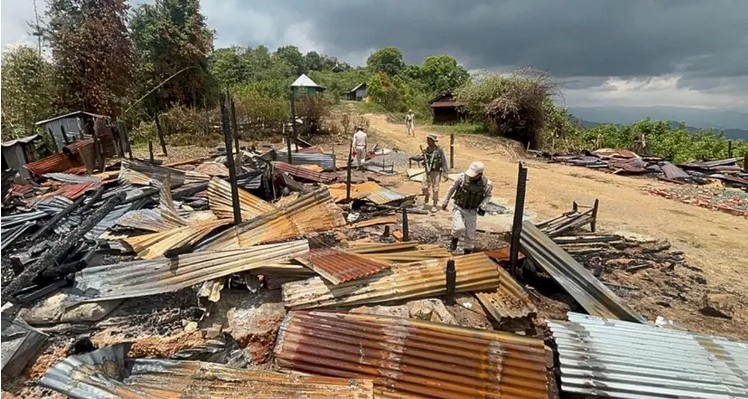
The consequence has been devastating. All movements of the warring communities are now restricted within their safe zones. Meiteis are now largely confined within the Imphal valley, Nagas are stuck on the upper reaches of the mountains and Kukis who live largely in the foothills adjoining the Imphal valley, are now left sandwiched between their two adversaries, Nagas and Meiteis.
Indications already are, if this freeze does not lift and the communities continue to throttle essential commodities supply routes and markets to each other, their sufferings will aggravate. Areas which are geographically more vulnerable are already sensing a humanitarian crisis. Kukis, most of whose settlement are embedded within Naga areas and now also cut off from the Imphal valley, is bearing the brunt.
There is a vital lesson in this unfolding tragedy. As Robert D. Kaplan cautioned in his 2012 bestseller The Revenge of Geography: What the Map Tells Us About Coming Conflicts and the Battle Against Fate and before him Halford Mackinder in his 1904 book Geographical Pivot of History, certain geographies are integral and disturbing this integrity can, and indeed have, led to deadly conflicts.
These authors point out that many, if not most conflicts all over the world were foretold by their geographies, illustrating this thesis with convincing examples from devastating wars in the past and present. This postulate should also throw valuable light in the understanding of complex conflict dynamics witnessed in places like Manipur. It is also a reminder that it is time for all stakeholders to reevaluate their own understanding of the tragedy they are in.
Only a realistic diagnosis of the problem can ensure realistic remedies. Many of the underlying prejudices which have caused these hateful differences, such as the pace of regional development, did not necessarily have to have come out of anybody’s motivation, but instead geographical destiny. Hence, not every grievance should be reduced to binaries that pit one against the other.
As in any less than liberal democracies, in Manipur too there are demagogic leaders inclined to take advantage of this predicament, never sparing any opportunity to create ethnic rifts that benefit their own vote banks. Hopefully they too have realised the harm potential of such politics and choose to tone down their damaging electoral rhetorics.
This article was first published in The New Indian Express. The original can be read HERE

Editor, Imphal Review of Arts and Politics and author