
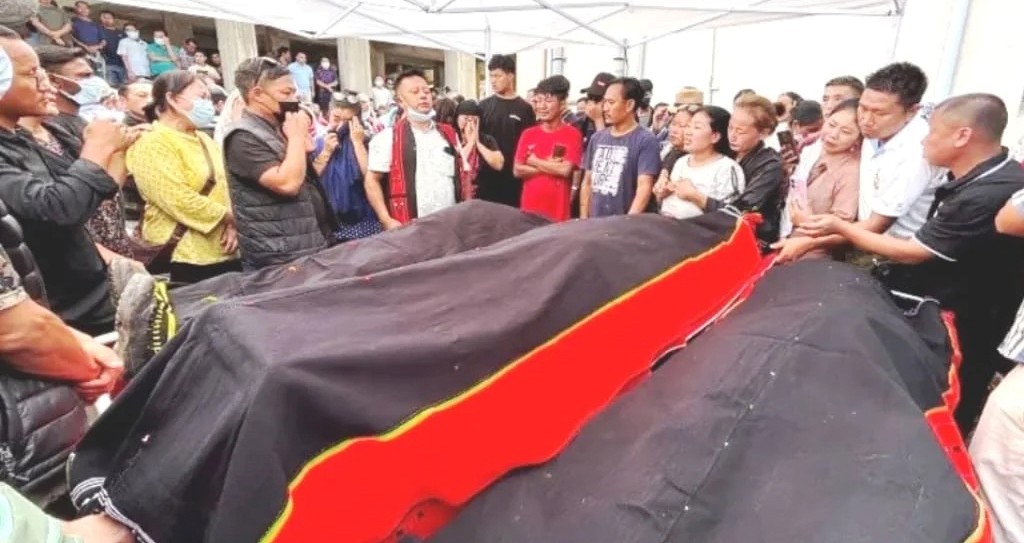
On the morning of August 28, 2026, thousands of people lined the road from Thonglang Atongba to Senapati District Hospital. Four coffins, draped in traditional Liangmai shawls, moved slowly through villages where mourning had become painfully familiar.
The dead were not combatants. They were Tadsongbou Ringkangmai, founder and principal of Right Path School, T. Khullen; Mariakdibou Wijunamai and Anil Wijunamai, executive members of the Makui Youth Club; and Wisobou Charenamai, chairman of the Chawangkining Village Authority, allegedly ambushed by Kuki militants between Makui Ashang and Thanamba on the Imphal–Tamenglong (IT) Road on the morning of August 27. Another civilian, Gaikamang Ringkangmai, remained in hospital with severe bullet injuries.
The ambush and bringing of the dead bodies after twenty four hours exposed one of the deepest contradictions in contemporary Manipur – the State believes peace is returning, while people continue to experience violence, insecurity and civilian killings.
Only days before the ambush, the Government of Manipur had celebrated the resumption of inter-state bus services along National Highway-2. The reopening was projected as a landmark achievement in restoring free movement after more than three years of violent conflict involving Kuki-Zomi and Meitei and, increasingly, Nagas, particularly Liangmai, Tangkhul and Inpui. Public statements spoke of rebuilding trust, reconnecting communities and bringing normalcy back to Manipur.
Yet in the very week that bus services resumed under heavy security escort, civilians travelling on another strategic road were shot dead.
This is not merely an isolated security failure. It exposes two fundamentally different understandings of peace – one reflected in the administrative language of governments and another experienced in the daily lives of ordinary citizens.
The distinction matters because policies built upon an inadequate understanding of peace do not necessarily produce reconciliation. They may simply make conflict more manageable.
The administrative meaning of peace
For governments, peace is often measured through visible and quantifiable indicators. Roads reopen. Government offices function. Public transport returns. Chief Minister travel to the hill districts, Ruling BJP leaders can visit hill districts, Security forces regain control of sensitive areas.
Since President’s Rule ended and the Yumnam Khemchand-led government assumed office in February 2026, restoring governance has understandably become a central priority. Arms-recovery drives, reopening highways, resuming bus services, reducing blockades and encouraging economic activity have become important markers of official normalcy.
These are not insignificant achievements. A State has an obligation to restore public order and enable ordinary civic and economic life.
But they do not, by themselves, establish peace.
In peace and conflict studies, the reduction or absence of direct violence is often described as negative peace. It is an important first condition. Yet the restoration of public order does not necessarily mean that the underlying causes of conflict have been resolved or that relationships between communities have been repaired.
In many societies emerging from riots, insurgencies or communal disturbances, the restoration of institutions and mobility can help begin the process of healing.
But Manipur is no longer experiencing an ordinary law-and-order crisis.
It is living through something much more complex.
Three years later, violence has changed its character
The violence that erupted on May 3, 2023 was initially understood principally by national media, Indian intellectuals and political leaders as an ethnic conflict between Meitei and Kuki-Zomi communities. Three years later, that description is increasingly inadequate.
By 2026, the conflict has evolved into multiple overlapping theatres involving Meiteis, Kuki-Zomi groups, Nagas, armed organisations, village defence volunteers, trans-border militant networks, competing territorial claims, demographic anxieties and constitutional disputes, and many others.
The latest IT Road ambush illustrates precisely this transformation.
The victims were Liangmai Nagas travelling through an area where Naga and Kuki villages exist in close proximity. Naga civil society organisations, including the United Naga Council (UNC), accused the President faction of Kuki National Front popularly known as KNF (P) and Kuki Revolutionary Army (KRA) – militant groups operating under the Suspension of Operations (SoO) agreement – of carrying out the attack and demanded a Special Investigation Team. The authorities, however, have so far described the assailants as unidentified armed persons pending investigation.
Whether the allegations against particular organisations are ultimately established is a matter for investigation and due process.
The larger reality is already evident.
The conflict has expanded beyond the original narrative of Kuki-Zomi–Meitei binary into a wider and more complicated crisis of inter-community insecurity.
That is precisely why measuring peace through reopened buses or functioning roads can become dangerously misleading.
The geography of fear remains intact
A road is not peaceful simply because vehicles are moving on it. A road is peaceful when travellers believe they can use it and return home alive.
That distinction is perhaps the most important lesson from the events of August 2026.
Imphal-Dimapur Road of National Highway-2 has resumed operations under heavy security escort. Convoys move according to administrative protocols. Security forces dominate vulnerable stretches. Officially, connectivity has returned.
Yet ordinary movement remains profoundly unequal.
Meitei civilians continue to hesitate before entering Kuki-dominated areas without security protection. Even after public transport resumed on NH-2, Meitei civilians who crossed the buffer zone into Kangpokpi district were reportedly stopped by security forces and handed over to Sekmai police. Meiteis remain unable to move freely along several strategic routes, including the Imphal–Churachandpur stretch of NH-2, Imphal–Moreh NH-102 and the Imphal–Ukhrul NH-202.
Kuki civilians, with some exceptions among communities such as Thadou, Vaiphei, Paite and Hmar, likewise remain unable or unwilling to travel freely through the Imphal Valley.
Nagas increasingly speak of insecurity on NH-2, NH-202 and the IT Road connecting Imphal/Kangpokpi/Senapati and Tamenglong. Earlier this year on May 13, twenty Liangmai Nagas were abducted and later fourteen were released; following the release of fourteen Kuki detainees by the Nagas on June 9, six of the unreleased abducted Liangmai Nagas were subsequently found dead on June 10 and are still lying in mortuary. Two more Liangmai Naga farmers were killed and two others injured in Langka village in Kangpokpi district on August 14. Now four more Liangmai Naga civilians have been killed on another arterial route.
The roads are technically open.
Psychologically, they remain closed.
This is the geography of fear – a condition in which constitutional freedom exists formally, but fear, territorial insecurity and social barriers make the practical exercise of that freedom precarious.
The Constitution protects freedom of movement under Article 19, subject to constitutionally permitted restrictions. But a constitutional right becomes severely diminished in lived experience when citizens can exercise it only under armed escort or when crossing an invisible communal boundary exposes them to danger.
The tragedy is therefore not simply that highways were once blocked.
It is that highways have acquired the character of borders.
The frozen conflict deepens
This is where the concept of a frozen conflict becomes increasingly important.
Manipur’s conflict is no longer adequately described as an episode of communal violence that simply needs to be brought under control. Nor can it be understood only as an insurgency or conventional law-and-order problem.
The conflict has acquired several characteristics associated with frozen conflicts: territorial separation, competing political claims, armed actors, displaced populations, hardened community boundaries, restricted movement and the absence of a comprehensive political settlement.
The most dangerous feature of a frozen conflict is that violence does not have to continue at its original intensity.
Indeed, conflict can become more deeply entrenched precisely when large-scale violence decreases.
The front lines become quieter.
The boundaries become harder.
Communities consolidate their territories.
Displaced populations adapt to displacement.
Security forces institutionalise buffer arrangements.
Separate administrative practices begin functioning in reality even where they do not exist constitutionally.
Children grow up without meaningful interaction with members of another community.
And political claims that once appeared extraordinary gradually become normalised.
That is the danger now facing Manipur.
The conflict may be freezing, not disappearing.
The buffer zones are perhaps the clearest illustration.
When Central security forces established buffer zones between opposing communities after May 3, 2023, the immediate objective was understandable: to prevent direct confrontation and further bloodshed.
But a temporary security mechanism can acquire a very different political meaning when it persists for years.
A buffer zone initially separates armed groups.
Over time, it can separate populations.
Eventually, it can begin to resemble a territorial boundary.
The distinction is crucial.
If a security arrangement prevents two communities from killing one another while enabling them eventually to resume normal interaction, it contributes to peace.
If it prevents interaction indefinitely, it can contribute to conflict freezing.
What began as an emergency security measure can gradually become a permanent geography.
The valley and hills cease to be merely administrative categories.
They become separate political spaces.
The psychological border becomes as significant as the physical one.
The State has restored movement, not relationships
The State can repair bridges. It cannot legislate trust.
Trust cannot be created simply through repeated appeals for communities to trust one another. It develops through repeated experiences of safety.
It emerges when police, civil servants, doctors, health workers and other government employees can serve without being perceived as belonging to separate communal systems; when students attend common educational institutions; when traders use the same markets; when festivals and social occasions again cross community boundaries; and when neighbours believe that others will offer protection rather than violence.
Nearly everything that historically produced everyday trust in Manipur has fractured.
Mixed villages have disappeared. Educational interaction has declined. Different communities cannot access all the markets. Religious institutions increasingly function within ethnic boundaries. Even humanitarian relief and aspects of state machinery have often followed community lines.
The Chief Minister’s appeal after the IT Road killings recognised the need to overcome the prevailing trust deficit and restore peaceful coexistence. That acknowledgement is important because it recognises, implicitly, that administrative stability alone cannot produce reconciliation.
But acknowledgement is only the beginning.
The real question is whether governance has moved beyond security management towards rebuilding relationships.
So far, the evidence remains limited.
Negative peace versus positive peace
Norwegian peace scholar Johan Galtung’s distinction between negative and positive peace remains particularly relevant to Manipur.
Negative peace refers broadly to the absence or reduction of direct violence.
Positive peace goes further. It requires justice, equality, trust and institutions capable of preventing violence from recurring.
The distinction helps expose the gap between what can be counted administratively and what people need in order to feel that peace has actually returned.
| The State’s indicators of stabilisation | The people’s requirements for peace |
| Highways reopened | Safe travel without escorts |
| Bus services resumed | Equal mobility for every community |
| Security forces deployed | Freedom from fear |
| IDP camps reduced | Displaced families able to return safely home |
| Educational institutions functioning | Children from different communities learning together |
| State machinery functioning | Employees from different communities working together |
| Government restored | Public trust restored |
| Militants contained | Armed groups lose political relevance |
| Violence reduced | Justice and accountability for past violence |
| Armed patrols increased | Civilian confidence increased |
The State understandably celebrates the indicators on the left.
The people continue searching for those on the right.
That is why official declarations of normalcy can sound disconnected from lived reality.
For a mother in Senapati who receives her son’s body, the reopening of NH-2 carries little meaning.
For an internally displaced family unable to return to its village after three years, the functioning of a government office does not signify peace.
For villagers who still sleep with volunteer patrols guarding their perimeter, normalcy is not a statistic.
It is an absence they experience every night.
Buffer zones have become political frontiers
One of the defining features of the post-2023 conflict has been the emergence of buffer zones enforced by Central security forces.
Initially conceived as temporary conflict-prevention mechanisms, these zones have increasingly hardened into territorial separators between communities. They have reduced immediate clashes in some locations, but they have simultaneously institutionalised separation.
This is the paradox of buffer governance.
The State prevents violence by preventing interaction.
Such arrangements may be necessary during the acute phase of a conflict. They become dangerous when they evolve into permanent political geography.
Children growing up after May 2023 increasingly inherit maps in which neighbouring communities are encountered not as fellow citizens but as territories beyond checkpoints.
Peace built upon prolonged separation eventually risks producing generations unfamiliar with coexistence.
Bosnia experienced comparable dilemmas after the Dayton settlement. Northern Ireland has confronted similar challenges through physical “peace walls” that continued dividing Catholic and Protestant neighbourhoods long after the formal cessation of large-scale conflict.
The historical lesson is not that physical separation is always wrong. Separation can save lives during periods of acute violence.
But physical separation can stop killing without creating shared citizenship.
That is the distinction Manipur must confront.
The forgotten question of justice
Every major killing in Manipur increasingly follows a familiar script.
A condemnation.
A high-level security meeting.
Promises of arrests.
Orders for investigation.
Appeals for calm.
And, in some cases, the eventual transfer of investigations to the National Investigation Agency (NIA).
The IT Road ambush followed the beginning of this familiar sequence. The Chief Minister convened senior security officials and directed the immediate identification and arrest of the perpetrators. The United Naga Council demanded a Special Investigation Team.
These responses are institutionally appropriate.
But they raise a more uncomfortable question:
How many earlier killings have produced credible judicial closure?
The public memory of Manipur is filled with unresolved names rather than completed prosecutions – Heirangoithong firing, Operation Bluebird, the Malom Massacre, the killing of Thangjam Monoroma, the two children killed in the Tronglaobi rocket attack and the six abducted Liangmai Nagas, among many others.
Numerous civilians remain politically remembered but legally unresolved.
Justice delayed does more than disappoint victims. It teaches society that violence may carry negotiable consequences.
Without credible accountability, every condolence risks becoming repetitive theatre.
Positive peace requires not only preventing future violence but also establishing that past violence has consequences.
Security cannot substitute for legitimacy
The increasing deployment of Central forces might have prevented larger massacres in many sensitive zones. That achievement deserves recognition.
Yet military presence and political legitimacy are different things.
A checkpoint can inspect vehicles.
It cannot persuade communities that the State belongs equally to all.
The repeated demands emerging from different communities – for an NRC before the Census, territorial integrity, separate administration, constitutional safeguards, protection of indigenous rights, or recognition of ancestral land – demonstrate that Manipur’s crisis is fundamentally political and structural as well as security-related.
When political grievances remain unresolved, security institutions are forced to perform tasks they were never designed to solve.
Soldiers become custodians of coexistence.
Police become managers of territorial boundaries.
Convoys become substitutes for citizenship.
No democracy can indefinitely sustain such an arrangement.
The State’s task is not simply to keep communities apart until violence becomes less visible. It must create conditions in which citizens can once again live within a shared constitutional and political space.
The Naga question returns to the centre
The latest killings also signal something politically significant.
For much of the post-2023 discourse, Manipur was narrated primarily as an ethnic conflict between Kuki-Zomi and Meitei communities.
The repeated targeting of Naga civilians – particularly Liangmais, Tangkhuls and Inpuis – has reopened the distinct Naga dimension of the crisis.
The United Naga Council described the latest ambush as a direct challenge to peace and demanded institutional accountability. Earlier attacks on Langka village and the killing of Liangmai civilians had already intensified insecurity across Senapati, Kangpokpi and adjoining districts.
This development complicates every existing peace framework.
A settlement designed around only two communities cannot adequately address a conflict involving multiple historical territorial claims, identities and structural grievances.
The danger is not simply renewed violence.
The danger is fragmented peace processes producing fragmented Manipur.
If every community begins to negotiate its security, territory and political future separately, the result may be not a comprehensive peace but a series of parallel accommodations that deepen the political fragmentation already visible on the ground.
What people mean when they ask for peace
Ordinary people rarely speak the language of geopolitical strategy.
Their vocabulary is remarkably simple.
They want to cultivate their fields without armed escorts.
They want children to attend schools, colleges and universities across ethnic boundaries.
They want buses whose passengers do not require security verification based on identity.
They want traders to share markets because all customers return – not because armed personnel stand nearby.
They want displaced families to return home.
They want missing persons to return alive rather than as dead bodies.
They want to sleep without listening for gunfire.
They want to live without fear-psychosis.
This understanding of peace is profoundly constitutional. It is rooted less in military victory than in equal citizenship.
People are not asking for the absence of administration.
They are asking for the presence of justice.
Rethinking normalcy
The greatest mistake governments can make after prolonged conflict is to confuse stability with reconciliation.
Stability is observable.
Reconciliation is relational.
Stability can be announced through press conferences.
Reconciliation is experienced through ordinary human behaviour – when neighbours visit one another again, when weddings cross community boundaries, when students share classrooms without fear, when markets and hospitals become common spaces again and when highways cease being ethnic corridors.
The funeral procession to Senapati reminds us that Manipur has not yet reached that point.
The State may legitimately report that buses have resumed, institutions are functioning and security operations continue. These are necessary milestones.
But they are not sufficient definitions of peace.
A society cannot be declared normal while mothers still identify their sons in hospital mortuaries under armed escort.
Nor can peace be measured by the number of kilometres of highway reopened if those kilometres continue to produce funeral processions.
Normalcy is an administrative condition.
Peace is a social and political condition.
Normalcy can be restored by administration.
Peace can be restored only by rebuilding citizenship.
Conclusion: From managed peace to shared peace
The challenge before Manipur is no longer simply to reduce violence.
It is to redefine what success means.
If peace continues to mean administrative functionality, the State may achieve impressive statistical progress while communities remain emotionally and territorially partitioned.
If peace instead means restoring equal dignity, freedom of movement, accountability and inter-community trust, policy priorities inevitably change.
Dialogue becomes as important as deployment.
Conducive environment becomes as necessary as dialogue.
Justice becomes as essential as security.
Rehabilitation becomes as urgent as infrastructure.
And reconciliation becomes as important as reopening roads.
The four Liangmai Naga civilians killed on the IT Road should therefore not be remembered only as victims of another ambush. Their deaths expose the unfinished journey from managed peace to shared peace.
Manipur does not merely need roads that are open.
It needs roads on which every citizen – Meitei, Naga, Kuki, Pangal or any other community –can travel without wondering whether the next bend in the road leads home or to a coffin.
That is the peace the people are still waiting for.

Senior Editor: Imphal Review of Arts and Politics

1 thought on “Beyond the Illusion of Normalcy: What Peace Means to the State and What Peace Means to the People of Manipur”
For the Government (I am talking of the one in Delhi as Manipur does not have one in the real sense), the attitude is still WHO CARES. Their intention to sustain the conflicts in one form or another is still the strategy practised by the Government. So they feel assured of their success if people kill each other and reports of deaths continue.
Comments are closed.