
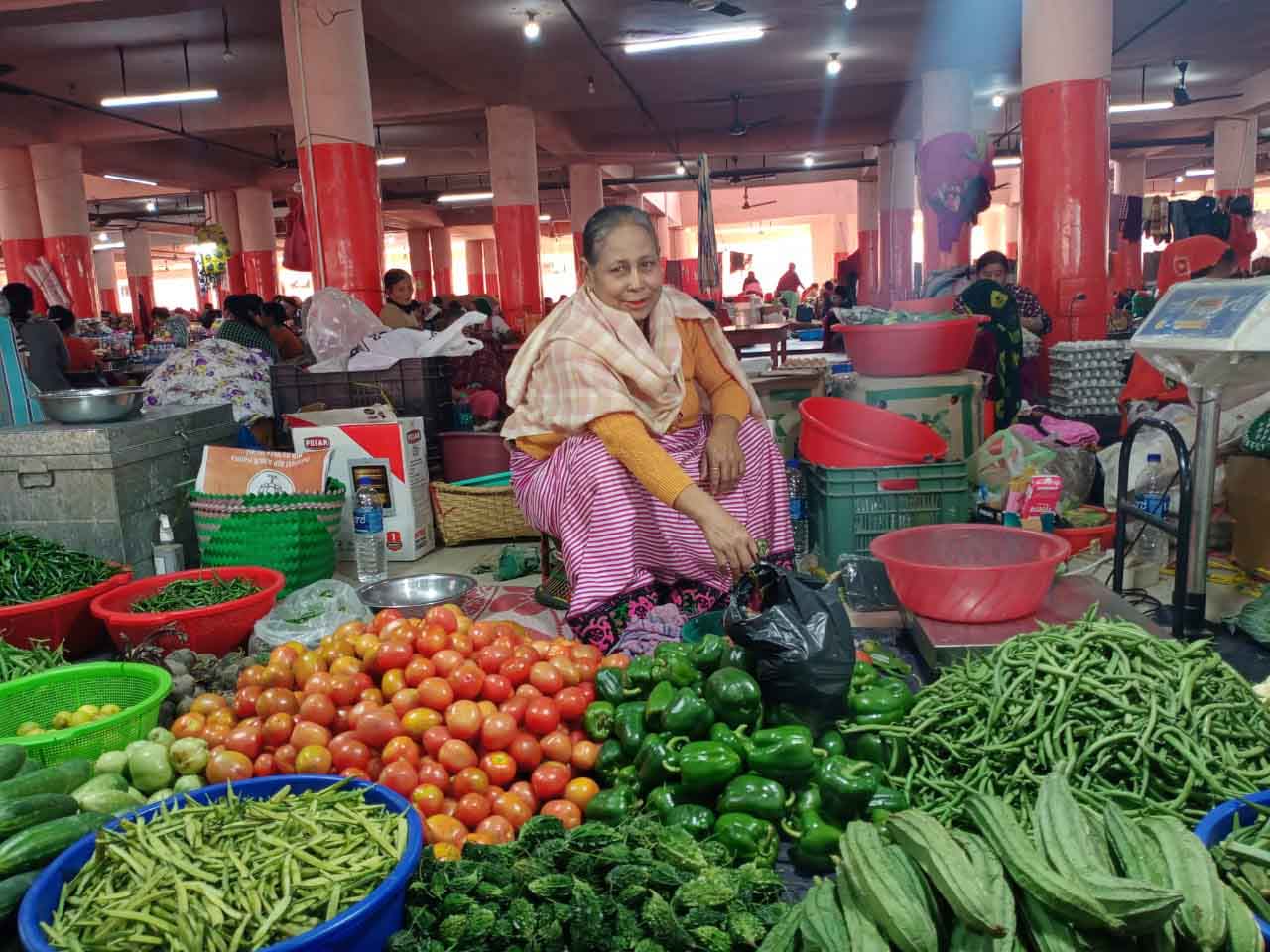
For nearly five centuries, Khwairamband Keithel — known across Manipur as Eema Keithel, the Mother’s Market — has stood as proof of what women’s collective enterprise can build. Established under King Khagemba and rebuilt over generations, it remains the only marketplace in the world run entirely by women. Some four to six thousand vendors trade vegetables, fish, handloom textiles, spices and household goods across three landmark buildings in the heart of Imphal, and male shopkeepers are barred by government order from operating inside its walls. Visiting dignitaries call it a symbol of Nari Shakti, women’s economic power, and its history is entwined with the Nupi Lan, the Women’s Wars of 1904 and 1939, when Manipuri women rose against colonial exploitation.
But behind that celebrated image sits a question the market has never fully settled: whose Eema Keithel is actually for? Is it a subsistence space, where home producers sell what they grow, weave or cook that same day, earning just enough to see their households through? Or has it drifted, stall allotment by stall allotment, toward organised retail, where a licensed few hold fixed shopfronts in the best-located buildings while everyone else is pushed to the margins? Caught between both visions is a third stakeholder rarely consulted: the ordinary commuter who simply wants fresh, affordable goods within easy reach of the bus stand. The struggle between licensed shopkeepers and unlicensed street vendors is, underneath it all, a struggle over which of these ideas of the market wins.
A Market Divided by Paper
When the current multi-storey complex was rebuilt and inaugurated in 2010, licensed vendors — those formally registered and holding a government-issued shop licence — were allotted fixed ground-floor spaces at the very centre of Imphal’s business district. Vendors without a licence were left out of the allotment altogether. Many had traded on that same ground for years; some were displaced during reconstruction on the promise of resettlement once building work was complete. That promise was not kept for everyone.
Instead, authorities have periodically proposed relocating unlicensed vendors to peripheral markets such as Lamphel and Porompat, several kilometres from the Keithel’s customer base. Vendors argue trade there is thin, and that a shop far from footfall is no livelihood at all. Upper floors of the market buildings, meanwhile, have at various points sat under-used — prompting street vendors to ask why that space could not simply be opened to them, a solution successive administrations have not adopted.
The friction has occasionally turned physical. Municipal drives to clear pavement vendors have led to standoffs with police, seized wares, and — vendors allege — informal arrangements in which some are allowed to stay upon payment while others are removed. Licensed shopkeepers, for their part, have sometimes protested being undercut by vendors trading just outside their doors without paying licence fees or rent.
A Law on the Books, Slow to Arrive
Nationally, the Street Vendors (Protection of Livelihood and Regulation of Street Vending) Act, 2014, was meant to settle disputes like this by guaranteeing vending zones, certificates of vending, and a Town Vending Committee to arbitrate competing claims to space. Vendor associations in Manipur, including the Roadside Vendors Welfare Association, have for years pressed the state government to implement the Act in full, pointing out that many street vendors remain unaware the law even exists. Without an active Town Vending Committee allocating space by rule rather than discretion, vendors say they remain dependent on ad hoc government decisions that can be reversed with the next Cabinet order.
Home-Grown Trade or Organised Retail?
Walk the ground floors of the Eema Keithel buildings today and both visions of the market are visible side by side. Many licensed stallholders are still, in the truest sense, small home producers — women selling handloom cloth they wove themselves, or vegetables from their own kitchen gardens. But a licence, once granted, tends to stay in a family for decades, and fixed floor space in the city’s busiest commercial address has itself become a kind of asset: one that licensed vendors are naturally protective of, and one that newer, unlicensed sellers cannot get access to at any price. That is not capitalised retail in the sense of a chain store or wholesaler, but it is no longer pure subsistence trade either. It is a market of small proprietors with secure real estate, competing against a far larger, uncounted tier of women who have neither the licence nor the location — only the daily walk to the pavement before sunrise.
For the buyer — the office-goer, the commuter stepping off a bus at Thangal Keithel, the household cook doing the morning marketing — this divide is mostly invisible. What matters is that the goods are fresh, cheap and close to hand, and both licensed stalls and pavement sellers meet that need, often for the same customer within the same ten minutes of shopping. Any policy that resolves the vendors’ dispute by simply removing one tier — pushing street sellers out to distant complexes, say — risks quietly narrowing what buyers can get, and where, even if no one intended it as a consumer issue at all.
Vending Amid Conflict and Climate
These older tensions have not eased with time; they have layered onto newer crises. Since ethnic violence broke out in Manipur in May 2023, the Keithel has weathered repeated curfews, shutdowns and strikes, each closure cutting directly into vendors’ daily earnings. This year, women trading on the streets around the market have also described worsening heat — mid-30s temperatures with no shaded shelters or public drinking water along the vending lanes — compounding an already precarious existence for those without the shelter of a licensed stall indoors.
What Remains Unresolved
At its core, the dispute at Eema Keithel is not between rival markets but between two tiers of the same workforce, separated by a licence allotted once and rarely revisited since. Licensed vendors have security of place but face competition at their doorstep; unlicensed vendors have decades of standing in the trade but no legal claim to the ground beneath their feet. Resolving it, vendor groups argue, will take more than another relocation order — it will mean bringing Manipur’s street vending law fully into force, and finally deciding what becomes of the market’s empty upper floors.
So whose market is it? The honest answer may be that Eema Keithel was never meant to be only one thing. It began as a subsistence space for women shut out of other work, has grown protective pockets of settled, licence-holding trade, and today still serves, above all, as the cheapest and freshest place in Imphal for ordinary people to shop. Any reform that favours one of these identities — pure home-grown vending, secured retail space, or the buyer’s convenience — at the total expense of the other two risks hollowing out what made the market worth protecting in the first place.
Until that balance is struck, the women of Eema Keithel — inside the buildings and on the pavements around them — continue to hold up one of Manipur’s oldest institutions, even as the rules governing who gets to stand where remain unsettled.
This article draws on public reporting, historical records, and vendor association statements. Figures and details should be verified with local authorities and vendor associations before final publication.

The writer is a former Member of Parliament and a former Union Minister of State External Affairs and Education, Government of India.




1 thought on “Whose Market Is It? Eema Keithel and The Question it has Never Fully Answered”
The property rights issues, seller-customer relationships, the historical legacy both socially and individually and related concerns are very lovingly put. Ima Keithel is one institution which Manipur can never afford to ignore. The public, the governance of the day and academics should continuously sustain being informed , study and protect the original institutional characteristics.
Comments are closed.