
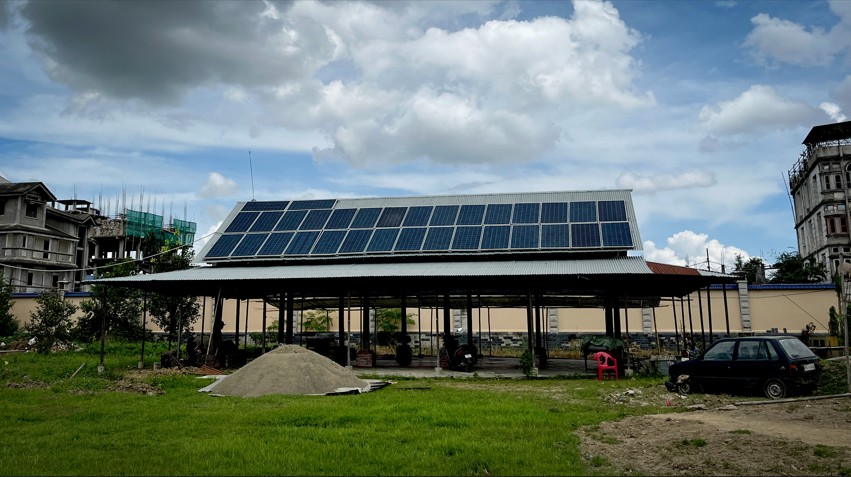
Climate change no longer needs an introduction. It is understood, broadly, as a long-term shift in the Earth’s weather patterns and average temperatures, but its effects show up in far more immediate ways. A bad monsoon. A heatwave. A landslide that closes a road for weeks. And science is no longer in dispute: humans are responsible for most of it, if not all.
The response, so far, has largely played out on a grand stage. Governments negotiate emissions targets at international summits. Scientists track rising temperatures and model their consequences. Nations pour billions into renewable energy, racing to displace fossil fuels before the damage becomes irreversible. Against that scale, a single household putting up a few solar panels can look almost beside the point. But climate action isn’t always measured by the size of the gesture.
At his home in Lamsang Bazar, London Koijam made a decision that had nothing to do with saving the planet, at least not at first. It was about the electricity bill. London runs an event rental company and supports a large family; between them, they were spending around Rs 2,000 a month on power. He didn’t hear about rooftop solar through a government campaign. He saw it at a friend’s house in his own neighbourhood, who walked him through what it could do.
What began as a household budgeting decision has turned London’s roof into something more: a small, independent source of clean power.
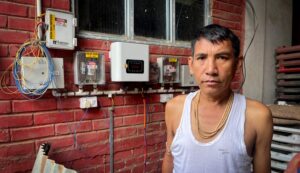
“As suggested by my friend, I contacted a solar installation shop located in Khurai, so they help me in securing bank loans and that also comes with a government subsidy of around Rs 85,000 and my setup is for a 3.5 kilowatt electricity. So, from the last three months, I am saving the amount that I spent on electricity for decades,” he says, with evident satisfaction. “I would pay an EMI of around 1,800 per month to complete the bank loans, but that is not a burden.”
He breaks down the arithmetic himself. “I spent only 2,000 as the initial amount since I procured it through a bank loan, even though I have to pay it. But the fact is that initially I have to pay 2,000 a month for electricity bills. For the installation process, I didn’t even go to the banks, I only signed some papers, paid around 1,800 as EMI, I now get free electricity, which will go on for decades.”
If we multiply London’s story by a few thousand, and a picture starts to emerge. One rooftop generating a handful of kilowatts will not shift the trajectory of a global crisis. But if enough households across Manipur make the same calculation London did, those separate, unremarkable decisions could add up to something that actually counts as climate response. The real question is whether enough people will.
That question has taken on new urgency as India pushes rooftop solar adoption through schemes like the PM Surya Ghar: Muft Bijli Yojana, which is nudging ordinary households toward generating their own power. In Manipur, the debate has moved past whether solar can work — it clearly can — to whether it can be adopted widely enough to matter.
Some households didn’t wait for the government to make the case. Geenishchandra Koijam, a relative of London’s, installed rooftop solar at his home nearly a decade ago, well before any popular national scheme existed. He runs a computer, a geyser, an electric rice cooker and a string of other appliances, and for most of the past ten years. He paid electricity bills once in a while but not every month.

Geenishchandra makes his living rearing broiler chickens, about 600 metres from his house at Lamsang Thong Maning. The farm alone costs him roughly Rs 6,000 a month in electricity during winter and Rs 3,000 in summer. Yet, he hasn’t installed solar there. Asked why, his answer reveals how uneven and unpredictable rural income can make a decision that looks simple on paper.
“I rear 1,000 broilers, which take only 45 days to mature and be sold. After those 45 days, there’s a break of a few days to clean the farm. The situation in Manipur is often marked by frequent bandhs and blockades, and if there’s a blockade, it adds to the problem — we don’t get the Day-Old Chicks (DOC) on time. So if there’s a long break, it doesn’t help my business. And since I have to pay the EMI, it isn’t feasible for me.”
He hasn’t ruled it out, though. He postponed it until the economics worked better. “But I am planning to rear 3,000 broilers in rotation mode, so that I don’t stop in between. At that time, I would also get the solar rooftop installation.”
Scale up from individual rooftops to the state as a whole, and the numbers start to look more substantial. Chandramani Mangsatabam, General Manager (Planning) at MSPDCL, the state utility responsible for distributing electricity across Manipur, explains the underlying logic of decentralised solar. “Rooftop solar generates clean, renewable power directly at the point of consumption, offsetting electricity generated from fossil fuels like coal and diesel. In Manipur, where energy demand fluctuates and remote geography complicates fuel transport, decentralized solar reduces reliance on carbon-heavy grid power and cuts line losses, directly lowering the state’s total greenhouse gas emissions.”
He offers figures to back the claim. “For every unit (kWh) of solar power produced, approximately 0.82 kg of equivalent emissions are avoided compared to the standard grid emissions factor. Existing institutional and residential systems collectively offset thousands of metric tons annually. As on 31-03-2026, a total generation of 55.404 MU (Million Units) have been generated since FY 2018-19, contributing Carbon Emission Reduction by 4,54,309.52 kgs.”
According to information MSPDCL has shared with Imphal Review of Arts and Politics, rooftop solar has now been installed across hundreds of residential, commercial and institutional buildings statewide, under a mix of central and state schemes including PM-Surya Ghar. As on 31 March 2026, 2,908 installations had been completed given Manipur’s recurring law-and-order disruptions and transport bottlenecks. The rollout has extended beyond homes to government buildings, health centres and schools, and by 5 August 2026, the state’s total installed rooftop solar capacity stood at 11.96 MW.
For Chandramani, the case for rooftop solar goes beyond the monthly savings that first drew someone like London in. “Transitioning public and home rooftops into clean power sources protects our natural landscapes, builds grid resilience, and secures a sustainable future for the next generation,” he says.
That still leaves the underlying mechanism worth spelling out: how, exactly, does one household’s decision translate into less reliance on fossil fuel-burning power plants?

Dr. Ibechoubi Langpoklakpam, Assistant Professor in the Department of Environmental Sciences at T.S. Paul Manipur Women’s College, lays it out plainly. When a household installs rooftop solar, it starts generating part of its own power from sunlight rather than drawing it from the grid. Since India’s electricity system still leans heavily on thermal power, she notes, every unit of solar electricity consumed at home is a unit of coal- or gas-fired power that doesn’t need to be produced — and therefore less carbon dioxide released into the atmosphere.
Dr. Ibechoubi continued: “India’s rooftop solar program is projected to avoid very large emissions over time, showing that millions of small household systems can add up to a major climate benefit. In short, tackling climate change by expanding solar panels and cutting fossil-fuel burning works because solar electricity displaces coal, oil, and gas without emitting CO₂ during operation, while every unit of fossil fuel avoided directly reduces the main driver of warming.”
She is equally direct about what it would take to convince more people to make that switch. “We need to emphasize on a few points to convince the public to become active clean energy producers. Fewer emissions meaning clean air and oxygen to breathe. Electricity bills will be considerably lowered. There will be better energy security during outages. Long term savings up to 30 years after the initial investments. The strongest environmental argument is simple: rooftop solar cuts greenhouse gas emissions, reduces air pollution, and lowers the pressure on fossil-fuel power plants. The strongest financial argument is equally practical: families can reduce electricity bills, gain more predictable energy costs, and in some cases sell surplus power.”
Dr. Ibechoubi has her own rooftop installation at her home in Lalambung, Imphal, and speaks about the stakes for the region with a certain urgency. “The climate threat is immediate, not abstract. For Manipur and the wider Northeast, warmer temperatures, irregular rainfall, heavier downpours, flooding, landslides, and stress on water and farming systems can all affect daily life, livelihoods, and infrastructure; that makes climate adaptation urgent as well as emission reduction.”
On whether rooftop solar specifically can move the needle on Manipur’s climate response, she is measured but optimistic. “Individual actions like installing solar panels do matter, but they work best as part of a larger shift. One rooftop system may only cover one home, but thousands of homes together can reduce fossil-fuel demand, ease grid pressure, cut emissions, and send a strong signal that clean energy is becoming normal. Rooftop solar is a very powerful tool for Manipur in the fight against climate change.”
No single rooftop will resolve a crisis of this magnitude. That much is obvious. But the fight against climate change has never rested solely on international summits and large infrastructure projects; it also depends on the accumulated weight of ordinary decisions, made one household at a time. Installing a rooftop solar panel need not be a daunting undertaking for an individual, and the public should be made equally aware that the benefit doesn’t end with the installation itself. It extends to everyday habits like switching off a bulb when it isn’t needed.
Any effort to sensitise people about solar power should carry that message alongside it: that electricity, even when it’s free, is worth using only as much as necessary, not without thought. In Manipur, those decisions are beginning to take a visible shape on rooftops, in homes, public buildings, colleges and institutions across the state, and that is a trend worth encouraging further. Politicians and world leaders will continue to debate climate change on the global stage, but for the rest of us, the effort can just as meaningfully begin at home, in one’s own locality, on one’s own roof.
(This feature is published under the 7th State Level Media Fellowship Programme on Climate Change, under the sponsorship of the Department of Environment and Climate Change, Government of Manipur.)

The writer is a media scholar and professional