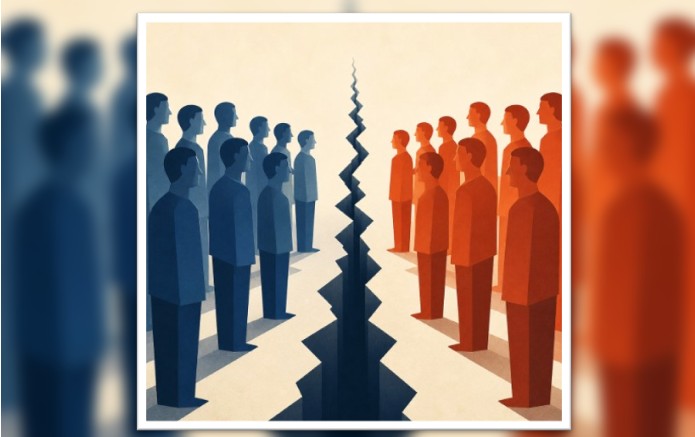
There is something very human about the words us and them, about the ease with which we divide the world into two sides, two histories, two versions of what happened, each convinced that its own reasons are understood while the reasons of the other are somehow harder to accept. Sometimes these divisions are imposed upon us, sometimes they grow out of genuine differences, and sometimes we create them ourselves because it is easier to carry an argument when we know exactly where the other side begins and where we believe our own responsibility ends.
I have often thought about Pink Floyd’s Us and Them, not so much because it is a song about war, but because those three words seem to describe a much larger human problem, one that appears in politics, in communities, in families and even in ordinary disagreements that have continued for so long that the people involved can no longer remember when the disagreement ended and the resentment began. Once we have made the distinction between us and them, even our anger seems to find its place, because we know whom to blame, whose actions to remember and whose suffering we are prepared to recognise.
But anger is a strange thing, and perhaps we do not always give enough thought to what it contains.
We often speak about anger as though it were something that must be removed before we can think clearly, as though calmness is always a sign of wisdom and anger is simply an obstacle to be overcome, yet some anger comes from caring deeply about something, from seeing an injustice that should not exist or a situation that should not have been allowed to continue, and from refusing to accept that what is wrong must therefore be inevitable. A person who sees children in a neighbourhood with nowhere to study may become angry about the neglect, and that anger might remain a complaint repeated over tea and in conversations for years, or it might eventually lead that person to find a room, collect some books, persuade a few friends to help and create a place where those children can learn.
The anger has not necessarily disappeared, but something has changed in what it produces.
Perhaps many of the changes we admire in the world have begun in some form of dissatisfaction, with someone looking at a situation that others had learned to accept and deciding that it could not continue in the same way. Anger at injustice has sometimes become reform, anger at exclusion has sometimes become a demand for dignity, and anger at neglect has sometimes become the determination to do what should have been done long before, but it is rarely the anger alone that brings about change, because between the feeling and the result there must be something else: the patience to persist, the imagination to see another possibility, the courage to begin and the discipline to continue when the first intensity of feeling has passed.
The same force, of course, can take us in the opposite direction, narrowing our vision until the person we believe has hurt us becomes more important than the life we are trying to protect, turning memory into ammunition and pain into a reason to cause more pain, until we become so occupied with proving the legitimacy of our anger that we stop asking what our anger is doing to us and what it is producing around us.
Perhaps the problem is not simply that we become angry, but that we do not always know what to do with the force of that anger once it has taken hold of us.
This becomes a much more difficult question when the anger is no longer individual but collective, when it is carried by an entire society, not necessarily for the same reasons or through the same experiences, but with enough intensity that it begins to shape how people see themselves, how they understand what has happened to them and how they look at those who stand on the other side of a divide.
What happens when an entire society is angry, when everyone has a reason for feeling hurt, when different people carry different memories and different understandings of justice, and when each can look across the divide and see something that confirms why their anger remains necessary?
This is where the familiar words return, quietly at first, until they begin to determine almost everything: our pain and their pain, our history and their history, our reasons and their excuses, our anger as a response to what happened and their anger as something that must be explained away. We begin to measure suffering against suffering, as though there must eventually be a final reckoning in which one side can be declared more wounded than the other, and therefore more entitled to remain angry, while the possibility that anger itself might be doing something to the whole of society becomes harder to see.
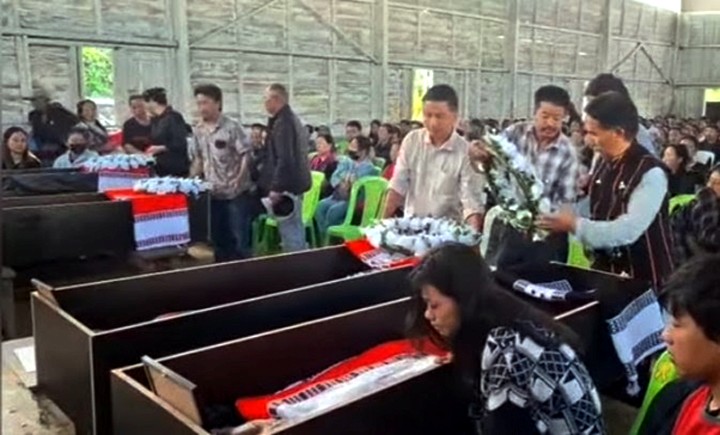
Manipur has lived with an enormous amount of anger since May 2023, and it would be both unfair and unhelpful to speak of that anger as though it appeared without reason, because people have experienced loss, displacement, fear, uncertainty and grief, while many continue to feel that things that should have happened did not happen, or did not happen adequately, leaving questions unanswered and memories raw in ways that cannot simply be resolved by asking people to move on.
There is no wisdom in pretending that these experiences can be wished away, nor should we expect people to become indifferent to what has happened simply because the continued presence of anger makes the future more difficult to imagine. Sometimes anger is the part of us that refuses to accept that something deeply wrong has become normal, and sometimes it is the only remaining expression of a hurt that has not found a satisfactory answer.
But perhaps there is another question we need to ask, one that does not require us to settle every disagreement about the past before we can begin to think about the future: what happens when all sides are angry, and what might become possible if that anger could be harnessed rather than allowed to keep returning us to the same divisions?
To harness anger is not necessarily to control it in the sense of suppressing it, asking people to calm down, forget what happened or surrender their demands for justice, because that would be to mistake the absence of visible anger for the presence of understanding. Harnessing anger means recognising the force it carries without allowing that force to determine every response, holding on to the conviction that something must change while remaining open to the possibility that the energy required to bring about that change need not be spent on destruction.
Perhaps this is especially difficult when the anger is collective, because collective anger does not mean that everyone is equally responsible, that every grievance is identical or that different accounts of the past must somehow be made to agree before anything constructive can happen. It means that anger exists across the society in different forms and for different reasons, and that the question of what it becomes cannot belong exclusively to one side, because no side can decide on its own what the accumulated anger of an entire society will eventually produce.
There may be something worth considering in the fact that we do not have to agree about everything in order to recognise the force that anger has acquired in our lives, just as we do not have to remember the past in exactly the same way to understand that living indefinitely inside it will have consequences for the future we are able to imagine. Perhaps we can acknowledge that anger is real, that it has reasons and that those reasons matter, while also recognising that the feeling itself does not automatically tell us what should come next.
This is where the idea of harnessing anger begins to interest me, because it asks for something more demanding than simply expressing what we feel or insisting that others understand why we feel it. It asks whether we can retain the intensity of our convictions without becoming prisoners of them, whether we can remain dissatisfied with what is wrong without allowing the need to oppose it to consume every other possibility, and whether anger can become the beginning of something that might eventually outlast the circumstances that produced it.
Constructive things are often slower and less visible than destructive ones, because what takes only a moment to break may require years of patience to rebuild, and the determination to create something different rarely receives the same immediate attention as the impulse to tear something down. Yet perhaps this is precisely why harnessing anger requires a different kind of strength, one that does not depend on the constant presence of an opponent, and that can continue working even when there is no crowd to affirm it and no immediate victory to reward it.
And perhaps this is where us and them returns to the centre of our thinking, because if anger must always have an opposite in order to sustain itself, then every attempt to move beyond the present will eventually be pulled back into the same argument about who began it, who suffered more and who must concede first. But if we can begin to recognise that anger, though different in its causes and expressions, has become part of the landscape we all inhabit, perhaps we can at least consider the possibility that it need not remain another boundary between us.
This does not mean that everyone must agree, that responsibility should be blurred or that the demand for justice should be abandoned in the interest of some convenient idea of togetherness; it means only that the future cannot be built entirely out of opposition, and that there must be some point at which a society begins to ask what it wants to become, rather than allowing what it has suffered to determine every answer.
When everyone is angry, perhaps the answer cannot simply be for one side to become less angry than the other, because that would leave us measuring the same emotion against itself and waiting for somebody to surrender before anything else can begin. Perhaps the harder task is to discover whether all that anger, carried by people whose experiences and beliefs may remain profoundly different, can become a collective force without requiring everyone to share the same grievance or arrive at the same understanding of the past.
I do not know whether this is something a society can consciously learn to do, or how long it takes before anger begins to change its character, but I wonder whether we sometimes underestimate what becomes possible when people refuse to let the thing that hurt them determine everything that follows. The anger may remain, the memory may remain, and the questions may remain, but none of these necessarily has to be the final word on what a person or a society can become.
Perhaps that is the problem of anger, after all, not simply that we have too much of it, but that we have not yet learned how to harness the force it carries, especially when so many of us are carrying it at the same time.
And perhaps the real test before us is not whether we can make ourselves stop being angry, but whether we can prevent our anger from becoming another reason we remain divided.

Sam Khumanthem writes about home, identity, and the quiet complexities of life in Manipur. His work reflects a deep connection to place, shaped by both love and uncertainty.