In Manipur, cloth has never been just cloth. For centuries, before a word was exchanged, a woman’s phanek or a man’s shawl announced who she was, which clan he belonged to, what he had achieved, and what standing his family held at court. Manipur’s textile tradition, layered over more than two thousand years of history, is one of South Asia’s most intricate sign-systems — a language woven in thread rather than written on paper.
The story begins in the Valley of Manipur, an ancient fluvio-lacustrine bed ringed by hills rising to over 2,500 metres. This geography split Manipur into two worlds that never quite separated: the sedentary, agrarian kingdom of the valley, and the more than thirty tribal communities — Naga in the north and east, Khongjai in the south and southwest — who built their own textile grammars in the surrounding highlands. Cloth moved constantly between the two. Valley silk and cotton travelled into the hills as prestige goods; hill-woven geometric shawls, in turn, shaped the motifs of valley weavers. The royal court in Imphal even legislated who could wear what across this boundary — an early form of dress law enforced by royal decree.
Long before looms, the earliest Manipuris painted their bodies with indigo, red ochre and white lime to mark clan and ritual status. When cotton weaving took hold in the valley in the early centuries CE, this painted vocabulary migrated onto cloth. Meitei society organised itself into seven exogamous clans, or Salai — Mangang, Luwang, Khuman, Moirang, Angom, Chenglei and Khaba-Nganba — each tied to a colour, a direction and a guardian deity. Colour, in other words, was cosmology before it was fashion.
The system grew more elaborate as the Ningthouja dynasty consolidated the valley kingdom. Kings wore the pheijom, a deep indigo cloth constitutionally forbidden to commoners. Court officials signalled rank through the colour of their turbans — white for high priests, red for military commanders, saffron for religious officials. Then, in 1717, King Pamheiba’s conversion to Vaishnavism upended centuries of practice almost overnight. Saffron and white, the colours of Hindu devotion, became obligatory in court contexts; lotus and chakra motifs replaced older animist patterns on the phanek. Many pre-existing codes did not disappear — they went underground, surviving in village ritual and hill practice long after the court had moved on.
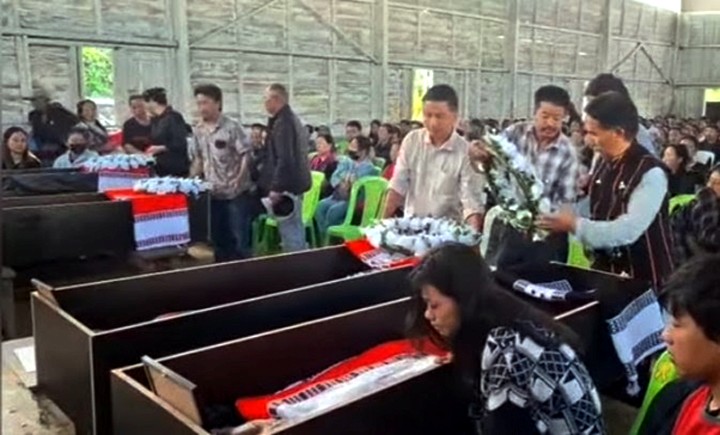
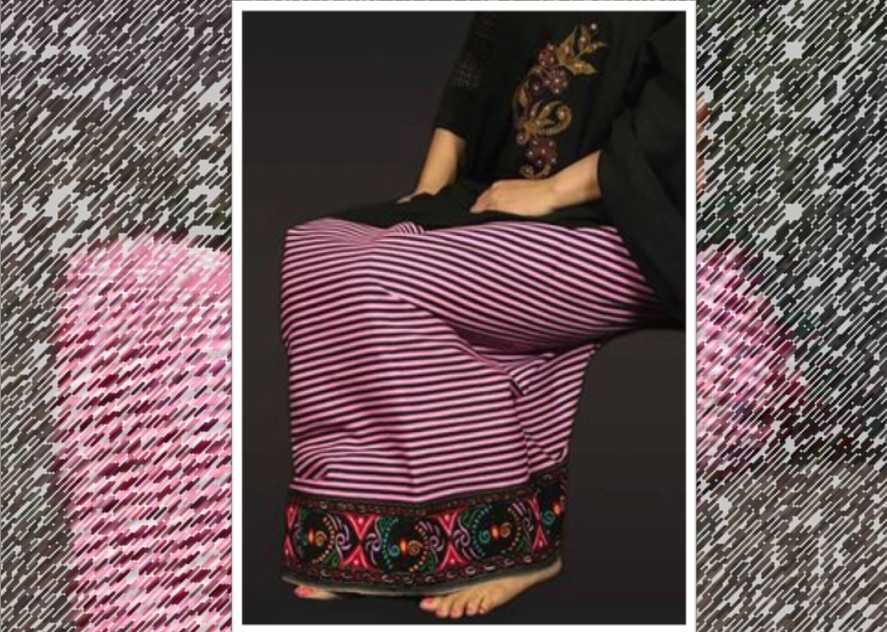
At the centre of Meitei women’s dress sits the phanek, a rectangular wraparound whose weave carries over three hundred documented motifs, some of which echo characters from the Meitei script itself. Weavers call this patterning mayek — a word that means pattern, script and mark all at once. Reading a woman’s phanek correctly, tradition holds, could tell you her clan, her lineage, and her ritual status, encoded across its coloured zones: a central field for identity, borders for clan or rank, and end bands for ritual standing. Its older ancestor, the Phege Phanek — a plainer, undivided length of cloth secured with a coloured cord called the leirum — survives today mainly in two settings that resist change more than any other: the Lai Haraoba festival, danced by ritual specialists called Maibis, and the funeral shroud, still draped in the archaic style to send the dead back to the ancestral world in the clothing of an earlier age.
Men’s dress carried its own, less familiar, institution: Khamanchatpa and Khumuchatpa, the royal system by which a king — or delegated clan elders — formally granted a man the right to wear the dhoti-style Pheijom otherwise reserved for nobility. This was not a garment but a ceremony, recorded in the royal chronicle and witnessed by court officials: a wearable patent of nobility, its border colour graded precisely to the rank of the man who had earned it. A plain white border marked the lowest sanction; a single red stripe, middle rank; gold-and-red, the highest officials below the king. British colonial administration, from 1891 onward, dismantled the legal machinery that enforced this system, though its memory lingers in the care some Meitei men still give to the border of a ceremonial Pheijom.
Beyond the valley, colour spoke an entirely different dialect. Among Naga communities, colour is biomorphic: red for blood and war, black for death and the ancestor realm, white for bone and purity. The Maring’s warrior shawl combines all three to narrate a complete cycle of life, death and continuity. Khongjai communities, by contrast, read colour ecologically — green for the growing crop, red for the fire of jhum cultivation and for ancestral blood, black for the fertile burned earth from which a new harvest rises.
None of this was possible without an equally sophisticated economy behind it. Manipur’s cottage industries — mulberry and Muga sericulture, cotton cultivation timed to the agricultural calendar, lac production for crimson dye, and the tributary Lallup labour system — fed directly into the palace’s textile workshop, the Phirel Laishang, and into Asia’s oldest women-run marketplace, the Khwairamband Keithel in Imphal, still trading today. Cloth functioned simultaneously as clothing, tax, currency and status marker; to wear a certain garment was to hold a certain place in a very real productive economy, not merely to make a fashion statement.
That economy, and the natural dye knowledge it sustained, has been eroding for over a century — first under colonial commercial fabrics, more recently under synthetic dyes and generic “Manipuri-style” cloth produced for the tourist trade. But since the 1990s, a determined revival has taken hold, backed by Geographical Indication tagging, handloom cooperatives, and researchers working to recover pattern vocabularies before the last weavers who hold them by memory are gone. Of the more than three hundred historically recorded phanek patterns, fewer than sixty remained in active production by the 1990s — a sobering reminder of how much can vanish within a single generation.
What survives, and what is being recovered, is more than decoration. In Manipur, cloth has long functioned as a kind of constitution worn on the body — encoding clan, rank, gender, ritual status and ecological belonging in a language legible to those who know how to read it. Preserving that language is not simply a matter of craft revival. It is a matter of keeping a record of who a people are, thread by thread

The writer is a former Member of Parliament and a former Union Minister of State External Affairs and Education, Government of India.