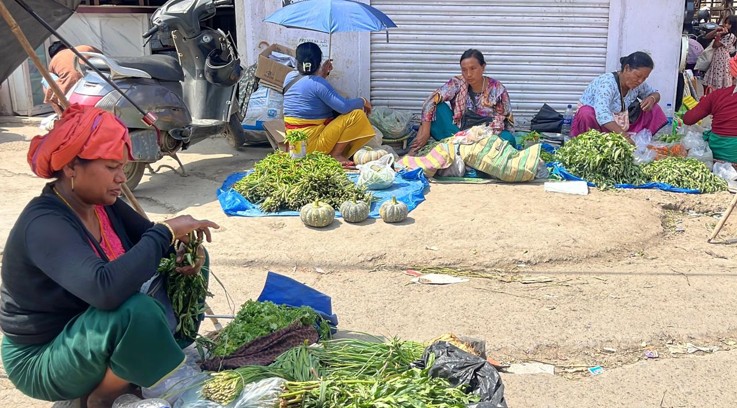
The above normal surge of temperature this summer has hardened the life of women street vendors, taking tolls both in terms of health and economic losses.
Manipur, a state once considered blessed with pleasant weather, pristine beauty, has geographical composition of approximately 90 percent hills surrounding the central Imphal valley constituting about 10 percent of state’s area. But the weather conditions of the state has seen drastic changes over the years, indicating it too is bearing the consequences of the rapid global climate change phenomenon.
Besides other factors, unchecked urbanisation, deforestation, rise in carbon consumption in the state have also aggravated this rapid change for the worse.
It is a truism that impact of climate change affected each and every individual with no exception. However, its hits people living below poverty the hardest. This class of people will include day labourers, street vendors and other similarly economically vulnerable groups, as they do not have adequate coping shields.
With the rise of mercury levels, the more affluent people try to stay indoor under the fan or air conditioner particularly during peak temperature just to beat the scorching heat. Street vendors and other wage earners do not have the comfort or can afford these means, therefore are often left at the mercy of raw nature. Since, fighting hunger and poverty is more urgent than anything else, they are compelled to come out in the open for toil to win their and their families’ daily meals. This makes compels them to risk exposure to any climatic condition that come their way, even the most extreme.
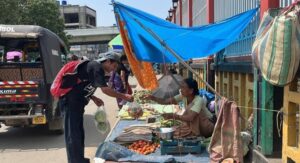
“As a breadwinner of my family, I have been selling dry fish along the roadside near Khwairamband Ima Market for more than 10 years. My daily schedule is to leave home at around 4 am and return back at 7 pm. The village where I came from is very far. I cannot bear the cost of travelling home for shelter from the heat during any time of the day, so I am compelled to remain here and bear the heat in the open all day,” said Khwairakpam Roma from Thanga Ithing under Bishnupur district.
Roma, 40, therefore remains directly exposed even during the peak temperature hours just to ensure she meets her meagre ends. The small umbrella in her hands is her only means to to some shade from the glaring midday sun. But the sweat running down her face shows that this shelter is barely enough, and her physical wellbeing is obviously is at risk each day.
“Life is getting so hard nowadays compared to past years. I can feel how my health is deteriorating each day. I get exhausted very fast during day time and even fainted sometimes. At those moments, my fellow street vendors help me and shift me to better shaded spaces and provide proper first aid cares until I feel better,” she expressed while stating that poverty compels her to continue her business even if she has to compromise her health.
Highlighting how popularisation of online marketing affected her business, she said that sale from her vending space has been reduce drastically due to advent of online marketing system. Over and above this, the ongoing conflict in the state has doubled the suffering. Amidst this situation, prices of every essential commodity is shooting up, making things worse.
“In a day, my expenditure including transport, meals, water bottle, and these overheads can be as much as Rs 400 daily. The money I earn on an average per day is around Rs 700 to Rs 1000, so the margin left in hand is very little,” she shared.
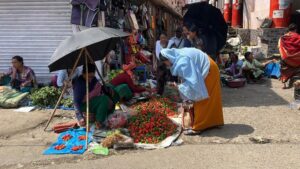
The stories of every woman street vendor, are similar. They all centre around financial constraint in keeping their self-employment activities afloat in the face of ever mounting multifaceted challenges. Quite obviously their complaints have also been about how adverse climate has accentuated their woes many times over.
Another street vendor from Mutum Phibou in Imphal West, Thounaojam Premila (59 years) who sells vegetable expressed her misery at facing incurring economic losses due to extreme heat.
She said that selling things along roadsides is troublesome and tiring. The heat that directly radiates from sunlight is bad enough, but the sunlight heats up the roads and the convection heat from the roads is notorious for withering and spoiling the vegetables we vend, she lamented.
“To get vegetables from wholesaler at cheaper rate, I get up at 3 am. I then resale these vegetables during morning hour till 9 am. I take a short break during noon time to avoid heat and resume my business around 3 pm and continue till all the vegetables with me are sold,” she shared stating how she manages coping with the extreme temperature.
She continued and highlighted her economic loss, lamenting how customers usually want only fresh vegetables, and the heat makes it impossible for venders to keep their vegetables fresh for the whole day. Most vegetables wither and turn musty at about noon and in order they do not go waste, we have to sell our wares at far cheaper rates.
Premila, mother of two has been into street vending since 2000. Although all her children are now grown up, she is compelled to continue her vegetable vending occupation for the want of a better means to meet her ends.
“My husband is a bed-ridden patient suffering from many diseases. I have two children and all grown up. My daughter got married and son is engaged in some petty day job. I therefore need to continue with my roadside vegetable vending,” she pointed out.
In order to cut corners, Premila rents a shelter space at the Temporary Market located near Khwairamband Ima Market, which was inaugurated few years back. She lives her most of the time and returns home only once a week.
While Premila is trying to save money minimizing her expenditure to lowest level, because of the rising temperature, she is now compelled to spend more money in buying water bottle.
“Every day I spent around Rs. 30 to Rs. 50 in buying water bottles. This amount of money is huge for a person like us who run from pillar to post in search of survival means,” said Premila.
Another vendor who is in the phase of facing menopause symptoms, selling fruits and other items at BT Road said that said exhaustion, fatigue, sleepless nights, dizziness has become her common health issues. To cope with these, she regularly hydrates herself drinking electrolyte, adding another burden to her meagre earnings.
President of Road Side Vendors’ Welfare Association Manipur (RSVWAM), Kshetri Tama said that women street vendors are hugely impacted by the rise of temperature and sudden heavy rainfalls and hailstorms. This phenomenon has affected their economy and health tremendously, she said. However, they have to push on with their weather exposed occupations to ensure poverty does not overwhelm them completely.
“Nowadays on the average. five to six women street vendors faint each day after prolonged exposure to sunlight. This seldom happened even a few years back. On the other hand, goods they collected from wholesalers for vending such as vegetables, fruits, fish etc., get spoil or rot fast because of extreme heat. At times of sudden heavy rainfalls, they run here and there for shelter,” she stated while highlighting how changes in climatic condition is affecting woman street vendor adversely in Manipur.
Tama recalled that RSVWAM was formed 28 years ago with around 600 women street vendors who sell things along roadside near Khwairamband Ima Market. But now the figure has reached to more than 5000.
“The ever-increasing population of vegetable vendors proves that our economic condition is worsening each year. In search of livelihoods, these vendors are forced to expose themselves to scorching heat even during the peak temperature hours when even people who can afford to be indoors feel drained and exhausted,” she explained while drawing attention of the government to take up necessary steps for street vendors, to save them from the eventuality of heat related illnesses reaching alarming proportion among them.
Tama while emphasising the economic condition of street vendors, said that all venders are from families which fall below the national poverty line threshold. However, most of them do not avail any welfare schemes that would help them in alleviating poverty, out of ignorance of these schemes.
“If they avail these government schemes, I am sure the number of days they are compelled to expose themselves in harsh sunlight by street will likely reduce. I would be grateful if concerned department conducted a camp for enrolment of to these government schemes in Temporary Market, where they spread awareness as well as help enrolment among the women vendors,” she suggested.
Tama also expressed the need for providing temporary shaded space, installation of free drinking water stations at vantage points.
Director of Environment and Climate Change, T Brajakumar Singh said that there is an alarming rise in temperature in the state. However, the state hasn’t come across any incident of heatwave so far.
“In our state, we have experienced on some days temperature rising above normal, but thankfully this is normally followed by rainfall within the next day or two. As such so far incident of heat wave has not occurred. If we continue to keep on neglecting climate change issue and its root causes, the state will surely face severe and worsening weather conditions,” he observed.
Brajakumar while stressing rise of temperature is one impact of climate change, he said that the directorate has formulated Manipur Action Plan on Climate Change (MSPCC). The plan projects a further rise of temperature by 1.7 degree Celsius by mid-2030. Over the last 100 years, the state’s minimum and maximum temperatures have increased by at least 1.7 degree Celsius and 1.5 degree Celsius respectively.
He continued said that under this action, the directorate has categorised four sectors for mitigation and adaptation of climate change. They are agriculture, water, forest and health. The directorate also identified farmers, labours, children, pregnant women as some of the vulnerable groups.
Street vendor being a vulnerable group, their issues will come under health category. According to this action plan, the directorate has advocated for strengthening awareness on heat precaution and need of setting up mobile ambulance team to save people when their life is at danger due to extreme heat, he added.
Brajakumar also stated that as a mitigation effort, the directorate has focused on popularising e-vehicle. The directorate even provided e-auto at subsidised rates. Other than this, MSPCC also is focused on promoting a shift from carbon-based vehicle to e-vehicle in the state.
According to data received from directorate of Environment and Climate, in 2015 the highest temperature was recorded at 39.77 degree Celsius in the month of June in Chandel district. But in 2024, the temperature reached beyond 42 degrees Celsius in the Noney district.
In 2025, the temperature in Imphal West reached to 41.91 degree Celsius in the month of June. But maximum temperature in 2015 in the district was 34.7 degree Celsius in September.
As per report, the average annual peak temperature of the state is rising steadily from 34.7 degree Celsius in 2013 to 35.7 degree Celsius in 2024.
Climate change is real and evident. Despite street vendor being among the least carbon consumers, they are among those who pay the heaviest price. Wouldn’t it be appropriate then for the government to formulate a proper policy and program that can bring at least some relief for this vulnerable group.
(This report is published under 7th state level media fellowship programme on Climate Change by the directorate of Environment and Climate Change)

The writer is an award winning reporter