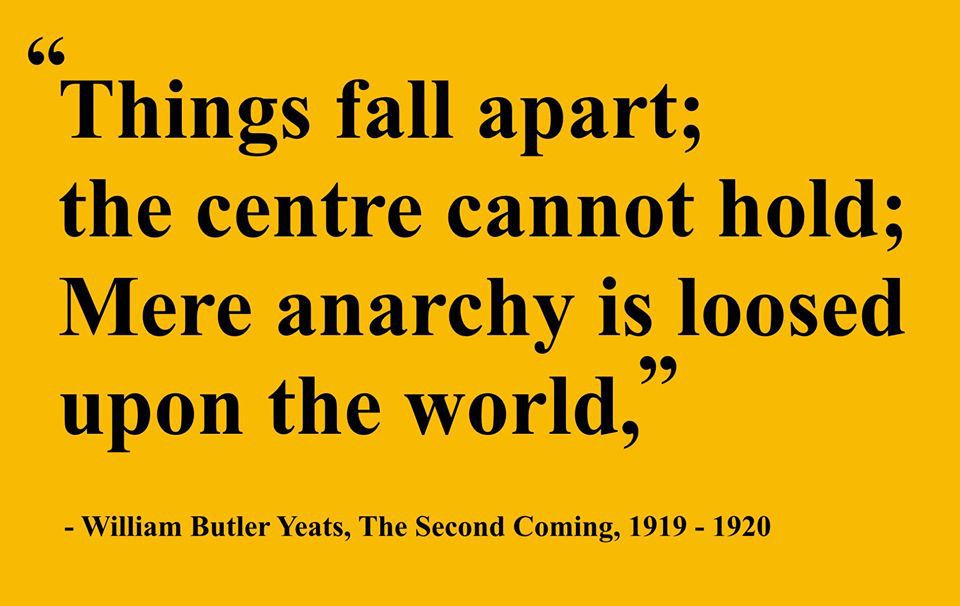
In this dark times Manipur is engulfed in, it is difficult not to recall the opening lines of Irish poet William Butler Yeats’ 1919 poem The Second Coming, encapsulating the aftermath of the deaths and destructions of World War-1, which came to be dove-tailed by the start of the Irish war of independence against Great Britain. The poem obviously was about the anarchy and lawlessness that marked life in Ireland of the time, but it very well could have also been a prescient anticipation of what Manipur is witness to today: “Turning and turning in the widening gyre / The falcon cannot hear the falconer; / Things fall apart; the centre cannot hold; / Mere anarchy is loosed upon the world, / The blood-dimmed tide is loosed, and everywhere / The ceremony of innocence is drowned; / The best lack all conviction, while the worst / Are full of passionate intensity.”
Two developing events, tragic in their own ways, exemplify this sorry state of affairs in Manipur. First is of course the ethnic conflict between Meiteis and Kuki-Zo group of tribes which just completed three years on May 3, leaving in its trail close to 260 deaths and 60,000 displaced. As if this is not bad enough, now the conflict is expanding to drag in the Nagas into this sordid theatre. But before this grave matter is dealt with, another completely unnecessary, but invited controversy now unfolding in the Manipur University over a Vice Chancellor-in-charge before a new full-fledged VC gets appointed following the end of term of the last VC, N. Lokendra Singh on May 7, needs urgent attention.
For unexplained reasons, the outgoing VC, who also it seems was campaigning to have his own term extended by another six months, decided to override the MU statute book, which simply states that in such an event of temporary vacancy of the VC’s post, the seniormost professor of the university would take charge to fill in the gap till the next VC is appointed. By this MU statute, Prof. Sumitra Phanjoubam, of the Physics Department was appointed VC in-charge on May 7, but it now seems the outgoing VC and his staff went beyond the brief of the MU Charter, and proposed to the Central government the name of another professor, third in the seniority list. Just one week after the appointment of Prof. Sumitra, the ministry responded saying the President of India has approved the “proposal” of the outgoing VC and staff to appoint Prof. Ganga Prasad Parsain as VC-in-charge. Many questions remain unanswered. Where was the requirement in the MU statute book dor a proposal to the Central government for handing over temporary charge of VC before a regular VC is appointed? This is not even a post contested for, or applied for. Again, why was the person third in seniority list given this charge over two others more senior to him? It is also not a trivial matter that Prof. Ganga Prasad is still embroiled in controversies of financial embezzlement while he was the officiating VC of Tripura University. This controversy has been widely reported in the media, with the Opposition Congress even seeking a thorough probe.
What is even more bewildering is that a good section of the MU community does not seem to see this as an affront on the university, and considers it a tussle relevant to the three senior professors in contention only. Most of them are simply content to be fence-sitters, waiting and watching which side may emerge winner so they can jump on to the bandwagon of the winning side to win personal favours. Few seem to consider it as a bad precedent for MU and its future, where its own statute and standards of rules-based order are being undermined, and that if this goes unchallenged by them, similar overstepping of norms can become acceptable in future too. This is a community who are supposed to be the custodians of the fountainhead of ideas in the state, working on the sacred forge of principles to set new moral standards for the university and indeed the state as a whole. It is depressing to witness this drama unfold, depleting everybody’s faith in systemic justice, a malady the state is afflicted by in practically all spheres. This so-called temple of higher learning, it now is apparent, is no different, therefore abjectly incapable of providing the beacon light to this beleaguered state in navigating its way out of the dark anarchy it has been progressively descending into. And now, what should have been just a routine matter, is set to be dragged into courtroom battles. Tragic.
Returning to the matter of the ethnic conflict in the state, nothing can be more alarming than the unfolding traumatic contest of hostage taking since the May 13 ambush on a two-vehicle party killing three Thadou tribe pastors along the German-Tiger road constructed under the initiative of two Kuki militants leaders German and Tiger. The road connects two Kuki majority districts of Manipur, Kangpokpi and Churachandpur. The religious leaders were travelling back to Kangpokpi from Churachandpur where they had gone to attend a peace convention. They were using this route, for the shorter and faster routes that cut through the Imphal valley are considered not safe for the Kuki-Zos ever since bloodletting broke out between the Meiteis and Kuki-Zos on May 3, 2023. The ambush spot was between two Kuki villages, Kotlen and Kotzim. What is also noteworthy is that this spot falls within the overlapping security jurisdictions of the 9 Sector (Brigade) Assam Rifles at New Keithelmanbi and the 57 Mountain Division Headquarter of the Indian Army at Leimakhong. The assailants are yet unidentified, nonetheless conspiracy theory addicts are on full throttle conjuring up scenarios, most of them outlandish.
Kukis of Leilon Vaiphei on the suspicion that it was the Zeliangrong United Front (Kamson faction) militants responsible for the carnage, kidnapped villagers of Konsakhul (a Liangmai Naga village) while they passed through Leilon Vaiphei on their way home. In retaliation, Nagas who even claim the Kukis were behind the ambush aimed at setting up Nagas as aggressors, swooped down on Taphou and Hengbung Kuki villages to also take reciprocal hostages. Making all these claims and counterclaims even more intriguing is that the ambush spot is considered a stronghold of Kuki militants. Thankfully, both sides have released women and children amongst the hostages, but there are still six Nagas and 14 Kukis still in captivity. Hopefully good sense will prevail and all of them will return home alive at the soonest, avoiding further escalation of the already dangerous second spell of Kuki-Naga conflict, the first being in the 1990s.
What is also intriguing in this prolonged and increasingly complex and bitter conflict is that while Nagas and Meiteis believe Central forces, in particular Assam Rifles, are using the Kukis as proxy fighters to undermine them, the Kukis believe the Manipur state police are against them. Bizarre though these claims may sound, there are underlying logics that they can actually be true in varying degrees. Meitei and Naga insurgents are fighting the Indian state to reclaim what they believe were their sovereign status before becoming a part of India. Kuki militants have never had any such ambitions, therefore would more likely to be considered by Indian forces as allies in their counterinsurgency mission. Likewise, in the other scenario of the Manipur Police, they too would tend to align with those opposed to Manipur fragmenting, which are definitely the Meiteis, and be pitted against those who aspire to splinter the state, which at the moment are the Kuki-Zos. It is unfortunate that both these categories of forces (Central and state) have not been able to rise above the logics of local canvasses of conflicts they are exposed to, and instead see the nation as the only legitimate wielder of legitimate power of coercion as Max Weber described, and therefore refrain from calibrating different militant groups on the scale of friends and foes.

Editor, Imphal Review of Arts and Politics and author