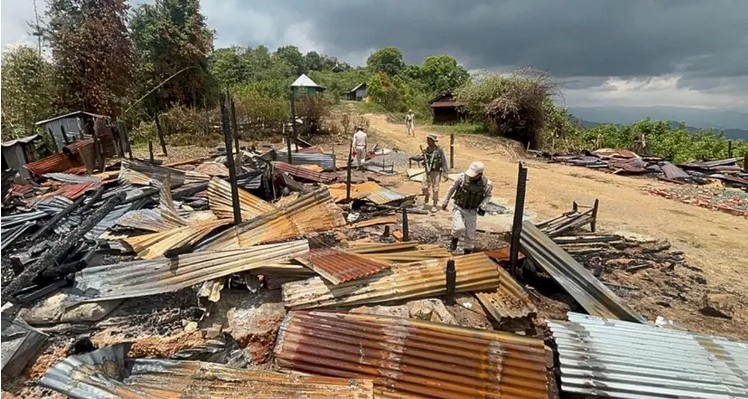
More than three years after the eruption of violence on May 3, 2023 in Churachandpur, Manipur stands at a dangerous historical crossroads. What was initially portrayed as an explosive confrontation between Meiteis and Kuki-Zomis has gradually evolved into something far deeper and structurally more alarming – the fragmentation of shared political space, the militarisation of ethnic geography, the normalisation of demographic separation, and the slow erosion of the authority of the state itself. The recent killings, kidnappings, retaliatory detentions, territorial threats, and ethnic evacuations unfolding across Kangpokpi, Senapati, Churachandpur, Ukhrul, Kamjong, Noney, and adjoining districts reveal that the crisis is no longer simply about sporadic communal violence. It increasingly appears to involve competing territorial imaginations, parallel ethnic authority structures, and the emergence of segregated zones of control that threaten the very idea of Manipur as a common political entity.
The chain of incidents that unfolded on May 13 and after illustrates further the gravity of this transformation. Three Thadou church leaders returning from a Baptist churches meeting in Churachandpur were ambushed and killed between Kotlen and Kotjim in Kangpokpi district. Several others were injured. The attack shocked not only the Thadou community but also church bodies, civil society organisations, and wider sections of the population because the victims were not armed actors. They were religious leaders associated with peace and reconciliation initiatives at a time when tensions between Kuki and Naga groups had already been escalating in parts of the hill districts.
The significance of the attack lies not merely in the brutality of the killings but also in the identity and political context surrounding the victims. The Thadou community has increasingly asserted that it is a distinct tribe and should not automatically be subsumed under the broader Kuki or Kuki-Zo nomenclature. In recent years, tensions have emerged between Thadou organisations and sections of Kuki political groups over questions of identity, representation, and political direction. The slain church leaders were also reportedly associated with efforts aimed at promoting reconciliation between Kuki and Naga communities. Their deaths therefore raise disturbing questions about the shrinking space for moderating voices amidst escalating militarised ethnic politics.
In deeply polarised conflicts, peacebuilders often become vulnerable because they challenge hardened narratives and territorial absolutism. The killing of individuals associated with reconciliation efforts carries symbolic implications beyond the immediate violence itself. It sends fear into communities and weakens fragile attempts at rebuilding inter-community trust. Whether the attack was intended specifically to sabotage reconciliation or not, the political effect is precisely that.
Security agencies cannot swiftly conduct search operations and take actions against the perpetrators of the violent actions. The inability of the state to swiftly identify and prosecute the perpetrators further deepens public mistrust. Competing organisations quickly accused rival armed groups. Some Kuki organisations earlier blamed a Meitei organisation, Arambai Tenggol and Valley-Based Insurgency Groups (VBIGs), and later turned on NSCN-IM-linked elements and the Zeliangrong United Front, while ZUF-K denied involvement entirely. The proliferation of accusations without authoritative state clarity reflects a larger institutional breakdown. In functioning political systems, the state determines responsibility through investigation and law. In Manipur today, competing armed narratives increasingly shape public perception instead.
The same evening, another violent incident occurred in the Joujangtek area under Noney district where a Chiru Naga man of Dollang village was killed and two others, including a woman, were injured in an ambush along the route to their Leimatak paddy fields. Under ordinary circumstances, such an attack may have been viewed primarily as a criminal or insurgent incident. But in the present context of militarised territorial polarisation, the significance of Joujangtek extends far beyond a localised act of violence.
Joujangtek occupies one of the most sensitive and contested geographical positions in the present conflict landscape of Manipur. Situated along the foothill route connecting Kangchup, Kangpokpi, Noney, and Churachandpur, the area lies near the boundary zones of Noney district and Churachandpur district and is often described as a strategic “link area” between the hill regions. It sits near the tri-junction connected through the Old Cachar Road and has increasingly acquired geopolitical significance because it functions as a transport and access corridor between multiple contested regions.
Since the outbreak of violence in 2023, Joujangtek and adjoining areas have effectively become part of the larger “buffer zone” geography that physically separates ethnic communities and regulates movement across territories. Different communities and organisations have also projected competing territorial claims over the area. While some Kuki groups associate Joujangtek with the Churachandpur sector, others place it within the administrative and territorial sphere of Noney district. In conflicts shaped by ethnic territorialism, such disputed geographical interpretations are never merely administrative disagreements. They reflect deeper political struggles over future control, access, and demographic influence.
The strategic importance of Joujangtek was already evident in July 2025 when local organisations reportedly warned against the illegal construction of the “German Road” or “Tiger Road” connecting Churachandpur and Kangpokpi via Joujangtek, Kotlen, and Kangchup. The objections were not merely developmental concerns. Critics warned that such road connectivity through sensitive foothill areas could destabilise the region, alter strategic access, intensify territorial competition, and affect multiple villages located along the corridor. This revealed how roads themselves have become politicised in the current conflict. Infrastructure is no longer viewed simply as development but as an instrument capable of reshaping territorial power and demographic movement.
The significance of areas like Joujangtek therefore extends beyond village-level tensions. Roads, transport corridors, ridges, foothill settlements, and buffer-zone junctions increasingly become part of wider calculations involving strategic influence, territorial continuity, demographic control, and military mobility. This is why every violent incident in such areas now generates anxieties about territorial intentions and future demographic reconfiguration.
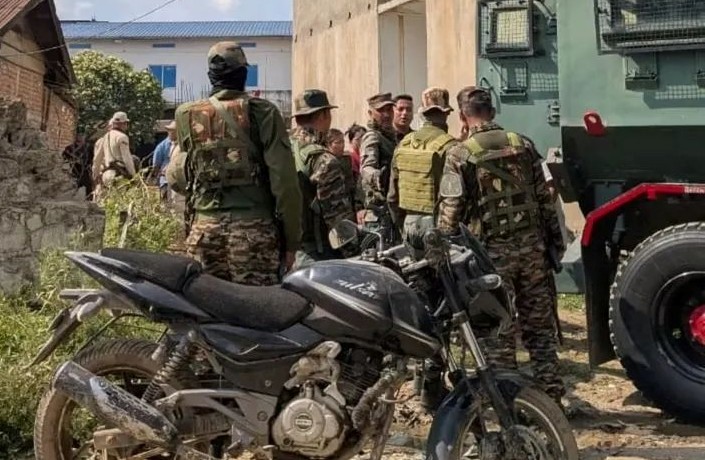
Shortly after the ambushes, reports emerged that 18 Liangmai Nagas from Konsakhul returning from attending a wedding had been abducted by armed Kuki elements at Leilon Vaiphei, leading to retaliatory detentions of Kukis of Taphou by Naga groups at Rikhumai Taphou and Phyamai Taphou of Senapati district. Over the next two days, hostage negotiations involving civil society organisations, security forces, and community bodies led to the release of most detainees. Yet six Nagas are still in captivity as of May 16 mid-day.
The Naga People’s Organisation (NPO) informs general public of Senapati district and all Nagas to avoid travelling along Senapati-Imphal Road, even though the agitation period declared by the Kukis has officially ended as the Nagas may still be taken hostage or even face threats to their lives.
The hostage crisis exposed how dangerously the conflict has evolved. Civilians were no longer merely trapped between armed groups; they themselves had become bargaining instruments in reciprocal ethnic coercion. The reports describing blindfolded captives moved through forests and mountainous terrain underline the complete collapse of civilian security in contested areas. Although many hostages reported they were not physically assaulted, the very normalisation of civilian detention by ethnic formations marks a deeply troubling development.
Equally significant is the emergence of parallel systems of authority. Negotiations over hostage release involved not merely the state but ethnic village guards, civil society organisations, armed formations, and community networks. These actors increasingly perform functions traditionally monopolised by sovereign institutions – detention, negotiation, territorial enforcement, population management, and conflict regulation. This signals not simply a weak state but the gradual diffusion of authority into competing ethnic structures.
The broader political fear emerging from incidents involving Konsakhul and adjoining areas concerns territorial consolidation. Meiteis and many Nagas increasingly suspect that insecurity and intimidation in strategic zones may eventually push communities out and facilitate the creation of contiguous ethnic territories under exclusive control. Whether this is an organised policy or an emergent consequence of prolonged conflict, the perception itself is politically significant. Territorial continuity has historically been central to many ethnic homeland movements in India’s Northeast. In conditions of escalating polarisation, demographic separation and territorial consolidation become deeply intertwined.
This is why the present conflict cannot be reduced and considered merely to spontaneous communal hostility. It increasingly reflects the transformation of administrative space into ethnicised political geography.
The statements issued by the Kuki Liberation Army-Letkholun, KLA (L) opposing the proposed visit of the Chief Minister to Churachandpur on May 15 reveal this transformation with striking clarity. The organisation reportedly declared that the Chief Minister would effectively be crossing “a boundary between two distinct entities” if he entered “Kuki-Zo areas”. This language is extraordinarily significant because it openly imagines Manipur not as a unified state but as already partitioned political space.
The implications are profound. When armed organisations and the community groups driven by them publicly declare that parts of the state constitute separate territories where the elected Chief Minister cannot freely move, the question ceases to be merely about armed struggle. It becomes a question about sovereignty itself. Who governs? Who controls territory? Whose authority is recognised?
The existence of buffer zones since 2023 already reflected the physical separation of Meiteis and Kuki-Zomis. Initially presented as temporary security arrangements to prevent violence, these zones increasingly resemble invisible borders regulating movement, administration, and political access. The recent statements by armed groups show how temporary conflict-management mechanisms can gradually acquire permanent political meaning.
This is one of the most dangerous aspects of the ongoing crisis. Security responses intended to contain violence may unintentionally normalise segregation. Every time communities are evacuated into ethnically “safe” areas as done after the 2023 May 3 violence in Churachandpur and post May 3 retaliatory violence in Imphal rather than coexistence being protected and restored, the principle of separation becomes further entrenched. Over time, emergency arrangements harden into accepted realities.
The evacuation or facilitated transfer of Naga students from Churachandpur Medical College and Kuki-Zomi students from Maram in Senapati district illustrates this pattern clearly. Such measures may be operationally necessary under immediate threat conditions. Yet politically they reinforce the perception that ethnic coexistence has become impossible. Educational institutions, roads, towns, and public spaces cease to function as shared civic spaces and instead become ethnically classified zones.
This pattern has repeated itself across Manipur since 2023. In both the hills and valley, Meiteis and Kukis are physically separated. In parts of the hills, Nagas and Kukis increasingly retreat into their own territorial spheres during crises. During incidents in Litan and Sanakeithel, communities were reportedly moved into “safe” ethnic areas rather than security being restored for mixed coexistence. Each such incident strengthens the psychological architecture of partition.
The long-term consequences are enormous. Children grow up in segregated environments. Shared social and economic networks collapse. Roads become ethnic corridors. District boundaries acquire militarised meanings. Most communities appear stop imagining a common political future.
The most troubling aspect of this trajectory is that the state increasingly appears unable to reverse it.
The inability of the state to guarantee free movement on National Highways, across districts, prevent kidnappings, identify attackers, dismantle armed networks, or ensure the unrestricted functioning of civil administration erodes public confidence in constitutional authority. In such circumstances, communities increasingly rely on their own ethnic organisations and armed defenders for security. The weaker the state becomes, the stronger ethnic militarisation grows.
This creates a vicious cycle. State weakness encourages armed consolidation. Armed consolidation further weakens the state. Fear then drives demographic separation. Demographic separation strengthens territorial claims. Territorial claims intensify demands for exclusive administration or political autonomy.
What emerges is not merely conflict or crisis but gradual political disintegration.
The prolonged nature of the crisis has also transformed political psychology. Initially, many believed the violence of 2023 would eventually subside through negotiation, security intervention, or political dialogue. But as the conflict persists year after year, temporary divisions increasingly become normalised. Entire communities now live thinking that separation appears to be permanent. That psychological shift may ultimately prove more consequential than the violence itself.
The language used by several armed and political actors increasingly reflects this normalisation. References to “Kuki-Zo land,” prohibitions on Meitei entry, insistence on ethnic exclusivity, and the portrayal of buffer zones as political boundaries indicate that parallel territorial imaginations are becoming institutionalised within public discourse.
At the same time, the state’s responses often appear reactive and routine rather than transformative. Security forces intervene after violence erupts. Hostage releases occur through emergency negotiations. Administrative authorities manage crises rather than restoring integrated governance. This may prevent immediate escalation but does little to reverse fragmentation.
The question therefore arises – is the state merely failing, or has prolonged failure itself become structurally functional?
This does not necessarily imply a grand conspiracy. Rather, it suggests that prolonged instability may now serve multiple competing interests simultaneously. Armed organisations gain territorial leverage and political legitimacy within their communities. Ethnic nationalist projects gain momentum through demographic polarisation. Security-centric governance expands. Political actors avoid difficult structural solutions by managing instability rather than resolving it.
In such conditions, fragmentation gradually reproduces itself.
The danger is compounded by the weakening of moderating institutions. Churches, civil society bodies, and reconciliation initiatives historically played important roles in maintaining inter-community communication even during periods of tension. But as armed politics expands, such institutions increasingly lose influence. The killing of church leaders associated with peace initiatives symbolises this dangerous shift. Moral authority weakens while coercive authority rises.
This is why the current crisis must not be viewed merely through the lens of law and order. What is unfolding is a transformation in the nature of political space itself. The conflict is reshaping how communities imagine territory, authority, security, and coexistence.
The greatest tragedy is that ordinary civilians bear the heaviest burden. Villagers become targets. Students become displaced. Roads become dangerous. Families are divided. Entire generations grow up amid fear and segregation. Every fresh incident deepens accumulated mistrust.
If this trajectory continues, the consequences for Manipur could be historic. The state may continue to exist constitutionally while becoming socially and territorially fragmented in practice. Formal administrative boundaries may survive, but lived political reality could increasingly resemble separate ethnic enclaves linked only by fragile security arrangements.
Yet despite the severity of the crisis, this outcome is not inevitable. Fragmentation becomes permanent only when political imagination surrenders entirely to separation.
For that reason, restoring coexistence must become the central objective rather than merely managing violence. Security operations alone cannot rebuild political society. Nor can peace emerge solely through tactical negotiations with armed groups while deeper questions of trust, justice, representation, and shared belonging remain unresolved.
The state must reassert neutral constitutional authority across all regions without appearing aligned to any ethnic bloc. Accountability for killings, kidnappings, and intimidation must become visible and credible. Roads and institutions must function as genuinely shared public spaces. Educational institutions, markets, hospitals, and administrative systems must be protected as spaces of civic integration rather than ethnic segregation.
Equally important, political leadership at both the state and central levels must recognise the long-term dangers of allowing emergency security arrangements to evolve into permanent ethnic separation. Buffer zones cannot become invisible borders. Humanitarian evacuations cannot become normalised demographic partition. Security management cannot replace political reconciliation.
The future of Manipur ultimately depends on whether its people and institutions still believe coexistence is possible.
Today, the crisis is no longer simply about armed conflict between communities. It is about whether Manipur can survive as a shared political idea. The growing normalisation of ethnic territories, parallel authority structures, retaliatory civilian detentions, restricted mobility, and competing sovereignties suggests that the struggle has entered a far more dangerous phase than before.
If the present trajectory continues unchecked, the greatest casualty may not merely be law and order or territorial integrity. It may be the destruction of the very social and political foundations that once allowed diverse communities to inhabit Manipur as a common historical space despite all their differences.
The central challenge therefore is not simply how to stop violence. It is whether the state, civil society, and political leadership can still prevent temporary ethnic separation from becoming permanent political destiny.

Senior Editor: Imphal Review of Arts and Politics