
It is well known that civil society is part of our life and the space that exists between the State on one hand and families on the other, that allows people to come together for a whole variety of public activities, and that is relatively independent of the State, a political entity that governs a specific territory and population, possessing a centralised authority with the power to enforce laws and maintain order.
However, civil society is not non-political or apolitical but a non-state collective space. In other words, civil society is now associated with everything good that the state is not. In its non-state functions, it can cover both political and social activities.
Political parties have a double role in a multi-party democracy like India. Political party becomes an appendage of the State when civic action is missing and can be considered as a political society.
In an ideal world, civil society should be concerned about the common interests of the whole society. The civil society has a responsibility to recognise and uphold the important values of society and, on the basis of these values, to set standards and norms for all sectors of society, including government and political society.
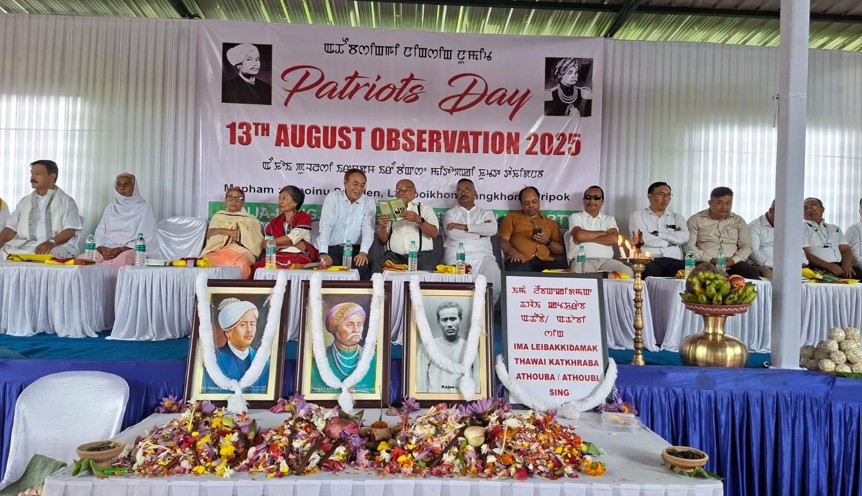
Notably, the Civil Society Organisations (CSOs) leaders of Manipur like former president of Tangkhul Sanao Long Grace Thumra Shatsang, President of Kabui Mothers’ Association, Manipur (KAMA) Atongpi Kamei, Convenor of the Coordinating Committee on Manipur Identity (COCOMI) Khuraijam Athouba, President of the Civil Societies Coalition, Kangleipak (CCSK) Jeetendra Ningomba, Co-Convenor of COCOMI and President of Heritage Council (HERICOUN) Yumkhaibam Surjitkumar Khuman, Former President of United Committee Manipur (UCM) Sunil Karam, President of Federation of Civil Societies (FOCS) B M Yaima Shah and members of various CSOs participated in the Patriots’ Day observation organised by the Manipur People’s Party (MPP), a political party in Manipur at Emoinu Sanglen, Lamboi Khongnangkhong in Imphal West.
The recent participation of the leaders of the prominent CSOs of Manipur in the observation of the Patriots’ Day on August 13, 2025 organised by the MPP, a political party in Manipur has led to analyse the relationship between CSOs and political parties in Manipur.
The relationship between civil society organizations (CSOs) and political parties in Manipur has always been complex, shaped by state repression, human rights movement, insurgency, ethnic politics, and demands for autonomy. However, the violent conflict that erupted on May 3, 2023 due to the attacks of the Kuki-Zomi militants against Meiteis in Churachandpur, Kangpokpi, Saikul and Moreh to claim the areas as their exclusive territories and the counter attacks by the Meiteis against the Kuki-Zomis in Imphal has drastically altered this dynamic.
Against this backdrop, the recent participation of CSO leaders in the Patriots’ Day observation organised by the MPP raises critical questions about the role of civil society in a highly polarised and militarized environment.
This analysis examines the evolving relationship between CSOs and political parties in Manipur through three key lenses: 1. The historical context of CSO-political party engagement in Manipur, 2. The impact of the ongoing conflict and shrinking civil society space, and 3. The implications of CSO leaders aligning with the MPP in the current political climate. And this interrogates whether this represents strategic adaptation, co-optation by political forces, or the erosion of civil society’s independent voice in Manipur’s fractured polity.
Historical Context of Civil Society and Political Parties in Manipur
Manipur’s civil society has been deeply involved in socio-political movements, ranging from human rights advocacy to demands for self-determination. Organisations such as the United Committee Manipur (UCM), All Manipur United Clubs’ Organisation (AMUCO), All Manipur Students’ Union (AMSU), Apunba Lup, and various women’s groups generally known as Meira Paibis like Nupi Samaj have played crucial roles in shaping public opinion and resisting state policies perceived as oppressive.
CSOs have often acted as watchdogs, challenging both state and non-state armed actors, and also acted even as arbiters during the Kuki-Naga ethnic clashes in the 1990s. However, their neutrality has been compromised due to ethnic affiliations.
Political parties, on the other hand, have often been seen as either collaborators with the Indian state or as ineffective in addressing local grievances. The MPP, a regional party, has historically positioned itself as a voice for Manipuri identity, but its influence has waned over the years. The recent participation of CSO leaders in the renewed MPP’s Patriots’ Day event suggests a possible realignment, raising questions about autonomy, co-optation, and the evolving role of civil society.
Ethnic-based political parties like Naga People’s Front (NPF) and Kuki People’s Alliance (KPA) have become key players in the power politics of Manipur and its future.
The ruling party, Bharatiya Janata Party (BJP) has been accused of deepening ethnic divisions. The Indian National Congress and other regional parties are often seen as ineffective in addressing core issues. National parties (BJP, Congress) in Manipur are often seen as centrally controlled.
Historically, Manipur CSOs maintained critical distance from political parties and they have distrusted political parties, viewing them as either co-opted by the Indian state or as ineffectual in addressing core issues complicit with New Delhi’s policies and divided along ethnic lines. However, the May 2023 violence has forced realignments.
Shrinking Civil Society Space in Manipur
Civil society space in Manipur has been shrinking due to multiple factors. State Repression and Legal Restrictions – The use of laws like the Unlawful Activities (Prevention) Act (UAPA) and the Armed Forces (Special Powers) Act (AFSPA) has curtailed dissent. CSOs advocating for human rights or autonomy often face surveillance, arrests, and stigmatization as “anti-national.” Arrests and detention of CSO leaders and prominent figures under security laws, like National Security Act (NSA) have been helping in limiting civic activities and shrinking civil society space.
During COVID-19 Pandemic the state control over public activities, restricting CSOs’ ability to mobilize was evident. Humanitarian efforts by CSOs were sometimes co-opted or sidelined by state-led initiatives, reducing their independent influence and civil society space has been curtailed.
Frequent and protracted internet shutdowns restricted mobilisation and advocacy activities by the CSOs thereby shrinking their role in the civil society space.
In the post-May 2023 militarisation and polarization due to the violent conflict has made civil society engagement riskier and more partisan. CSOs like COCOMI and AMUCO who stands for a united Manipur and coexistence of different ethnic groups of Manipur are now seen as aligned with the Meitei community, losing their neutral stance. State and Central governments have further restricted many activities of the CSOs, framing dissent as “divisive.”
Co-optation by political parties also helps to shrink civil society space. Some CSO leaders have been absorbed into political structures, blurring the lines between activism and partisan politics.
The MPP’s attempt to associate with CSO leaders during Patriots’ Day could be seen as an effort to regain legitimacy by aligning with popular civil society figures.
The Patriots’ Day Observation and Its Implications
Patriots’ Day commemorates the martyrdom of Manipuri leaders who resisted British colonial rule. The MPP’s observation of this day with CSO leaders raises several critical questions – Why Are CSOs Engaging with the MPP Now?
- Symbolism vs. Substance – Is this collaboration a genuine effort to uphold Manipuri identity, or a strategic move by the MPP to reclaim relevance? The party is apparently trying to regain relevance by aligning with civil society. Why do CSOs risk losing their critical edge if seen as aligning too closely with a political party, especially one with diminishing influence.
- Autonomy of Civil Society – Civil society’s strength lies in its independence from political parties. Participation in the events of political parties may undermine its credibility. However, in a shrinking civic space, CSOs may be seeking political leverage for survival or showing ethnic solidarity. Many Meitei-dominated CSOs may see the MPP as a pro-Meitei platform or a potential saviour to protect the integrity and unity of Manipur and coexistence of different ethnic groups. However, if CSOs are seen as MPP associates, their credibility as independent actors diminishes. The BJP-led government may further restrict CSOs that align with opposition parties like MPP.
- Ethnic and Political Divides – Manipur’s civil society is fragmented along ethnic lines (Meitei, Naga, Kuki-Zomi). The MPP is now predominantly Meitei-dominated, and its association with certain CSOs may alienate other groups. This could deepen ethnic polarization rather than foster inclusive politics.
Emerging New Orientation of CSOs in Manipur
A new orientation is emerging among CSOs in Manipur, characterized by: 1. Adaptation to Repression – Some CSOs are shifting from confrontational tactics to more subtle forms of advocacy, engaging in dialogue rather than direct protest. Others are focusing on grassroots development work to avoid state backlash.
- Increased Digital Activism – With physical gatherings restricted, CSOs are leveraging social media to mobilize support and raise awareness. However, frequent and protracted internet shutdowns have made it difficult to carry out successfully and even when there is no shutdown digital surveillance poses new risks.
- Strategic Alliances – If Some CSOs are forming temporary alliances with political parties to push specific agendas, while maintaining nominal independence, this is a double-edged sword – while it may yield short-term gains, and it risks long-term co-optation.
Critical Perspectives on the Evolving Relationship
If CSOs are seen as extensions of political parties, their legitimacy as independent voices diminishes. However, strategic issue-based alliances can amplify their impact on policy. Manipur’s civil society is not monolithic; ethnic divisions influence their engagement with political parties. The MPP’s alignment with Meitei-dominated CSOs may exclude Naga and Kuki-Zomi groups, exacerbating tensions. The Indian State’s increasing authoritarian tendencies (UAPA, internet shutdowns) force CSOs into difficult choices – either resists and face repression or adapt and risk dilution of their mission.
Conclusion: Rethinking Civil Society’s Role in Manipur’s Politics
The participation of CSO leaders in the MPP’s Patriots’ Day event reflects the complex and evolving relationship between civil society and political parties in Manipur. While such engagements may provide temporary platforms for advocacy, they also raise concerns about autonomy and co-optation.
Now, civil society in Manipur is at a crossroads – adapting to shrinking space by forming new alliances, but also risking its independent voice. For CSOs to remain effective, they must navigate these challenges carefully, balancing strategic engagements with political actors while preserving their critical, non-partisan stance.
A united, non-partisan civil society is needed now more than ever – but the current trajectory suggests further fragmentation.
Unless neutral platforms for dialogue emerge, Manipur’s civil society risks becoming an extension of ethnic politics, losing its ability to mediate peace and hold power accountable. But Manipur’s civil society has historically shown remarkable resilience. Its ability to navigate this crisis will determine whether Manipur moves toward peace or perpetual conflict.
Ultimately, the future of Manipur’s civil society will depend on its ability to resist state repression, bridge ethnic divides, distance from political parties and power, and redefine its role in a rapidly changing political landscape. The Patriots’ Day episode is just one manifestation of these broader dynamics – one that demands deeper reflection on the direction of civil society activism in Manipur.

Senior Editor: Imphal Review of Arts and Politics
1 thought on “Relation Between CSOs And Political Parties Demands Deeper Reflection on the Direction of Civil Society Activism in Manipur”
Complex at the lower level.
Comments are closed.