On a late Sunday night in Delhi’s Kilokari, a musician from Imphal, Chongtham Vikram Singh, was beaten to death outside his home. Police said it started over noise. That may be the immediate trigger. But the deeper truth is more uncomfortable.
In India, violence against North-Eastern citizens is often possible because of a deeper social logic. Their bodies are marked as foreign, suspect, and disposable.
To see this as just one more case of street violence is to miss the structure behind it. What happened to Singh has a history. For a long time, people who look North-Eastern in mainland India have faced ridicule, harassment, surveillance, and sometimes fatal attacks.
The point is not that every attack is planned by ideology. The point is that a social order already exists where some bodies are more open to humiliation and harm than others.
This is why we need the language of race.
In India, we hesitate to use the word race. We prefer softer words like prejudice, regional bias, or lack of familiarity. But those soft words hide what we see every day. People from the North-East are often treated as if they are less Indian.
Race, here, does not mean only biology or looks. It means a social arrangement. It decides who gets recognition, belonging, and safety. It decides whose body is seen as normal and whose body is seen as out of place.
The philosopher W. E. B. Du Bois called this burden double consciousness. It means seeing yourself through your own eyes, and also through the hostile eyes of a dominant society. This captures the North-Eastern experience well. A person from Manipur, Nagaland, Mizoram or Meghalaya carries his own identity. But in the mainland’s public imagination, he is reduced to a stereotype — Chinese, Nepali, outsider, non-Indian. The result is not just insult. It is a break in civic belonging.
Frantz Fanon takes us further. He showed how racial domination becomes ordinary. Violence does not come only in big explosions. It lives in language, in institutions, in habits of seeing. When a group is constantly made an object of suspicion, then aggression against them starts to feel normal to the aggressor and inevitable to the bystander. That is why racial humiliation is not just hurt feelings. It is a political condition. It decides the line between protection and abandonment.
We must also see the history. Colonial administration classified communities through hierarchies of tribe, frontier, and backwardness. It treated the North-East as a periphery to be governed, not as a region of equal civic worth. After Independence, forms of policy changed, but many of the underlying assumptions remained. The language was integration, but the imagination was still distance. The idea of the North-East as exceptional, remote, or ethnically distinct continued. Institutions do not just reflect prejudice. They can preserve it.
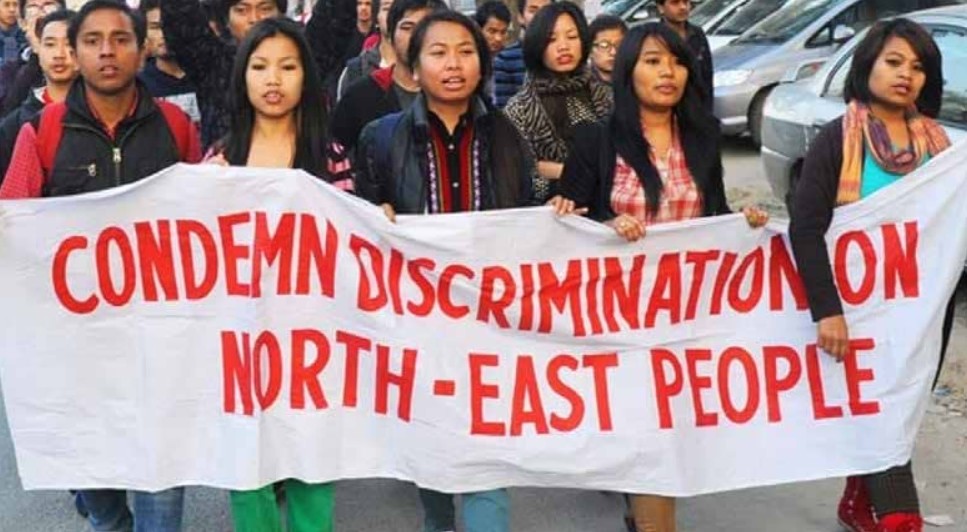
Everyday life shows the result. North-Eastern students in hostels, workers in cities, families in rented houses report slurs, intrusive questions, and exclusion from spaces where others move freely. Women from the region face sexualised racism. Men are stereotyped as weak, alien, or dangerous, depending on the context. The common thread is denial of ordinary dignity. These are not random acts of bad behaviour. They are the everyday grammar of racialisation.
That is why the killing of another North-Eastern man in the capital cannot be treated as a standalone tragedy. It sits next to the killing of Nido Taniam in 2014 and other cases that have forced the country to ask the same question again and again: why are some Indians more vulnerable than others inside India itself? The answer is not one culprit or one institution. It is a culture of impunity fed by indifference, stereotypes, and weak accountability.
The legal response must be more than routine outrage. Punishing the accused is necessary, but not enough. The state must recognise racial discrimination as a structural problem, not just a set of individual offences. That means stronger hate-crime enforcement, faster investigation, witness protection, and police training that treats racial profiling and ethnic abuse as serious misconduct. It also means schools, universities, and public institutions must confront prejudice before it becomes violence. Laws matter, but public culture matters too.
Ambedkar’s constitutional vision is useful here. He understood that equality does not come from formal declaration alone. It needs institutional design, political will, and social transformation. A republic that leaves whole communities open to routine humiliation is not living up to its own constitutional promise. The burden should not always be on victims to prove that they belong. Citizenship itself should secure belonging.
There is a moral urgency beyond legal reform. The everyday language used for North-Eastern people must change. Stereotypes are not harmless shorthand. They are the first step on a ladder that can end in exclusion, assault, or murder. When people are repeatedly made visible only as “different,” the line between prejudice and violence becomes thin. Each slur, each joke, each casual mockery participates in a larger order of devaluation.
Chongtham Vikram Singh was not only a victim. He was a musician, a teacher, a father, and a citizen whose life should have been protected with the same seriousness as anyone else’s. His death should force India to ask not only who struck the blows, but what kind of society makes such blows possible.
The answer lies in dismantling the racial contract that governs so much of public life: the tacit agreement that some bodies are more protected, more credible, and more grievable than others.
If the republic is to mean anything, it must mean this: no Indian should be made unsafe because of how he looks, where he comes from, or how his body is read by the majority. That is the democratic minimum. Until it is secured, the violence done to Chongtham Vikram Singh will remain not an aberration, but a symptom.