The indefinite economic blockade intensified by the United Naga Council (UNC) across Manipur’s major national highways from September 9, 2026, exposes the limits of the Government’s claim that normalcy is returning to the State. Barely weeks after the Manipur government presented the resumption of public bus services on National Highway 2 as a major step towards restoring normal life, the same highway, along with NH-37, NH-202 and NH-102A; has again become an arena of political confrontation. The contradiction is stark – a government that celebrates the reopening of a highway as evidence of normalcy remains unable to prevent that highway from becoming the object of indefinite economic blockades and counter blockades.
The problem, therefore, is deeper than transport disruption. It is a crisis of authority.
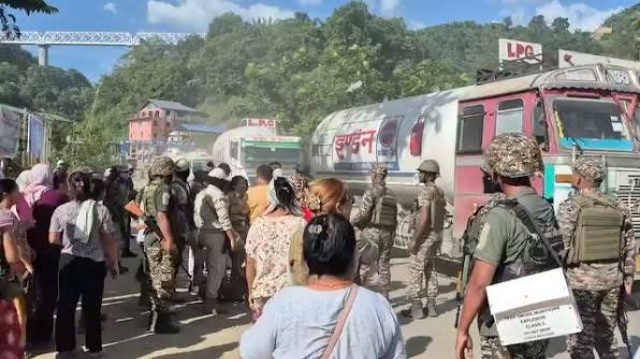
The UNC’s intensified blockade, effective from 1 a.m. on September 9 following its September 2 presidential council meeting in Ukhrul, covers NH-2 towards Mao and Dimapur, NH-37 towards Jiribam, NH-202 towards Jessami and NH-102A between Tadubi and Ukhrul. Goods-laden vehicles are being restricted, while medical supplies, water, power, telecommunications, media services and other emergency essentials are exempted. The UNC says the action is intended to press for justice and accountability over the abduction and killing of six Liangmai Naga civilians taken from Leilon Vaiphei on May 13.
The grievance cannot be dismissed. The killings occurred amidst an escalating Kuki-Naga confrontation, and the failure to deliver what Naga communities regard as credible justice has deepened insecurity and political alienation. Nine Naga legislators stayed away from the final sitting of the Assembly on September 7, demanding action over the killings and against Deputy Chief Minister Nemcha Kipgen.
But precisely because the grievance is serious, the government’s failure becomes more consequential.
A democratic State cannot allow a community to conclude that the only effective route to accountability is to paralyse its principal arteries. Nor can it respond merely with warnings that road obstruction will invite prosecution. The fundamental question is why a community has come to believe that an economic blockade is more likely to produce a response than constitutional and judicial mechanisms.
That is the central failure.
The present blockade is not an isolated event. It is the latest stage in a pattern in which highways have progressively been transformed from public infrastructure into instruments of political bargaining. Since the outbreak of the violent conflict on May 3, 2023, roads in Manipur have ceased to be merely roads. They have become boundaries, pressure points, strategic corridors and symbols of competing territorial claims.
The earlier Kuki-Naga blockade and counter-blockade demonstrated the same transformation. When one community restricts movement along one highway, another responds elsewhere. NH-2 becomes the site of one confrontation, NH-202 another, while NH-37 becomes vulnerable to the consequences. The State then negotiates separately with different groups to restore selected stretches of road.
This is how constitutional authority becomes fragmented.
The danger lies not simply in the economic damage. It lies in the precedent created when community-controlled obstruction is treated primarily as a political problem to be negotiated rather than a constitutional problem to be resolved.
A democratic government can negotiate with civil society organisations over grievances, security, rehabilitation and political demands. It cannot allow citizens’ right to use a national highway to become conditional upon the consent of an ethnic organisation.
That principle must apply universally. It cannot be invoked against Nagas or Meiteis while being ignored when Kukis impose restrictions, nor against Kukis while being ignored when Nagas blockade roads. The State loses legitimacy when constitutional principles are applied selectively.
The Kuki counter-blockades on NH-202 and other hill routes emerged from the Kuki perception that supplies were being prevented from reaching Kuki areas. After negotiations with Chief Minister Yumnam Khemchand and state ministers, Kuki groups lifted the counter-blockade at Litan in August, allowing hundreds of stranded trucks to move towards Imphal and Ukhrul. But the subsequent intensification of the UNC blockade demonstrates that the underlying problem was not resolved. It was displaced.
The pattern is now familiar – one community blocks, another responds, the government negotiates, a route partially reopens, another becomes contested, and the cycle begins again.
This is not normalcy. It is managed disruption.
And it is the distinction between managed disruption and constitutional normalcy that the government has failed to confront.
When public transport resumed on NH-2 on August 21 after more than three years, the development was rightly welcomed. The journey of buses and Wingers from Imphal towards Dimapur was both practically and symbolically significant after more than three years of restricted movement. But the significance of that reopening was never simply that vehicles could travel along the highway. The larger question was whether the State had restored the constitutional freedom of movement or merely created a protected corridor through a conflict zone.
The September blockade makes that distinction unavoidable.
If a highway can be reopened with considerable political effort and security arrangements in August and become the subject of an indefinite blockade in September, the government cannot reasonably treat the August journey as proof that normalcy has returned.
The bus journey demonstrated that movement was possible.
The blockade demonstrates that movement has not yet become secure, predictable and institutionally guaranteed.
That is the real test.
For more than three years, Manipur has lived with a peculiar contradiction. The State formally remains one constitutional territory, but everyday movement increasingly depends upon which community controls a particular stretch of geography. A road may be legally open but practically inaccessible. A citizen may possess the constitutional right to travel but still require security escort to exercise it. A national highway may appear on a government map as a continuous route while being experienced on the ground as a sequence of ethnically controlled spaces.
This is why the weaponisation of highways represents a constitutional crisis.
A national highway is not merely asphalt. It is part of the State’s territorial and administrative authority. It connects citizens, districts, markets and Manipur to the rest of the country. When its use becomes subject to collective ethnic veto, that authority is diminished.
The government cannot escape responsibility by pointing out that the blockade is organised by civil society organisations rather than by the State. The legal distinction is obvious but politically insufficient. The question is whether the State can enforce the law and protect public movement when a non-State actor deliberately prevents it.
If it cannot, the practical effect is a transfer of authority.
The September blockade must therefore be viewed against the broader trajectory of Manipur’s conflict. The State has increasingly attempted to manage competing territorial realities rather than restore a common constitutional space. Buffer zones, restricted movement, security escorts and community-specific negotiations may be unavoidable transitional arrangements in a deeply divided society. But when transitional arrangements become permanent, they cease to be mechanisms of conflict management and begin to normalise separation.
The most worrying consequence is the conversion of exceptional practices into accepted political facts.
A temporary blockade becomes indefinite. A counter-blockade becomes a legitimate response. A security corridor becomes a substitute for free movement. A buffer zone becomes an informal boundary. Political demands become linked to territorial control. Citizens gradually begin to experience their State not as one shared historical and constitutional space but as a collection of territories controlled by different communities.
That is how a frozen conflict deepens.
The government therefore cannot address the present crisis only in terms of supply chains. The economic consequences are severe. Stranded trucks, oil tankers and LPG carriers increase transport costs, create shortages and push up prices. Students, patients, workers, traders and ordinary families bear the consequences.
But the economic damage is only the most visible cost.
The deeper cost is political.
Every successful blockade teaches that collective coercion works. Every successful counter-blockade teaches that collective retaliation works. Every negotiated reopening without a durable settlement reinforces the perception that constitutional institutions are weaker than organised community pressure.
That is dangerous political education for a conflict-ridden society.
The government’s response remains largely reactive. It warns that road obstruction will be prosecuted, security forces escort vehicles through sensitive stretches and ministers negotiate with community organisations. But none of these measures addresses the central question – why is the State unable to guarantee the continuous functioning of its national highways?
A warning is not authority. Authority is demonstrated when the law is enforced.
Yet enforcement cannot be reduced to a police or military operation. A purely coercive response to the UNC blockade could deepen the perception among Naga communities that the government is unwilling to address their demand for justice. The killings of the six Liangmai Naga civilians cannot be treated as another routine law-and-order incident. Accountability must be pursued credibly, transparently and through due process.
The government therefore faces a dual responsibility – protect the right to free movement while demonstrating that the underlying grievance will receive serious legal and political attention.
One cannot substitute for the other.
The Supreme Court’s intervention in the highway blockade issue is important in this context. The Court has sought proposals from the concerned communities for clearing the blockades and has brought the National Highways Authority of India into the matter. But judicial intervention cannot substitute for executive responsibility.
The constitutional government must ultimately ensure that public roads remain public.
The crisis has now acquired an unmistakably political dimension. Nine Naga legislators belonging to the BJP, NPF, NPP and Independents abstained from the final Assembly sitting, signalling that the dispute over the killings has begun to penetrate the institutional foundations of the Khemchand government.
The possibility of withdrawal of support makes the situation more serious. Deputy Chief Minister Losii Dikho has warned that Naga MLAs may withdraw support if the Centre fails to respond to their concerns, including demands concerning Nemcha Kipgen. Dikho also abstained from the five-member cabinet meeting chaired by Chief Minister Khemchand on September 10 on the same grounds.
This transforms the blockade from a law-and-order challenge into a test of the government’s political viability.
The Khemchand government came to office after President’s Rule was lifted with the stated objective of restoring elected constitutional government. Its legitimacy therefore depends on more than the existence of a Chief Minister, ministers and an Assembly. It must demonstrate that elected institutions can govern across the State’s communal divisions.
If Naga legislators withdraw from the government, the consequences will extend beyond Assembly arithmetic. It would raise questions about whether the government has succeeded in building a sufficiently broad political compact across Manipur’s communities, particularly when the return of two Kuki MLAs to the Assembly was itself presented as a sign of political normalisation.
A government established to restore political normalcy cannot afford to become the site of another institutional fracture.
The demand for Nemcha Kipgen’s removal presents the BJP and the Centre with an equally difficult challenge. The issue cannot be resolved by simply protecting a minister politically. Nor can a minister be removed solely because many demand it without due process. What is required is a credible investigation capable of establishing facts independently and transparently.
The government must demonstrate that justice is not determined by political affiliation.
That principle is particularly important in Manipur, where perceptions of selective justice have repeatedly deepened distrust. If one community believes political connections shield accused persons while another believes its members are selectively targeted, constitutional institutions lose credibility on both sides.
The same principle applies to the Suspension of Operations (SoO) agreements.
The UNC’s demand for abrogation of the SoO arrangements with Kuki militant groups reflects a wider Naga concern over whether political and security arrangements have privileged one armed constituency at the expense of another. The government cannot resolve such a complex question through slogans. It must explain the legal and security basis of the agreements, the obligations of the signatories, the monitoring mechanisms and the consequences of violations.
Transparency is essential.
The government’s larger failure is its inability to connect these issues into a coherent political strategy.
The killings, blockades, counter-blockades, SoO arrangements, buffer zones, the demand for separate administration, the return and rehabilitation of displaced persons and the restoration of highways are not separate problems. They are interconnected manifestations of a conflict in which communities increasingly distrust the State’s capacity to protect their interests.
Yet governance remains compartmentalised. One arm deals with highways, another with security, another with political negotiations; ministers negotiate with community organisations, while the Centre deals with armed groups and the Assembly debates selected aspects of the conflict.
The people, however, experience these as one crisis.
This fragmentation of governance is itself part of the problem.
The State needs a comprehensive framework based on a simple proposition – no community can acquire sovereign authority over a public highway, but every community is entitled to security, justice and political representation within the constitutional framework.
That principle allows the government to distinguish legitimate grievance from illegitimate coercion.
The deprivation of Meitei access to major highways for more than three years is unjustifiable. The UNC’s demand for justice can be legitimate even if the method of an indefinite blockade is constitutionally unacceptable. Similarly, Kuki concerns over access to essential supplies can be legitimate even if their blockade against Meiteis and Nagas, and counter-blockades against Nagas are unacceptable.
The government must hold these propositions simultaneously.
Instead, Manipur has increasingly witnessed a politics in which the legitimacy of a grievance is judged through the identity of the community raising it.
That is unsustainable.
The present crisis also exposes the weakness of equating restored transport with restored normalcy. Normalcy is not a few buses travelling under heavy security escort. It is the ability of a citizen to travel without calculating which community controls the road, whether a blockade may begin, whether a convoy is available or whether political tensions will make the journey dangerous.
Normalcy is predictability. It is equal access. It is the absence of collective punishment. It is the ability of the State to enforce the law before communities feel compelled to enforce their own claims through economic coercion.
Until those conditions return, Manipur remains in a state of suspended normalcy.
The September blockade is therefore more than another interruption of traffic. It is a direct challenge to the claim that constitutional authority has been restored.
The government must now decide whether it intends merely to manage the blockade or to address the political conditions that make recurring blockades possible.
Managing means escorting trucks, negotiating temporary openings, issuing warnings and waiting for the next confrontation.
Governing means restoring the rule of law, ensuring justice, protecting movement and creating political mechanisms through which grievances can be pursued without shutting down the State’s arteries.
The distinction is crucial.
For too long, the government has behaved as though keeping one highway open for a few days is equivalent to restoring connectivity. Constitutional authority cannot be measured in temporary openings. It must be measured by the State’s capacity to keep public infrastructure functioning despite political disagreement.
The September 9 blockade is therefore a test of the Khemchand government’s political maturity.
It should not treat the UNC simply as an adversary to be defeated. Nor should it concede that an indefinite blockade is an acceptable form of political negotiation. It must separate the grievance from the method – investigate the killings urgently and transparently; communicate progress publicly; protect witnesses and families; act against those found responsible through due process; address the political concerns of the Naga legislators; and make clear that national highways cannot be permanently appropriated as instruments of ethnic pressure.
At the same time, the government needs an all-community mechanism for securing highways and guaranteeing movement. The objective should not be a permanent security corridor for one community, but the restoration of ordinary civilian use by all communities.
That is the only sustainable way to break the cycle of blockade and counter-blockade.
Otherwise, Manipur risks entering a more dangerous stage of frozen conflict in which communities increasingly regulate movement through reciprocal economic coercion while the formal State merely negotiates the terms of temporary access.
Such a State may retain constitutional institutions, but its constitutional authority will increasingly exist in abstraction.
The political repercussions could be profound. Withdrawal of Naga legislators could destabilise the ruling coalition. Perceived inaction by the Centre could widen the distance between Naga political opinion and the BJP-led establishment. Action against Kuki political representatives could trigger another cycle of mobilisation. And continued restrictions on highways could intensify Meitei perceptions that the government cannot guarantee territorial and economic integrity.
In such circumstances, every community begins to calculate political power by its capacity to disrupt.
That is precisely the logic the State must break.
The ultimate issue is not whether the UNC is justified in its anger, whether Kuki groups were justified in their counter-blockades or whether security forces can clear a particular stretch of road.
The question is whether Manipur will continue to be governed as a constitutional State or increasingly function through negotiated ethnic jurisdictions.
The answer will be visible on its highways.
If NH-2, NH-37, NH-202, NH-102, and NH-102A remain vulnerable to indefinite blockade whenever a community concludes that the government has failed it, the State will have conceded an important part of its governing authority. If counter-blockades continue to be treated as the natural response, collective retaliation will become embedded in public life.
And if the government responds only after highways have been paralysed, it will remain perpetually behind the crisis.
The State must move from reaction to prevention.
Justice for the six Liangmai Naga civilians must be pursued. The killings must be investigated without fear or favour. Political accountability must follow evidence. The concerns of Naga legislators must be addressed. The status, monitoring and enforcement of the ground rules governing the SoO agreements must be explained. And the security of every traveller – Kuki, Naga, Meitei or otherwise – must be guaranteed equally.
None of this requires surrendering the principle that national highways are public constitutional spaces.
Justice and free movement are not competing goals. They are mutually necessary.
A government that cannot guarantee justice will lose public trust.
A government that cannot guarantee movement will lose territorial authority.
A government that cannot guarantee both will eventually find that political legitimacy itself is being negotiated on the highways.
That is the real danger facing Manipur.
The August reopening of NH-2 was presented as a beginning. The September blockade has shown how fragile that beginning remains. The challenge before the government is no longer to demonstrate that it can reopen a highway for public buses with security. It must demonstrate that no community can close it indefinitely.
Only then will reopening a road amount to restoring a constitutional right.
And only when the State can ensure that the same highway remains open to Nagas, Kukis, Meiteis and every other citizen without ethnic permission, political negotiation or fear of collective retaliation can Manipur begin to speak credibly of normalcy.
Until then, the highways remain more than blocked.
They remain contested instruments of political power – and a measure of how far constitutional authority has yet to be restored.

Senior Editor: Imphal Review of Arts and Politics